

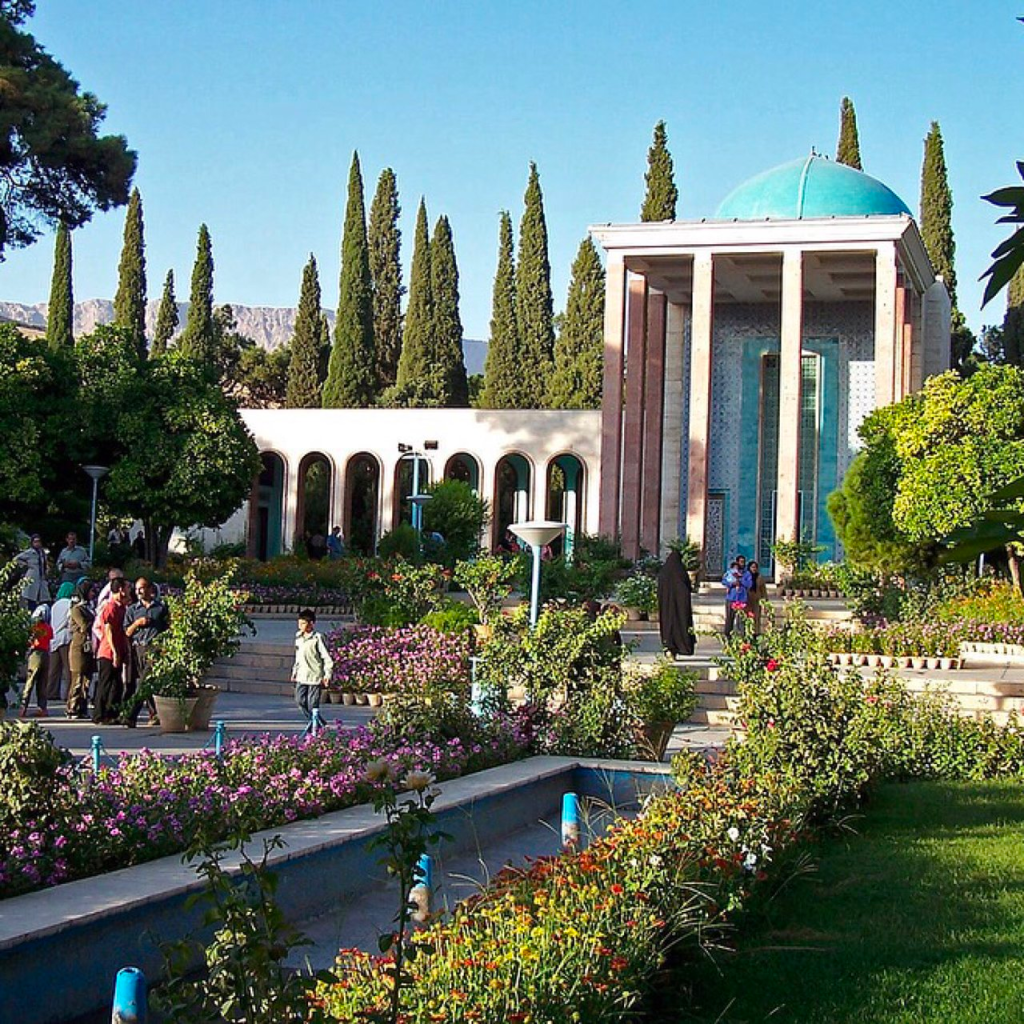
Sa’di’s mausoleum in Shiraz, visited by many lovers of his work every year
Sa’di (born in Shiraz, ca. 1209 and died ca. 1292) was a poet of tolerance and common sense. He left his native town and travelled around most of the Middle East, Central Asia, and many parts of India, and possibly even to the city of Kashgar in China’s Xinjiang province, for some 30 years. In his best-known works, Bustan (The Orchard), written in verse and completed in 1257, and Gulistan (The Rose Garden), written in prose and completed in 1258, Sa’di tells many colourful anecdotes of his travels. The unsettled conditions following the Mongol invasion of Iran and some neighbouring countries were the main motives for his wanderings.
Sa’di wrote poems in both Persian and Arabic. For a while, he studied and taught at the famous Nezamiya College in Baghdad, and he lectured in many countries he visited. He writes about his adventures in India, Anatolia, Syria, Egypt, Iraq, Jerusalem, Mecca and Medina, Oman and many other countries. He returned to his beloved Shiraz in 1257 when the city had achieved calm under the rule of Atabak Abu-Bakr Sa’d ibn Zangi, whose name Sa’di chose as his nom de plume. By the time he returned to Shiraz, he was already a very famous and respected poet in many Persian-speaking countries. He is regarded as the great master of both prose and poetry, as well as a hakim or savant, and his popularity has continued right to the present century.
For a long time, Sa’di’s Gulistan was a textbook used in India for the training of civil servants. Sir William Jones (1746-1794), the British diplomat and chief judge of India, and one of the founders of the Royal Asiatic Society, was one of the first Westerners to introduce Persian literature to the West. He could be regarded as a founder of both comparative religion and comparative literature in the West. In his introduction to his Persian Grammar, Jones wrote: “The Persian language is rich, melodious, and elegant; it has been spoken for many ages by the greatest princes in the politest courts of Asia; and a number of admirable works have been written in it by historians, philosophers, and poets, who found it capable of expressing with equal advantage the most beautiful and the most elevated sentiments.” Of Sa’di’s works, he wrote: “a century or two ago, they would have been suppressed in Europe, for spreading with too strong a glare the light of liberty and reason.”[1]
With some exaggeration, Jones wrote: “… Persia has produced more writers of every kind, and chiefly poets than all Europe together…”[2] He complained that not sufficient attention had been paid to Iran’s literary and cultural contribution to the world. He wrote: “Thus, while the excellent writings of Greece and Rome are studied by every man of a liberal education, and diffuse a general refinement through our part of the world, the works of the Persians, a nation equally distinguished in ancient history, are either partly or wholly unknown to us.”[3]
Sa’di’s lines about the oneness of humanity have become famous, and President Barack Obama used those lines in one of his Nowruz messages to Iranians. This is a rendering of those lines by Richard Jeffrey Newman:
All men and women are to each other
the limbs of a single
body, each of us drawn
from life’s
shimmering essence, God’s perfect pearl;
and when this life we
share wounds one of us,
all share the hurt as
if it were our own.
You, who will not
feel another’s pain,
you forfeit the right
to be called human.[4]
Ralph Waldo Emerson, the father-figure of American literature, took Sa’di as his ideal poet. Writing in his Journals, he praised Sa’di (whose name he spelt as Saadi), in the following words: “The human race is interested in Saadi… Saadi is the poet of friendship, of love, of heroism, of self-devotion, beauty, serenity, and the divine Providence.”[5] Emerson compared Sa’di’s writings to the Bible in terms of their wisdom and beauty of narrative.
He found in Sa’di a fellow optimist and someone who could overcome misfortune and adversity. He wrote of Sa’di:
“The word Saadi means Fortunate. In him, the trait is no result of levity, much less of convivial habit, but first of a happy nature to which victory is habitual, easily shedding mishaps, with sensibility to pleasure, and with resources against pain. But it also results from the habitual perception of the beneficent laws that control the world. He inspires in the reader a good hope. What a contrast between the cynical tone of Byron and the benevolent wisdom of Saadi.”[6]
He also admired Sa’di’s love of beauty and his dislike of religious formalism. He quotes a story from Sa’di’s Gulistan about when Sa’di came upon a man chanting the Koran in a harsh voice, and asked him why he was chanting. The man replied: “I read for the sake of God.” Upon which Sa’di said: “For God’s sake, do not read; for if you read the Koran in this manner you will destroy the splendor of Islamism.”[7]
In a long poem dedicated to Saadi, Emerson wrote:
Many may come,
But one shall sing:
Two touch the string,
The harp is dumb.
Though there come a million,
Wise Saadi dwells alone.
Footnotes:
[1] The Works of Sir William Jones, Volume 4, p. 544FF
[2] ibid, Volume 4, p. 540
[3] ibid, Volume 4, p. 545
[4] Selections from Saadi’s Gulistan, translated by Richard Jeffrey Newman (Global Scholarly Publications, 2004).
[5] The Journals and Miscellaneous Notebooks of Ralph Waldo Emerson (Harvard University Press, 1982), Volume 15
[6] Ibid
[7] Ralph Waldo Emerson, Works, VIII, 121.

