

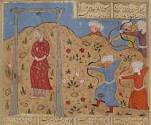
Mazdak (died c. 524 AD)
Mazdak was another revolutionary Iranian prophet and visionary who appeared towards the end of the Sasanian period. Mazdak was a Zoroastrian priest (mo’bad), but he rebelled against his faith and claimed to have been sent by Ahura Mazda to reform and purify Zoroastrianism and to guide the people to a new path. He introduced a totally revolutionary concept of equality of all classes. Naturally, he came into conflict with the majority of Zoroastrian priests, who regarded his teachings as heresy.
Given the very rigid class structure, the unequal distribution of wealth, and the division of the society into four major classes of clerics, courtiers and military, artisans, and farmers and labourers, Mazdak introduced the very revolutionary concept of equality of all classes and the need for the division of all social assets and benefits, which allegedly also included the sharing of women. However, it has been suggested that the latter concept about the sharing of women was a false allegation by his enemies in order to vilify him, as it has been done in the case of some other persecuted sects.
Mazdak’s Teachings
According to Mazdak, God had placed the means of subsistence on earth so that they could be divided equally between the people, but the strong had oppressed the weak, seeking domination and causing inequality and conflict. There were “Five Demons” that had turned men away from Righteousness. They were Envy, Wrath, Vengeance, Need and Greed.
The only way to overcome those evils was to act in keeping with justice, which involved making all wealth common to all. The famous scholar of Persian literature, E. G. Browne refers to Mazdak, as the world’s first “Communist philosopher”.[1]
This is how the 10th century Persian poet Ferdowsi describes those concepts in his Shah-Nameh:
پیچاند از راستی پنج چیز
که دانا برین پنج نفزود نیز
کجا رشک و کینست و خشم و نیاز
به پنجم که گردد برو چیزه آز
تو چون چیره باشی برین پنج دیو
پدید آیدت راه کیهان خدیو
ازین پنج ما را زن و خواستست
که دین بهی در جهان کاستست
زن و خواسته باشد اندر میان
چو دین بهی را نخواهی زیان
کزین دو بود رشک و آز و نیاز
که با خشم و کین اندر آید براز
همی دیو پیچد سر بخردان
بباید نهاد این دو اندر میان
Ferdowsi sums up Mazdak’s beliefs as follows:
The rich and the poor are equal in rank,
It is not right for one to be above and the other below.
The rich are society’s warp and the poor the woof.
The world should run based on equality,
Why should the rich have domination over the poor?
Women, property and wealth should be divided
The poor and the rich should benefit equally from those bounties
He said he would implement this virtuous doctrine
So that pure religion would be established on earth.[2]
This is how the 12th century Iranian historian Mohammad Ibn Abdol-Karim Shahrestani explained Mazdak’s teachings: “Mazdak told his followers to shun hostility, opposition and killing. As most conflicts are due to wealth, material assets and women, he called for equality and sharing of wealth and the fair distribution of women and assets.”[3]
It is not clear whether the sharing of women was one of Mazdak’s teachings or a slur used by his opponents to attack him because hostile forces dwelled upon the alleged “sharing of women” to accuse him and his followers of sexual promiscuity and confusion in the line of descent. However, he clearly believed in the equal distribution of wealth.
He forbade his followers from shedding blood and inflicting harm on others. He directed them to enjoy the pleasures of life in moderation in the spirit of equality and to practise hospitality. His religion also preached pacifism, anti-clericalism and public programmes to help the poor. It is amazing that, initially, his teachings won the backing of the ruling King Kavadh I (who rules from 488-531) who converted to Mazdakism, but the opposition of the Zoroastrian priest became so intense that King Kavadh I was overthrown in 496, although he managed to regain the throne three years later. However, he distanced himself from Mazdak, and his successor Anushiravan launched a campaign against Mazdak, culminating in the killing of Mazdak and the massacre of most of his followers.
According to Mazdak, light and darkness are the two “modes of being and principles that existed before the world.” Light is the positive force that acts intentionally and voluntarily and is endued with knowledge and perception, whereas darkness is negative and is the absence of light. It is ignorant and blind and acts blindly and at random. The mixture of light and darkness that came about by chance was the start of life, and at the end of the world, the separation of light and darkness will also come about at random.
Therefore, like Manichaeism, the teachings of Mazdak are also based on dualism, light and darkness as original principles, two demiurges that result from the mixture of the elements and effect the good and evil in the elements. The second principle regarding the created world is based on four “generals” of the heavens, the seven planets and the twelve signs of the zodiac.[4]
The teachings of Mazdak survived the Islamic conquest and manifested themselves in a series of radical Shi’a doctrines. We have the cult of al-Muqanna’ (died c. 783), who claimed to be an incarnation of God. Al-Muqanna’, whose original name was Hashem, became known by his nickname al-Muqanna’ (the Veiled One) because he covered his face, according to some reports due to a scar that he had sustained as the result of a chemical experiment, or according to others to hide his dazzling face from the people.
Like Mazdak, Muqanna’ claimed to be a prophet and founded a religion which was a mixture of Zoroastrianism and Islam. He got a huge following, and his intent was to overthrow the invading Arabs. The Abbasid caliphs were forced to send several commanders to crush the rebellion. After his death, his armies, the Khorram-Dinan, continued to exist until the 12th century.
His cult achieved some popularity in the West. In 1787, Napoleon Bonaparte wrote a short story about al-Muqanna’ called “Le masque prophete”. Also, the first poem in Lalla-Rokh (1817) by Thomas Moore is titled The Veiled Prophet of Khorasan.
Some scholars have argued that Shi’ism itself was to some extent influenced by Zoroastrian teachings. The Zoroastrian Saoshyant or universal saviour that appears at the end of time in order to usher in a period of justice and peace influenced the concept of the Hidden Imam, and the hereditary rule of Iranian monarchs also influenced the hereditary succession of Shi’a Imams.
The Manichean and Mazdakite dualism of good and evil and light and darkness also influenced subsequent Shi’a belief in God and the devil and good and evil, such as the concept of righteousness and devotion as represented by Imam Husayn and evil and tyranny as represented by the Umayyad ruler Yazid. The Sasanian practices and rituals associated with “mourning for Siavash” (Siavashun) provided a prototype for the mourning ceremonies marking the martyrdom of Imam Husayn, etc.
[1] E. G. Browe, The Persian Revolution of 1905-1909 (Cambridge University Press, 1910), Preface, p. xiv.
[2] Shah Nameh, Vol VIII, the Reign of Qobad, p. 565.
[3] Shahrestani, al-Milal val-Nihal, ed. Mohammad Seyyed Kalani, Part One, p. 80
[4] See Werner Sundermann, “Cosmogony and Cosmology in the Mazdakite Religion” (Encyclopaedia Iranian, last updated October 31, 201)
 F Jahanpour