

This webinar, organised by the University of Copenhagen and held on 22 May 2022, primarily focuses on Toynbee’s book, Civilisation on Trial, which I translated into Persian and was published by the University of Isfahan Press in 1975. My translation of the book has been republished recently in Iran, accompanied by a new introduction of mine that addresses international developments since the book’s last publication, and is now available online. In this webinar, I also talk about Toynbee’s massive 12-volume book A Study of History and his philosophy of history and the factors that, according to him, have led to the emergence of civilisations and their eventual decline and fall.
In 1974, I translated the late Arnold Toynbee’s Civilisation on Trial into Persian. The book was published by the University of Isfahan Press, and initially it attracted a great deal of attention. However, as a result of the revolutionary upheaval, it was caught up in the revolutionary maelstrom, and the most influential cleric in Isfahan, Ayatollah Seyyed Hossein Khademi, the head of the Religious Seminary in Isfahan, banned the book. Ayatollah Khademi had not read the book, but declared it to be anti-Islamic as a result of the agitation by some revolutionary activists who used every excuse to attack the Shah’s government and the leading institutions of the country and to intensify Islamic fervour. As a result, the sale of the book was stopped, and the remaining copies of the book were destroyed.
However, recently, some friends in Tehran have republished the book with a new introduction by me about the latest developments since the publication of the original English version of the book in 1948, and they have made it available to the public by putting it on the internet. I was asked to lead a webinar on 22 May 2022 and discuss the contents of the book and Toynbee’s philosophy of history. Here is a summary of what I said in the webinar on Toynbee.
Arnold Joseph Toynbee (1889-1975) was one of the most prolific, influential, and controversial historians of the last century. His output was enormous, with hundreds of books, pamphlets and articles. His books were translated into more than thirty languages. The first ten volumes of his major 12-volume book, A Study of History, which comprised 6,290 pages and more than 3,150,000 words, discussed the factors that, according to him, led to the rise and fall of different civilisations. The first three volumes of A Study of History were published in 1934, the next three volumes in 1939 and the rest of the volumes were published in 1954. Volume 11 contained maps and appendices, and in volume 12, he provided answers to some of the criticisms that had been made about the contents of the book.
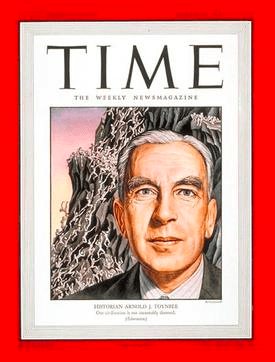
D. C. Somervell abridged the ten volumes of A Study of History in two volumes, which sold more than 300,000 copies in the United States alone. Toynbee’s A Study of History was chosen as the best book of the year by Time magazine in 1947, with an article describing it as “the most provocative work of historical theory written in England since Karl Marx’s Capital”.
Toynbee’s views on the reasons for the rise and fall of different civilisations:
In his massive 12-volume work, The Study of History, discussing the rise and fall of many great empires in the past, Arnold Toynbee enumerates five factors that led to the undoing of former empires and that might pose a threat to the continued domination of Western civilisations. These were:
1. Wars and militarism. Most empires have been weakened as a result of their policy of militarism and engaging in continuous wars. Applying that principle to recent history, we see that the same factors apply to contemporary empires, such as the former Soviet Union and the current superpower, the United States of America. American military capabilities are enormous, but they are not limitless. During the First Gulf War, most of the cost of the war, estimated at over 60 billion dollars, was borne by Saudi Arabia, Kuwait, the UAE, Japan and Germany. However, in the case of the invasions of Afghanistan, Iraq, Libya, Syria, Somalia, etc, few countries have volunteered to bear the cost of those wars. The American leaders openly anticipated that the use of Iraq’s oil resources would pay for the occupation, but not only did the United States not reap any material benefits from that invasion, it has had to suffer massive financial and human losses and has aroused intense anger among the Iraqis and other Arab nations.
2. Excessive pride and chauvinistic nationalism. Most former empires became too proud as a result of their power and tried to impose their will upon others. Their pride eventually resulted in their fall. At the height of the Roman, Islamic and British empires, many proud rulers believed that their empire was eternal, and that the sun would not set on their dominions. We can also see many signs of excessive nationalism and arrogance of power among certain sections of US leaders, especially among the right-wing conservative elements who believe that America has a God-given right to impose its will on other countries.
3. Extreme level of social and economic differences. One of the causes of the downfall of former empires was a growing gap between the rich and the poor. At the moment, the gap between the rich and the poor seems to be growing. On the one hand, there is a small minority of people who live in excessive luxury, while a quarter of the human race can barely survive. According to the World Bank, over 1.2 billion people today live on less than one dollar a day, and nearly half of the entire world population earns less than 2 dollars a day. Bernard Wasow of the Century Foundation has calculated that between 1965 and 1997, the poorest 10 per cent of the world’s population increased its share of world income from 0.3 per cent to 0.5 per cent, while the richest 10 per cent, meanwhile, expanded its share from 50.6 per cent to 59.6 per cent.
During recent times, the gap between rich and poor countries has grown alarmingly. In 1800, the difference in incomes between the richest and poorest countries was about 3 to 1; in 1900, it was about 10 to 1. Today, the United States and other rich countries enjoy incomes about 100 times greater than those in the poorest countries. This scale of inequality is not only unjust to the poorer countries, but it is even dangerous for the richer countries.
This wide economic disparity is not true only between the rich and poor countries, but one can already see a growing gap between the rich and poor in the developed countries, including the United States of America. On the one hand, there are some multi-billionaires whose wealth exceeds the wealth of some nations, and on the other hand, more than 40 million Americans live below the poverty line and do not even have medical insurance.
4. Environmental problems. In their headlong rush towards greater and greater consumption and development, most empires overused and overspent their natural resources, and that eventually contributed to their impoverishment and their fall. The same is true of the modern world, where, due to overconsumption, we are already experiencing many shortages of raw materials.
The present level of consumption in the United States cannot be sustained, and it definitely cannot be copied elsewhere. About four per cent of the human race is consuming a quarter of the world’s energy resources and is producing more than a quarter of the world’s pollution. The exhaustion of many resources has forced the United States to turn to other countries for raw materials, especially rare earth and together minerals. However, even those resources are finite and sooner or later they will run out.
5. The clash between mind and heart, between intellect and emotion. One reason for the downfall of most former empires has been excessive attachment either to materialism or to religious fanaticism. Unless we can restore a balance between our rationality and our spirituality, the world is doomed. The present world is suffering from excessive materialism on the one hand, and excessive religious dogmatism and fundamentalism on the other. In fact, although these two seem to constitute opposite poles, in reality, they are the two sides of the same coin. The main problem of the contemporary world is fundamentalism – religious, secular, political and social fundamentalism. The battle today is not between various religions and ideologies, but between fundamentalists and moderates, and between radicals and liberals in all cultures.
At the beginning of the first volume of The Decline and Fall of the Roman Empire, published in 1776, Edward Gibbon remarked that empires endure only so long as their rulers take care not to overextend their borders. But the ”vanity or ignorance” of the Romans, Gibbon went on, led them to ”despise and sometimes to forget the outlying countries that had been left in the enjoyment of a barbarous independence.” As a result, the proud Romans were lulled into making the fatal mistake of ”confounding the Roman monarchy with the globe of the earth.”
Let us make sure that we do not repeat the same mistakes and do not overstep our mark.

