

By Sadiqeh Vasmaqi, translated by Farhang Jahanpour
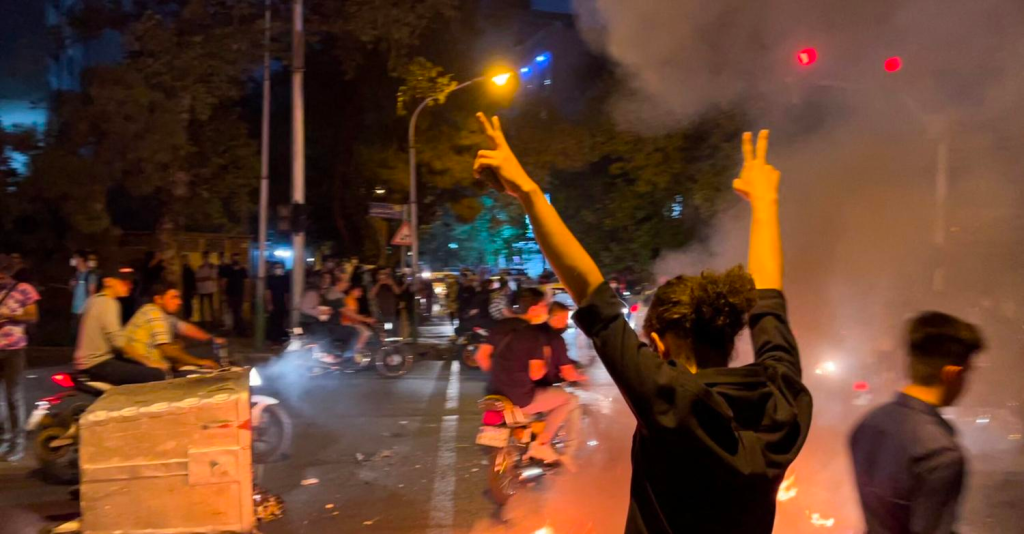
Here is a translation of an interesting article by Sadiqeh Vasmaqi regarding the current demonstrations that are being held in Iran following the death of Mahsa Amini under police custody. Sadiqeh Vasmaqi is a poet, scholar, writer, theologian and political activist who studied Islamic theology in a religious seminary in Tehran for three years. Later on, she received her doctorate in theology from the University of Tehran where she also taught for a number of years as an assistant professor of theology. She was also elected to the first city council in Tehran after the revolution and became the spokesperson of the council. She was arrested and detained for a while in Tehran due to her opposition to compulsory hijab, and after her release from jail she left Iran and taught as a visiting professor at Gottingen University and later on at Uppsala University in Sweden where she now lives. Her views are important as they come from a leading scholar of Islamic jurisprudence.
In this article Dr Vasmaqi argues that the Islamic Republic has done the greatest service to secularism by making the people, especially women, aware of the oppressive nature of the Sharia and Islamic jurisprudence. Happy reading:
Women will help Iran pass through this historic juncture
Sharia and jurisprudence can be regarded as the strongest barriers against changing the status of women in Islamic societies.
The jurists are the exponents of Sharia, which is a mixture of the tradition and way of life of the first followers of Islam, and the views and culture of the jurists. The basic task of Islamic jurisprudence is to introduce a model for the life of Muslims in all ages and societies based on the customs and traditions common among the first followers of Islam, a model that is considered obligatory, without any divine justification.
The main pillar of this model of Islamic jurisprudence is the discrimination against women and their control by men, a pillar whose removal will naturally lead to the collapse of the foundations of Islamic jurisprudence. Even the laws regarding criminal behaviour and corporal punishments are not as important [in the eyes pf the jurists] as protecting the principle of discrimination against women. This is why in many Islamic societies throughout history, the jurists have not insisted on implementing the criminal laws of the Islamic Sharia, but they have always backed the principle of discrimination against women. The rare fatwa of some contemporary jurists in favour of women does not mean accepting women’s equality and recognising their independence.
Iranian women have been fighting and paying for freedom for more than a hundred years. In the last century, the Iranian nation experienced two revolutions for freedom and getting rid of tyranny, the constitutional revolution and the 1978 [Islamic] revolution. In my opinion, the reason why none of these two revolutions led to the freedom and liberation of the Iranian nation from tyranny and did not establish democracy and the rule of law was the dependence of the people on the clergy and the so-called Sharia laws.
This dependence basically contradicts the freedom, democracy and the rule of law that the Iranian nation has been seeking, because the requirement of this dependence is to follow the model set by jurisprudence. In this way, the majority of people have always been on the sidelines, they have not been able to have an effective intervention in the determination of their social and political destiny, as well as the establishment of laws.
Before the 1978 revolution, although Islamic jurisprudence was the basis of Iran’s first set of civil laws, which included discrimination against women in the laws, and although the members of the clergy were always against amending the laws in favour of women, nevertheless, since the clergy was not at the centre of political power it was not easy for people to identify the main root of the problems and discriminations as they do today.
The potential for this epoch-making and transformative knowledge was provided for the Iranian nation after the 1978 revolution, in the sense that during the life of the Islamic Republic, various classes and groups of people, especially women, experienced the laws of the Sharia in their personal and professional lives and, consequently, became completely aware of the practical consequences of the Islamic Sharia.
Women, who were oppressed for centuries by Islamic jurisprudence in the name of God and were prevented from social mobility behind the barrier of traditional anti-feminist culture which was always strengthened and justified with the support of jurisprudence, after the 1978 revolution fought in a tougher front to defend their integrity, dignity and rights. In other words, the revolution of 1978 opened a new front against women, which was in line with Islamic jurisprudence and traditional culture and, unfortunately, this time it was backed and enforced by political power
The Islamic Republic mixed traditional culture, Islamic jurisprudence and the personal prejudices of extreme rulers in relation to women and created an unfortunate situation for them. Mahsa Amini’s murder is just a bitter example of countless tragedies that have befallen women. What has happened may show the extent of force and coercion that has been used to suppress women in the last four decades. Although women have suffered a lot of harm and many injuries, on the other hand, it must be said that their spirit was not broken and they did not give up under the burden of this overwhelming pressure and force, but they have become more aware and stronger day by day.
Now, based on their costly and transformative experience, Iranian men and women have realised how damaging and harmful the model of jurisprudence and Sharia laws are in life. To achieve this transformational truth, Iranian women have paid the most. The Islamic Republic has used all its efforts to impose many unjust laws, and at the top of them is the compulsory hijab, on women and has not spared any oppression in this regard. However, all the evidence shows that women are the victors in this field of struggle.
With this costly victory, women will enable the Iranian nation as a whole to pass with them through an important historical strait. We, the people, will be able to establish freedom and equality in Iran, by crossing the barriers of jurisprudence, and with unity and cohesion, shunning any discrimination and inequality, we will determine our political and social destiny, and will be the effective agents for change and transformation.
In my opinion, in view of the fact that Islamic jurisprudence has pitched its tent on the pillar of discrimination against women, and the Islamic Republic has based its foundation on Islamic jurisprudence, women are not only determining the fate of Iran and the political system of the Islamic Republic, but are also determining the fate of Islamic jurisprudence and the Sharia. In other words, they have tied their fate to the status of women, which is why the change in this situation in Iran today will lead to other fundamental and important changes that will affect the status of women in other Islamic societies, especially those that are living under the rule of religious regimes such as Afghanistan.
Considering that the official institution of religion can be regarded as the most important obstacle against changing the status of women in Iran, the abolition of the mandatory hijab law under the rule of a religious government can gradually lead to relatively stable legal reforms in favour of women. It should be noted that the mandatory hijab is the first and perhaps the most difficult obstacle and the biggest chain that women try to remove from their feet with their commendable perseverance in the company of men. Making women’s clothing optional paves the way for recognising the individual and social freedoms of all Iranians and eliminating discrimination against religious minorities, which is one of the infrastructures of democratic and popular government.
Considering what has been said, I think that if the only achievement of the great popular movement that took place following the murder of Mahsa Amini is the abolition of the mandatory hijab law and the unconditional removal of women’s veils, it will also constitute a big step towards freedom and democracy. It is hoped that with the conscious and continuous perseverance of the people and a show of restraint by the government, this inevitable change will come about in Iran without the use of too much violence.

