

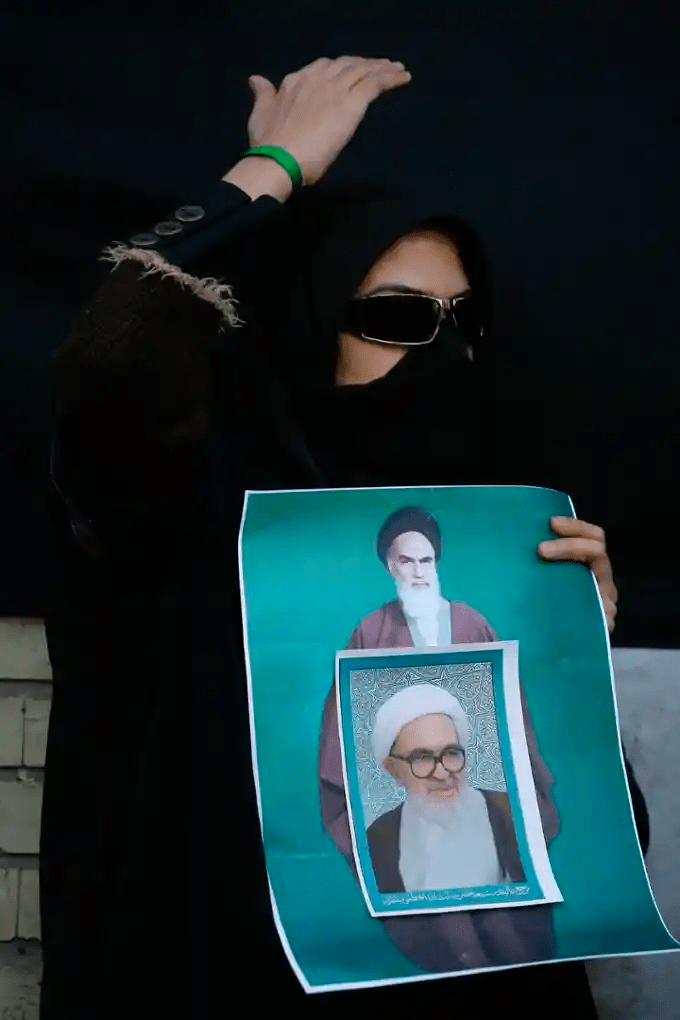
First published December 2009
The Grand Ayatollah Hossein Ali Montazeri’s death on Saturday, 19 December 2009, marked yet another turning point in the 30-year history of the Islamic Republic. His passing may well mark the beginning of the end of the theocracy that he helped to establish.
In Iran’s long history, the clerics have always played a mainly negative role and have been responsible for great catastrophes that have befallen the nation. In fact, whenever clerics of any religious persuasion assume power in any society and make religion into a profession, they misuse people’s sincere faith for the sake of their own power and glory. The enormous power of the Magi or Zoroastrian priests towards the end of the Sassanid Empire (224-651 AD) resulted in weakening that empire and paved the way for the triumph of Arab invaders who brought Islam to Iran. A similar fate befell the Safavid Empire (1501-1722). Under the rule of the last Safavids, the mullahs’ domination of the rulers weakened the government to such an extent that it fell to invading Afghan rebels. During the nineteenth century, the mullahs forced the Qajar kings to declare war on Tsarist Russia twice and, on each occasion, Iran suffered great defeats and lost vast territories in the Caucasus.
However, during this long history of negative impact, from time to time, there have been some clerics who have redeemed themselves and their profession and have joined the progressive forces. Due to the religious feelings of the masses, many reformers have found it necessary to co-opt the support of the mullahs to fight against the superior power of the governments. In the Iranian Constitutional Revolution (1905-1911), most of the leading clerics, led by the most prominent cleric of the day, Sheykh Fazlollah Nuri, were in league with despotic and corrupt Qajar rulers and opposed the Constitutional Movement that they feared would erode their power. The reformers turned to two relatively junior clerics, Seyyed Abdullah Behbahani and Seyyed Mohammad Tabataba’i, who opposed the majority of the clerics and supported the constitutional cause. While Sheykh Fazlollah Nuri’s name is remembered with ignominy in Iranian history, these two clerics have received a great deal of praise for their championship of democracy. In fact, the term Ayatollah (Sign of God) was coined for the first time as a sign of affection to refer to those two clerics.
Despite his earlier record of supporting an oppressive regime, Ayatollah Montazeri, alongside some other reformist clerics such as former president Mohammad Khatami, presidential candidate Mehdi Karrubi, Mohsen Kadivar and Mohammad Mojtahed-Shabestari, may go down in history as leaders of the Reform Movement. Ayatollah Montazeri, in particular, will be remembered as a man who sacrificed his power and political position for the sake of his principles.
The son of a poor farmer in Najafabad, central Iran, Montazeri rose to become one of the greatest leaders of Shi’i Islam. As a young man, he joined anti-Shah demonstrations. When his teacher, Ayatollah Ruhollah Khomeini, openly attacked the Shah’s so-called “White Revolution” and was exiled to Turkey, Montazeri, who was by then a mid-ranking cleric in Qom, became his representative in Iran. He collected the donations that pious merchants and others made to Khomeini and sent them to him in Najaf, where he had taken residence. Montazeri was imprisoned for a while, but in his Memoirs and in his recent speeches, he has said that the conditions were not very harsh, certainly compared to what goes on under the clerical regime. Montazeri was released from jail shortly before the revolution and took an active part in anti-government protests.
In February 1979, when Ayatollah Khomeini returned to Iran in triumph, Ayatollah Montazeri became his right-hand man. He was appointed a member of the secretive Revolutionary Council, and one of the first preachers at Tehran Friday prayers whose sermons were broadcast live throughout Iran and set the agenda for other Friday imams and for the political developments in the country. When, instead of setting up a Constituent Assembly to draw up the constitution of the new republic, as had been promised, Ayatollah Khomeini set up an Assembly of Experts, Montazeri became its chairman. It was mainly due to Ayatollah Montazeri’s influence in the Assembly that the concept of the Velayat-e Faqih (the Guardianship of the Jurisprudent) became the central concept in the new constitution. He also wrote a massive tome called Dirasat fi Vilayah al-Faqih (Lessons on Velayat-e Faqih), a scholarly book in four volumes explaining the concept of the administration of the state by Islamic jurists.
This new theory about the nature of governance in Shi’i communities was first promulgated by Ayatollah Khomeini. In a series of lectures, which were subsequently published in a book [1], Ayatollah Khomeini formulated his ideas about an Islamic government based on the rule of the leading cleric. Ayatollah Khomeini argued that Prophet Muhammad did not merely reveal laws, but was also an executor of the law and acted in the capacity of a ruler. Therefore, in the absence of the Prophet and the Shi’i Imams, the clerics who are experts in Islamic law must assume the role of the leadership of the community.
Not only was this concept alien to the views of the majority of the followers of the Sunni sect, but it also did not have a precedent among the Shi’is either. In fact, with his theory about the illegitimacy of non-clerical governments, Ayatollah Khomeini condemned the entire history of Islam during the past 1,400 years, because after the death of the Prophet and the short-lived government of Imam Ali, the fourth caliph, Muslim countries have never been ruled by the Imams or clerics. Among a dozen grand ayatollahs, Ayatollah Mohammad Kazem Shariatmadari and Ayatollah Seyyed Hassan Tabatabai-Qomi openly criticised this concept and were put under house arrest, and all other grand ayatollahs remained silent. Not one grand ayatollah openly agreed with this concept.
Nevertheless, this concept became the cornerstone of the new constitution, from which all other organs of the state derived their legitimacy. For his services to the revolution, his position as a ”source of emulation” and his closeness to the founder of the Islamic Republic, in November 1985, Khomeini appointed Ayatollah Montazeri as his heir apparent and designated successor. Montazeri remained the second most prominent figure in the Islamic Republic until April 1989, when, in a letter to Khomeini, he resigned from his post.
Towards the end of Ayatollah Khomeini’s life, Montazeri grew disenchanted with the many excesses of the Islamic regime and openly criticised some of its policies and practices. He criticised the so-called Velayat-e Motlaqe-ye Faqih, or the Absolute Guardianship of the Jurisprudent, which put Khomeini above the law, giving him the power even to abrogate some Islamic teachings due to “the expediency of the system”. Montazeri also criticised Khomeini’s fatwa ordering the assassination of Salman Rushdie, the British author of The Satanic Verses, saying: “People in the world are getting the idea that our business in Iran is just murdering people.”[2]
However, the last straw came when Khomeini issued orders for the summary execution of a large number of prisoners. When the members of the Mojahedin-e Khalq foolishly joined Saddam Hussein’s forces in the last days of the Iran-Iraq war to attack Iran, Ayatollah Khomeini issued orders that all Mojahedin supporters held in Iranian prisons had to be executed if they did not openly renounce the group. Ayatollah Montazeri has published for the first time the text of Khomeini’s murderous letter in his massive Memoirs. In a part of his letter, Khomeini wrote: “[T]hose who remain steadfast in their position of nifaq [hypocrisy or opposition to the regime] in prisons throughout the country are considered muharib [waging war on God] and are condemned to execution.” He set up three-man committees to judge these prisoners throughout the country, and their word was final. Some of these prisoners had completed most of their sentences and were due to be set free. Nevertheless, according to Ayatollah Montazeri’s figure in his Memoirs, as many as 2,800-3,800 were summarily executed. Some reports put the figure as high as 6,000.
Following Ayatollah Montazeri’s objections to that slaughter, he was dropped as Khomeini’s heir apparent only a few months before Khomeini’s death. After Ayatollah Khomeini’s death, Ayatollah Montazeri was passed over, and Seyyed Ali Khamene’i, who was a mid-ranking cleric, was overnight given the title of ayatollah by the Assembly of Experts and appointed Khomeini’s successor.
Ever since Khamene’i’s appointment, Montazeri remained his main critic, both in view of his lack of qualifications as the supreme leader, as well as his misuse of his power. Shortly after Khamene’i’s appointment, the Islamic Republic’s constitution was changed, and the leader was given many more powers than even Khomeini had enjoyed. According to the new constitution, the supreme leader oversees all three powers. He endorses the president’s election, appoints the head of the judiciary, the commanders of all the armed forces and the police, the head of the Intelligence Ministry, all Friday Imams, and the head of the Broadcasting Organisation. By directly appointing six jurist members of the Guardian Council, which vets the candidates for presidency and for the Majlis, Khamene’i is also directly in charge of the legislative and executive organs of the state.
Ayatollah Montazeri has argued that the office of Velayat-e Faqih was not supposed to have such uncontrolled powers. He wrote:
“It is certain that the legitimacy of this post is acquired through popular election. In reality, there is a social contract between the people and the Leader, and the Constitution was drafted on that basis. Accordingly, his term may be limited and temporary, like that of the president or a member of parliament. And given that the Leader is accorded responsibility by the people, he is not infallible. He must accept criticism and be responsible for his actions.”[3]
Despite his earlier enthusiasm for the concept of Velayat-e Faqih, his later statements sounded almost democratic. In an interview with the French Communist Party newspaper, L’Humanité, in his written replies to questions put to him by fax, he wrote: “The concentration of powers in the hands of a single person is not accepted and must not be accepted.”[4] He added: “The separation of powers is a progressive and reasonable principle and is not in contradiction with a religious government.” He continued: “The legitimacy of the religious government resides in the people — without the people it has none.”
Montazeri warned that, as Khamene’i was not chosen by the people and was not answerable to them, the Iranian system’s popularity was threatened. “If the leadership does not change its behaviour radically, there is no future for the religious government,” he said. In order to escape that predicament, Montazeri called for constitutional changes, either combining the posts of the president and the spiritual guide to produce a powerful elected leader, or giving the former more authority and leaving the latter as a figurehead, with no right to interfere in government. He wrote: “Islam does not oppose the idea of separation of powers or of decentralisation, because the accumulation of power in the hands of someone who is not infallible and is prone to making mistakes is incompatible with reason and wisdom.” He continued: “If the leadership does not change its behaviour radically, there is no future for the religious government.”
For his opposition to the Supreme Leader’s unchecked powers and the regime’s excesses, Montazeri was put under house arrest in 1997. However, despite official denunciation, he remained popular with a large segment of the public and even of the clerical establishment. In an open letter, 554 clerics, including some ayatollahs from Qom and Mashhad religious seminaries, as well as some 150 Majlis deputies, denounced Montazeri’s house arrest as both “illegal and illegitimate ” and urged the authorities to guarantee his total freedom.[5] Finally, Montazeri was released from house arrest in January 2003, but his movement and activities remained very restricted. He was not allowed to take part in political activities or to address open meetings, but he continued writing and giving interviews right to the last days of his life. His massive Memoirs revealed many secrets about the early days of the revolution, and in it he also expressed his continued opposition to Khamene’i.[6]
After last June’s controversial election, Montazeri became one of the fiercest critics of the system and condemned Khamene’i for his hasty support for what he branded a “fraudulent election”. He also denounced the clerical establishment as a dictatorship. He said that as a result of recent events, the Islamic Republic was no longer either Islamic or a republic. In response to a series of questions put to him about President Mahmoud Ahmadinejad’s claims and the position of the supreme leader for an Analysis programme on Radio Four, which was broadcast on Monday, 19 Oct 2009, Montazeri expressed his fierce opposition to the election.[7] He called on the clerics “to be in step with the people”, join the reformers and distance themselves from those who suppress the people. He denounced the show trials as “illegitimate and illegal” and blamed a minority for making all the decisions. He wrote:
“A small minority that is currently in power takes the major decisions, and those decisions are mainly against the interests of the country, and are not in keeping with religious and Islamic principles and values. If the present course of action continues, the rift between the people and the government would definitely grow day by day, and people’s dissatisfaction would increase. The way that the government has dealt with the protests of the majority of the people against the results of the recent presidential election, the arrests and the illegitimate and illegal trials of many members of the elite and political activists have contributed to public dissatisfaction.”
Montazeri died as an enemy of the regime he had helped to create. In November 2009, on the eve of the 30th anniversary of the seizure of the United States Embassy in Tehran, Ayatollah Montazeri apologised for it and described it as a mistake that cost Iran dear.[8]
He also opposed the regime’s nuclear ambitions, or at least the way that it went about it. While agreeing that Iran had the right to develop nuclear energy, he called Ahmadinejad’s approach to the issue aggressive, saying, “One has to deal with the enemy with wisdom, not provoke it, … his [provocation] only creates problems for the country.” In response to Ahmadinejad’s insistence that nuclear energy was Iran’s right, Montazeri asked, “Don’t we have other rights too?”[9]
Out of all religious minorities, the Baha’is are the most persecuted in Iran. Hundreds of their leaders have been killed since the revolution, and currently, seven members of their National Assembly are in jail for their religious activities. Nevertheless, Ayatollah Montazeri showed rare courage for a cleric in stressing their human rights as Iranian citizens. In a fatwa in response to a query about their status in Iran, he wrote:
“The congregation of Baha’ism, not having the heavenly book like those of Jews, Christians, and Zoroastrians in the constitution [of the Islamic Republic of Iran], is not considered one of the religious minorities. However, since they are the citizens of this country, they have the right of citizenship and the right to live in this country.”[10]
This shows that he believed in the separation of the church and the state, and although he did not believe that the Baha’is could be regarded as a religious minority, he nevertheless stated that, as Iranian citizens, they were entitled to citizenship rights.
As in life, so in death, Ayatollah Montazeri became a focal point of the opposition. Despite all the restrictions that were placed on people’s participation in his funeral, hundreds of thousands of people took part in his funeral in Qom, although a memorial meeting for him in the Grand Mosque in Qom had to be cancelled due to the activities of some vigilantes. The seventh day of his death fell on the day of Ashura, the anniversary of the martyrdom of Imam Hussein in 680 AD. According to the Shi’is, Imam Hussein and a small band of his followers rose up against the despotic government of Yazid, the Umayyad Caliph, and accepted death rather than giving in to tyranny.
Thirty years ago, the mullahs used religious festivals, especially Tasu’a and Ashura, the ninth and the tenth days of Muharram, in order to whip up the emotions of the people against the Shah’s regime. Qom, Isfahan and Tehran were the three cities that played the most important role in the revolution; Qom as the centre of clerical power, Isfahan as another centre of religious learning and the first city where martial law was declared, and Tehran as the scene of the biggest demonstrations during Tasu’a and Ashura shortly before the victory of the revolution. It is poetic justice that Qom has now become the main centre of opposition to the clerical rule, and massive demonstrations in both Tehran and Isfahan have shaken the foundations of the regime.
As the traditional commemoration of the seventh day after Ayatollah Montazeri’s death fell on Ashura, people turned that day into an excuse for anti-regime demonstrations. The clerical regime did not even respect the sanctity of Ashura and mercilessly attacked the protesting mourners. According to the government, eight people were killed on that day and 500 detained, but the opposition claims that 37, including Mir Hoseyn Musavi’s nephew, were killed and at least 1,100 detained. Video clips show police forces driving over some demonstrators.
Some of the slogans that people chanted on Ashura (27th December 2009) were very significant. In reference to his house arrest and detention, one popular slogan was “Montazeri-ye Mazlum, Azadiyat mubarak; Rahbar azadegi, azadiyat mubarak” (Oppressed Montazeri, enjoy your freedom; leader of the free, enjoy your freedom). After Montazeri’s death, Ayatollah Khamene’i issued a lukewarm message of condolence, but criticised his stance against Khomeini. Referring to that message, the crowds chanted “We don’t want rationed condolence” (referring to rationed food).
While after the June election the slogans were directed against Ahmadinejad, in these massive demonstrations the crowds openly attacked Ayatollah Khamene’i, including: “Dictator, this is your last message: The people of Iran are rising!” “Dictator, dictator, Montazeri is alive!”; “In mah mah-e khuneh, Seyyed Ali Sarneguneh” (This is the month of blood, Seyyed Ali will be toppled); “Khamenei haya kon, Mamlekat-o raha kon” (Khamene’i shame on you, leave the country alone); “Khamenei qatel-e, velayatesh batele” (Khamene’i is a murderer, his guardianship is null and void); “Nang-e ma, nang-e ma, rahbar-e aldang-e ma” (Our thuggish leader is a source of disgrace). There were many references to Imam Hussein and the tyrannical Yazid, portraying Khamene’i as Yazid, such as “In Mah Mahe khun-e, Yazid sarnegune” (This month is the month of blood, Yazid will be toppled). These slogans were interrupted by the chants of “Hussein, Hussein, Mir-Hoseyn”, referring to the name of Imam Hussein, as well as Montazeri and Musavi’s first names.
What was different about the events of Ashura this year was the radicalisation of the opposition. In some cases, the demonstrators turned against the security forces and Basij militia that attacked them. People overpowered them, disarmed them and then set them free. Despite a massive crackdown during the past six months, the protest movement has continued and has even gained in strength. The regime is lashing out in a state of panic, but the protest movement seems to be irresistible. In these demonstrations, Ahmadinejad was all but forgotten, as though he were no longer relevant, and the slogans directly targeted Khamene’i.
These developments show that people’s protests have moved well beyond their initial demands to get back their stolen votes, and now they are openly calling for the end of the clerical regime. The regime has the choice of either resorting to greater repression, leading to greater radicalisation, or accepting the demands of the Green Movement as set out in the reformist candidate Mirhoseyn Musavi’s latest defiant statement issued on 1st January 2010. In his statement, Musavi pointed out that he was not afraid of joining other martyrs of the Green Movement, but warned that killing him or Mehdi Karrubi and other reformist leaders would not solve anything. Instead, he called on the authorities to implement his five-point plan: The government to be held accountable to the Majlis and the judiciary, new laws to be prepared for a fair and transparent election, freeing political prisoners, introducing press freedom, and guaranteeing freedom of assembly and protest.
Judging by the latest developments, the clerical regime should know that the choice is not between it and the Green Movement, but between the Green Movement and a more violent and radical uprising that would result in unprecedented violence in the country. The sooner the regime listens to people’s demands and dismantles its oppressive system, the better it will be for it and for the people. Ayatollah Montazeri’s journey from being the main ideologue of the clerical regime to becoming its harshest critic has provided the clearest indictment of its failure.
Footnotes:
[1] For a translation of some of Ayatollah Khomeini’s writings, see: Imam Khomeini, Islam and Revolution: Writings and Declarations, translated and annotated by Hamid Algar (KPI Ltd., London, 1985).
[2] See: Robin B Wright, The last great revolution: turmoil and transformation in Iran. New York: A. A. Knopf. (2000), p. 20
[3] Hoseyn Ali Montazeri, Dirasat fi Vilayat al-Faqih va fiqh al-Dowlat al-Islamiyya [Lessons on Velayat-e Faqih and religious views concerning Islamic government]. These lessons were taught between 1984 and 1989 at the Qom Religious Seminary.
[4] These and subsequent quotations come from Ayatollah Montazeri’s interview with L’Humanité, as quoted by AP, 18 July 2001. H. A. Montazeri, Interview with l’Humanité: ‘Le régime a perdu sa légitimité’ Available online at http://www.humanite.fr/2001-07-19_International_Le-regime-a-perdu-sa-legitimite
[5] See Reuters and IPS, 18 July 2001.
[6] For the Persian text of the Memoirs, see: http://www.iranvision.com/pdf/khaterat.pdf
[7] http://www.bbc.co.uk/programmes/b00n80b5
[8] See: “Green November” The Economist, Nov 5th 2009
http://www.economist.com/world/middleeast-africa/displaystory.cfm?story_id=14816819
[9] BBC “Iranian cleric attacks president”, 22 January 2007, http://news.bbc.co.uk/1/hi/world/middle_east/6286771.stm
[10] See: “Ayatollah Montazeri Proclaims Baha’is Citizens of Iran”, Mideast Youth, 22 May 2008
http://www.mideastyouth.com/2008/05/22/ayatollah-montazeri-proclaims-bahais-citizens-of-iran/

