

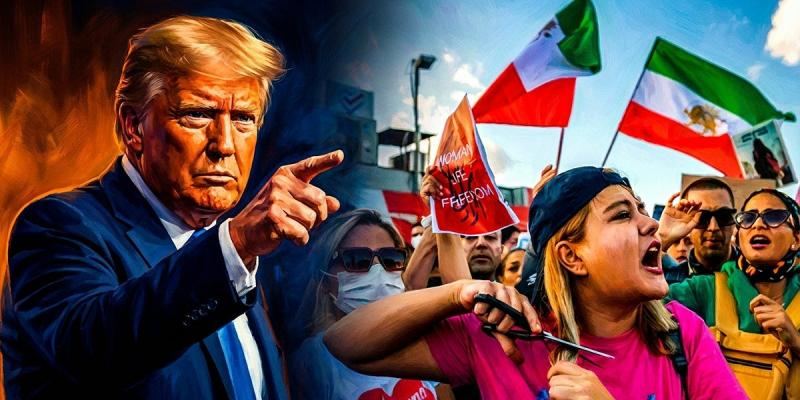
As a “beautiful US Armada” is moving towards the Persian Gulf with overt threats by both Israeli and US leaders of a massive attack on Iran, here is an article by a BRICS publication about how they see the Iranian protests.
After nearly two years of intense negotiations between the Iranian government and the so-called 5+1 (the five permanent members of the Security Council plus Germany), led by the United States, the parties reached a landmark nuclear agreement known as the JCPOA (the Joint Comprehensive Plan of Action) in 2015. Under the JCPOA, Iran agreed to drastically cut its nuclear enrichment, join the so-called Additional Protocol, and accept unannounced IAEA inspections, in return for lifting the sanctions that the United States and other Western countries had imposed on Iran. The agreement was unanimously ratified by the UN Security Council Resolution 2231, which gave it the force of an international treaty.
However, under pressure from Netanyahu, President Trump withdrew from the agreement in 2018 and imposed even harsher sanctions on Iran. Iran continued to comply with its obligations under the agreement for nearly two years, hoping that the next US president would return to it. However, when President Biden failed to renew the agreement, Iran adopted its look-to-the-East policy. In January 2024, it became a full member of BRICS.
BRICS is a political and economic union formed in 2009 by Brazil, Russia, India, China and South Africa. Later on, more countries joined it, and now it has eleven members. Altogether, they have a population of about 3.3 billion people, and their combined GDP has surpassed the GDP of the G7, a mainly Western union with a joint population of 780 million people. BRICS is not a military union, and its members are not required to defend other members militarily.
However, the competition between BRICS and G7 is the major geopolitical reality of today’s world. The West sees BRICS as a major political and military threat to its global hegemony and vice versa. Many conflicts that we are witnessing in the world are somehow related to this intense competition between the two blocs. By joining BRICS, Iran has made itself a target of Western pressure. Therefore, it is important to examine how BRICS see the conflict in Iran. It should be added that the protests in Iran are mainly homegrown against a cruel and incompetent regime, and the number of the dead is in the thousands, not hundreds:
“Iran’s situation reveals a fundamental tension in international relations: the gap between stated humanitarian concerns and underlying strategic interests. When does supporting protesters represent genuine solidarity, and when does it serve as a pretext for geopolitical repositioning? The answer matters enormously for Iran’s 88 million citizens, who will live with whatever comes next long after Western attention shifts elsewhere.”
https://lnkd.in/e5tT-G7q

