

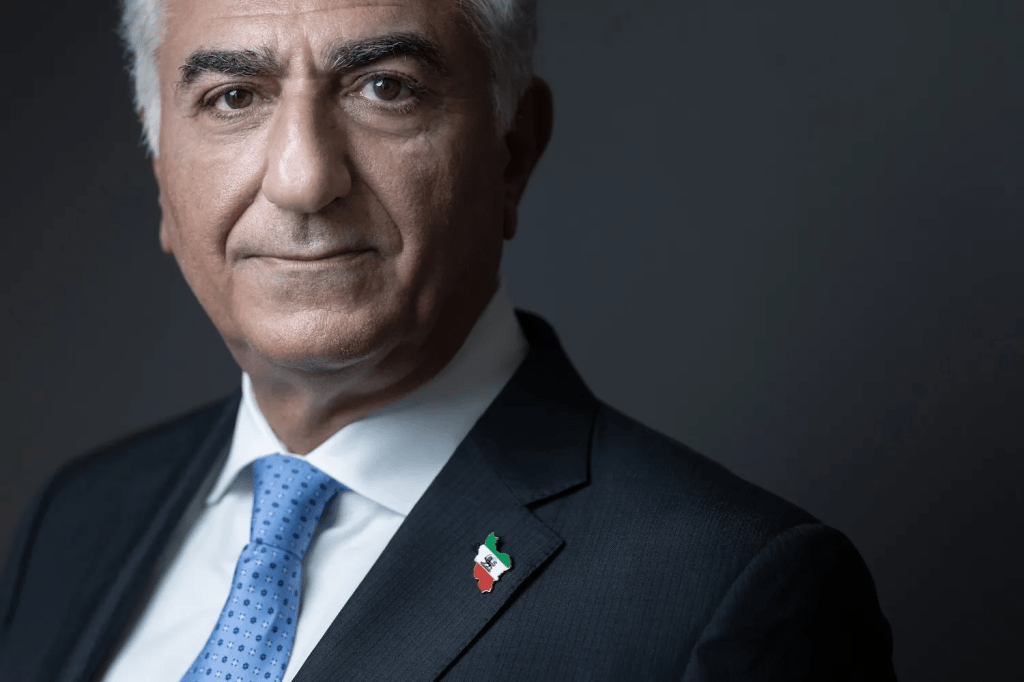
History has shown that once monarchies fall, they rarely, if ever, are restored. This has been the case in Russia, France, the Austro-Hungarian Empire, Greece, etc., in Europe. In the Middle East, too, the fall of royal families in Turkey, Egypt, Iraq, Syria, Libya, etc., has been followed by republics or military juntas. It is unlikely that the situation in Iran would be any different.
However, Reza Pahlavi can play an important and maybe indispensable role, not as a future monarch but as a person with name recognition and with some support among Iranians who can unite a divided, leaderless opposition and can prepare the way for a more democratic, elected form of government.
It is extremely unlikely that he can revive the monarchy in Iran, but he can act as a catalyst towards a more democratic republic. Many Iranians have favourable views of the reforms initiated by Reza Shah and Mohammad Reza Shah, and although they failed to establish democracy, which during Mohammad Reza Shah’s reign was quite achievable, at least they established a relatively long period of stability, economic development and prosperity. If instead of ruling, the late Shah had reigned, which was his constitutional role, the revolution might not have happened.
If Reza Pahlavi can restrain his monarchist supporters who sometimes sound as absolutist as the supporters of the Islamic regime, and use foul and at times violent means against other groups who follow a different path from them, and if he can make it clear that he sees his mission merely as a facilitator to manage a transitional period from the current clerical dictatorship to a democratic Iran, he can play a very useful and historic role in unifying the Iranian people during a period of transition.
I believe that his nearly 50 years of residence in the United States have taught him the virtues of democracy and representative government, and the terrible experience of the Islamic Republic has shown him the evil of despotism and dictatorship. Therefore, he is fully qualified to fight for democracy, the rule of law and the separation of religion and politics.
“If Iran is indeed approaching a moment of reckoning, it will require not a savior but a facilitator, not a redeemer but a figure capable of trust-building across deep divides. In that narrow but indispensable space, Reza has positioned himself not as Iran’s ruler but as its custodian for a passage between political eras. Should that moment arrive, it is increasingly difficult to imagine a transition in Iran without such a role for him.”
https://lnkd.in/e8nbujvE

