

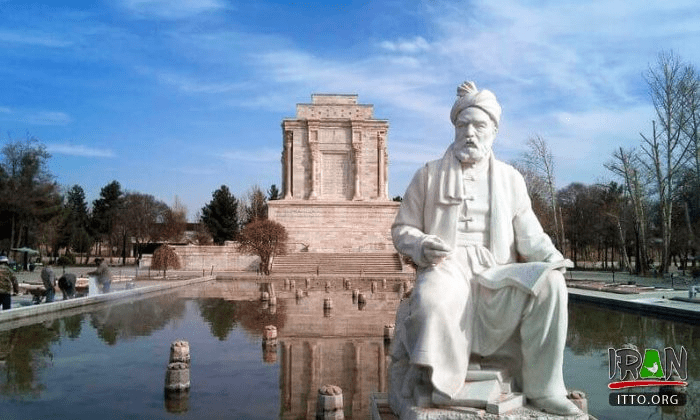
By Farhang Jahanpour
Abol-Qassem Ferdowsi (940-1020 AD) was born in a village near Tus, in Khorasan, a province in the northeast of Iran. His great epic, the Shahnameh, to which he devoted most of his adult life, was originally composed for the Samanid kings of Khorasan, who were the chief instigators of the revival of Persian cultural traditions after the Arab conquest. However, during Ferdowsi’s lifetime, the Samanid dynasty was conquered by the Ghaznavid Turks, whose great leader, Sultan Mahmud, did not appreciate Ferdowsi’s great epic, which glorified Iran and Iranian history.
Legend has it that Ferdowsi contemptuously refused to accept Sultan Mahmud’s silver coins that were sent to him instead of the gold coins that he had been promised by the Samanid rulers. He returned to his native Tus, where he died, apparently in poverty. Again, the legend has it that later on, Sultan Mahmud regretted his disrespect to Ferdowsi and sent him the gold coins as had been promised. But the emissary with gold coins arrived too late. As his procession entered the main gate to the city, it encountered another procession leaving the same gate with Ferdowsi’s coffin.
Ferdowsi revived the Persian language and Persian nationalism. It reminded Iranians of their former glory and great past empires. After the Arab conquest, when tens of thousands of Iranians were killed, cities destroyed, palaces looted, and libraries burned, like many other countries that fell victim to the first wave of Islamic conquest, Iran too went into a deep shock. A leading Iranian literary scholar, Abolhossein Zarrinkub, wrote a celebrated book called “Two Centuries of Silence”, referring to almost two centuries when the Iranian nation gradually emerged out of the shock of the Arab conquest.[1]
The book details the story of the first two centuries after the Islamic conquest, when the Iranians initially had to forsake their ancient culture, religion and language and over 1,500 years of empire, and adjust to an alien religion, culture and language. They also had to endure a long period of suppression and humiliation when their love for their country and the Iranian spirit had to remain dormant.
However, shortly after that period, Iranian culture, learning, and literature flourished, and the Persian language was revived through the work of great scholars, poets, and writers. Ferdowsi played a most prominent role in breaking that long period of silence and gave voice to the Iranians in the beautiful Persian verses of his great epic poem, the Shah-Nameh.
The Shah-Nameh (the Book of Kings), the longest epic poem written by a single man in any language, is a celebration of pre-Islamic Iranian heritage. The book, in fact, demonstrated if not a rejection of Islam, at least a rejection of the Arab conquest of Iran. As Dick Davis, one of the best translators of the Shah-Nameh and many other books of Persian verse, writes: “The conquest by the Arabs, with which the poem ends, is seen as an unmitigated disaster. To sum up and oversimplify: Ferdowsi is not anti-Muslim, but he is quite vehemently anti-Arab.”[2]
Ferdowsi, who was very learned in ancient Persian history, was fully aware of his enormous contribution. The subject matter of his book was vast, covering thousands of years, from the first mythical Persian kings to the Arab conquest in the 7th century, which brought the religion of Islam and a new Arabic language, culture and religion. Ferdowsi’s task was to stop the Islamic and Arab onslaught and revive the Persian language, history and culture. He says:
I have struggled much these thirty years,
But I have given a new life to the Iranians with this Persian verse.
He rightly believed that he had revived the Persian language and the tales of old Iranian heroes and, consequently, had revived Persian history and culture:
These tales, which relate to the monarchs of old,
In volumes of elegant verse I have told.
The men of renown and of prowess and fame,
Whose deeds are recorded herein, name by name.
Time swept them aside, and death stilled heart and brain,
But here in my verses, they live once again.
Like Jesus, whose voice called the dead back to life.
I’ve awakened dead heroes of struggle and strife.
At long last, each noble construction decays,
Assaulted by wind and the sun’s scorching rays.
But I have erected a Palace of Rhyme:
No blast shall o’erthrow it, nor passage of time.[3]
He ends his book secure in the conviction that his great name and his fame shall remain:
I’ve reached the end of this great history
And all the land will fill with talk of me
I shall not die; these seeds I’ve sown will save
My name and reputation from the grave
And men of sense and wisdom will proclaim
When I have gone, my praises and my fame.[4]
It was as a result of the works of early poets, especially Ferdowsi, that, unique among all the nations that were conquered during the first wave of Arab invasions and accepted Islam, the Persian language and Persian culture remained intact. This is what sets Iran apart from many other ancient cultures and nations, such as the Egyptians, the Syrians, the Iraqis and many other countries that were Arabized as a result of the first wave of Arab invasion in the seventh century. It should also be added that not only did Ferdowsi revive the Persian language and turn it into the lingua franca of Eastern Islam, from Iran to the Subcontinent, Central Asia and right up to the walls of China, but also saved many other local languages spoken by fewer people, such as Kurdish, Lori and many other minority languaged that did not have an established literature.
Had it not been for the wall that the Persian language erected in front of the spread of Arabic, the Arabic language would have swept away most of those other native languages, as it managed to do in other countries during the first wave of Arab conquest. Many countries in the Middle East with long civilisations and recorded history, such as Syria, Lebanon, Egypt and many other North African countries, succumbed to the spread of Islam and not only became Muslims, but were also Arabised and became part of the Arab world.
At the time of Ferdowsi, it was customary for books of poetry to start with praise of God, the Prophet, religion and spiritual issues. The Shah-Nameh, however, starts with the praise of God of reason, with God’s incomprehensibility and His purpose behind creation:
Now in the name of God whose power controls
Wisdom and has created human souls,
Exalted beyond all that thought or speech
Is able to encompass or to reach,
The lord of Saturn and the stars at night,
Who gives the sun and moon and Venus light,
Above all name and thought, exceeding all
Of his creation, and unknowable…[5]
The first line of the Shah Nameh and the homily to God reads:
به نام خداوند جان و خرد کزین برتر، اندیشه بر نگذرد
The literal translation of this line is “In the name of God of life and intellect, above which imagination cannot soar.” In other words, God created life and also endowed man with intellect, a quality which is above all else, and nothing can surpass it. This emphasis on reason and rationality was quite remarkable at a time when religion preached the supremacy of revelation and religious dogma and superstition over reason and rationality.
The Shah-Nameh includes stories of war, heroism, chivalry, politics, and conquest, but also of friendship, love, forgiveness and generosity. It stresses the importance of compassion, modesty and heroism and the supremacy of love and friendship over war and conflict. The Shah-Nameh’s heroes always respect their enemies and call for peace and negotiations. It is only when those pleas fail, and war is imposed on them, that they fight like lions and achieve victory. Even so, they always remain magnanimous towards the vanquished foes.
Far from being a chronicle of war and fighting, the Shah-Nameh is a complex book that provides a varied, rich and multi-dimensional picture of life, demonstrating the highs and lows of human experience. It is also a book that defines the battle between good and evil, between the Zoroastrian God, Ahura Mazda, and the symbol of evil, Ahriman. In Iranian history, these two forces are best represented by the good king Jamshid, who lived for seven hundred years, and the tyrannical ruler Zahhak. Under Zahhak’s cruel and unjust rule, the wise concealed themselves and their deeds, while evil people achieved their heart’s desire. Virtue was despised, and magic and evil flourished. Good people were spoken of only in secret, while demons rejoiced in their wickedness.
However, a new king, Fereidun, was born, and the world was renewed by him. He grew tall and strong, and Jamshid’s imperial farr (divine favour) radiated from him as if he were the sun. With the help of Kaveh, a skilled archer, Fereidun crowned himself king and went to fight against Zahhak. When he came near Zahhak’s palace, he came upon an idol made by Zahhak. When Fereidun saw that it bore a name other than that of the Creator, he overturned it. With his mace, he crushed the heads of the magicians and demons who were in the palace, then placed his foot on Zahhak’s throne in victory. With Fereidun’s victory, the reign of tyranny and cruelty under Zahhak came to an end, and people rejoiced and lived in peace and prosperity. This story shows the constant battle between the powers of good and evil, but good will always triumph and evil will be vanquished.
In addition to its literary value, the Shah-Nameh, written in some 50,000 rhyming couplets or 100,000 single lines, was a clear political statement against the Arab conquest of Iran. The Shah-Nameh refers to Iran, Iran-Zamin (land of Iran), and Iran-Shahr (country of Iran) more than a thousand times. Contrary to the prevailing belief that nationalism is a relatively recent concept, Ferdowsi’s emphasis on the love of Iran-Zamin or the land of Iran shows the attachment that he and, no doubt, many of his contemporaries felt to their country. The following lines by Ferdowsi cannot be interpreted in any other way than intense devotion to the concept of Iranian nationalism:
If there is no Iran, may I also cease to exist
May not a single soul be alive on this land and country
Far better if all of us, one by one, were to be killed
Than surrendering the country to the enemy
It would be such a shame for Iran to be ruined
To become a roaming ground for tigers and lions
Yet, at the end of the battles and heroic deeds, friendship and enjoyment of life are what remain. Wars should not drown humanity. In the words of the great Iranian hero of Shah-Nameh, Rustam:
These battles that I fought, I fought alone,
No man has shown the valour I have shown.
But we have talked enough: if you agree,
Take up your wine, and slake your thirst with me.[6]
The attachment to the country, to its ancient history and its geographical boundaries has remained constant, and memories of the stories about the Pishdadi (the mythical Iranian empire based on early Zoroastrian texts, similar to the stories of David and Solomon in the Hebrew Bible), the Medes, the Achaemenid, the Parthian (also known as the Arsacid) and the Sassanian empires, stretching over some 6,000-years, are very alive in the minds of Iranians, especially through the Shah Nameh.
The Shah Nameh is not only about war and the heroic battles fought by many Iranian heroes, such as Zal and Rustam, but it also includes many love poems in which women play strong and prominent roles. Many legendary or historical women mentioned in the Shah Nameh are strong and positive figures. They include Sindokht, Rudabeh, Sudabeh, Farigis, Manizheh, Katayun, etc., who fall in love, are independent characters and in many cases support and even dominate their lovers or husbands. For instance, Manizheh defies her non-Persian father to be faithful to the Persian hero she loves. On the other hand, Gordyeh represents the traditional Iranian virtue of modesty and loyalty to ancient mores. The romance between the Sasanian king, Khosrow Parviz, and an Armenian woman, Shirin, is legendary and has been borrowed and repeated by later poets, such as Nezami (the twelfth-century author of the better-known romance version of her tale).
In short, the Shah Nameh is not only a great epic poem about the adventures and exploits of great Iranian kings and heroes in Iran’s long history, but is also a book that recorded thousands of years of Iranian history which was in danger of being forgotten, and revived the Persian language, and with it, the Persian culture, literature, and the sense of a distinct Iranian national and religious identity. By reminding people of their old religious beliefs, especially Zoroastrianism, it influenced the course of Islam, which was accepted by most Iranians.
Many scholars have argued that, in a way, Shi’ism borrowed a great deal from Zoroastrianism and created a distinct version of Islam which was quite different from the dominant form of Islam in most Arab countries. Sufism, which also became a distinct form of Iranian Islam, also owed a great deal to ancient Iranian and, through it, to Hinduism and Buddhism. This is why the version of Islam that spread in most of the Subcontinent by Iranians contained a strong element of Sufism, which was more acceptable to former Hindus and Buddhists.
Muhammad H. Haykal, the legendary Egyptian journalist and the veteran editor of Al-Ahram newspaper, responding to the question as to why Egypt, despite its illustrious history, had become so thoroughly Arabized, quipped that it was because Egypt had not had its Ferdowsi. Language is often at the root of culture, and the fact that the Iranians retained their Persian language meant that their culture remained intact and was not absorbed into the Islamic-Arab culture. In this way, they maintained their special national and cultural identity and remained different from the countries that were Arabised.
[1] For a good translation of this book, see: Paul Sprachman, Two Centuries of Silence (Mazda Pub, 2017)
[2] Cynthia Haven, “Translator, poet champions medieval Persian verse”, Stanford News, October 22, 2008, https://news.stanford.edu/news/2008/october22/davistwo-102208.html
[3] Translated by Rev. Norman Sharp, quoted in H. B. Dehqani-Tafti, Norman Sharp’s Persian Designs (Sohrab Books, 2001), p. 15
[4] Dick Davis, Shahnameh: The Persian Book of Kings (Penguin Paperbacks, 2016), p xi
[5] Davis, op cit., p. xiv
[6] Davis, p. 392

