

Poets as Prophets of Revolution
by Farhang Jahanpour
In Iran, poets and writers have often been regarded by the public – and by themselves – as seers, guides or even prophets who lead and enlighten the masses. The ‘committed’ or ‘engaged’ writers are the eyes, the ears and the conscience of the society and, for better or worse, exert a profound influence upon the minds of the reading public.
One great difference between classical and modern literature is that, while in the past poets acted as spiritual guides, revealing divine secrets, engaging in metaphysical speculation, and elucidating Sufi mysticism, modern writers are more concerned with the here and now and with political and social issues. With the dawn of the Constitutional Movement – a movement which itself owed a great deal to Iranian writers and intellectuals – a new literary climate was created. With the introduction of printing, the spreading of education and greater access to books and newspapers, Iranian writers and poets found a much larger audience to communicate with and many new political and social issues to write about.
With the dawn of the Constitutional Movement (1905-11) – a movement which itself owed a great deal to Iranian writers and intellectuals – a new literary climate was created. With the introduction of printing, with the spreading of education and with greater access to books and newspapers, Iranian writers and poets found a much larger audience to communicate to and many political and social issues to write about. One aspect of the Iranian revolution that has not received enough attention has been the role that writers and poets played in mobilising the people – especially the educated classes – and instilling revolutionary thoughts into their minds.
Throughout the 20th century, Iran’s dominant political sentiment leaned left. The Tudeh Party, and later on the Mojahedin-e Khalq, the Feda’iyan-e Khalq, the Maoist Komeleh and other Marxist groups and even moderate opposition groups such as the National Front Party or the Iran Party, opposed the Pahlavi regime and the ‘imperialist’ and ‘colonialist’ order from a leftist vantage point. There were many non-political writers, but they were dismissed as uncommitted, and consequently, they exerted little influence upon society.
The first Congress of Iranian Writers, which was attended by most leading literary figures of the time, was held in 1946. Professor Parviz Natel-Khanlari, a notable writer, poet and scholar, addressing the assembled literati, stated: “Your primary duty is the preservation of freedom, freedom which is the vital essence of artistic thought and talent.” Fatemeh Sayyah, a leading female writer, raised the question of the ‘goal of our literature’, and Bozorg Alavi, a leading member of the Tudeh Party and famous novelist, advocated a revolutionary position for writers who “must know the purpose of art and the duty of the artists,” and who must “move in front of the people to guide them” in their struggle.
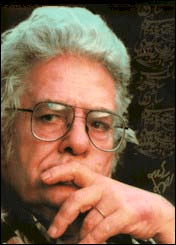
Ahmad Shamlu, the most influential Iranian poet during the decades leading to the revolution, persistently saw himself as a prophet. In a famous poem called “Ba Chashmha” (O ye with eyes), he yearns:
Oh, I wish I could,
For one moment, I wish I could
Set upon my shoulders
This innumerable mass of people,
To carry them around the bubble of the earth
That they may see with their own eyes where their sun is
Oh, I wish I could![1]
Reza Baraheni, a prominent critic, in his introduction to his book on literary criticism, Tala dar Mes (Gold in Copper), wrote that the “duty of intellectuals … was to show and alert” the people to social ills. In one of the chapters, the author enumerated four missions (resalat) for the poets:
1- Historical and temporal: The poet “must understand in what period of human history and in what era of ethnic history he lives…”
2- Geographical and spatial: “The poet must know what makes up his environment … He must understand the ground upon which he stands and in what region he makes contact with the globe.”
3- Social cognitive: “The poet … must profess the path of freedom, oppose authoritarian tyranny and charlatanism, and also avoid restricting human beings to socially or philosophically limiting schools and principles.”
4- Literary: The literary commitment of the poet consists of “knowing in what period of literary history of his people he lives…”
In his second work, Qessehnevisi (Writing Fiction, 1968), Baraheni once again devoted many pages to the issue of the “writers’ social commitment”. Considering the writer as the “true historian of his age”, which he called “the era of the night” (asr-e shab) or the era of socio-political oppression, he wrote: “The writer’s duty is to record the true history of this ‘era of the night’ and even to fight at the side of the people in their struggle.”
Most Iranian poets and writers took those words to heart. Ahmad Shamlu, in a poem published in 1954 – a year after the Anglo-American coup – called She’ri ke zendegist (Poetry which is Life), wrote:
Today
Poetry is the weapon of the people
because poets
are themselves a branch from the forest of the people
not jasmines, hyacinths in someone’s flower garden.
Today’s poet
is not a stranger
to the pains of the people.
He smiles
with the lips of the people.
He grafts people’s pains and hopes
to his own bones.
He writes poetry,
that is
He touches the wounds of the old city
that is
at night
he tells a story
of the pleasant morning…
This theme of awakening the sleeping masses and the feeling of expectancy for a great happening, a renaissance, a revolution or the appearance of a saviour was common to many poets. Nima Yushij, in his poem entitled ‘Naqus’ (the Church Bell), writes:
Rain shall pour from this drawn-out cloud
(made of our sighs)
Rain as clear as hail
And the heart-rending stories of sorrow
Shall change to stories of anger
And a time shall come when in this house of terror
Fire shall be set and spread
An iron hand shall embrace
This injured one on the scene.
Trembling with kindness
The burnt harvest that day
Shall awaken as a flower garden
And the path to the destination
Sought by the caravan of the yearning generation
Shall be within sight
And a fire from which
A frost-bitten body seeks warmth
Shall be hidden in the eye.
Unfortunately, this social commitment was nearly always aligned to the left and always dwelt on the darker aspects of life. It embraced nihilism, instead of mobilising the masses to achieve greater heights and to cure social ills. As the expectations for social and political change engendered by the Constitutional Revolution and subsequently by the period of relative freedom between Reza Shah’s abdication in 1941and the toppling of Dr Mosaddeq’s government in 1953 were shattered, and as the government resorted to greater censorship and oppression, the feeling of hope turned into despair and disillusionment. Nearly all the works produced in the 1960’s and 70s convey a feeling of doom and gloom, and images of death, night, cold, winter, walls, and prison abound.
Mehdi Akhavan-e Sales (1928-1990), a popular Persian poet, contrasts the former glory of Iran with its present miserable state, and refers to his generation as “the miserable generation”, or “the spineless generation”. In a poem entitled ‘Shush ra didam‘ (I saw Susa, 1972), he describes the glories of the ancient ruins, but instead of former grandeur, the wind blows and howls through the ancient ruins and carries the poet to convey his message to the “miserable generation”:
O spineless generation…
Spineless generation, you have been imagined
From nothing, you who are an effigy
You who cast no reflection!…
O how many days and how many nights
Have come and have gone.
Either destroy me, level me with the dust,
Sweep me away, or rebuild me,
O spineless generation…
His poem ‘Zemestan‘ (Winter) contains another bitter attack on his contemporaries, and symbolically expresses the chilly and frozen atmosphere that he experiences:
They don’t want to answer your greetings –
Heads are in collars.
Nobody wants to raise his head to answer
Or to see a friend.
Eyes can see only one step ahead
For the road is dark and slippery.
And if you extend a hand of love toward another
With reluctance he will take out a hand from under his arm
For the cold cuts hard.
The breath which comes out of the warm space of your chest
Turns into a cloud, stands like a wall before your eyes.
Akhavan-e Sales’s poem ‘Katibeh‘ (The Inscription) is perhaps his most pessimistic poem and expresses a sense of the futility of the efforts of his contemporaries to change the circumstances. ‘The Inscription’ is a narrative tale of a “tired mass of men and women, young and old” who are chained to one another next to a large slab, a mass of chained slaves abandoned to their fate somewhere in oblivion. In the midst of this nightmarish existence, however, the chained slaves hear a constant call, a voice from an unknown source, telling them:
There lies the slab, and a sage from ancients
has inscribed a secret upon it, for one and all…
Fatigued by the weight of their heavy chains and their unfortunate circumstances, they first ignore the call. But eventually the voice provokes them to action, and one night they make a joint effort to help one of their members to climb the rock to discover its secrets. A sense of elation comes over the chained slaves when the man has climbed the rock to discover its secrets. A sense of elation comes over the chained slaves when the man who has climbed the rock reads the inscription on the top:
He my secret will discover
Who will turn me from this side to the other
With a newfound spirit of optimism and sense of purpose, the slaves set to work and finally manage to accomplish the task and turn the rock from one side to the other. Once again, one among them is chosen to climb the rock to read the ultimate message:
Clearing the covered inscription from dust and clay,
He reads to himself (and we, impatient),
He wet his lips with his tongue (and we did the same)
cast a glance at us and remained silent
read again, his eyes fixed, his tongue dead
his gaze drifting over a far-away unknown
we yelled to him
“Read!” he was speechless
“Read it to us!” he stared at us in silence
after a time
he climbed down, his chain clanking
we held him up, lifeless as he was
we sat him down
he cursed our hands and his
“What did you read? huh?”
He swallowed and said faintly:
“The same was written:
He my secret will discover
Who will turn me from this side to the other
We sat
And stared at the moon and the bright night
and the night was a sickly stream.
In the works of a few other poets, one finds the same feeling of hopelessness, and yet the anticipation of something amazing happening. There was a sense of anticipation for a fundamental change in society, for the coming of a saviour, for a violent revolution that would turn everything upside down.
Forough Farrokhzad (January 5, 1935 — February 14, 1967), the most famous poetess of modern Iran, in a poem entitled “I Have Dreamed” predicts the coming of a social messiah, “someone who isn’t like anyone”. In a part of that poem we read:
I have dreamed
That someone is coming…
someone who is like no one,
not like Father,
not like Ensi,
not like Yahya
not like Mother,
and is like the person who he ought to be.
And his name is
(just as mother says in the beginning and end of her prayer)
the ‘judge of judges’
or ‘need of needs’.
Someone is coming,
someone is coming,
someone who in his heart is with us,
in his breathing is with us,
in his voice is with us,
someone whose coming
can’t be stopped
and handcuffed and thrown in jail,
Conquest of the Garden
I am not talking about timorous whispering
In the dark.
I am talking about daytime and open windows
and fresh air and a stove in which useless things burn
and land which is fertile
with a different planting
and birth and evolution and pride.
Iranian women played a prominent role in the Iranian revolution and marched and fought shoulder to shoulder with men. Indeed in many huge marches that I personally witnessed, children were made to march ahead of the crowds, followed by a long line of women, and finally followed by men. This was done partly to show that the marches were not limited to a few militant men, but were supported by entire families, and partly to shield the men from attacks by the military forces.
Farrokhzad played a leading role in encouraging Iranian women to put an end to their age-old oppression and to demand equality with men. Apart from her sexually explicit poems that for the first time in Persian literature speak about women’s sexual desires, she addressed many poems directly to women, calling on them to demand their rights. In an angry poem called ‘To My Sister,’ she wrote:
Sister, rise up after your freedom,
why are you quiet?
rise up because henceforth
you have to imbibe the blood of tyrannical men.
Seek your rights, Sister,
from those who keep you weak,
from those whose myriad tricks and schemes
keep you seated in a corner of the house.
How long will you be the object of pleasure
In the harem of men’s lust?
how long will you bow your proud head at his feet
like a benighted servant?
How long for the sake of a morsel of bread,
will you keep becoming an aged haji’s temporary wife,
seeing second and third rival wives.
oppression and cruelty, my sister, for how long?
This angry moan of yours
must surely become a clamorous scream.
you must tear apart this heavy bond
so that your life might be free.
Rise up and uproot the roots of oppression.
give comfort to your bleeding heart.
for the sake of your freedom, strive
to change the law, rise up.
In another militant poem called “Call to Arms,” she chastised Iranian women for having fallen behind other women in the world.
Only you, O Iranian woman, have remained
In bonds of wretchedness, misfortune, and cruelty;
If you want these bonds broken,
grasp the skirt of obstinacy
Do not relent because of pleasing promises,
never submit to tyranny;
become a flood of anger, hate and pain,
excise the heavy stone of cruelty.
It is your warm embracing bosom
that nurtures proud and pompous man;
it is your joyous smile that bestows
on his heart warmth and vigour.
For that person who is your creation,
to enjoy preference and superiority is shameful;
woman, take action because a world
awaits and is in tune with you.
Sleeping in a dark grave is happier for you
than this abject servitude and misfortune;
Where is that proud man? Tell him
to bow his head henceforth at your threshold.
Where is that proud man? Tell him to get up
because a woman is here rising to battle him;
her words are the truth, in which cause
she will never shed tears out of weakness.
Although many writers and poets advocated or anticipated violent change or a revolution, none of them foresaw the way that things actually turned out. All their dreams of progress and a new dawn were soon shattered and were replaced by a long nightmare. Not only did the Iranians not achieve political freedom, but they also lost the social freedoms and the economic well-being that they enjoyed under the Shah. After the Islamic Revolution, the feeling of pessimism and alienation was further compounded. Most popular Iranian writers either went into self-imposed exile or led embittered and quiet lives at home.
Nader Naderpour’s verdict after the violent revolution was:
In my homeland
After the dawn of blood
There is no sign of the sun
Ahmad Shamlu, a formidable critic of the former regime who had called on his compatriots to rise up, shortly after the victory of the revolution summed up the feeling of most of his fellow-poets in a poem called ‘Dar in Bonbast’ (In this dead-end road), in which the post-revolutionary period is described as a new and worse kind of hell:
They sniff your mouth,
Lest you’ve said, ‘I love you,’
They sniff your heart.
These are strange times, darling…
And they whip love
On the barricades…
We must hide love in the backroom of the house.
They keep the fire burning
In this crooked dead-end of the Cold
With fuel
Of songs and poems
Don’t endanger yourself
By thinking.
These are strange times, darling…
Whoever pounds on the door at night
Has come to kill the light…
We must hide light in the backroom of the house.
They are the butchers
Standing at the crossroads
With clubs and bloody cleavers.
These are strange times, darling…
And they excise the smile
From the lips, and the song from the mouth…
We must hide Joy in the backroom of the house.
The canary roasting
Over a fire of lilies and jasmines
These are strange times, darling…
Drunk and victorious
Satan feasts our mourning…
We must hide God in the backroom of the house.
The lesson that one can learn from the Islamic revolution is that what writers and poets called commitment was indeed a form of escapism. There was too much pessimism and negativity, as well as too much misplaced wishful thinking and euphoria, instead of realism and pragmatism. There was a lack of planning and a form of fatalism that things would turn out all right. There was no clear vision of what they wanted to achieve after the regime had been toppled. Indeed, any questioning of the future was frowned upon and silenced under the excuse that the most urgent task was to topple the regime.
After the revolution, there was a great deal of paranoia about the nasty designs and plots of foreigners, especially the British and the Americans. This prevented interaction with foreign countries even when it was possible, and instead resulted in confrontation. The most serious problem of the revolutionaries was to imagine that the clerics were not interested in politics and would go back to their mosques once the revolution succeeded, as indeed Ayatollah Khomeini had promised. They clearly had not read their history books closely enough to see that, whether in Islam or even in Christianity, which claims separation between religion and politics, whenever men of religion have achieved power, they have stamped their mark on politics and society and have not been willing to give up power voluntarily. This is true of the history of the influence of Zoroastrian priests on the Sassanid Empire, the role of the ulema in the Safavid dynasty, or the power of the Pope and the clergy in Medieval Christianity.
Most Iranian opposition groups are making the same mistakes today. They are united in their opposition to the present regime, but are not clear exactly what they want to achieve beyond wanting to topple the regime. Instead of planning for a real alternative to the present regime and the realistic means of achieving it, all the talk is about another violent revolution or invasion and regime change. These hopes will also be dashed like many others before them. They know what they want, but they also fear that they will never achieve it. Their feelings for freedom and emancipation was summed up by Forough Farrokhzad in her poem called “The Captive”
I want you, yet I know that never
can I embrace you to my heart’s content.
You are that clear and bright sky.
I, in this corner of the cage, am a captive bird.
Yet it is only through clear vision, toil and perseverance that the ultimate desire can be achieved. Revolutions are by nature violent and oppressive; they can never lead to freedom. In order to achieve freedom and build an ideal society, one has to start with oneself, to shun violence, to take a step at a time, but never lose sight of the ideal. In these hard times, Iranians could do well to turn to Hafiz’s immortal poetry and his promise of a new dawn:
Although the way station you want to reach
Is dangerous and the goal distant, do not
Sink into sadness; all roads have an end.
[1] I have mainly used the translations of poems given in Professor Mohammad Reza Ghanourparvar, Prophets of Doom: Literature as a Socio-Political Phenomenon in Modern Iran. Lanham, Maryland: University Press of America, 1984. In connection with the topics discussed here, also see his In a Persian Mirror: Images of the West and Westerners in Contemporary Iranian Fiction. Austin: University of Texas Press, 1993.

