

By Farhang Jahanpour
Feeling of Despair and Disappointment
Unfortunately, as the result of repeated political and social disappointments, especially after the 1953 CIA-led coup, the feeling of hope turned into despair and disillusionment. Nearly all the works produced in the 1960’s and 1970’s convey a feeling of doom and gloom and images of death, night, cold, winter, walls and prison abound in them.
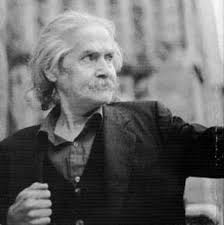
Mehdi Akhavan-e Sales (1928-1990), a popular Persian poet, contrasts the former glory of Iran with its present miserable state, and refers to his generation as “the miserable generation”, or “spineless generation”. In a poem entitled “Shush ra didam”(I saw Susa), published in 1972, he describes the glories of the ancient ruins of Susa the renowned capital of ancient Iran, but the wind blows and howls through the ancient ruins and carries the poet to convey his message to the ‘miserable generation’:
O spineless generation…
Spineless generation, you have been imagined
From nothing, you who are an effigy
You who cast no reflection! …
O how many days and how many nights
Have come and have gone.
Either destroy me, level me with the dust,
Sweep me away, or rebuild me,
O spineless generation…
His powerful poem “Zemestan” (Winter) contains another bitter attack on his contemporaries, and symbolically expresses the chilly and frozen political atmosphere that he experiences:
They don’t want to answer your greetings –
Heads are in collars.
Nobody wants to raise his head to answer
Or to see a friend.
Eyes can see only one step ahead
For the road is dark and slippery.
And if you extend a hand of love toward another
With reluctance he will take out a hand from under his arm
For the cold cuts hard.
The breath which comes out of the warm space of your chest
Turns into cloud, stands like a wall before your eyes.
Due to strict censorship, poets and writers could not openly criticize the government or the prevailing situation in Iran. So, they made use of topics, such a winter, ice, frost, walls, etc. to express their views. Although they could not be taken to task by SAVAK for having written a poem about winter, practically all their readers understood the analogy and agreed with the poet.
Akhavan-e Sales’s poem “Katibeh” (The Inscription) is perhaps his most pessimistic poem and expresses a sense of the futility of the efforts of his contemporaries to change their circumstances. “The Inscription” is a narrative tale of a “tired mass of men and women, young and old” who are chained to one another next to a large slab, a mass of chained slaves abandoned to their fate somewhere in oblivion. In the midst of this nightmarish existence, however, the chained slaves hear a constant call, a voice from an unknown source, telling them:
There lies the slab and a sage from ancients
has inscribed a secret upon it, for one and all…
Fatigued by the weight of their heavy chains and their unfortunate circumstances, they first ignore the call. But eventually the voice provokes them to action, and one night they make a joint effort to help one of their members to climb the rock to discover its secrets. A sense of elation comes over the chained slaves when the man who has climbed the rock reads the inscription on the top:
He my secret will discover
Who will turn me from this side to the other
With a new-found spirit of optimism and sense of purpose, the slaves set to work and finally manage to accomplish the task and turn the rock from one side to the other. Once again, one among them is chosen to climb the rock to read the ultimate message:
Clearing the covered inscription from dust and clay,
He reads to himself (and we, impatient),
He wet his lips with his tongue (and we did the same)
cast a glance at us and remained silent
read again, his eyes fixed, his tongue dead
his gaze drifting over a faraway unknown
we yelled to him
“Read!” he was speechless
“Read it to us!” he stared at us in silence
after a time
he climbed down, his chain clanking
we held him up, lifeless as he was
we sat him down
he cursed our hands and his
“What did you read? huh?”
He swallowed and said faintly:
“The same was written:
He my secret will discover
Who will turn me from this side to the other.”
We sat
And stared at the moon and the bright night
and the night was a sickly stream.

