

Text of Lectures given at Religion and Society Seminar at Kellogg College, Oxford, January 2011
Egyptian Religion
The Egyptian description of the beginning of creation is very similar to that in the Old Testament. It talks about void and chaos. Yet chaos was not imagined as immaterial: it was a boundless ocean, called Nun. Darkness was on the face of the deep, for there was yet no sun. But within that dark, watery abyss lay in a latent state, the primal substance out of which the world was to be formed. Also submerged somewhere within it was the demiurge who was to do the forming.
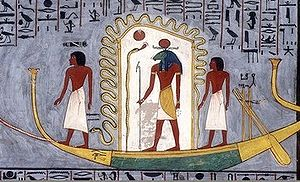
The theologians of Egypt regarded the demiurge as the Sun God Ra, and as the Earth God Ptah. All agreed that he came into full existence at a moment when the primordial hillock emerged. While at the stage of Nun he had been in a state of ‘somnolence’ or ‘inertia’, as he became aware of himself he transformed himself. Not begotten of any father, not conceived by any mother, of his own volition he gave himself a body and entered upon active existence.
Probably the greatest Egyptian religious text was what has come to be called the Book of the Dead, but more correctly is called The Book of Going Forth by the Day. It is based substantially on much earlier so-called Coffin Texts. So, in parts it is very ancient, and at the same time it represents the standard Egyptian view of the nature of death and the way to survive it.
The mythic scene, which underlay the process, consisted of the life, death and resurrection of the god Osiris. Next to Ra, the great Sun God, Osiris was undoubtedly the most important deity in the Egyptian tradition. By the Middle Kingdom period (about 2050-1750 BC) when the Book of the Dead was assembled, Osiris was the focus of much piety. The living Pharaoh was identified as Osiris’s son, as the ‘living Horus’, and a dead Pharaoh was identified as Osiris himself.
Having overcome death, Osiris becomes the presiding deity of the afterlife for the judging of the dead, which is described in some detail in the Book of the Dead. The soul of the deceased is weighed against the feather of Truth. This notion of the scale of justice became a widely used metaphor. In chapter 125 of the book there is a protestation of innocence addressed to the forty-two judges who are trying the dead, which gives a good insight into the ethics of ancient Egypt and the similarity of those ethics with the Ten Commandments.
The person protests that he “has not stolen, or been covetous, or killed a human being, or damaged a grain-measure, or told lies, or trespassed, or practised usury, or gossiped, or committed adultery, or had sex with a boy, or been abusive of a king, and so on.”
In other words: Thou shalt not kill, thou shalt not steal, thou shalt not bear false witness, thou shalt not commit adultery, and so on.
Many ancient Egyptian texts influenced some parts of the Old Testament, including the Psalms. One of the most famous of all the parallels is the hymn of Ikhnaton to the Sun God.
Thou appearest in beauty on the horizon of heaven
Thou living Sun, the first to live.
Thou risest on the eastern horizon,
Suffusing all lands with thy beauty.
Glorious art thou, and mighty,
(290)
Parallels to Psalms in Near Eastern Literature 291
Shining on high o’er the lands;
Thy rays encircle the countries.
To the farthest limit of all thy creation;
Thou are Re reaching out to their uttermost border,
Subduing them for thy beloved son.
Far off art thou, yet thy beams touch the earth;
Thou art seen of man, but thy pathway they know not.
Thou settest in the western horizon,
And the earth becomes dark as death.
Men rest in their chambers,
With head enveloped, no eye sees aught.
Should their goods be taken that lie under their heads,
They would fail to perceive it.
The lion comes forth from his lair,
And the serpents bite.
Darkness rules, and the earth is still,
For he that made all rests in the horizon.
When the earth becomes light, thou risest on the horizon,
And, as the sun, dost illumine the day;
The darkness flees when thy rays thou dost spread;
The two lands rejoice,
They awake, stand up on their feet,
When thou hast raised them up;
They cleanse their bodies and clothe themselves,
Their arms give praise, for thou hast appeared.
The whole earth goeth forth to labour.
The cattle are satisfied with grass;
The trees and the herbs grow green,
The birds from their nests fly forth,
With their wings they offer thee praise.
The beasts spring up on their feet,
The birds and every flying thing
Live, when thou art risen.
There go the ships, down-stream, up-stream,
All paths are free, since thou are arisen.
The fish in the sea leap up before thee,
For thy rays penetrate to the ocean’s depths.[1]
The similarities between this prayer and Psalm 13 are clear,
and there are many other similar examples. For instance, the Hymn to Ramman,
the weather God, dated about the third millennium B.C., reminds one of Psalm 29
concerning the voice of the Lord in the storm.
[1] W. O. E. Oesterley, A Fresh Approach to the Psalms (New York: Scribner, 1937) pp. 16, 17.

