


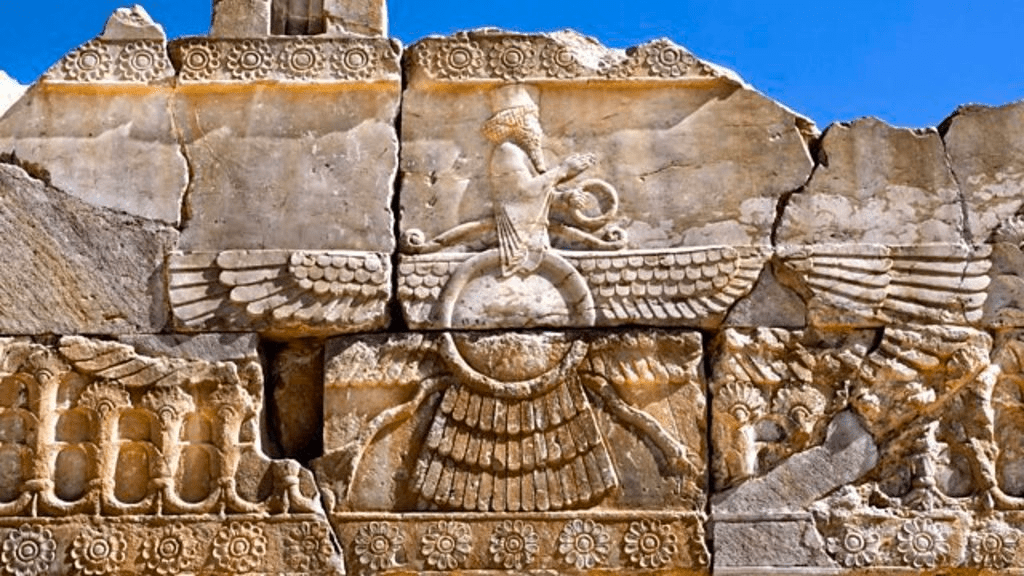
Winged sun, symbol of Zoroastrianism
Zoroastrian influences on Judaism
The Zoroastrian religion influenced many other religions, including Judaism, Christianity and Islam. In 586 BC, the Babylonian Emperor Nebuchadnezzar conquered Jerusalem, destroyed the Jewish Temple and carried off a large number of Jews into exile. This “Babylonian captivity” lasted almost fifty years. In 539 BC, the Achaemenid King Cyrus conquered Babylon, and in 538, Cyrus issued a decree stating that the Jews would be allowed to return to their homeland. Not only were the exiles released, but Cyrus and Darius also supported the rebuilding of the Temple in Jerusalem. Due to his great services to the Jews, Cyrus was praised more than any other non-Jewish historical figure in the Bible.
Cyrus’ policy was motivated partly by his religious tolerance, as he also encouraged other people to maintain their own religions. However, many Jews did not go back to their homeland but stayed under the Persian Empire, and some of them achieved high positions in the service of the imperial court. It was during this period that the most significant contacts took place between the Jewish and the Persian cultures. It is clear in the Bible that Jewish thinking changed after the Exile. One can see the Persian influence in the Hebrew texts that were written after those contacts.
Fourteen books of the Hebrew Bible or the Old Testament have either directly dealt with an event that happened in Iran or have references to Iran. There are seven books out of the 14, which are in the form of memoirs of the Jews in the courts of the Medes and the Achaemenids, while seven others refer to events which happened in Iran.
In the first category, one can mention the Book of Esther, which is about the history of a Jewish girl who is married to Xerxes I (died 465 BC), whose name is given as Ahasuerus in the Bible. She prevents the massacre of the Jews by the Agagite Haman with the help of her uncle Mordecai and the support of her husband, the Persian king. In Jeremiah, we have a reference to the Medes as God’s sword against the enemies of Israel. Ezekiel is about the period of exile in Babylon, which ended with Cyrus’s conquest of Babylon. In Ezra, there is the story of the rebuilding of the temple with the assistance of Cyrus and Darius.
In Isaiah, there are many complementary references to Cyrus and God’s support for him. He is referred to as the Lord’s ‘anointed’ and ‘messiah’. Cyrus is my shepherd and will accomplish all that I please; he will say of Jerusalem, “Let it be rebuilt,” and of the temple, “Let its foundations be laid.”’[1]
The book of Daniel is about the period of his service at the court of Darius and the forecasts that he made for that king. One can still visit the beautiful tomb of Daniel in Susa and of Esther and Mordechai in Hamadan, which are places of attraction and even pilgrimage by Muslims and Jews alike. The book of Nehemiah is about the story of the cupbearer and confidante of Artaxerxes I of Persia. In Zechariah, we again have the story of the rebuilding of the Temple on the orders of Darius.
Many scholars believe that the Jewish belief in the immortality of the soul was borrowed from or at least influenced by the religion of Zoroaster. In the earliest books of the Old Testament, before the Jews came into close contact with the Persians, there is no explicit mention of the immortality of the soul. “It is well known,” says F. Max Müller, “that those doctrines were entirely, or almost entirely, absent from the oldest phase of religion among the Jews.” (F. Max Müller, Theosophy or Psychological Religion: The Gifford Lectures Delivered before the University of Glasgow in 1892 (Cambridge University Press, 1893), p 47)
One of the most visible changes after the Exile is the emergence of a Jewish idea of Heaven, Hell, and the afterlife. Before the Exile, Jews believed that the souls of the dead went to a dull, Hades-like place of darkness called “She’ol”, very similar to the Egyptian concept of the netherworld or Abyss. However, after the Exile, the idea of a moralised afterlife, with heavenly rewards for the good and hellish punishment for the evil, appeared in Judaism. One of the words for “heaven” in the Bible is Paradise, and this word that also found its way into the Koran in the form of Ferdows, comes from the ancient Persian word Paradise (pairi-daeza, or enclosed garden). This moral view of the afterlife is characteristic of Zoroastrian teaching from its very beginning in the Gathas.
It is also believed that the Jewish idea of a coming Saviour or Messiah was also borrowed from the Zoroastrian idea of a Saviour, Saoshyant, who brings about a final renovation of the world. Saoshyant is not only a Zoroastrian but a universal saviour who will make the world perfect and peaceful and will put an end to evil and Druj (lie, which is one of the worst Zoroastrian sins).[2] In the book of Second Isaiah, written during the Exile, the prophet speaks of a Saviour who would come to rescue the Jewish people: a benefactor, “anointed” (the word “messiah” means the “anointed one”) by God to fulfil his role. In many verses, the text in fact identifies Cyrus the liberator as the anointed one or messiah, too.
The Zoroastrian tradition included stories about the symbolism of fire, light and darkness. The eternal fire had to be kept burning in all Zoroastrian temples, a tradition that continues to the present time. In the Second Book of the Maccabees (which dates from about 124 BC and is one of the latest books of the Old Testament), there is a story about how the Jewish altar fire was restored to the Temple after the Captivity. Jewish Temple practice required a continuously burning flame at the altar. The Bible itself gives the clue to its Persian origins: “When the matter (restoring the fire) became known and the king of the Persians heard that in the place where the exiled priests had hidden the fire a liquid had appeared, with which Nehemiah and his people had purified the materials of the sacrifice, the king, after verifying the facts, had the place enclosed and pronounced sacred.”[3]
Apart from the direct contact that was established between the Jews and the Persians at the time of Cyrus the Great, later on, the cult of Mithra (from the Persian root Mehr, which means both sun and love, so the Sun God or the God of Love), which was developed out of Zoroastrianism, exerted some influence on Judaism and Christianity. A great scholar of ancient Iran, the late Professor Roman Ghirshman writes: “Achaemenian religion, passing by the north-west, penetrated into Cappadocia, and then into Cilicia, where the pirates adopted the cult of Mithra, which in the Roman army later became the predominant cult.”[4]
Mithra’s Birth and Christmas
According to old traditions, Mithra was born on 21 December, the winter solstice, which is still celebrated in Iran as Shab-e Yalda, or the Night of Nativity, when people make bonfires and jump over them, leaving behind the longest night of the year and looking forward to the gradual approach of spring. This date was also celebrated in Roman territories as Mithra’s birthday. When Christianity spread to Rome, early Christians took that day and celebrated it as the birth of Jesus.
In the 4th century A.D., because of some errors in counting the leap year, the birthday of Mithra shifted to the 25th of December and was established as such. Hence, in 274 A.D., the Roman emperor Aurelius declared December 25th as the birthday of the “unconquered sun”. Until that time, the birthday of Jesus was traditionally celebrated on 6th January, as it is still done by the Greek Orthodox and Armenian churches. After almost destroying the temple of Mithra in Rome in 376 AD, Pope Leo proclaimed the 25th of December as Christ’s birthday instead of the 6th of January.
Connections between Christianity and Iran
There was also a close connection between Christianity and Iran. The story of the three Magi or Zoroastrian priests visiting the newborn Jesus is well-known. It is not, however, generally realised that Iran also played a leading role in the spread of Christianity. Many Christian churches were established in Iran when the Christians were still savagely persecuted by the Roman Empire.[5]
Christianity had spread to Persia towards the end of the first century AD, and had organised churches and bishops. The Chronicle of Arbil, written by Mashiha Zakha early in the sixth century, provides the biography of 20 leading bishops of the Christian church in Persia, the first of whom lived in 99 AD. An Iranian bishop called Yuhanna or John represented the Persian church in the first Council of Nicaea, which was held in 325. From the letters written by the Christian patriarch in Persia, a man called Ishuyab, to various Christian churches in 650 and 651 AD, we learn that the Christian church in Persia had a patriarch, two archbishops and at least 38 bishops at the time of the Arab invasion.[6]
Persian missionaries were the first to take Christianity to India and China. For instance, in 635 AD, the Persian church sent a team of missionaries led by an Iranian monk called A-lo-pen to the Chinese capital Ch’ang. The names of two other Iranian missionaries, Mihrdad and Gushansab, are given in an inscription in Hsi-an in 781 AD.[7]
According to legend, the first Persian to visit the British Isles was a certain bishop of the Nestorian Church named Ivon. In the sixth century, when the Nestorians were sending missionaries to India and China, Ivon went in the opposite direction, to England, and resided here till his death. When a ploughman in the county of Huntingdon turned up his bones in the year 1001, the bishop straightaway became a saint and gave his name to the Church of St Ives, built on the spot.[8]
Another clue to the influence of Zoroastrianism on early Christianity comes with the Feast of the Epiphany, or the “Feast of the Three Holy Kings”, commemorating the manifestation of Christ to the Gentiles, the Magi. The Magi, the title of Zoroastrian clergy that was Latinized as Magoi, which is also the origin of the word magic, were known as learned people, especially experts in astronomy and astrology. In early Christian art, the Magi usually wear Persian clothes (e.g., the Catacombs of Priscilla in Rome, 2nd century AD). The Magi saw a bright star in the sky and set out to greet the infant Christ, offering him gifts of gold, frankincense and myrrh.
As we can see, there are many examples of Zoroastrian influences on both Judaism and Christianity. As Professor Foltz points out:
“Much of what has been described in this chapter as the ‘basics’ of Zoroastrianism will no doubt seem familiar to many readers. What may not be apparent is that these widespread beliefs and practices appeared in Zoroastrianism first, and only later in other religions. The concept of an all-powerful Creator god who is purely good, the personification of evil in an opposing being, the resurrection of the body after death, the judgement of the dead based on their deeds while living, the existence of a heavenly paradise for the good and a hell of damnation for the evil, the expectation of a savior and a final cataclysmic battle in which good will ultimately triumph, as well as a universe populated by angels and demons, are all ideas that other religions acquired either directly or indirectly from Zoroastrianism.
Other notions, such as the possibility of an individual as opposed to a communal relationship to the divine, the superiority of one faith over all others, the emphasis on right belief and not just practice, and a professed adherence not only to a single deity but also to a particular prophet, may have originated with Zoroaster as well. For the first time, we hear of a religion being actively spread by missionaries, who are sometimes persecuted or killed for their efforts.”[9]
Footnotes:
[1] Isaiah 44-45
[2] Yasht 19: 88-96
[3] Second Book of Maccabees, 1:33-34
[4] Ghirshman, Roman, Iran from the Earliest Times to the Islamic Conquest, translated into Persian by Mohammad Moein (Tehran, Elmi Farhangi Press, 1955) p. 320.
[5] For information about the history of early Christian churches in Iran, see: Bishop H. B. Dehqani-Tafti, Christ and Christianity among the Iranians [in Persian], (London: Sohrab Books, 1992), vol. I, pp. 13-28.
[6] For further information about the history of early Christian churches in Iran, see: Bishop H. B. Dehqani-Tafti, Christ and Christianity among the Iranians [Persian title: Masih va masihiyyat nazd-i Iraniyan], (London: Sohrab Books 1992) vol. I, pp. 13-28.
[7] Ibid.
[8] John D. Yohannan, Persian Poetry in England and America: A 200-Year History (Caravan Books, New York, 1977), x.
[9] Richard C. Foltz, Spirituality in the Land of the Noble: How Iran Shaped the World’s Religions, (Oneworld, 2004), pp. 40-41

