

First Published by “Iranian Studies”, Vol 18, No. 2/4, Sociology of the Iranian Writer, Cambridge University Press (Spring-Autumn, 1985), pp. 449-458
Although there were many political, economic and religious factors behind the Iranian revolution, one should not ignore the sociological, intellectual and literary factors that contributed to a feeling of alienation among Iranians, especially the educated young people who formed the backbone of the revolution. Iranian writers had taken to heart the advice of the Italian Marxist philosopher and politician Antonio Gramsci and his writings on “cultural hegemony.”
Gramsci argued that ideological wins precede political wins. He argued that the Marxists were failing because they had not managed to gain the ideological and cultural upper hand. He believed that the main requirement of lasting political success was to change the ideological and intellectual framework of society, and the best way to do that would be to slowly change people’s ideas, values, culture, and worldview.
Iranian writers and intellectuals were determined not to repeat that mistake, and they believed that their main mission was to inform and awaken the public, change their religious and ideological orientation, and prepare them for the dawn of a new era. There were a large number of Iranian intellectuals with that outlook. However, a few names stand out in the group of leftist-religious intellectuals who acted as the main opponents of the monarchical regime and as the ideologues of the revolutionary movement. Among them, Jalal Al-e Ahmad and Ali Shariati occupy a distinct position.
Al-e Ahmad and Shariati were perhaps the two most influential writers in Iran whose ideas had a great impact upon the young university-educated people and who paved the way for the emergence and victory of the Islamic revolution. Both Al-e Ahmad and Shariati came from clerical backgrounds, turned towards leftist ideologies and created a synthesis between the two.
A great deal has been written about both authors, and my aim is not to provide a comprehensive synopsis or analysis of their work but simply to highlight some of their main ideas and show some clear contradictions in their outlook. Also, I do not intend to belittle their great contribution to Iran’s intellectual life during the reign of the Shah, but I simply wish to point out their oscillation between the past and the present, and between religion and leftist ideologies, and how their rather confused and unorthodox ideas shaped the minds of the younger generation.
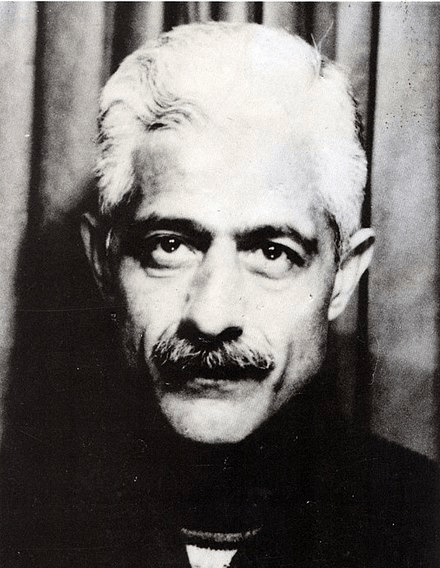
Jalal Al-e Ahmad (1923-1969)
Al-e Ahmad was primarily a novelist, a short-story writer, translator and philosopher, but through his writings that combined Marxist ideas and seemingly progressive religious ideas, and due to his denunciation of the West he gained great popularity among university-educated students, and had a profound influence on young people in Iran who were looking for an answer to political, religious and sociological issues that they faced.
Al-e Ahmad’s grandfather, father, older brother, two brothers-in-law, and a nephew were all clerics. Ayatollah Mahmud Taleqani, the famous revolutionary cleric from Tehran who played a very prominent role immediately before and after the Islamic revolution, was Al-e Ahmad’s cousin.
In 1943, Al-e Ahmad was sent by his father to Najaf as a talabeh or seminary student to be trained as a mullah under the supervision of his older brother. After a short stay in Najaf in 1955, he abandoned his religious studies and returned to Iran, in his own words, “Fed up and stifled, and turning my back on both my father and my brother. Because on that journey, I had seen a trap in the form of a mantle and a cloak.”[1]
After abandoning his religious studies, he enrolled at Tehran Teaching College, and in 1946, he graduated with an M.A. in Persian literature and became a school teacher. He pursued his secular education and started a doctoral programme in Persian literature at Tehran University, but left in 1951 before he had defended his dissertation. Meanwhile, in 1950, he married Simin Daneshvar, a well-known Persian novelist and translator and lecturer at Tehran University. The couple had no children, and both of them devoted themselves to their writings and political activities.
Having rebelled against his religious background, Al-e Ahmad threw himself heart and soul into political activities and became an active member of the communist Tudeh Party of Iran. Within a year, he was a member of the Tehran provincial committee and the co-editor of a party newspaper. In 1948, he was a member of the group which, under the leadership of Khalil Maleki, broke away from the mainline Tudeh Party and set up a new group called enshe’ab (separation or breakaway), which was still firmly within the framework of Marxism-Leninism.
On the afternoon of January 17, 1948, Moscow Radio openly attacked the new group, charging its members with treachery. Instead of remaining faithful to their principles, Al-e Ahmad and most of those who had signed the declaration of enshe’ab immediately signed a new statement announcing the dissolution of the new party. Al-e Ahmad joined several other leftist parties, but after the 1953 coup, he issued a “renunciation”, saying that he had ceased all his political activities and did not belong to any political party.
However, the influence of his twin early affiliations to religious orthodoxy and to communism remained with him throughout his life. His fundamentalist background instinctively set him against change and modernism, and his Tudeh background made him doubly hostile towards any modernisation associated with imported ideas from the West.
Jalal Al-e Ahmad’s famous book, Gharbzadegi, became the most important manifesto of all those who resented the excessive influence of the West in Iran.[2] The word Gharbzadegi was coined by Ahmad Fardid, a professor of philosophy at the University of Tehran and Al-e Ahmad’s friend, but it was due to Al-e Ahmad that the term achieved such fame and influence. Gharbzadegi, which has been translated as “disease of Westernism”, ‘Westitis’, ‘Westernosis’, ‘Westomania’, ‘Weststrickenness’, ‘Weststruckedness’, ‘plagued by the West’, or “Westoxication”, starts with the following words:
“I speak of being afflicted with ‘westitis’ the way I would speak of being afflicted with cholera. If this is not palatable, let us say it is akin to being stricken by heat or by cold. But it is not either. It is something more on the order of being attacked by a tongue worm. Have you ever seen how wheat rots? From within. The husk remains whole, but it is only an empty shell like the discarded chrysalis of a butterfly hanging from a tree. In any case, we are dealing with a sickness, a disease imported from abroad, and developed in an environment receptive to it.” [3]
He defines the West as the developed or industrialised countries, which “with the aid of machines, are capable of converting raw materials into something more complex and marketing it in the form of manufactured goods. These raw materials are not just iron ore or oil or gut or cotton or tragacanth. They are also myths, principles of belief, music, and transcendental realities.” [4]
The problem with Al-e Ahmad’s assessment of the West is that although he describes Western superiority and domination to be the result of its mastery of the “machine”, he is not sure whether it is a good thing for Iranians to master the machine like the Westerners or not. On the one hand, he seems to suggest that in order to be freed from Western domination, it is essential for Iranians to become industrialised. He writes: “As long as we are solely consumers, as long as we do not manufacture machines, we shall be afflicted with the West.” On the other hand, he believes that the mastery of the machine will also lead to being plagued by machines: “And the ironic part is that as soon as we are able to make machines, we shall become machine-stricken! We shall be like people of the West whose cries about self-willed technology and machines are heard everywhere.” [5] He refers to La France contre les Robots by George Bernanos[6] as an example of the Western disenchantment with machines.
At times, he seems to forget that Western technological development is only the product of the past few centuries, and his “Western plague” becomes synonymous with Christianity. He complains: “How can we view these twelve centuries of struggle and competition as anything but a struggle between Islam and Christianity?”[7]
Yet, at other times, in a complete distortion of the meaning of the words, of the East and the West, the North and the South, Islam and Christianity and the present time and the time of Prophet Muhammad, he goes on to say:
“We know that, in his youth, the Prophet traded with Syria and that he spoke with a certain monk there. And was there ever any easier way to proselytise than with the cry ‘Say: There is no God but Allah and ye shall prosper’? Moreover, in the final analysis, was not our turning towards Islam a turning towards the West? We will be able to provide a precise answer to this question once we have learned what incredible injustices were visited on people as a result of the ossified customs of the Sasanians.” [8]
In this passage, he mixes his denunciation of the West with the negative influence of Islam on Iran and with the ossified religious customs of the Sasanians that allegedly led to the acceptance of Islam by Iranians. This intellectual and historical confusion is not untypical of his other works.
However, despite these inconsistencies, maybe even because of this rejection of whatever was foreign and alien, whether Islam or Christianity, the Crusades or European civilisation and modern machines, Al-e Ahmad struck a sympathetic chord in young people who were fed up with the loss of their identity and with a veneer of Westernisation, and were searching for native authenticity. Despite the general mixing of praise and blame for Islam and strongly criticising the behaviour of the Safavid clergy who, according to Al-e Ahmad, were responsible for Iran’s subsequent backwardness, the major message which can be deducted from Gharbzadegi is a kind of return to “genuine, progressive” Islam, whatever that might be.
In his later writings, such as Dar Khedmat va Khiyanat-e Rowshanfekran (On the Services and Treasonable Activities of Intellectuals), Al-e Ahmad advocated an alliance between intellectuals and the clergy against the Pahlavi regime. In 1962, when Jalal’s father died, Ayatollah Ruhollah Khomeini, the future leader of the Islamic revolution, arranged a memorial service for him, after which the two men met, and Khomeini spoke approvingly of Al-e Ahmad’s Gharbzadegi. In another meeting between the two men in Qom in Esfand 1341 (February/March 1963), Al-e Ahmad suggested an alliance between the intellectuals and the mullahs against the Shah. Shaking hands with Khomeini, Al-e Ahmad is reputed to have stated: “We will defeat the government if we continue holding hands.”[9]
A year later, Al-e Ahmad went on a pilgrimage to Mecca, and Khasi dar Miqat (Lost in the Crowd) is the account of that journey. The same love-hate relationship and an attitude of reverence and revulsion can be seen in his interesting account of his pilgrimage to Mecca, in which he talks approvingly of the unity which exists between the pilgrims from all over the world who have come with sincerity and intense faith to perform their religious duty of pilgrimage.
At the same time, he criticises what he describes as the coarseness and crudeness of the crowds and speaks of the arrangements made for taking care of the pilgrims as “mechanised barbarism.”[10] He was one of the first persons to say that the control of Hajj ceremonies had to be taken out of the hands of the Saudi authorities and be given to an international organisation composed of Muslims from all over the world, an idea which found favour with many Islamic activists in Iran during the first few years after the victory of the Islamic revolution when there were numerous clashes between Iranian pilgrims and Saudi authorities.
Al-e Ahmad’s concept of Gharbzadegi proved very popular, especially to impressionable young people not closely familiar with the West and its scientific, cultural, and intellectual background. Later on, Ayatollah Khomeini adopted Al-e Ahmad’s terminology to give vent to his anti-Western ideas. In one of his messages to the pilgrims leaving for the Hajj pilgrimage in Mecca, Khomeini wrote: “The poisonous culture of imperialism is penetrating to the depths of towns and villages throughout the Muslim world, displacing the culture of the Qur’an, recruiting our youth en masse to the service of foreigners and imperialists…”[11]
However, had Al-e Ahmad been alive during the heyday of the Islamic Republic he would have been one of the first to be criticised for insulting Islamic sanctities and to be denounced of counter-revolutionary activities and as someone who had been afflicted by “decadent” Western ideas in the way that he referred to religious seminaries, to the sacred issue of Haj pilgrimage and above all to equate turning to Islam and the Prophet’s teachings with Westoxication.
[1] “Gozaresh az Khuzestan, Karnameh-ye Seh Saleh,” Ketab-e Zaman, n.d., p. 67. Quoted in Robert Wells, Jalal Al-e Ahmad: Writer and Political Activist (PhD thesis, University of Edinburgh, May 1983), p. 67.
[2] For an English translation of this book, see: Jalal Al-e Ahmad, Plagued by the West, translated by Paul Sprachman (Bibliotheca Persica, Caravan Books, New York, 1982). All references to this book will be to this translation. There are at least two other English translations of this work.
[3] Ibid, P 3.
[4] Ibid, p 3.
[5] Ibid, p 7.
[6] Paris: Pilon, 1970.
[7] Ibid, p 9.
[8] Ibid, P 17
[9] Quoted in Robert Wells, Jalal al-e Ahmad: Writer and Political Activist (PhD Thesis, University of Edinburgh, May 1983), p. 124.
[10] This book has been translated into English as Lost in the Crowd, translated by John Green with Ahmad Alizadeh and Farzin Yazdanfar (Washington, DC: Three Continents Press, 1985).
[11] “Message to the Pilgrims”, Islam and Revolution: Writings and Declarations of Imam Khomeini, (1981), p. 195

