

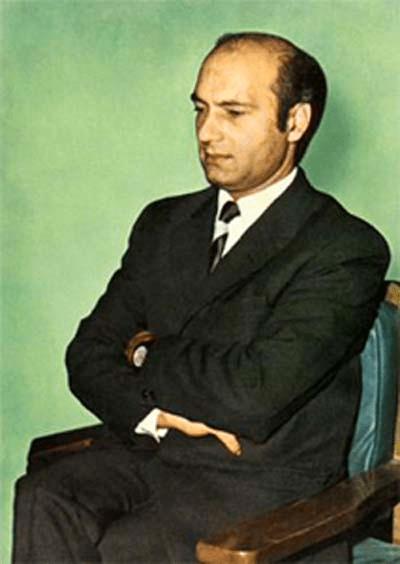
Like his fellow religious intellectual Al-e Ahmad, Ali Shariati also came from a religious family, and like Al-e Ahmad he also played a major role in paving the way for the Islamic revolution. He has been described as one of the most influential Iranian intellectuals of the 20th century, and is known as the “ideologue of the Islamic revolution” and the ideological father of the Islamic Republic.[1]
Before Ayatollah Khomeini’s return to Iran, Shariati was by far the most influential Islamic thinker who was instrumental in the fall of the Pahlavi dynasty. His life reflected the social convulsions and the leftist and Islamic influences that put an end to the Shah’s attempts to push Iran from a traditional society towards a Western-defined state of modernity.
Ayatollah Mahmud Taleqani, the most popular Iranian cleric next to Khomeini in the early days of the revolution, credited Shariati with having created a new school of thought. He wrote: “Shariati created a new maktab. It was he who drew the youth of Iran into the revolutionary movement.”[2] Ayatollah Mohammad Beheshti, the most powerful revolutionary next to Khomeini, admitted that Shariati was even more influential among the youth than Khomeini. He wrote: “The works of Shariati were essential for the revolution. Those of Imam Khomeini were not exactly suitable for winning over the younger generation.”[3]
Shariati was born in Kahak, a small village in Mazinan, a suburb of Sabzevar in north-eastern Iran. His father, Mohammad Taqi, was a cleric who had set aside his turban but continued as an activist Islamic scholar and a member of Dr Mosaddeq’s National Front. He advocated a “progressive Islam” that could compete against the seductive materialism of the Tudeh Party. In 1947, he founded a “Centre for the Propagation of Islamic Truths” in Mashhad, which became a popular venue for young religious students.
His non-religious studies started with a course at Teachers’ Training College in Mashhad, and after graduation, he was recruited as a high-school teacher. During his studies at the college, he was exposed to some aspects of Western philosophical and political thought. He elucidated those ideas in a series of articles that he wrote for the daily Khorasan newspaper in Mashhad. In addition to articles on some Western philosophers and thinkers, he also wrote many articles on modernist Islamic thinkers, such as Jamal al-Din Afghani (Asadabadi) and Muhammad Iqbal Lahuri. In the early 50s, he also translated a book on Abu Zarr al-Ghifari, entitled Abu Zarr: khodaparast-e sosiyalist (Abu Zarr: A God-fearing Socialist) by an Egyptian novelist Abdol Hamid Jawdat. Abu Zarr was a companion of the Prophet who remained faithful to Imam Ali and who is famous among the Shi’is for his opposition to the opulence of the Umayyad Caliph Mu’awiyya, who fought against Ali.
Although the book was in reality a work of fiction based to some extent on Abu Zarr’s life, nevertheless, to Shariati, he represented a faithful Shi’i, and he described Abu Zarr as the “first Islamic Socialist”. The young Shariati also became a member of a political grouping initially known as the Movement of God-Worshipping Socialists, which later changed its name to The League for the Freedom of the Iranian People.[4]
At the school where he was teaching, he founded the Islamic Students Association, which led to his arrest following a demonstration in support of Mosaddeq and the National Front. After a series of other arrests and reversals at school, he managed to get an Iranian government scholarship to study in France and continued his graduate studies at the Sorbonne in Paris, receiving a PhD. Degree in Sociology in 1964. A good friend of mine shared a flat with Shariati in Paris for several years, and he describes him as a very quiet, introverted and studious student with very little interest in Paris’s attractions, devoting all his time to his studies and his political activities. In Paris, he also met some of the leading intellectuals, including Jean-Paul Sartre.
In Paris, he threw himself into political activities and collaborated with the Algerian National Liberation Front (FLN) and other revolutionary causes. He was arrested in Paris on 17 January 1961 while taking part in a demonstration in honour of the Congolese politician and independence leader Patrice Lumumba, who had been executed by a firing squad under Mobutu.
The same year, he also joined Sadegh Qotbzadeh, Ebrahim Yazdi, and Mostafa Chamran in founding the Freedom Movement of Iran abroad. Those three formed very close relations with Ayatollah Khomeini and achieved high office shortly after the revolution. Qotbzadeh, who served as the first head of the broadcasting organisation after the revolution, was later accused of plotting to bomb Ayatollah Khomeini’s residence and was executed. Ebrahim Yazdi became the leader of the Freedom Movement after the death of its founder Mehdi Bazargan, the first prime minister in the interim government formed by Khomeini after returning to Iran, but the movement was banned by Khomeini, and Yazdi suffered a great deal as an opposition leader. Mostafa Chamran, a physicist and politician, became the first defence minister in the post-revolutionary government and was killed during the Iran-Iraq war.
After returning to Iran in 1964, Shariati was arrested at the border and jailed for six months for his anti-regime activities in Paris. After his release from prison, he was recruited as a lecturer at the University of Mashhad. Later on, he left Mashhad for Tehran and began lecturing at Hosseiniyeh Ershad, which was an institute attracting many young people who were interested in non-traditional Islamic learning. It organised lectures on Islamic culture, history and religious studies. Shariati was a great orator, and his lectures achieved huge popularity. The lectures that he delivered to the packed gatherings at Hosseiniyeh Ershad were recorded on cassettes, the new technological tool that was being used in the service of the revolution, and distributed far and wide. Later on, they were published in 20 book-length volumes. When I was at the University of Isfahan, practically all the students had the cassettes of Shariati’s mesmerising speeches and listened to them, and passed on many of them to me to listen to.
His continued popularity aroused the government’s interest, and he and several students at the institute were arrested but released shortly afterwards due to public outcry. He was allowed to leave Iran for England for medical treatment and died in a Southampton hospital while being treated for a heart condition. His death was immediately described by his followers in Iran as “mysterious”, but again, I knew someone who used to visit him in the hospital and who assured me that he died of a fatal heart attack. He is buried at the Shi’a shrine of Sayyidah Zaynab, Imam Husayn’s sister, in Damascus.
Caught between the two extremes, blind imitation of the West and blind allegiance to Islam, most young educated Iranians were looking for a way to reconcile the two. They wanted to create a native form of modernism and accommodate it to Islam, while those with a more religious bend wanted to make Islam compatible with modernism in the form of a “progressive Islam”. Shariati performed that task and interpreted Islam, even if it meant distorting many historical facts, to make it attractive to young people and compatible with a revolutionary message.
As Professor Ali Rahnema explains in his scholarly work on Shariati,
“For Iranians, the genuine need for modernity and the struggle to protect Islam became a contradictory dilemma. Modernity was westward-looking, change-oriented and anti-traditional, while Islam was the formal cornerstone of society’s established traditional values, a deeply valued reliable cultural heritage. For a majority of intellectuals, Islam and modernity presented trade-offs. The choice of a path to modernity – economic, political and ideological – posed itself only after modernity was pursued at the cost of religion. This clash of powerful contradictory ideas left a few intellectuals – a third group who sought a union of opposites – in a limbo of uncertainty. Ali Shari’ati was of this group.” [5]
Shariati achieved this by reinterpreting some of the main Islamic principles and aspects of Islamic history in a fresh and Marxist-oriented way. It does not mean that he was a Marxist. In fact, he saw his main mission to be the person who would present an interpretation of Islam that could compete with the prevalent Marxist ideology. It was Marxism expressed in Islamic terminology, or rather, Islam distorted in such a way that it could be made compatible with scientific communism, but with God thrown in. During his early political life, he toyed with different forms of leftist ideologies to finally drop them in favour of Islam. In some ways, his journey was the opposite of the one undertaken by Al-e Ahmad.
In order to achieve a blend of Marxism and Islam, he reinterpreted Marx’s ideas in a very unconventional way, in the same way that he put forward a very unconventional interpretation of Islam. In his book Marxism and Other Western Fallacies, he distinguished between three different periods in Marx’s life. According to Shariati, the first Marx had been a militant atheist who failed to see any redeeming features in religion and saw the world in crude economic terms. The second Marx was a sophisticated sociologist who studied how the rulers oppressed the ruled. The third Marx, according to Shariati, had made politically expedient compromises. For Shariati, only the second Marx had anything to teach young Muslims.
Shariati had an incredible knack for coining new terms with similar-sounding words to describe his unusual interpretations of Islam, particularly of Shi’ism. One of his favourite classifications was “zar, zur, tazvir” (namely gold, force and hypocrisy) to describe excessive wealth and exploitation, force or despotism, and hypocrisy or making use of religion for personal gain. He further elaborated those terms as representing estethmar (colonialism), este’mar (imperialism) and a third term that he coined estehmar (literally donkeyfication or stupefaction), namely making use of religion in the service of fooling the people and gaining power, best represented by the clerics in most Islamic societies. So, the reactionary mullahs joined despots and colonialists as the enemies of the people.
In order to make a distinction between that form of Islam or Shi’ism and a modern and revolutionary Shi’ism, he split the history of Shi’ism into Shi’a Alawi and Shi’a Safavi (the Alawid Shi’ism and the Safavid Shi’ism). According to him, the Alawid Shi’ism (as true followers of Imam Ali) represented struggle, sacrifice, blood and martyrdom, while the Safavid Shi’ism (the kind of dogmatic Shi’ism propagated under the Safavid dynasty) represented submission, passive acceptance of force, compromise and self-interest. A revolutionary society, towards which the Iranian society was moving, demanded chivalry, honour, sacrifice and high ideals, and the rejection of what he called “court clerics” who had sold their souls for the sake of worldly gains and getting close to power.
The Safavid dynasty, which had made Shi’ism the official religion of Iran, relied heavily on “court clerics” for elaborating the tenets of Shi’ism in a way that suited them and that portrayed the kings as “the shadow of God on earth”. By doing so, many clerical families, notably clerics such as Mir Damad, Mulla Sadra, Mohammad Taqi Majlesi and Mohammad Baqer Majlesi, achieved great wealth and prominence in the service of the kings.
However, in portraying the Safavid Shi’ism as being the opposite of the Alawid Shi’ism, Shariati seems to have forgotten that the Safavids initially came from a Sunni Sufi sect and were revolutionaries who overturned the ruling establishment and made use of Shi’ism merely as a weapon against the Sunni Ottomans. On the other hand, most Imams were not involved in politics and got along with the ruling governments. Except for Imam Husayn, who was martyred in Karbala while fighting against the Umayyad ruler Yazid, practically all other Shi’a imams accepted the rule of the dominant Umayyads and, later on, the Abbasids and did not challenge them.
Even in the case of Imam Husayn, from what we know about his life, it is clear that he was not simply a rebel who deliberately risked his life for the sake of his principles. He continued to abide by the treaty that his older brother Imam Hasan had signed with Mu’awiyya for as long as Mu’awiyya was alive. However, after Mu’awiyya’s death, Imam Husayn was invited by the people of Kufa to go to that city and act as their leader. He set off for Kufa, but before reaching it, he was met by the forces of the new Caliph Yazid.
According to many reliable accounts from his time, he asked the forces of Yazid to either allow him to meet Yazid face-to-face to swear allegiance to him in Person, as it was below his status as the grandson of the Prophet and the son of the Fourth Caliph Imam Ali to swear allegiance to one of Yazid’s minions, or to let him go and fight in one of the fronts in support of Islam, or to return to Mecca from whence he had come. When all his requests were rejected, he had no option but to fight to protect his honour and the dignity of his family, and this is how he was martyred.
However, for Shari’ati, such inconvenient facts should not get in the way of a good theory about the revolutionary nature of the Imams and the reactionary nature of the Safavid clerics or the clerics under the Shah.
[1] For two excellent accounts of the writings and ideas of Ali Shari’ati, see Ervand Abrahimian, Radical Islam: The Iranian Mojahedin (I.B. Tauris, 1989), and Ali Rahnema, An Islamic Utopian: A Political Biography of Ali Shariati (I.B. Tauris, 2000)
[2] Cited in Ettela’at, 17 June 1980, quoted by Ervand Abrahimian in Radical Islam: The Iranian Mojahedin, p. 105
[3] cited Mojahed 164 (1983) quoted by Abrahimian, ibid.
[4] See: Baqir Moin, Khomeini: Life of the Ayatollah (I.B. Tauris, 1999), p. 172.
[5] Ali Rahnema, An Islamic Utopian: Political Biography of Ali Shariati (I.B. Tauris, 2000), p. ix.

