

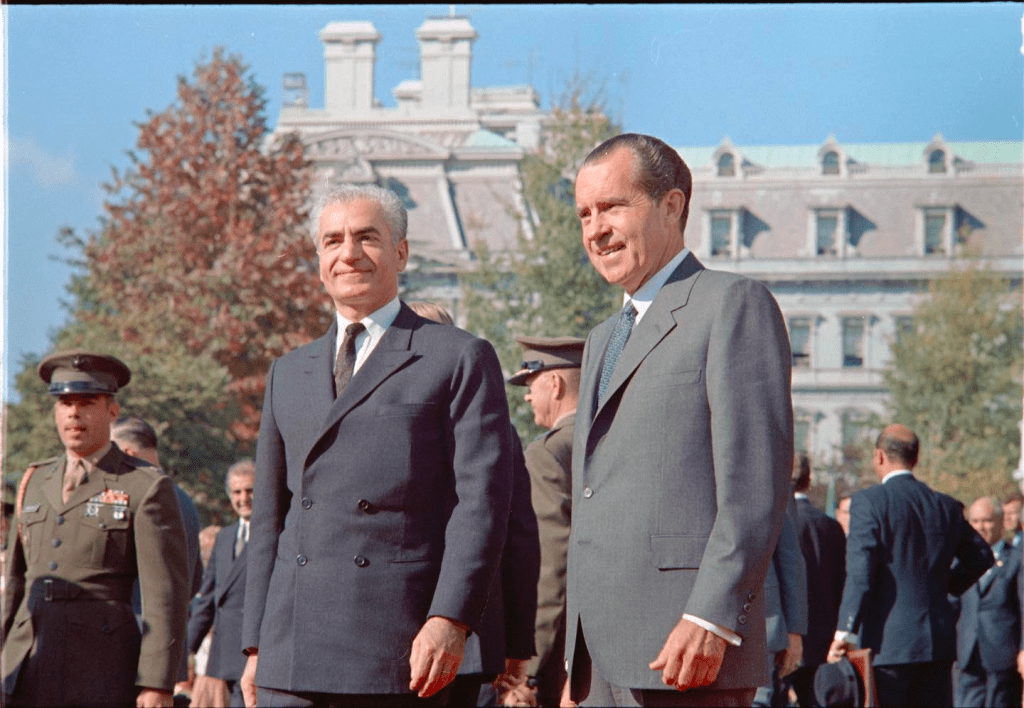
Iran-US Relations: From Close Friends to Enemies
Lecture given at Rewley House, Department of Continuing Education, University of Oxford, 30 August 2019
Dr John Limbert, one of the American hostages at the US Embassy when it was attacked by the so-called Students Following the Line of the Imam, is one of the best-informed and most balanced scholars of Iran. Professor Limbert is one of the few American politicians who speaks fluent Persian and is familiar with Iran as someone who has lived there and knows the country from within. Limbert first travelled to Iran in 1962 when his parents were working there for USAID. He returned to Iran as a Peace Corps volunteer (1964-66). Later on, he served as an English Instructor at Pahlavi University in Shiraz (1969-72). He joined the Foreign Service in 1973 and held a number of prestigious posts in some countries in the Middle East and Africa, including Ambassador to the Islamic Republic of Mauritania. He was one of the first civilian officials to enter Baghdad in April 2003. After returning to the United States, Limbert worked for a while as Deputy Assistant Secretary of State for Iran in the State Department’s Bureau of Near Eastern Affairs.
Limbert’s distinguished academic career has also included serving as Professor of Political Science at the U.S. Naval Academy (1981-84), Senior Fellow at Harvard University’s Center for International Affairs (1991-92), Dean of the Foreign Service Institute’s School of Language Studies, and an appointment as the Distinguished Professor of International Affairs in the departments of political science and history at the U.S. Naval Academy in August 2006.
In November 2009, Limbert was appointed the first-ever U.S. Deputy Assistant Secretary of State for Iran. However, after only nine months in that post, he returned to his teaching at an endowed chair. He cited the lack of diplomatic progress with Iran as the reason for his decision, adding, “The Obama administration has been in office now for over a year and a half, and I think everyone thought we would be in a better place with Iran. Not necessarily that we would be friends, but that we would at least be talking to each other on a regular and civil basis.”[1]
Given his wealth of knowledge, his diplomatic and academic qualifications, and especially his experiences as a hostage at the American Embassy in Tehran, Limbert is in a unique position to comment on Iran-US relations. He is certainly someone who has to be listened to, and his views should be taken very seriously as they can point to a solution to the long-lasting Iranian-U.S. hostility. In a very important article on Iran-US relations, he wrote:
In the last hundred years, for Iranians, the United States has gone from friend to puppet master to enemy and scapegoat. In Iran’s century-long struggle for dignity and independence, Americans were originally on the right side. Americans supported Iran’s constitutional movement, and, after World War II, helped Iran preserve its independence against a serious threat of partition backed by the Soviet Union. A few years later, however, they let the Cold War, blind anti-Communist ideology and willful ignorance create an unhealthy patron-client relationship with the repressive Pahlavi monarchy.
Since the revolution of 1979, grievances on both sides, fed by third countries that fear any US-Iran engagement, have continued to fester. Like a couple trapped in a bad marriage, interaction has mostly consisted of reciting complaints with no goal beyond venting.[2]
These few paragraphs sum up succinctly the history of relations between Iran and the United States. Instead of trying to address the historical grievances, both sides have perpetuated and intensified those differences, and it can be argued that Iran-US relations are at the moment in the worst state since the hostage crisis, and probably even more dangerous than ever before.
The early parts of those relations were very cordial and even friendly. In 1907, Howard Baskerville, a recent graduate from Princeton University, went to Iran and started teaching English and American history to mixed classes of boys and girls at the American Presbyterian-run Memorial School in Tabriz, the capital of Iranian Azerbaijan.[3]
In 1909, when the Constitutional Revolution was facing opposition from the Qajar ruler Mohammad Ali Shah, who wanted to reverse the revolution, Baskerville was so impressed by the people fighting for their freedom that he joined the revolutionaries. Surrounded by royalist troops, the people of Tabriz fought back. Baskerville joined the outgunned and outnumbered constitutionalists. The young Nebraskan has been quoted as saying, “The only difference between me and these people is my place of birth, and this is not a big difference.” He was given command of a contingent of 150 men whose job was to defend the city’s fortifications.
On April 19, 1909, Baskerville was killed by a sniper’s bullet and was buried in the Christian Armenian cemetery in Tabriz, while over 1,000 mourners took part in his funeral. He was 24 years and 9 days old.
He was eulogised as a patriot and martyr of Iran and the Constitutional Revolution. Right up to the present time, a bronze bust of Howard Baskerville is on display in the Tabriz Constitutional House. Aref Ghazvini, one of Iran’s leading poets, travelled to Tabriz to pay tribute to Baskerville in 1923.
In 1909, Iran’s Constitutionalists turned to the United States for assistance to reform its finances. When William Taft took the oath of office in 1909, his inaugural address expressed optimism about the possibility of improved trade relations with Iran. In 1910, the newly minted Iranian Parliament (the Majles-e Shura-ye Melli, or the National Consultative Assembly) recruited a 35-year-old American lawyer, Morgan Shuster, to be ‘Treasurer-General’, and gave him broad powers to restructure the country’s finances. Morgan Shuster devised a new taxation system and planned to set up a tax-collecting gendarmerie.
His active support for the Constitutional Movement and his attempts to improve Iran’s financial affairs displeased Russia and Britain, forcing the Iranian vice-regent to expel him in 1911. Back in America, he authored a remarkable book, The Strangling of Persia, which still remains one of the best accounts of the designs of foreign imperial powers to suppress the Iranian constitution. In his book, he wrote: “It was obvious that the people of Persia deserve much better than they are getting, that they wanted us to succeed but it was the British and the Russians who were determined not to let us succeed.”[4]
After the First World War, again Iran turned to another American, Dr Arthur Millspaugh, to continue the work that had been started by Shuster. He was a former advisor to the U.S. State Department’s Office of Foreign Trade. He was hired by Iran’s Finance Ministry and served in Iran from 1922-27 and again from 1942-45. He helped Iran become independent of foreign loans, and he was seen by the Iranian public and government as a liberator from British and Russian dominance.
Back in the United States, he tried to influence the State Department’s policies towards Iran. Following Morgan Shuster’s example, in 1925 Millspaugh published a book about his first assignment in Iran, The American Task in Persia.[5] After his second assignment, he wrote another book, Americans in Persia.[6]
The Iranian public became steadily enamoured with the United States, and thus began a remarkable 30-year love affair between the two countries – the kind of thing that has never been seen before or since. Shuster’s turned out to be just the first of three such American missions – the last wrapping up its work in 1945.
During the oil nationalisation period and early years of Dr Mohammad Mosaddeq’s government, Iran looked to the United States as an ally in the struggle of the Middle Eastern countries to throw away the yoke of imperialism. It also served the American purpose of wishing to get a foothold in the Middle East oil that was mainly controlled by British concessions. Mosaddeq himself believed that the United States government would side with him in his disagreement with the Anglo-Iranian Oil Company.
However, the growing influence of the Soviet-backed Tudeh Party, which was at times encouraged and set up by British agents to frighten the Americans about the growing Soviet influence in Iran, persuaded the American government that things were getting out of hand and that the Soviet Union might make use of the disturbances in Iran to install a communist regime there.[7] This fear led the British and American governments to organise the 1953 coup against the nationalist government of Dr Mosaddeq and to bring back the Shah, who had fled into exile. Mosaddeq himself was imprisoned, and many of his supporters were also jailed or killed.
That event marked a turning point in the popular perceptions of the United States in Iran and was comparable to the fall of Salvador Allende in Chile. No matter what the West thought of Mosaddeq, he was very popular in Iran and was regarded as a great nationalist figure who was trying to put an end to decades of foreign economic exploitation and political interference in the domestic affairs of Iran. Personally, he had no pro-Soviet tendencies, and his only mission was to safeguard Iranian interests by nationalising the oil industry and strengthening Iranian nationalism.
Iran as a pillar of US foreign policy in the region
During the 1960s and 1970s, Iran became one of the most important pillars of American foreign policy in the Persian Gulf region and in the Middle East as a whole. The other pillars of American policy in the region are Israel, Turkey and Saudi Arabia. Iran was perhaps the most important pillar compared to the other three, in view of its population that was much larger than that of Israel and Saudi Arabia, and its oil wealth and geopolitical position and long borders with the Soviet Union that made it a more pivotal country than Turkey.
The United States had a vital interest in the Persian Gulf oil resources, and Iran was well placed to safeguard these Western interests. Under President Richard Nixon and his Secretary of State Henry Kissinger, Iran was given access to an unlimited amount of the most advanced American weapons, short of nuclear weapons, and Iran became one of the leading American trade partners in the region. During a visit to Tehran, Nixon signed an arms deal with Iran worth $44 billion, which in today’s money is close to a trillion dollars.
As the result of the overwhelming American support for Iran, the Shah’s pro-Western policies, Iran’s oil wealth and the size and sophistication of the Iranian armed forces, the Arab countries of the region had no option but to accept or endure Iranian hegemony. Iran established friendly relations with Israel, the only Muslim country in the region to do so after Turkey. The Shah refused to join the Arab oil and economic boycott against Israel. Saddam Hussein, who had pursued very hostile policies towards Iran and had expelled hundreds of thousands of Iraqis of Iranian origin, was forced to accept the reality of Iran’s superior military might.
Iran and Iraq had fought a kind of low-level, undeclared war from 1969 to 1975. However, in 1975 Saddam Hussein signed the Algiers Accord, agreeing to drop Iraqi claims of sovereignty over the Shatt al-Arab (or Aravand Rud as it is called in Iran) and accepting Iranian demands to regard the Thalweg Line as the border between the two countries. Iran also provided an important behind-the-scenes role in the negotiations between Egypt and Israel that led to the signing of the Camp David Accords.
Although the Shah’s rule from 1953 to 1978 brought a great deal of prosperity and progress to Iran, he was never forgiven for the coup and was always regarded as an American lackey. When the Shah’s power grew and the scale of repression became intolerable, most people blamed the United States as the main supporter of the Shah. As a result, the popular perception was that the United States approved of all the oppressive measures of the Shah and the American-trained SAVAK. American advisors set up SAVAK in 1957, and its personnel were trained mainly by CIA and MOSSAD agents.[8]
Of course, the hostility of the revolutionaries, both leftists and Islamists, did not come entirely out of the blue. The United States had been the strongest supporter of the Shah. The 1953 coup against Dr Mosaddeq’s nationalist government was led by the United States. US and Israel set up SAVAK, which detained and tortured many clerics who later became revolutionary leaders. What was even more relevant to the clerics was the spreading of Western influences in the country that they regarded as Western decadence. Also, the Shah had spent huge amounts of Iranian oil revenue on US weapons to do what to most people seemed to be the US bidding. While the Shah had friendly relations with Israel, he had hostile relations with the Palestinians and some radical Arab states, as well as the Muslim Brotherhood. One of Khomeini’s main criticisms of the Shah as early as the early 1960s was the Shah’s friendship with Israel at the expense of the Arabs.
In the course of the Islamic Revolution, the American administration instinctively supported the Shah, as it was again worried — as in the days of Mosaddeq — that the revolution would bring a militant, pro-Moscow regime to power.
However, both the Shah and the Americans underestimated the danger that militant Muslims posed. This was partly because they had no contacts with the mullahs and with their large following, especially among the lower classes, and also because they had put their full trust in the Shah and were convinced that he had the situation firmly under control.
America’s unquestioning support for the Shah right to the end and even the attempts by the National Security Advisor Zbigniew Brzezinski and the US’s special envoy to Iran General Robert Huyser to encourage the Iranian armed forces to declare their neutrality in the contest between the Shah and the revolutionaries and to maintain their structures and be ready to stage a coup against the revolution in case needed, turned the United States into the main target of hate when the revolution finally succeeded.
During the first few months after the victory of the revolution, there was a deadly competition going on between the leftist and the religious forces for supremacy. The hostage crisis was the result of mutual incomprehension between the revolutionary government and the United States, because even before the victory of the revolution, the Carter Administration had reached the conclusion that the Shah had to go.
The Americans had even prepared to send emissaries to Paris to meet Khomeini, where he stayed a few months before returning to Iran to reassure him that the United States was willing to work with him, but at the last moment, President Carter had cancelled that meeting. U.S. Ambassador to the UN Andrew Young called Khomeini Iran’s Gandhi.
On the Iranian side, initially, the hostage taking was not intended as an anti-American act, but was primarily a feature of the domestic power struggle between the clerical establishment and communist and leftist groups that were vying for power.
Before the attack on the US Embassy in Tehran by the so-called Islamic Students Following the Imam’s Line, some members of the radical Marxist group the Feda’iyan Khalq had attacked the Embassy on 14 February 1979 and had taken a US Marine, Kenneth Kraus, hostage. Ambassador William Sullivan surrendered the Embassy to save lives, but Prime Minister Bazargan immediately sent his Foreign Minister Ebrahim Yazdi to talk to the radical Feda’iyan Khalq supporters. His mission succeeded, and the militants left the embassy within three hours and released Kraus six days later.
Leftist propaganda claimed that Bazargan’s government was subservient to its “American patrons”, and they accused Ebrahim Yazdi, who was chosen as the new foreign minister, of being a CIA spy as he had resided for many years in the United States and had met with US officials in Paris during Khomeini’s residence there. They criticised the government for the arrest and imprisonment of Mohammad Reza Sa’adati, a Mojahedin-e Khalq (MEK) member accused of spying for the Soviet Union.
In order to counter the left’s “anti-imperialist” slogans, some radical Muslim students decided to launch an attack of their own on the Embassy to show that they were as revolutionary as the Marxists. So, a group of them got together and consulted a young cleric, Mohammad Mousavi-Kho’iniha, about what they intended to do. He warned them against it because he said that the government was bound to attack and dislodge them as it had done in the case of the earlier attack by the Feda’iyan Khalq.
However, he also told them that if the takeover of the Embassy proved successful by attracting mass support, Khomeini would not oppose it. Some of the students wanted to attack the Soviet Embassy, but others thought that it would not have the same propaganda effect in neutralising the left as the American Embassy. So, the hostage crisis was in reality the symbol of a struggle between the leftist and religious forces to gain control of the revolution.
On 4th November 1979, a group of radical Muslim students attacked the Embassy in the early hours of the morning. One of the ringleaders of the attack, Ebrahim Asgharzadeh, said later that initially they had intended to occupy the embassy for a few hours to object to some US policies. He said: “Announcing our objections from within the occupied compound would carry our message to the world in a much more firm and effective way.”[9]
However, the takeover of the embassy proved more popular than they could have imagined, with large groups of leftist and radical Islamic students gathering and demonstrating in front of the Embassy, demanding the return of the Shah.[10]
After two days of silence, seeing the public support for the takeover of the embassy, on the third day, Khomeini finally put his full support behind the students and called their action “the second revolution”. He added that the first revolution had been against the Shah, while the second revolution was against imperialism. Meanwhile, Prime Minister Bazargan and the entire cabinet resigned when they failed to kick the students out of the Embassy.
After the resignation of Bazargan’s government, many moderate opponents of the clerical regime were accused of being lackeys of the West and were forced out of office. The government’s duties were assumed by the shadowy Islamic Revolution Council until elections were held for the first president. Meanwhile, Abol-Hasan Bani-Sadr was put in charge of the Foreign Ministry for a short time. Bani-Sadr has stated: “During this time, I called all the ambassadors from the European and North American countries and told them that the occupation of the embassy was in fact a strike against the Iranian government; it was we who were being held hostage. I asked them to help us end it.”[11]
As Mohammad Ayatollahi-Tabaar points out in a scholarly article on the hostage taking:
For political factions clamouring for power in a climate of uncertainty following the revolution, anti-Americanism was a commodity to be appropriated for political gain. Leftist and Islamist factions instrumentally deployed anti-Americanism to outbid one another’s anti-imperialist credibility. This chain of strategic interactions culminated in the Islamists’ seizure of the US embassy on November 4, 1979 (667).[12]
The occupation of the American embassy was a brilliant tactical move as far as the religious militants were concerned. It served Khomeini’s domestic purposes well, as he managed to crush the leftist forces one after another. It consolidated the power of the mullahs and silenced their opponents. The liberal elements were intimidated by highly selective and even fraudulent leaks from the embassy files about their alleged links with the “Great Satan”; while the leftist forces were jubilant about that audacious “anti-imperialist” move, which humiliated America and put an end to the possibility of the return of the monarchists or other right‑wing elements to power.
The embassy saga was stage‑managed to great effect and was drawn out for as long as any benefit could be derived from it. It assumed the characteristics of some of the passion plays or ta’ziyya that were staged by the mullahs each year in the lunar month of Muharram, mourning the martyrdom of Imam Husayn, at which they are past masters. The fact that it destroyed Iran’s international reputation as a law‑abiding country, isolated Iran in the international community and entailed great financial loss was of little consequence to the mullahs, who were purely interested in consolidating their position and defeating their nationalist rivals and outflanking the leftists. Their anti‑American campaign also won them many friends among the nations and groups that were hostile to the West.
However, it proved a very costly mistake as far as Iran’s foreign policy was concerned. The image of American diplomats held hostage, blindfolded and humiliated, has been ingrained in the minds of all Americans. The hostages were kept for 444 days and were then released physically unharmed, but the cost to Iran has been incalculable.
US’s Role in the Iran-Iraq War
During the Iran-Iraq war, Saddam Hussein received the support of practically the entire world. The United States, which had been pursuing an anti-Saddam policy when the Shah was in power, changed its policy towards him and even provided him with some military equipment and raw materials for the manufacturing of chemical weapons.[13] US officials closed their eyes to Saddam’s use of chemical weapons against Iranian forces as early as 1983, and even provided him with intelligence to target his attacks more effectively. On the other hand, nearly all Iranian weapons were American-made. In view of the U.S. attitude towards revolutionary Iran, it became extremely difficult for Iran to receive spare parts for those weapons.
In the latter stages of the war, when Iraqi forces were on the verge of defeat, the United States launched the so-called Operation Earnest Will (24 July 1987 – 26 September 1988), the largest naval convoy operation since World War II. It involved the reflagging of Kuwaiti-owned tankers in order to protect them from Iranian attacks. This was done even though Iraqi attacks on Iranian ships continued, and in fact, in the course of the hostilities, nearly twice as many Iranian as Iraqi ships had been attacked.
Although the excuse for the operation was to ensure the freedom of navigation in the Persian Gulf, the reality was that the Americans feared the fall of Basra, Iraq’s Shi’a-majority oil capital. U.S. law forbade the use of Navy ships to escort vessels under a foreign flag, so they re-registered Kuwaiti ships under the U.S. flag. This was despite the fact that on 17 May 1987, an Iraqi F-1 Mirage fired two Exocet missiles at the guided missile frigate USS Stark, killing 37 sailors and injuring 21. Both the U.S. Senate and the House opposed the reflagging policy, but it went ahead anyway.[14] The U.S. Navy also sank several Iranian frigates and attacked several Iranian oil platforms.
Shortly before the end of the war, on 3 July 1988, a guided missile cruiser, USS Vincennes, fired a missile at an Iranian passenger aircraft, an Airbus A300, destroying the plane and killing all 290 people on board, including 66 children. The jet was hit during a routine flight from Bandar Abbas to Dubai.
It has been alleged that the shooting of the Iranian aircraft was due to a mistake which confused the big civilian aircraft with an Iranian F-14 aircraft that had been part of the Iranian Air Force inventory. It is difficult to accept how a modern US frigate with sophisticated equipment could have confused a civilian aircraft on a routine flight for a military fighter. Some commentators have argued that the captain behaved recklessly and had been overly aggressive.[15] What is even stranger is that the captain of the Vincennes, William C. Rogers III, was awarded the Legion of Merit “for exceptionally meritorious conduct in the performance of outstanding service as commanding officer…”
In any case, the downing of the civilian aircraft and all the losses that Iran had suffered during the previous year due to U.S. support for Iraq persuaded Iranian leaders that it was impossible to continue with the war, and Ayatollah Khomeini “drank from the poisoned chalice” and accepted the U.N. Security Council Resolution 598 that ended the war on 20 August 1988, with neither Iraq nor Iran having achieved what they had wished for.
The Iraqis claimed that between 105,000 and 375,000 had been killed on their side. Other estimates put the number of Iranian losses at 600,000. Iran’s economic losses were estimated at $637 billion. So, the effect of the hostage crisis has been catastrophic for Iran.
Since the hostage crisis, the United States’ attitude towards Iran has understandably continued to be very hostile. Occasionally, the intensity of hostility between them has slightly subsided, but deep-rooted suspicions and hostilities have persisted. Under the Obama administration, after unprecedented “crippling” sanctions that were supported even if reluctantly by most of America’s Western allies and even by Russia and China, the two countries began to talk seriously for the first time in 35 years.
President Obama realised that the climate of intense hostility was to neither side’s benefit, and that the unilateral sanctions and even those imposed by the Security Council on Iran were gradually being eroded, so he decided to pursue the path of talks and reconciliation, and ultimately that approach produced results in the form of a landmark nuclear deal after many years of deadlock.
Trump Administration and Iran
However, since the start of the Trump administration, that process has been reversed with a vengeance, and the level of hostility between the two sides has reached a fever pitch and may even deliberately or by chance lead to a military confrontation between the two countries.
This change of tune has been partly due to President Trump’s wish to reverse any agreements reached under President Obama, and also due to the intense anti-Iranian feelings of some of those who have surrounded him, particularly National Security Advisor John Bolton, Secretary of State Mike Pompeo, the president’s lawyer Rudy Giuliani, and many others both in the administration and in Congress. Both Bolton and Giuliani have spoken repeatedly at the conferences organised for the MEK terrorist group and have received huge fees for their speeches.
As a result of constant hostile propaganda and lobbying, mainly by Israel and Saudi Arabia and their American supporters in Congress and the media, it has become exceedingly difficult to portray Iran with some degree of objectivity and analytical balance, to tone down the anti-Iranian rhetoric and to look dispassionately at the facts and at the areas of common interest.
These anti-Iranian policies have become so extreme that the Trump administration is even contemplating taking military action against Iran on false pretences. After big protests took place in Basra due to economic problems and government mismanagement, some militants allegedly attached to Moqtada al-Sadr’s Movement, which has adopted a strong anti-U.S. and anti-Iranian stance, attacked both the Iranian and American consulates in that city in September and October 2018, respectively. Some U.S. officials blamed Iran for having been behind the attacks against the U.S. Consulate. According to a report by the Wall Street Journal, on those dubious pretexts, President Trump’s national security team asked the Pentagon for “options to strike Iran.”[16]
The depth of hostility of some members of the current administration could be seen in the remarks of U.S. Secretary of State Mike Pompeo following the unprecedented floods in some 23 Iranian provinces that killed 57 and 478 people. Instead of showing sympathy for the plight of the victims of those natural disasters, the New York Times quoted Pompeo saying: “These floods once again show the level of Iranian regime mismanagement in urban planning and in emergency preparedness.” He continued: “The regime blames outside entities when, in fact, it is their mismanagement that has led to this disaster.”
This is even though the United States has been very slow to provide relief to the victims of the 2016 hurricane in Haiti, which killed 546 people, nearly ten times the number of victims of Iranian floods, or many subsequent disasters in Haiti or on the U.S. mainland. That kind of attitude has been out of line with the normal responses of most governments to natural disasters. It is even more surprising as it comes from a man who wears his Christianity “on his sleeve”, often trumpeting the fact that he is a Christian evangelist. Instead of showing any empathy for Iranian people suffering from natural disasters compounded by U.S. sanctions, the State Department takes delight in issuing fact sheets about the harsh effects of its sanctions on Iran.[17]
Some Attempts by Iranian Leaders for Rapprochement with the United States
The fact is that, with good cause, many Iranians view the United States as implacably hostile to the Islamic Republic, turning it partially into a self-fulfilling prophecy. On the other hand, the United States regards Iran under the Islamic Republic as its main adversary in the region.
This is despite the fact that on several occasions after Ayatollah Khomeini’s death, some Iranian governments have tried to extend a hand of friendship towards the United States, but the neoconservatives and other anti-Iran forces in various U.S. administrations have always opposed any rapprochement between Tehran and the West and have worked hard to block it.
When Akbar Hashemi-Rafsanjani was elected president (1989-1997), he tried to rebuild the war-shattered economy. As a gesture of goodwill, he gave a $1 billion oil contract to the American oil company Conoco to show that after 10 years of revolution and war, Iran was open to interaction and collaboration with the United States. Unfortunately, pro-Israeli officials who had achieved prominent positions in the Clinton administration rejected his olive branch.
Conoco was forced to cancel the deal. Rafsanjani, meanwhile, was rewarded with the “dual containment policy”, courtesy of Martin Indyk, a former head of the pro-Israel Washington Institute for Near East Policy (WINEP) who was serving as senior director of Near East and South Asian Affairs at the National Security Council.
Iran’s Reformist president, Mohammad Khatami, subsequently went even further. He strongly condemned the 9/11 terrorist attack and called for a “dialogue of civilisations.” He made a remarkable offer to the United States through the Swiss ambassador in Tehran to resolve all the issues of contention between the two countries, including Iran’s nuclear program and its approach to the Arab-Israeli conflict. He appointed Hassan Rouhani as the head of the team negotiating a nuclear deal with the European Troika (Britain, France, and Germany), and reached a deal to reduce Iran’s activities to research and development only and very limited low-level enrichment. This time, President George Bush responded to Iran’s gesture by including Iran in an “Axis of Evil” with Saddam Hussein’s Iraq and Kim Jong Il’s North Korea.
Washington’s list of grievances against Iran is also long. It includes Iran’s alleged support for international terrorism, which mainly means Iran’s support for the Lebanese Hezbollah and to a lesser extent for various Palestinian groups that are hostile to Israel; Iran’s alleged quest for weapons of mass destruction, although the Iran nuclear agreement has put an end to that concern; and, generally speaking, to Iran not towing America’s line in the Middle East and being an impediment on the path of pursuing US interests in the region, be it in the Persian Gulf, Iraq, Syria, or Yemen, or America’s longstanding attempts to block the encroachment of Russia and China into the Middle East.
Therefore, as things stand, Tehran and Washington are on a collision course, pursuing conflicting and mutually incompatible goals that cannot simply be “negotiated away” without a great deal of compromise by both sides, or at least trying to see the situation from the other side’s point of view. Clearly, a military confrontation between Iran and the United States would prove very costly, mainly for Iran, but also for the United States and for the region.
Having gone through a gruelling and destructive eight-year war with Iraq, most Iranians are not looking for another war. Also, after the costly and disastrous experiences of American wars in Afghanistan, Iraq, Libya, Syria, Yemen, Somalia and elsewhere, most Americans are against waging another and more disastrous war in the Middle East.
Therefore, common sense dictates that, instead of beating the drums of war and moving blindfolded into another disaster, both sides must explore all the possibilities and try to reach some form of coexistence, if not a strategic alliance.
If we study the long history of relations between Iran and the United States, we will see that there are grounds for optimism, as both sides have many common interests. Above all, cooperation rather than confrontation can serve the interests of both sides and can enable them to achieve their goal without costly confrontation.
So, where should we start to reverse this dangerous course? In a perceptive and wide-ranging speech before the Council on Foreign Relations on “Reassessing U.S. Policy toward Iran”, Former Congressman Lee H. Hamilton made some remarks that are as relevant today as they were over two decades ago when he made them, and they encapsulate the issues involved in Iran-US relations. Let us remind ourselves of what he said and waste no more time in futile hostility. He said:
First, no country has caused the United States more anguish or more trouble over the past two decades than has Iran. Problems with Iran contributed to the downfall of one President and tarnished the record of another. Emotions have run high. The rhetoric has been hot, and mutual recriminations frequent.
Second, confrontation between the United States and Iran—between two peoples and two countries that were once close friends and partners—has benefited neither country. Years without dialogue have served the interests of neither the United States nor Iran.
Third, important changes are underway inside Iran. It is a society in transition. President Khatami wants to promote civil society and the rule of law. He wants to end Iran’s isolation. He wants to improve the lives of the Iranian people. He is reaching out to Iran’s neighbours — and he is reaching out to the United States. He is also engaged in a fierce power struggle inside Iran.[18]
He went on to say that Iran matters because
“With over 65 million people [over 80 million now], Iran is the most populous country in a region of vital importance to the U.S. national interest, the Persian Gulf. Iran has some of the world’s largest oil and natural gas reserves… Iran controls half of the coastline of the Persian Gulf and one side of the Strait of Hormuz, through which half of the world’s traded oil moves. Iran borders the Caspian Sea, the Caucasus, and Central Asia, where huge reserves of oil and gas are now being tapped. Poor U.S. ties with Iran harm the competitive position of U.S. companies in Central Asia, and make it more difficult to bring new energy supplies to world markets… In short, poor relations with Iran immensely complicate American foreign policy. Improved relations with Iran could lead to comparable benefits. An Iran that rejoins the family of nations and follows its rules could make a major contribution to regional prosperity and stability. A better relationship with Iran would serve the strategic interests of the United States, and improve the climate for the Middle East peace process.”
He summed up the American policy towards Iran as consisting of
A sound bite that we want Iran “to change not just words, but deeds
A slogan called “dual containment”; and
A sledgehammer in the form of the Iran-Libya Sanctions Act, known as ILSA.
All that he said about President Khatami’s efforts to initiate change and make friends with neighbours is equally true of President Rouhani. After nearly 40 years of estrangement, it is time for both countries to reassess their relations and see if there are ways of improving them. Most Americans are not aware of the price that Iran has paid since the Islamic Revolution, especially in connection with the hostage taking. Even the members of the current U.S. administration keep harking back to the hostage crisis and the alleged assistance that Iran provided to the insurgents in Iraq after the U.S. invasion in 2003. However, they belittle the military, political and economic damage that the United States has inflicted on Iran.
Ever since the hostage crisis, Iran has found it extremely difficult to attract investment or even to borrow money from international organisations. Right up to the present time, all Iranian moves in trying to establish close links with Asian and European countries have been partially blocked and frustrated by the United States. The catalogue is endless. If one adds all the sanctions imposed on Iran over the past four decades and the benefits that Iran could have derived as a result of oil and gas pipelines passing through its territory, the cost to Iran runs literally into trillions of dollars.
Therefore, if any country has suffered as a result of the hostage crisis, it is Iran and not the United States. The time has come for both sides to put that sorry episode behind them and move forward. It is also important to reassess the relations in view of the real changes that have taken place in Iran’s domestic and foreign policy, as well as the new realities in the Middle East and the world as a whole.
During the past few years, the Iranians have shown that they are in favour of moderation and have extended the hand of friendship towards the United States. The landmark nuclear agreement put an end to the main U.S. concern about Iran’s ability to produce nuclear weapons. Iran’s Foreign Minister Mohammad Javad Zarif has often said that the nuclear agreement formed the base and not the ceiling of Iran’s cooperation with the West. Had it been honoured, it could have acted as a first step to raising all the other outstanding issues between the West and Iran and resolving some of the intractable problems and disputes in the Middle East. Even Ayatollah Khamenei, who has always been suspicious of the United States, said that the nuclear agreement could act as a test case and, if successful, could help reach other agreements with the West.
Not only does Iran not pose a threat to the United States, or for that matter to Israel; on the contrary, the two countries have many common interests. John J. Mearsheimer, one of the most important and influential international relations scholars in the world, in his latest book The Great Delusion: Liberal Dreams and International Realities, touches on the U.S.’s international role and its relations with many countries, including Iran.[19] His book has generated a great debate in the United States, and The Financial Times has included it among the most important works of 2018.
According to Mearsheimer, liberal hegemony, the foreign policy pursued by the United States since the Cold War ended, which involves interference in other countries’ domestic affairs and instigating regime change in the countries that the United States disapprove of, is doomed to fail. In an interview discussing his book, he was asked if Iran posed a direct threat to the United States, as many neoconservatives close to the Trump administration claim. His answer deserves to be quoted in full. He said:
Iran is not a direct threat to the United States. It is not even an indirect threat to the United States. First, Iran does not have nuclear weapons, and it has signed an agreement with the world’s major powers that makes it impossible for Tehran to develop nuclear weapons in the foreseeable future. Second, Iran does not have missiles that can strike the U.S. homeland. Third, Iran has weak conventional forces, which cannot be used against the United States or any country in the Middle East that is under the American security umbrella. Fourth, Iran is not a serious threat to attack another country in its region. It has not launched a war against another country even once in modern times, and there is no evidence that it is now preparing to take the offensive against any of its neighbours. Fifth, Iran is not the source of America’s terrorism problem. To the extent that any one country deserves that title, it is Saudi Arabia, not Iran.
The truth is that it is the United States that is a direct threat to Iran, not the other way around. The Trump administration, with much prompting from Israel and Saudi Arabia, has its gunsights on Iran. The aim is regime change, and there is much evidence that the United States might use military force to achieve that goal.[20]
On a number of occasions since the Islamic Revolution, Iran and the United States have cooperated with each other. Iran played a significant role in bringing the members of the Northern Alliance in Afghanistan to the table to talk to the United States after the fall of the Taliban. Iran even provided U.S. forces with some valuable intelligence in the course of the war against the Taliban.
After the 9/11 attacks that were carried out by 15 citizens of Saudi Arabia, two from the United Arab Emirates, one from Egypt and one from Lebanon, the Iranian President offered his deep condolences to “the great American nation”. Many Iranians took part in spontaneous candle-lit vigils and expressed sympathy for Americans.[21] Nearly all American visitors to Iran have testified to how friendly Iranians are towards Americans.[22]
In its domestic policies, too, the Rouhani government has initiated many remarkable reforms, which can move Iran towards greater democracy, with much reduced roles for the clerics and the IRGC, but for all this to happen, the United States needs to signal real change in its attitude towards Iran.
Instead of reneging on the JCPOA, a move that has been condemned by practically the entire world, the United States should return to the agreement, but call for progress on a number of other contentious issues on the basis of detailed and realistic talks similar to the JCPOA. Such a move requires recognising Iran’s legitimate interest as a major Middle Eastern country in regional affairs. Taking the side of the militant Sunni states, which have been the main instigators of terrorism in the Middle East, will only intensify conflicts in the region, without benefiting the US’s long-term interests.
The United States’ main interests in the Persian Gulf region are to ensure freedom of shipping and the free flow of oil. Although America no longer needs Middle East oil for herself, she certainly wishes that the flow of oil to her allies is not interrupted. The United States does not wish to see either Russia or China replace it as the main power in the region or for any regional country to act as the sole hegemon.
To achieve these goals, the United States must push for a system of collective security that includes both the Arab states of the region (Egypt and the GCC), as well as Iran and Turkey. Such a security system would foster collaboration between those states, would ensure peace and stability in the region, including the free flow of oil and gas, and would also enable the United States to withdraw its forces from the region that imposes huge costs on the U.S. Treasury.
The United States is also very concerned to safeguard the security of Israel. However, the claims of existential threat emanating from Iran to a country that possesses a nuclear arsenal and the most modern and sophisticated military in the region, as well as enjoying the U.S.’s unquestioning support, are exaggerated. The threats that Israel is facing are mainly due to its aggressive policies towards the Palestinians. Various Iranian presidents have stressed that they would accept any agreement that Israel can reach with the Palestinians. However, Israel’s policy of blocking the so-called “peace process” and occupying more and more Palestinian lands and establishing more Israeli settlers is not conducive to long-term peace with the Palestinians or with its Arab neighbours.
President Trump’s decision to declare Jerusalem the capital of Israel and to move the U.S. Embassy from Tel Aviv to Jerusalem, declaring that Israel is entitled to keep the Golan Heights, and even naming the occupied territories as “controlled territories”, has further emboldened Israel’s right-wing government to continue with its aggressive policies. The United States needs to return to its long-held policy of acting as an honest broker between the Israelis and the Palestinians. It is only through the establishment of a two-state system or a single democratic state with equal rights for the Israelis and the Palestinians that this long-lasting conflict can be resolved.
Three Events that have shaped Iranian perception
It is essential for the West and particularly the United States to try to understand the reasons behind the way that Iranian leaders act and the need to address those issues if relations are to improve. As has been pointed out, Iranian perception of their dealings with the West has been mainly shaped by four main developments.
The first event was the 1953 U.S.-UK-orchestrated coup that overthrew the popular government of Mohammad Mosaddeq. The Iranians who had pinned their hope on the United States to curtail the power of the imperial powers in Iran saw that the United States colluded with Britain in order to safeguard its oil interests. They toppled Iran’s democratically elected prime minister, imprisoned him and put him and put him under house arrest for the rest of his life, executed his foreign minister and a few other officials, and shared Iranian oil with the British and a few European oil companies. The Shah, who had fled the country when his initial attempt to dismiss Prime Minister Mosaddeq had failed, was returned to power and ruled the country with an iron fist, supported by the United States. So, Iranians who had regarded the United States as a defender of democracy and human rights saw it as the inheritor of the British Empire with no regard for the democratic aspirations of other countries.
The second event was the eight-year-long Iran-Iraq war during the 1980s, supported by the whole world—from the Soviet Union to the United States and Europe. On the other side, Iran was isolated and was forced to focus on developing its domestic capabilities, producing most of its military equipment, from drones and missiles to cyber warfare capabilities. That gruelling experience taught the Iranians that even when they were the victims of an aggressive invasion by a dictator such as Saddam Hussein, not only were they not helped by the supposedly democratic West, but the whole world joined to support the aggressor killing and gassing nearly a million Iranians. That experience further eroded their faith in Western democracies.
The third event was the example of the double standards regarding nuclear weapons. The 1981 pre-emptive attack by Israel against the Osirak nuclear reactor in Iraq, built by France, and its total destruction, which was viewed around the world as a sign of Israeli strength rather than aggression, was a powerful lesson for the Iranians. The demilitarisation of Libya before attacks by Western powers was another example that the West only understood the language of strength. The difference in the way that the West generally, and President Trump particularly, dealt with Iran and North Korea was a further confirmation that if you wish to be immune from foreign invasions and attacks, you must develop nuclear capabilities. Iran, which has not developed nuclear weapons, has been subjected to sanctions and threats of war, while North Korea, which left the NPT and developed nuclear weapons, is treated with respect and even has summit meetings with Trump.
The fourth event was the completion of the 2015 nuclear deal and the U.S. withdrawal from that deal in 2018. After many years of hostility towards Iran and almost constant sanctions since the victory of the Islamic revolution, a US president decided to respond positively to Iran’s outstretched hands for rapprochement with the United States. President Obama recognised Iran’s right under the NPT to have access to nuclear technology for peaceful purposes. In return for that recognition, Iran agreed to drastically curtail its nuclear programme, accept the Additional Protocol that involved constant and unannounced inspections of all its nuclear sites, and a massive reduction of the amount of low-enriched uranium that it could keep.
Yet as a result of new elections and a change of government, all the agreements that had been reached over two years of detailed and laborious talks were thrashed by the incoming U.S. president, who furthermore imposed illegal extraterritorial sanctions on Iran in contravention of the Security Council Resolution 2231. This showed Iranian officials that they could not trust American leaders even when they had agreed to a multilateral deal with Iran. Iran had abided by all the requirements of the deal, as 15 quarterly International Atomic Energy Agency reports had confirmed, yet Iran was deprived of the economic benefits of that agreement and was in fact subjected to unprecedented hardships.
The U.S.’s “capitulate-or-else campaign” has been aimed at regime change in Tehran and even the obliteration of Iran’s economy and ultimately its annihilation as a country. This showed that no matter what the Iranian government did, the ultimate aim of U.S. administrations was to fight against it and bring about a regime change even worse than what she had done in the 1953 coup.
Five Lies against Iran
To achieve that aim, U.S. politicians have engaged in a campaign of disinformation and lies against Iran, similar to what they did before the invasion of Iraq.
Lie number one: Iran Is Building Nuclear Weapons. Despite the nuclear deal that has curtailed Iran’s nuclear activities and has blocked all the paths to Iran’s manufacturing nuclear weapons, some U.S. officials, echoing Netanyahu and his compliant pundits and think tanks in the United States, continue to accuse Iran of aiming to develop nuclear weapons, while Israel remains the only country that has amassed a nuclear arsenal through lies and deception.
Lie number two: Iran Violated the Nuclear Deal. Although the IAEA, which is the legal and expert organisation that should assess Iran’s nuclear programme, has repeatedly reported that Iran has been completely abiding by all the provisions of the JCPOA, U.S. officials, including the Secretary of State and the national security advisor, falsely claim that Iran has violated the nuclear deal.
Lie number three: Iran is the Leading State Sponsor of Terror. This has been one of the constant accusations levelled at Iran. To be sure, at the beginning of the revolution, Iranian intelligence services that were responding to some terrorist activities carried out against them, mainly by the Mojahedin-e Khalq and various terrorist organisations supported by Israel, the United States and some Persian Gulf countries, engaged in some terrorist acts against their opponents in Europe and elsewhere.
The fact is that nearly all the major terrorist organisations, including Al Qaeda, Taliban, Boko Haram, ISIS, al-Nusrat Front and many extreme organisations in Pakistan and elsewhere that have been involved in major international terrorist acts have been the offshoots of the extreme Sunni and especially the Wahhabi school of thought supported by Saudi Arabia and other Persian Gulf states. Iran has, in fact, been fighting against most of those terrorist groups, especially al-Qaeda and Taliban, with which Iran nearly went to war after their takeover of Afghanistan with U.S., Saudi and Pakistani help. Iran was the main opponent of ISIS when it occupied large chunks of Syrian and Iraqi territory, long before U.S. forces got involved in fighting them. Iraqi and Syrian officials have openly said that had it not been for Iran’s immediate assistance, the ISIL might have been able to occupy Damascus, Baghdad and Erbil. So, to accuse Iran of being the main sponsor of terrorism is quite inaccurate and indeed bizarre.
Lie number four: Iran is working with Al Qaeda. In the same way that before the invasion of Iraq, the Bush administration falsely accused Iraq of possessing weapons of mass destruction and having links with Al Qaeda. Both allegations were proved false, but the combination of terrorism and weapons of mass destruction provides a powerful weapon to frighten and mislead the public and persuade them to accept military attacks against other countries.
In the case of Iran, facts point to the opposite conclusion. Iran’s Shi’a theocracy was seen by Bin Laden as the main enemy that had to be fought and defeated. The relationship between Al Qaeda and Iran is “not one of alliance” but “highly antagonistic,” according to a report by the Combating Terrorism Centre at West Point in 2012.[23] The Iran-Al Qaeda conspiracy theory is an especially dangerous one because the 2001 Authorisation for Use of Military Force, passed by Congress in the wake of 9/11, allows the president to “use all necessary and appropriate force against those nations”.[24] The opponents of Iran in the United States are intent on making those allegations stick to provide an excuse for the president to launch an attack on Iran without Congressional authorisation.
Lie number five: War on Iran Would Be Easy. The Israelis and Iran hawks in the US administration wish to get the United States involved in a war with Iran by pretending that such a war would be easy and cost-free and that Iran would capitulate easily. Similar false propaganda about the Iraq war being a “cakewalk”, or majority of Iraqis were against Saddam Hussein and would welcome US soldiers with flowers, proved disastrously wrong. Even now, 16 years after the invasion, the United States is stationing thousands of soldiers in Iraq and is fighting terrorist groups, such as ISIS, who were created as a result of their resentment against the foreign invasion.
The situation would be much worse in the case of Iran. Iran’s population of 82 million is more than three times the size of the Iraqi population, which was 26 million before the invasion. Iran is more than twice the size of Iraq, but more importantly, unlike Saddam, who was ruling by brute force, Iranian leaders enjoy a fairly high level of legitimacy in the eyes of a substantial segment of the population. The current Iranian system is the outcome of a popular revolution supported by millions of people.
Despite many economic shortcomings, a very poor human rights record, widespread corruption and oppression, many Iranians still regard this regime as a product of their sacrifices during the revolution and during the brutal Iran-Iraq war. In Iran, there are regular presidential, parliamentary and local elections. The rate of participation in nationwide elections is normally higher than in most Western countries, often exceeding 70% of eligible voters, and those elections are meaningful and often produce surprising and unexpected results.
For all these reasons, a war with Iran would be a disastrous mistake, would lead to the death of millions of Iranians and thousands of American forces, and the outcome would be very different from what is expected. A war with Iran would not be limited to that country, but in view of Iran’s close links with several allies in Lebanon, Syria, Iraq, Afghanistan and other Middle Eastern countries, would give rise to a regional conflagration. If 18 years after the U.S. invasion of Afghanistan, the Taliban is resurgent and occupying more than half of the country, and the United States finds it necessary to hold talks with the Taliban behind the back of the Afghan government to be able to withdraw its 18,000 troops that are still stationed there, a war with Iran would create a situation as the result of which the United Stated would be forced to get out of the Middle East altogether.
The Need for a Policy Change
Under the critical current circumstances in the Middle East, and after devastating wars that have shattered some of the most ancient civilisations in the region, it is time to lead the region towards peace and reconciliation through a balanced and equitable collective regional security system. With its long history of association with the region, its unmatched military and economic power, and above all, its ideals and values, the United States is the only power that can bring this about.
The continuation of the current policies would lead to many more years or decades of conflict and instability. As the United States is preparing itself to meet the challenges of an expanding China and a more assertive Russia, it is in its interest to put an end to decades of futile and mainly failed policies in the Middle East and look for alternative policies that would free US forces from involvement in the region and would also bring peace and calm to that geostrategic region.
[1] “Diplomat: ‘Ghosts In The Room’ Plague U.S., Iran”, NPR, July 31, 2010. https://www.npr.org/templates/story/story.php?storyId=128897271&t=1551635953312
[2] John Limbert, “The Iron and Depressing Laws of US-Iran Relations”, Atlantic Council, February 6, 2019. https://www.atlanticcouncil.org/blogs/iransource/the-iron-and-depressing-laws-of-us-iran-relations
[3] For a brief biography of Baskerville, see Fereshteh Sabetian: “The American Hero in Iran: The True Story of Thomas Baskerville”, SurfIran, July 17, 2018. https://medium.com/@surfiran/an-american-hero-in-iran-the-true-story-of-howard-baskerville-3953ae752f27
[4] Morgan W. Shuster, The Strangling of Persia: A Personal Narrative (Mage Publishing, Washington, D. C., 1912).
[5] Arthur Millspaugh, The American Task in Persia (New York: Arno Press, 1925)
[6] Arthur Millspaugh, Americans in Persia (Washington, D.C., The Brookings Institution, 1946)
[7] For British attempts to intensify demonstrations and riots in Tehran, see Stephen Kinzer, All the Shah’s Men: An American Coup and the Roots of Middle East Terror (Wiley, 2008), pp. 159-161.
[8] For the American role in setting up the SAVAK, see Iran: A Country Study by Federal Research Division Library of Congress edited by Glenn E. Curtis and Eric Hooglund (pp. 276-7).
[9] Mark Bowden, “Among the Hostage-Takers”, The Atlantic, December 2004 issue, https://www.theatlantic.com/magazine/archive/2004/12/among-the-hostage-takers/303596/
[10] [10] “Iran Hostage Crisis”, New World Encyclopedia, http://www.newworldencyclopedia.org/entry/Iran_hostage_crisis#Public_opinion_in_Iran
[11] Abolhassan Bani-Sadr, “‘Argo’ helps Iran’s dictatorship, harms democracy”, The Christian Science Monitor, March 5, 2013 https://www.csmonitor.com/layout/set/print/Commentary/Global-Viewpoint/2013/0305/Argo-helps-Iran-s-dictatorship-harms-democracy
[12] Mohammad Ayatollahi Tabaar, “Causes of the U.S. Hostage Crisis in Iran: The Untold Account of the Communist Threat.” Security Studies 26:4 (2017): 665-697. DOI: https://doi.org/10.1080/09636412.2017.1336390.
[13] For U.S. supply of chemical weapons to Saddam Hussein, see The Riegle Report. https://usiraq.procon.org/sourcefiles/riegle-rpt.pdf. Also see Shane Harris and Matthew M. Aid, “America Helped Saddam as He Gassed Iran”, Foreign Policy, August 26, 2013. https://foreignpolicy.com/2013/08/26/exclusive-cia-files-prove-america-helped-saddam-as-he-gassed-iran/
[14] Pelletiere, Stephen C., The Iran-Iraq War: Chaos in a Vacuum (New York: Praeger, 1992), pp. 125-130
[15] John Barry and Roger Charles, “Sea of Lies”, Newsweek, 13 July 1992.
[16] See Golnar Motevalli, “White House Asked the Pentagon for Options to Strike Iran, WSJ Says”, Bloomberg, 13 January 2019. https://www.bloomberg.com/news/articles/2019-01-13/white-house-last-year-sought-options-to-strike-iran-wsj-says
[17] As one example, see the fact sheet following Special Representative Hook’s remarks, “Maximum Pressure Campaign on the regime in Iran”, 3 April 2019. https://content.govdelivery.com/attachments/USSTATEBPA/2019/04/02/file_attachments/1185553/Iran%20Fact%20Sheet.pdf
[18] Speech by The Honourable Lee H. Hamilton, Member, U.S. House of Representatives (D-IN) before the Council on Foreign Relations Reassessing U.S. Policy Toward Iran, April 15, 1998, Washington, D.C. http://archives.usaengage.org/archives/legislative/hamilton3.html
[19] John J. Mearsheimer, The Great Delusion: Liberal Dreams and International Realities (Yale University Press, September 2018).
[20] Roberto Vivaldelli, “Interview with Mearsheimer”, LobeLog, March 22, 1919
[21] https://www.youtube.com/watch?v=5k1TTSftquE
[22] Nicholas D. Kristof, “Those Friendly Iranians”, New York Times, May 5, 2004. https://www.nytimes.com/2004/05/05/opinion/those-friendly-iranians.html
[23] “Letters from Abbottabad: Bin Ladin Sidelined”, Harmony Program, The Combating Terrorism Center at West Point, 3 May 2012, https://ctc.usma.edu/app/uploads/2012/05/CTC_LtrsFromAbottabad_WEB_v2.pdf
[24] Joint Resolution, Public Law 107-40, 107th Congress. https://www.congress.gov/107/plaws/publ40/PLAW-107publ40.pdf

