

Lecture given at Rewley House, Department of Continuing Education, University of Oxford, 14 December, 2018
1878 in the Middle East
The decline of the Ottoman Empire and the start of reform movements
This year marks the 140th anniversary of the establishment of the Department of Continuing Education at the University of Oxford, the first such department in Britain and even in the United States. It runs more than 1,000 courses per year on a part-time basis, offers degrees at the undergraduate and postgraduate levels, and has some 15,000 students, the largest department at Oxford. I have been privileged to teach in this department for over 20 years.
When I was asked to speak on the anniversary of this important event, I thought it would be interesting to look at my area of expertise, namely the Middle East, and see what was happening in that part of the world when the Department of Continuing Education was founded. Of course, at that time, Britain was also a very different place compared to what it is now. It was at the heart of the mightiest empire of the time and ran a large part of the world on which the sun never set. In 1878, the second Anglo-Afghan war was fought, which Britain won and established a buffer between the British Raj and the Russian Empire. In 1878, all tension between Britain and Russia in Europe ended with the June 1878 Congress of Berlin. At that point, the British Empire was the uncontested major power in the subcontinent and many parts of the East.
While Britain was on the ascendant at that time, Middle Eastern empires, the Mughals in India, the Ottomans in Turkey and the Qajars in Iran were in decline. Around the 17th century, Mughal India became the world’s largest economic power, accounting for 24.4% of world GDP and the world leader in manufacturing, producing 25% of global industrial output until the 18th century, ruling over more than 150 million subjects. However, in 1858, the British crown formally assumed direct control of India, and in 1876 Queen Victoria adopted the title of the Empress of India.
The Safavids formed the biggest Iranian Empire since the Islamic conquest, and at its height, the empire ruled over the present Iran, Afghanistan, parts of modern Iraq, large parts of Central Asia and the Caucasus. However, with the collapse of the Safavid and the establishment of the Zand and Qajar dynasties, Iran started a period of decline.
At the beginning of the 19th century, the Qajars suffered many setbacks in their confrontation with a rising Russia. The Russians had started to move south on both sides of the Caspian Sea, into the Caucasus, Georgia and Armenia in the West of the Caspian Sea and into Central Asia in the east of the Caspian Sea. As the result of two devastating wars that Iran fought to stem the tide of Russian expansion, Iran suffered comprehensive defeat and lost large parts of the Caucasus as the result of Gulistan Treaty in 1813, and lost what is now Daghestan, eastern Georgia, most of the Republic of Azerbaijan and northern Armenia; and Turkmenchai treaty in 1828, as the result of which Iran lost South Caucasus, and Erivan, Nakhchivan and Talysh khanates, north of Aras river which marked the border between Iran and Russia. Those defeats gave rise to a reform movement, which led to Amir Kabir’s reforms, including the establishment of Dar al-Fonoun, Iran’s first university of technology in the middle of the century, culminating in the first Constitutional Revolution in the Middle East in 1905, which limited the power of the kings and made them subject to the Majles or Parliament. [Ottoman Timeline]
Similar setbacks happened under the Ottoman Empire. In 1774, the Ottomans signed the Kutchuk-Kaynarja Treaty with Russia after a thorough defeat on land and sea, and in 1789, serious efforts were made to reform the empire, called the Tanzimat (Reforms or Regulations).
The Tanzimat era began with the purpose, not of radical transformation, but of modernisation, trying to consolidate the social and political foundations of the Ottoman Empire. It was characterised by various attempts to modernise the Ottoman Empire and to secure its territorial integrity against internal separatist movements and external powers that were already waiting for the collapse of the empire.
The reforms sought to thoroughly integrate non-Turks into Ottoman society by enhancing their civil liberties and granting them equality throughout the empire. In the midst of being forced to recognise the supremacy of Western power, the Ottoman elite intellectuals attempted to bring reconciliation between Western and Islamic ideas and integrate some aspects of Western culture. The reforms both in Iran and Turkey were mainly secular, with greater emphasis on modern civilisation than on Islam.
During the Tanzimat period, the government established a fairly modern conscripted army, banking system reforms, and the replacement of religious law with secular law. Incredibly, same sex sexual activity was legalised in the Ottoman Empire in 1858, although they were not given the same legal rights as heterosexual couples. The change also involved encouraging people to give up their traditional clothing and wear more modern clothes.
The changes also involved the elimination of the devshirme system of conscription in favour of universal conscription, as well as many legal reforms mainly based on the Napoleonic Code. Also, a policy called Ottomanism was meant to unite all the different peoples living in Ottoman territories, “Muslim and non-Muslim, Turkish and Greek, Armenian and Jewish, Kurd and Arab”. That policy began officially with the Edict of Gulhane of 1839, declaring equality before the law for all Ottomans.
On November 3, 1839, Sultan Abdulmejid I issued a Hatt-e Sharif or imperial edict called the Edict of Gulhane, which officially inaugurated the Tanzimat. Among the reforms were:
- Guarantee to ensure the Ottoman subjects’ perfect security for their lives, honour, and property
- The introduction of the first Ottoman paper banknotes (1840)
- The opening of the first nationwide post office (1840)
- The reorganisation of the finance system (1840)
- The reorganisation of the Civil and Criminal Code (1840)
- The establishment of the Meclis-i Maarif-i Umumiye (1841), the prototype of the Ottoman parliament (1876)
- The first national identity cards (1844)
- The institution of a Council of Public Instruction (1845) and the Ministry of Education (1857), the Ministry of Healthcare (1850), and the establishment of the Academy of Sciences (1851)
- The abolition of slavery and the slave trade (1847)
The new reforms called for an almost complete reconstruction of public life and a new orientation for society.
THE OTTOMAN EMPIRE
The Rise of the Empire
1055 The Seljuks took over the Abbasid capital in Baghdad
1071 The Seljuks defeated the Byzantines, driving the Eastern Christian empire from Anatolia and the Levant.
1288 Utman, Ertogrul’s son, began the policy of expansion
1326 Bursa in northwestern Anatolia was captured
1402 The defeat of Bayazid by Timur in Ankara
1413-51Mehmet I and Murad II revive the old policies of expansion:
1430 Wresting Thessalonika from Venice
1444 Defeating a Christian counter-offensive by Janon Huyandi
The Heyday of the Empire
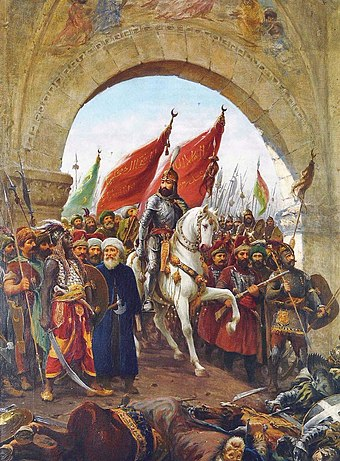
1453 Constantinople was conquered by Mehmet II (Mehmet Fatih).
1459 Conquest of Serbia
1461 Conquest of Trebizond, the last Christian state in the East
1463 Conquest of Bosnia
1468 Conquest of Morea and Albania
1504 The Romanian principalities absorbed
1514 Battle of Chaldiran against the Safavids and the temporary occupation of Tabriz
1516-17 Armies of Sultan Selim I captured Syria, Palestine, Egypt and Muslim holy places in Arabia. The Sultan assumes the title of Caliph
1520 Conquest of Belgrade
1522 Conquest of Rhodes
1526 Conquest of Hungary
1529 Conquest of Algeria
1534 Iraq captured: Baghdad 1534, Basra and Kuwait 1538, Bahrain 1554
1535 Tunisia captured
1538 Albania captured
1551-60 North African conquests: Tripoli 1551, Bougie 1555, Jerba 1560
1565 Malta captured, Cyprus captured
Beginning of Decline
1683 Failure of the siege of Vienna
1699 Peace of Karlowitz, the Sultan relinquished most of Hungary
1774 The Kutchuk-Kaynarja Treaty was signed with Russia after a thorough defeat on land and sea
1789 Serious efforts to reform the empire, called the Tanzimat
1798 Napoleon invades Egypt
1830 French invasion of Algeria
1876 The first Ottoman Constitution under the last Tanzimat reformer, Midhat Pasha
1881 Tunisia lost
1882 Egypt lost
1908 The Young Turks Revolution
1912-13 The Balkan Wars, and the empire’s expulsion from Europe
1922 The end of the empire. Caliphate abolished

