

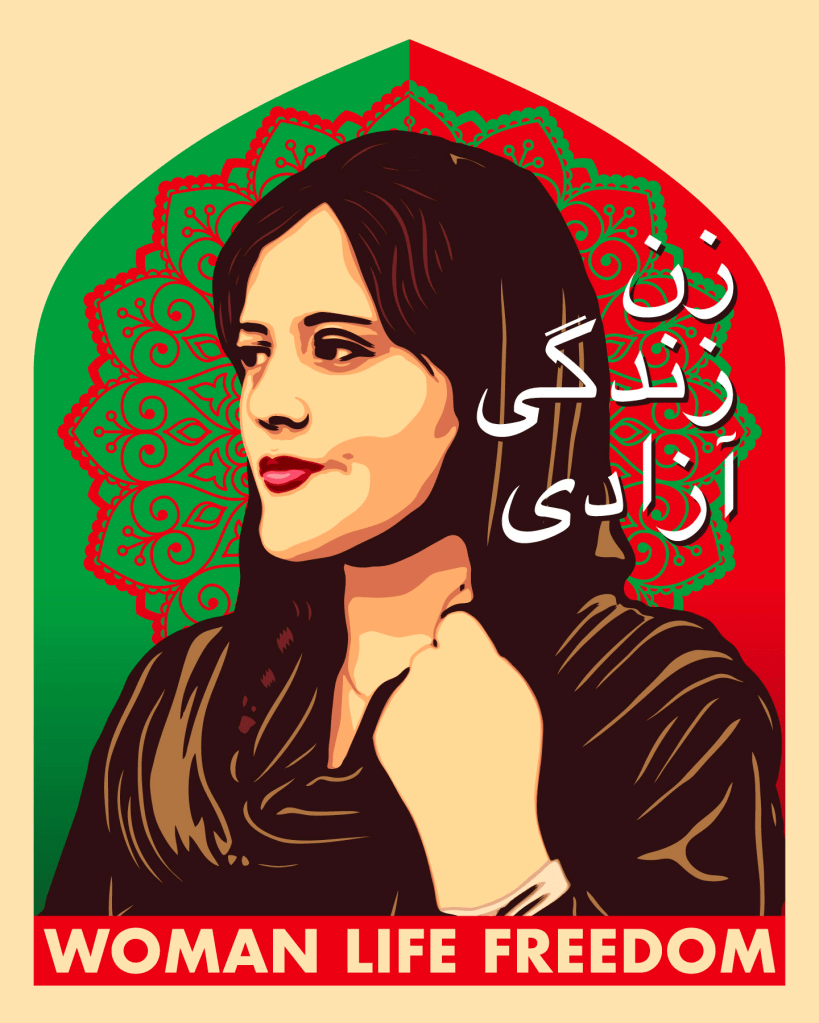
Recently, I was asked to speak at a conference in Paris on 18 March 2023 on the latest protests in Iran. I could not attend personally, so I sent a recorded talk. Here is a link to it in case anyone would like to listen to it. The talk is in Persian:
The English translation:
Iran on the eve of the “Woman, Life, Freedom” Revolution, by Farhang Jahanpour
In the past few months, there has been much discussion about nationwide protests in Iran led by women following the tragic death of Mahsa Amini, with the powerful and beautiful slogan of “Woman, Life, Freedom.” Instead of addressing some points that are completely known to all of us, I would like to discuss some generalities.
There have been many ups and downs in Iran’s long history. Some of those changes have been very important and groundbreaking. Such as the establishment of the Median dynasty, the establishment of the Achaemenid Empire, Alexander’s invasion, the Parthians, the Sassanids, the Arab invasion and the establishment of Islam, the Mongol invasion and the establishment of the Safavid Empire.
In recent Iranian history, the Constitutional Revolution ushered in a new era, marking the end of absolute rule and the move toward a democratic system. However, despite numerous sacrifices, the Constitutional Movement did not achieve all of its goals. World Wars I and II and the involvement of foreign powers interrupted and undermined that movement. After that, the establishment of the Pahlavi dynasty, although it led to reforms and the modernisation of Iran, the British removal of Reza Shah, the 1953 coup, and the late Shah’s hesitation about reigning instead of ruling, prevented Iran from moving toward true independence and democracy.
The 1979 revolution began with the slogans of freedom, independence, and social justice, and many people believed that the revolution was a continuation of the Constitutional Movement, but very soon, most people realised they had been deceived. The revolution not only failed to establish political freedom but also deprived the people of many of the social freedoms they enjoyed at that time. Instead of establishing democracy, the Islamic regime founded one of the most brutal, arbitrary, regressive, and authoritarian regimes in the history of contemporary Iran.
In my opinion, Iran is on the cusp of another significant and transformative period. The question is whether this nationwide movement will fail again due to violence, excessive ambition, impatience, and a lack of a clear plan, or whether it will usher in a new era of development and democracy in Iran this time.
There’s a good English proverb that we shouldn’t make the perfect the enemy of the good. In other words, sometimes in the hope of achieving perfection, we can fail to achieve the best that is available.
The revolution was an inspiration to other anti-Western and Islamist groups in the Middle East and beyond, and it marked the beginning of a period of political Islam. However, the nationwide protests that have continued since the death of 22-year-old Mahsa Amini in the custody of Iran’s so-called “morality police” on 16 September 2022, on charges of not adhering to hijab, have shaken the foundations of the clerical regime perhaps more than ever before.
The difference between the current protests and previous ones is that the new uprising was initiated primarily by women with the beautiful and powerful slogan “Woman, Life, Freedom,” which was soon supported by a large segment of the population. This uprising spread to all parts of the country and has continued for months despite widespread government violence.
It is important to analyse the reasons for the failure of the Islamic Republic. The survival of the Islamic Republic, which has weathered many storms, is based on six factors:
1. The regime maintained some elements of democratic legitimacy, meaning that while it called itself Islamic, it was also a republic with some elected bodies such as a parliament or assembly and a president.
2. The religious nature of the revolution enjoyed the support of a large number of religious people, including the powerful religious establishment.
3. The regime’s populist economic programs and increased focus on the lower classes and rural areas attracted the support of the poorer classes, who make up the majority of society, in contrast to the Shah’s pro-urban and elite-centric policies.
4. The horrific experience of US-backed wars in Afghanistan, Iraq, Libya, Syria, and Yemen convinced many Iranians to stick with the devil they knew rather than plunge the country into chaos.
5. There was no single, sustainable alternative, either within Iran or among Iranians abroad, which seemed attractive to most Iranians.
In recent years, virtually all of the above benefits have been reversed. The regime’s democratic claims have been seriously undermined in the course of the last parliamentary and presidential elections. In the last parliamentary elections on February 9, 2021, the Guardian Council disqualified almost all reformist and moderate candidates. As a result, the Conservatives won the vast majority of seats.
The situation was worse in the last presidential election in June 2011. After disqualifying all prominent reformist and moderate candidates, the Guardian Council only approved seven candidates, including Ebrahim Raisi, the candidate selected by Mr Khamenei, and Mr Raisi was declared the winner. In this way, Khamenei and the Guardian Council tried to have a homogeneous team by manipulating the elections. They have achieved this because conservatives now control the executive, legislative, and judicial branches. But all of this has created serious divisions in the country and even within the religious establishment.
At least seven leading ayatollahs have condemned the excessive use of force against protesters and distanced themselves from the regime. Among them, Ayatollah Asadollah Bayat Zanjani described the “behaviours” that caused Amini’s “regrettable” death as “illegal, illogical, and illegitimate.” He warned that the use of force by government forces has never led to the spread and establishment of divine and human values in any society. In a fatwa, he said that all Muslims are obliged to defend themselves and others “against plainclothes agents who attack protesters with weapons or knives.”
Sayyed Hassan Khomeini, the grandson of Ayatollah Ruhollah Khomeini, who has sided with the Reformists, called on the judiciary to deal “immediately” with those responsible for Amini’s death. He said the government “had better start listening to the people.”
Opposition to Ayatollah Khamenei has also extended to members of his own family. Badri Hosseini Khamenei, the leader’s sister and the wife of a prominent cleric, wrote in an open letter in late November: “The regime of Khomeini and Ali Khamenei’s Islamic Republic has brought nothing but suffering and oppression to Iran and Iranians.” She bravely emphasised, “I hope to soon witness the victory of the people and the overthrow of this tyrannical ruling Iran.”
This level of criticism from a large number of prominent ayatollahs and close associates of Khomeini and Khamenei is unprecedented and indicates that many members of the religious hierarchy are abandoning a sinking ship. This is in addition to the harsh statements made by former President Hassan Rouhani, former Parliament Speaker Ali Larijani, and former Foreign Minister Javad Zarif, all of them condemning the use of force against protesters.
In the meantime, the views of two members of the reformist camp stand out. Former Prime Minister Mir Hossein Mousavi called for a new constitution to replace the current one in an open letter. His proposals were:
One: Holding a free and “healthy” referendum on the necessity of making changes to the current constitution or drafting a new constitution.
Two: If the people respond positively, the formation of a “Constituent Assembly” composed of the true representatives of the nation through free and fair elections.
Three: Holding a referendum on the approved text of that parliament in order to establish a system based on the rule of law, stemming from the will of the people, while also respecting human rights principles and human dignity.
These are revolutionary proposals. They are demanding the complete dismantling of the Islamic Republic and the establishment of a new system based on the will of the people. Mousavi’s proposals have garnered significant support both domestically and among Iranians abroad.
On February 5, 2023, one day after Mousavi’s open letter was published, former President Mohammad Khatami issued a statement in which he attempted to moderate Mousavi’s demands. Khatami called for reforms instead of overthrowing the Islamic Republic. Khatami put forward 15 proposals in his lengthy statement, including: free and competitive elections, improving the judicial process, releasing political and house arrest prisoners, lifting media restrictions, combating government corruption, reviewing the role and composition of the Assembly of Experts, the Guardian Council, and the Expediency Council, reducing the role of the military in politics and the economy, and a foreign policy based on dialog rather than isolationism.
Whether Iranians accept Khatami’s or Mousavi’s proposals or take more radical actions, it can be said with certainty that a return to the situation before Mahsa Amini’s death is not possible. After 44 years of experience, Iranians have seen the true face of religious dictatorship and are thirsty for freedom and democracy.
Instead of debating the proposals of various members of the clerical regime, we should emphasise the importance of the UN Charter, which is accepted by all countries of the world, including Iran, and which speaks of freedom, peace, and equality. Iranian government and other dictatorial regimes must either act in accordance with the UN Charter or leave the United Nations. Other important provisions of that charter include:
Respect for human rights and fundamental freedoms
Freedom of association
Freedom of speech and belief
Access to power and its exercise in accordance with the rule of law
Holding free and fair periodic elections by public and secret ballot as an expression of the people’s will.
A pluralistic system of political parties and organisations, separation of powers, judicial independence, transparency and accountability in public administration, and free, independent, and diverse media.
Changes in Iran should be brought about by the Iranians themselves, with the moral support of other countries and international organisations. The West can help the Iranian democratic movement by emphasising that not every change leads to an imposed regime from abroad. By not interfering in Iran’s internal affairs, the West can help Iranians do the necessary work for themselves and replace a bankrupt and corrupt regime with the first truly democratic government in the Middle East.
My suggestion to the regime’s leaders is to provide an opportunity for peaceful change. It is impossible to continue the current system in the long term, or even the medium term. Their only choice is to either be forcibly removed from power, which would be costly for them and for Iran, or to submit to public demands and allow peaceful changes to occur. If they choose the second option, they will do a great favour to themselves and to the patient and oppressed Iranian people. If they act in time, they can avoid the fate of Saddam or Gaddafi. They need to learn a little humility and soften their hard hearts. As Rumi said
A hard stone will not blossom and go green in spring.
Become soil so that colourful flowers may bloom.
For years you were a hard stone, cold and dead.
For a change, be dust for a time.
The choice is theirs. The current rulers will not have the choice of resisting the impending revolution, but they do have the choice of allowing it either to occur peacefully or violently.

