

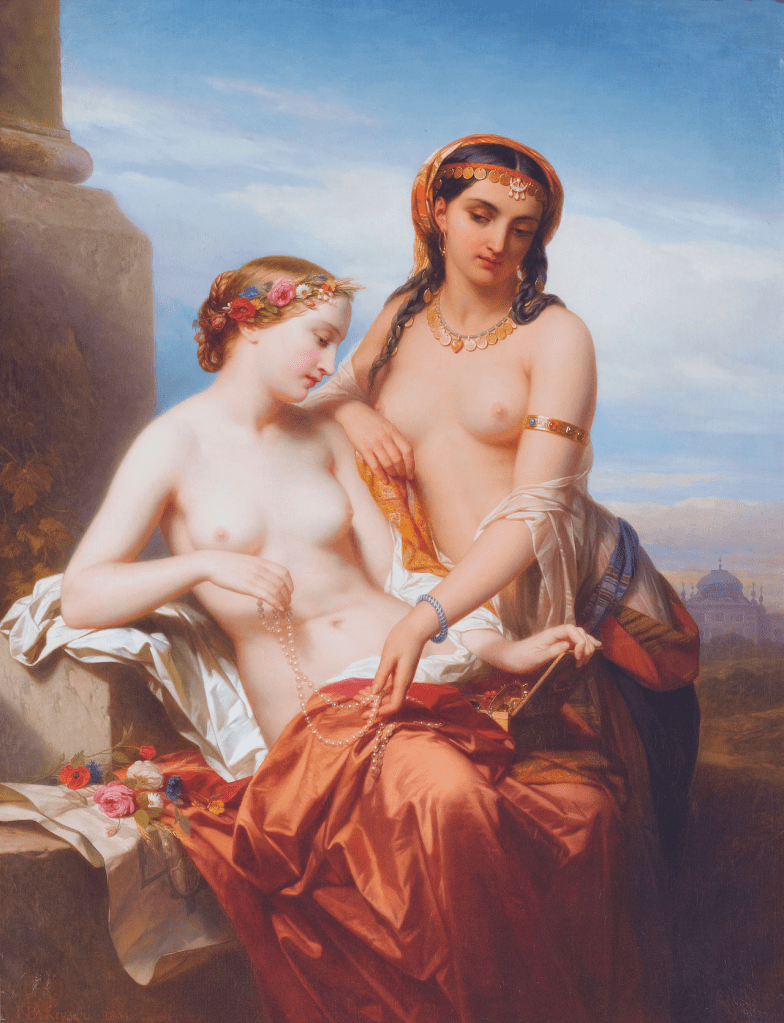
The Orient and the Occident, by Nicaise de Keyser (1854)
Lecture 2 in a series of lectures given to a group of British and American journalists at the BBC Monitoring on 2 March 1999
In the same way that Western perceptions of the Middle East – especially in the popular media – are simplistic and generalised and often hostile, Middle Eastern impressions of the West are also widely inaccurate and simplistic, maybe even more so than the other way around. In the same way that many people in the West regard the Middle East or Islam as a monolithic entity plagued by fundamentalism and terrorism, many people in the Middle East also think of the West as a single homogenous, indivisible, frightful, materialistic, ungodly, militaristic and hostile entity. Professor Akbar Ahmed, a Pakistani scholar and Fellow of Selwyn College at the University of Cambridge and a leading scholar of Islam and the West, who is a very moderate Muslim and is in no way a friend of Muslim fundamentalism, in his book Postmodernism and Islam writes:
“Western civilization – whenever historically exploding from Europe – has meant death and destruction: From the time of the Crusades (usually launched with a wholesale massacre of Jews, setting the pattern for Europe’s treatment of its minorities), to the sixteenth century when it wiped out the entire native population of the Caribbean; from the devastating consequences, in Africa, of slavery and transportation in the death-ships, to the decimation of the autochthonous tribes of Australia and the United States. And in the two world wars that shook this century, Western civilization fought itself. Nothing on this scale had been seen before. Western civilization enveloped the entire globe in the madness of war; millions and millions of people were killed and entire nations obliterated.”[1]
Of course, like all generalisations that are made by Western observers about the Middle East, the above statement also has a germ of truth in it, but it is not the whole truth. It is simplistic and engages in stereotyping. Due to its preeminence among Western nations, the United States is regarded by the rest of the world as the leader and the true representative of the West as a whole, and as being responsible for the alleged Western ills. To quote the above author again:
“… In its role as the champion of the West from the middle of the twentieth century onwards, America has begun to acquire the historical, psychological and geo-political characteristics of imperial power: an Imperial Rome in ancient history and an Imperial Europe in contemporary times. Visions of a New World Order, dispatching troops all over the world to enforce it, and providing a lead to other nations in almost every human society are imperial signs (or neo-imperial, if you like). The United States may be a reluctant Roman entrant to the imperial club but is, nevertheless, there with the Romans and all the others.
The actions of America when dealing with native, non-white populations, therefore, have ominous historical resonances and do not inspire confidence; the treatment of American Indians in the last century set the tone: Hiroshima and Nagasaki in 1945, napalm and carpet-bombing in Vietnam in the 1960s and the horrors of the Gulf War in 1991 were a logical sequence. The motto and promise of the typical American soldier to ‘bomb them into the Stone Age’ is as much a philosophical statement as a reflection on a historical and cultural tradition.”[2]
Although the above sentences do seem harsh and extreme to many Europeans and Americans who have a completely different view of their history and of their present role in the world, it is essential to realise that this is how some people — especially in the Middle East — view the United States. T. S. Eliot said that people cannot stand too much reality. Therefore, they resort to myths. However, myths can be very strong, and they can become substitutes for reality. All of us, either consciously or unconsciously, are under the spell of some powerful myths. These myths become more powerful when we are faced with a superior force that is seemingly beyond our control.
As informed journalists who have read all the statements that keep coming out of Iran and the rest of the Middle East, especially from the Islamist sources, about the West in general and about the “Great Satan” in particular, you do not need me to repeat them to you. However, it may be useful to look at some of the headings of the problems that concern the people in the Middle East and try to categorise them, and see if one can find any solutions for those distorted ideas. Stating the grievances of many religious-minded people in the Middle East about the West does not mean that they are correct or that I agree with them, but it is important to at least be aware of some of the major issues that bother them.
Some of the most common complaints of Middle Eastern peoples against the West are:
1- A sense of Western domination of the Muslim world. As I mentioned in the last lecture, since Napoleon’s invasion of Egypt in 1798, nearly all the Middle Eastern countries, except for Iran and Turkey, became colonies of Western powers. Even Iran and Turkey, which were not directly colonised, came under overwhelming European power and influence. Although the era of direct colonialism gradually ended after the Second World War, the power and influence that European countries exerted on the Middle East have been replaced with the dominant power of the United States.
At the moment, the United States exerts the greatest military and economic influence over the entire Middle East as a whole, especially over the Persian Gulf littoral states, as was witnessed by the Gulf War. A few dozen allied fatalities, most of them through accident or by friendly fire, as opposed to tens of thousands – maybe hundreds of thousands – of Iraqi casualties, demonstrated the overwhelming power of the West vis-à-vis the Middle East. In the eyes of many Middle Eastern people, America’s domination over the Middle East smacks of neo-colonialism. They believe that after the collapse of the Soviet Union, the American superpower is now acting as the only remaining empire.
2- A feeling that Western imperialism is dividing the Islamic world. The Ottoman Empire, the last seat of the Islamic Caliphate, was dismantled after the First World War, and its territories were mandated to various European powers. The West, in pursuit of its own oil interests and pursuing the divide-and-rule policy, created many new states in the Persian Gulf region. If we look at the map of the Middle East at the beginning of this century, we will see that the political geography of the area was quite different from the present one. At that time, most of the Middle East was dominated by the Ottoman Empire and Iran, and the tiny sheikdoms that now form the GCC did not exist. Even Iraq did not exist in its present form. It was established by Great Britain in 1923.
The Kurds had been promised a home by Articles 62-64 of the Treaty of Sèvres of 1920, and they were expecting statehood or at least autonomy, but in renegotiating this treaty, the Treaty of Lausanne in 1923 omitted any reference to Kurdish autonomy. Kurdish areas were divided between Turkey, Iraq and Iran. Mosul and Kirkuk, the oil-bearing regions of the former Ottoman Empire, were transferred to the new Iraqi state, mainly for Britain to have access to the oil reserves of that region. Jordan was artificially created out of the post-World War I carve-up of the Middle East by Britain and France.
At the moment, following the Second Gulf War and the establishment of the No-Fly Zones in northern and southern Iraq, many people in the Arab world are worried about the possible dismemberment of Iraq. Many people also complain that the West attempts to turn some Muslim states against others, as can be seen in the Persian Gulf, Afghanistan and Central Asia.
3- The West supports dictatorial regimes. In many Middle Eastern countries, the regime and the people are not one and the same thing. In fact, in many of them, the state is seen as the real enemy that has been imposed on the people and has to be fought even before fighting the foreign infidel. There is a feeling in the Middle East that if there is a choice between two absolutist regimes, the West will support the one that is not Islamic. Non-Islamic — or preferably anti-Islamic — dictators are favoured above Islamic dictators or even Islamic reformers. The West remains silent about the violation of democratic elections in Algeria, or the removal of an Islamist government in Turkey by the military, but constantly complains about the lack of democracy in countries such as Iran, Sudan, Libya, etc.
4- The use of democracy and human rights as foreign policy tools. The issues of democracy and human rights are highlighted selectively, depending on whether the West favours a regime or not. Violations of the rights of ethnic or religious minorities, of women, or the violation of the most basic individual rights are ignored in some countries, which are allegedly friends of the West, while similar problems are highlighted and criticised in other countries that do not have pro-Western governments. Therefore, it is argued that the West is not really sincere in its advocacy of democracy and human rights, and engages in double standards when applying these principles to different regimes in the Middle East.
5- A sense that the impact of the West is corrupting. To the conservative, religious societies in the Middle East, the secular modern world with all that it entails for family life, for relations between the sexes, for the alienation of older and younger generations from each other, even for the way that people live, dress, think and work, seems to be a major threat. Western ideas and values are propagated through Western media or even through domestic media that is heavily influenced by the West. The impression that serials like Dallas and Dynasty, often dubbed and broadcast on local media, leave on the lives of impoverished people living in the slums of some Middle Eastern countries must be quite devastating, to say nothing of the huge amount of pornography that is flooding the Middle East. By watching such serials, the impoverished people of the Middle East can only become more aware of the enormous economic gap that exists between them and the lavish lifestyles portrayed in those serials.
Another source of the transfer of Western customs and values is through tourism, both as a result of millions of people from the Middle East visiting the West, and millions of Western tourists visiting the Middle East. In the eyes of religious fundamentalists, the much freer lifestyle of the tourists and Westernised local elite is a manifestation of prostitution, corruption, decadence and vulgarity. They feel that they are losing their grip on all that seems sacred to them. No wonder that Ayatollah Khomeyni’s major attacks against the regime of the Shah revolved around the issues of the emancipation of women, the corruption of morals, inviting a large number of American advisors to Iran and granting them diplomatic immunity, and in general, what he and others called “Westoxication”.[3] In Egypt, tourists are one of the main targets of Muslim militants, not only as a way of disrupting government income but also to prevent what they see as the corrupting influences of foreign tourists. The enormous impact of the Western media, information technology and alluring Western lifestyles is what was termed by Khomeini as the “Western cultural onslaught.”
6- The West is imposing its own standards in the case of cultural, political and human rights values. In the cultural, literary and artistic domains, there is also a feeling that ancient local literary and cultural values are looked down upon, while the imported Western culture is favoured by the new secular elite. In Turkey and most countries in Central Asia, even the way that people write is changing from the millennia-old Arabic script to the Latin script. Even the way that the people dress marks them out as passive victims of Western culture. This is why in Iran or Afghanistan, even wearing a tie is often regarded as a Christian symbol and a sign of Western cultural domination. This is why in most Islamic countries, the issue of female dress has assumed such political significance, why the chador or hijab is used almost as an Islamic uniform, while lipstick and nail varnish are regarded as signs of capitulation to the West.
7- The West is indifferent to Muslim oppression, not only in Palestine, but in Chechnya, where some 40,000 Muslims were killed by Yeltsin and there was only very muted protest in the West, or in Bosnia where tens of thousands of Muslim women were gang-raped by Serb soldiers, thousands were killed and a large number were made homeless before the West took any action. Many people in the Middle East believe that the West does not attach the same value to the life of someone from the Middle East as it does to the life of a European or an American.
8- The slow pace of progress in resolving the Arab-Israeli conflict. To many people in the Middle East, the creation of the state of Israel was at the expense of the Palestinians, where the land of the Muslims and Arabs was given mainly to European and American Jews. According to them, the Palestinians had to pay the price for the atrocities that had been committed against the Jews in the West. The alleged Western inaction regarding the continued occupation of Palestinian, Syrian and Lebanese territory by Israel is regarded as a sign of Western double standards when compared to the strict enforcement of UN resolutions concerning the Iraqi invasion of Kuwait.
When Saddam Hussein tried to bargain with the West and say that he would leave Kuwait if Israel also left the occupied territories, President Bush stressed that UN Security Council resolutions were not for bargaining, and had to be implemented to the letter. However, a large number of Security Council resolutions calling on Israel to withdraw from the occupied territories – most notably Resolutions 242 and 338 – are gathering dust, and the West does not seem to be too enthusiastic about implementing them. In fact, instead of forcing Israel to implement those resolutions, the West has changed the rules of the game and has started a “peace process”, as a result of which the Palestinians are called upon to make one compromise after another.
9- The biased coverage of all these issues in the Western press. As I said in the last lecture, many Middle Eastern people and even many Muslims in the West see the portrayal of Middle Eastern affairs in the Western press to be very biased and one-sided, stressing all the negative aspects of unfriendly Middle Eastern countries and minimising their contribution either to Western civilisation in the past, or their own achievements in economic and social fields under difficult conditions at present time. The events in the Middle East are often reported in a very biased and convoluted way, covering up the atrocities of the regimes friendly to the West and exaggerating the misdeeds of others.
While some of these complaints are real and have a basis in fact, as a whole, they are distorted and misleading. These perceptions of the West are often the result of the lack of sufficient information about the West and Western policies towards the Middle East. In order to put these issues in perspective and to correct some of the misunderstandings, it is important to pay attention to some of the following points:
1- Starting with the comments about American policies and American neo-colonialism with which I started my talk, it is often forgotten that the American Revolution, the American Constitution and the Bill of Rights provided the inspiration for the French Revolution and, strangely enough, even for the communist revolution and many other subsequent revolutions. The ideas about the separation of powers, the inalienable rights of the individuals, the ending of the powers of the kings and tyrants, a genuine desire for decolonisation and providing equal opportunity for all were very revolutionary ideals for the time. They still shine like a beacon of light for many countries plagued by dictatorship, despotism and violations of human rights. America assumed a leading role in the creation of the League of Nations, the United Nations and the Universal Declaration of Human Rights. These were and still are the strongest legal means for the protection of the rights of the smaller and weaker countries, and they provide a benchmark for judging the behaviour of large and small countries. I believe that these points need to be stressed more, for the information of the critics outside, as well as for providing a reminder to the Americans about their own highest aspirations.
Indeed, compared to any other former great power or empire, the United States has been the most benevolent and altruistic and has been most anxious to abide by the rule of law and international obligations. It provided massive help for the rebuilding of Europe after the Second World War in the form of the Marshall Plan, and enabled the war-shattered economies of European countries to be rebuilt, in time to provide a major rival to that of the United States. As an outside power that was not directly involved in the conflict as a major European player, the American influence enabled the former enemies to live in peace and to create the European Union.
The United States played a major role in the decolonisation of Asia, Africa and the Middle East, from its initial support for the nationalisation of the oil industry in Iran before the 1953 Coup, to stopping the British, French and Israeli invasion of Egypt during the Suez fiasco. It also helped provide the security background for the British withdrawal from the East of Suez in the early seventies. President Woodrow Wilson’s Fourteen Points were a revolutionary statement of peace and decolonisation, infused with a rare and forward-looking sense of optimism and idealism.
In his speech on January 8, 1918, in which Wilson outlined the main principles of his plan, he directly addressed what he perceived as the causes of war by calling for the abolition of secret treaties, a reduction in military spending, an adjustment in colonial claims in the interest of all, specifically the colonized people. He advocated the removal of economic barriers between nations, the promise of self-determination of nations and national minorities, and a world organisation that would guarantee the “political independence and territorial integrity [of] great and small states alike.” In short, it was a revolutionary anti-colonialist and anti-imperialist document.
The United States has been one of the most generous providers of economic and financial help to the Third World. Above all, its treatment of an impoverished Russia after the collapse of communism shows that, despite all the hostile propaganda about American capitalism and imperialism, the United States did not use Russia’s weakness after the collapse of the Soviet Union to crush that country. On the contrary, she has provided generous economic assistance to that country to put it on the road towards democracy and liberalism, even though in time, Russia may again develop to a point that it might act as a rival to the United States.
2- A lot of the criticism directed against the West is not exclusive to Islam or the Middle East. It is the common language of the colonised world in Latin America, North Korea, China, Africa, etc. This is also reminiscent of the kind of criticism that was made against the West in the former Soviet Union. The feeling of being oppressed is common to all nations when they are faced with countries much more powerful than themselves. Similar criticisms were made against the British or the French at the height of the British and French empires. The Ottomans and the Persians were criticised for arrogance or oppression when those countries were in a position of superior power.
It should be borne in mind that all countries and nations have national interests, and various Western countries are merely pursuing their own national interests, which might go against the interests of other nations. If the activities of some Middle Eastern countries accord with Western interests, Western leaders are quite willing to close their eyes to some of the shortcomings and violations of those countries. On the other hand, if Western powers regard a country to be hostile to them, they will pursue a hostile policy towards that country and will make use of concepts such as democracy and human rights as additional ammunition to embarrass that country. This does not mean that Western advocacy of democracy and human rights is not sincere or laudable, but it is important to bear in mind that the West is not always consistent in the application of these standards to other countries.
3- When governments in Iran, Iraq, Afghanistan, Sudan, Saudi Arabia or elsewhere in the Islamic world say something in the name of Islam, how much of it is government view and government propaganda, and how much of it is truly Islamic? In the same vein, how much of what those governments say and do necessarily represents the views and the interests of their citizens, and how much of it is merely an excuse for holding on to power and creating real or imagined enemies? Indeed, the question to ask is whether in the Iran-Iraq War or the Gulf War, it was the United States that inflicted the greatest human casualties and economic loss upon those countries or the regional states themselves, most notably Iraq. Has America done more harm to Afghanistan or various Mujahideen groups who fought for years among themselves for supremacy, followed by the Taliban that have imposed a medieval, brutal and harsh regime upon the entire population of that tragic land?
The United States spent more money on Muslim Mujahideen in Afghanistan than it spent on any other single project. At the time that the Afghan Mujahideen were fighting against the Soviet Union, the West was not concerned about their fundamentalist Islamic ideology. That became an issue only when that ideology was used as a weapon against the West. Therefore, the West is not launching a campaign against Islam, but against what it regards as a threat to its interests.
4- The West does not have friends or enemies, but interests. These interests are more and more concerned with the acquisition of markets. In a clear definition of the Capitalist economy, Voltaire said that “in the marketplace, there is no difference between a Jew, a Christian or a Mohammedan. The only infidel is a bankrupt.” If the West sees that its enormous economic interests in the Persian Gulf and its access to secure oil at a reasonable price is threatened, it will take action to safeguard its interests, as it did during the Iran-Iraq War and the First Gulf War.
5- Many of the problems of the Middle East are not imposed from outside but are self-inflicted. The chronic disunity among the Arab countries, the lack of democracy, the prevalence of corruption in many governments, and the lack of popularity and legitimacy of many Middle Eastern regimes are not due to Western plots but are due to the inadequacy of those regimes, or the inability of the people to change those regimes. It has often been argued that the Middle Eastern people are not ready for democracy and human rights. This argument may suit the autocratic governments of the region, but it does not suit the tyrannised people. Taking the case of Iran, we have seen that in all free elections that have been held in that country, a vast majority of people have opted for democracy, political liberalisation, extension of individual freedoms and human rights. Yet the right-wing elements whose interests will be undermined as a result of these policies have continued to deny people’s basic human rights in the name of protecting Islam.
6- Another major problem in the Middle East is a kind of political fatalism. People feel paralysed to do anything themselves to change the situation. They criticise outsiders for meddling in their affairs, but at the same time, they are waiting for a solution to be imposed from outside. Those societies will change only when they learn to take their own destiny into their own hands and bring about the desired changes. Again, taking the case of Iran, in the past, all the problems of the country were attributed to Britain, while at the moment, the “Great Satan” is held responsible for all the problems that the country faces. After the triumph of the Islamic revolution, many educated Iranians argued that the West had imposed the Islamic regime on them, and it was up to the West to remove that regime from power. The feeling of political helplessness is not unique to Iran. Most Middle Eastern people seem to believe that they are powerless in the face of what they regard to be Western domination and superior power.
7- Many concepts and ideas have now become universal, and many Middle Eastern countries have signed up to them. These values, such as the equality of the rights of men and women, human rights, freedom of belief, expression and movement, should not be regarded as merely imposed Western ideas. They are universal values that have evolved with time, even in the West, and they should be accepted and adhered to by the Middle Eastern countries as part of a common human heritage. Indeed, many Muslims rightly claim that a great deal of the human rights violations that are committed in the name of Islam, such as the issues of obligatory female hijab, the unequal relationship between the sexes, harsh physical penalties, the issue of blasphemy, etc., have nothing to do with Islam. It could even be argued that there are many Koranic injunctions against such practices, and they should be stopped.
8- The Western support for Israel is not merely due to self-interest, the result of the influence of the Jewish lobby or due to anti-Arab or anti-Islamic policies. I believe that the Arabs and the Muslims as a whole have not properly appreciated and acknowledged the enormity of the Holocaust and the role that it played in shaping the Jewish psyche. Some six million innocent people were massacred purely due to their religion or race. A great deal of universal sympathy for the Jews and for the state of Israel is sincere and heartfelt. It is an attempt to protect the Jews from ever going through those awful experiences again. This is something that must appeal to Muslims too. What is needed is more education about what the Jewish community as a whole went through over many centuries, especially during the Second World War.
Because of the long history of cooperation and co-existence between the Jews and Muslims, the Islamic world needs to show greater understanding and sensitivity towards the tragic consequences of the Holocaust, in which Muslims, Arabs or the people in the Middle East played no role. They should appreciate the unique historical harm that was inflicted upon the Jews as a whole and accommodate them in their midst, in the same way that was done after the expulsion of the Jews and Muslims from Spain in 1492. Islam regards Muslims and Christians as the People of the Book and, consequently, their treatment in Islamic countries has, on the whole, been much better than in the West in past centuries.
The present climate of hostility and mutual propaganda against each other, and a feeling of hatred that has marred the relationship between the Arabs and the Israelis, are most unfortunate and indeed unprecedented. The Arab-Israeli conflict will not be solved until both groups develop a feeling of sympathy for the other side, and the Israelis try to be integrated into the Middle East, rather than regard themselves as a Western enclave in the heart of the Middle East. They either believe that they belong to the Middle East and, therefore, they must feel and act like Middle Eastern people, or if they regard themselves as basically Western people forced upon the Middle East as a result of a colonial endeavour they will never feel at home in the Middle East or be fully integrated into it. For this to happen, they also need to feel secure within recognised borders.
Solutions:
Of course, it is unrealistic to expect the governments to forego their national interests. However, it can be argued that in the modern world, national interests can be served better through mutual understanding and cooperation rather than through confrontation and the use of force. The stability of the Middle East is in the long-term interest of the West. Therefore, it is essential to ensure the Middle East’s long-term stability even at the expense of some short-term Western interests.
The situation in the Middle East is extremely volatile at the moment. An entire generation of older leaders is leaving the stage to be replaced by younger politicians who might have a different approach to international issues and to their relationship with the West than the older generation. We have already witnessed this change in Jordan and last week in Bahrain. During the next decade, there will be more changes in Syria, Egypt, Morocco, Saudi Arabia and the rest of the Gulf states and in the leadership of the PLO.
We have already seen the initial moves towards greater democracy in Iran, Turkey, Kuwait and this week in the first election in Qatar with the participation of women. All of these are good signs, yet there are also many potential dangers on the way. The future of Iraq is still uncertain, and none of the options on offer is very enticing. The situation in Afghanistan has gone from bad to worse with the domination of the Taliban. Turkey will be going through major elections next April that can once again produce a strong showing for the Islamist and even the Kurdish parties. The situation in Algeria is very tragic and very dangerous.
Immediately after the victory of the Islamic revolution in Iran, there was a great deal of anxiety about the spread of the revolution and the effect that it could have on the rest of the Middle East. As these dangers did not materialise, a feeling of false security emerged. Most revolutions take some time to mature and for their influence to be felt in other parts of the world. At the moment, the Middle East is poised between the possibility of greater democracy and liberal governments on the one hand, and another lurch towards militancy and Islamic radicalism on the other. If, for instance, the Islamist forces in Algeria were to triumph and establish a radical Islamic government, that would have a strong effect on many other Arab countries in North Africa and beyond. Of course, these developments primarily rely on the activities of the people in the Middle East, but the policies that the West will adopt in its relations with the Middle East will also have a great impact on the course of developments in future.
There is a much greater degree of political awareness and political activism among the young generations in all the Middle Eastern countries. More than half of the population of nearly all Middle Eastern countries is below 25, and nearly two-thirds are below 30. If the new generations who will be running the Middle East in the coming decades lose hope in Western democracy and Western ideals, they will turn with a vengeance to Islamic militancy. It is absolutely essential for the West to take a long-term view of the situation and to try to persuade the emerging generations to turn towards liberal democracy rather than towards anti-Western religious militancy. In order to achieve that end, I humbly propose that the West must do some of the following:
1- Try to encourage democracy — in deeds and not in words — in all the Middle Eastern countries. The selective advocacy of democracy where it suits the West and trying to prevent it when it is believed to be against short-term Western interests would be disastrous. There is a higher level of education among young people in all the Middle Eastern countries, and thousands of young people complete their advanced studies in the West and return to their countries. If these educated people who have become familiar with Western democracy find that their democratic rights are suppressed back home, or if they cannot fully participate in the political life of their country, they will become disillusioned, and the experience of Iran will be repeated.
The West might feel that some of its short-term interests would be better served by preventing the spread of genuine democracy in some of the oligarchic states in the Persian Gulf or in the rest of the Middle East. Democratic governments might want to question the amount of oil and other resources that are exported from their country, how the revenue is being spent, or the presence of Western troops in their country. However, in the long term, those countries have to sell their oil, and if they can become more democratic, they will be more stable and more reliable. The continuation of a feudal and undemocratic situation in many Middle Eastern countries will lead to havoc after the present generation of leaders eventually leaves the scene, and there is a battle for succession among their appointed heirs.
2- Stop demonising Islam and Islamic regimes, for that might become a self-fulfilling prophecy. There should be a real and genuine respect for people’s beliefs and way of life, while making it clear that violence, radicalism and terrorism are not acceptable ways of behaviour whether by Islamic or non-Islamic groups or governments. The convening of more conferences and gatherings for dialogue and genuine understanding between Muslim and Western intellectuals, artists, sportsmen, etc., can be very beneficial in removing the walls of mistrust.
3- Try to create respect for international organisations and international treaties. If the Middle Eastern people see that international organisations, such as the UN, the Security Council, the World Bank or the International Monetary Fund are being used as tools in the hands of the big powers, they will not feel obliged to adhere to them and will instead take the law into their own hands. That would only lead to anarchy and lawlessness. On the other hand, if they see that these organisations are acting independently for the good of all the member states, the respect for those organisations and for the rule of law will grow. UN resolutions will be respected if they are enforced equally in respect of all nations, but if they are enforced selectively, those international agreements and resolutions would lose their legitimacy and their effectiveness.
One of the greatest achievements of the post-World War II world has been the creation of international organisations that could pave the way for a New World Order. These organisations should be strengthened, not undermined or devalued. At the same time, efforts should be made to make them more representative of the present power blocs in the world, rather than resembling a club of the victors after the Second World War.
4- Try to resolve the Arab-Israeli conflict on a fair and equitable basis. The security of the state of Israel should be guaranteed by the West, but that does not mean that the West should pander to the most extreme demands of ultra-nationalist or ultra-religious Israeli groups. While nearly all Middle Eastern people have come to accept the right of Israel to exist within secure borders, they feel very strongly about the plight of the Palestinians as well. The fact is that the solution to the Arab-Israeli dispute and the status of Jerusalem are not only of interest to the Palestinians themselves but to the Islamic world as a whole. The grievances of the Palestinians still act as a rallying call throughout the Middle East and, in fact, the Islamic world.
The real solution for this conflict is for both the Jews and the Arabs to come to accept each other, for the Jews to feel that they belong to the Middle East, and for the Arabs to accept the Jewish people as one of their own. Not only are both the Jews and the Arabs Semites, not only do they share many religious beliefs as Islam and Judaism are very close, in a sense the state of Israel is also a semi-Arab country. Nearly one million Palestinians are living in Israel itself, as well as another million in the Gaza Strip and 1,500,000 in the West Bank and Jerusalem. There is also a growing percentage of the Israeli Sephardic Jewish population that has come from various Arab countries. This means that rather than continuously regarding themselves as a Western enclave in the Middle East, the Israelis should regard themselves as part and parcel of the Middle East, and should be regarded as such by the rest of the population. The Jewish connection with the Middle East goes back more than three thousand years, and ever since the rise of Islam, the Jews and Arabs have lived quite amicably together.
If Israel is truly integrated into the Middle East, as was the hope behind the Madrid and the Oslo Agreements, not only would Israel find permanent peace and prosperity, but it could even act as the engine of development for the rest of the Middle East. However, if the present conflict continues, not only will it deny Israel the peace and security that it craves, but it will also further alienate the rest of the Middle East from Israel and its Western supporters.
5- Genuine attempts should be made to strengthen the provisions of regional peace and cooperation. There should be regional security pacts that would provide an incentive for all the regional countries to cooperate in the cause of peace, rather than constantly increasing their armament and living in a state of permanent confrontation. Supporting one group or one country in the Middle East at the expense of others is counterproductive. The United States cannot go on policing the Persian Gulf region forever. Genuine security arrangements with the backing and supervision of the West would be much cheaper and much more stable.
6- Get rid of the nuclear weapons and the weapons of mass destruction in the Middle East as a whole. If some countries see that others possess such weapons, there would be a very strong temptation for them to acquire them as well. This would ultimately destabilise the entire region and may lead to unforeseen consequences. However, a genuine, even-handed and transparent attempt at the destruction of such weapons throughout the Middle East would greatly reduce tension and would pave the way for greater cooperation. For a long time, many leading regional countries, including Iran and Egypt, have called for a nuclear-free Middle East that includes all states. This has often been opposed by Israel, with Western backing. In the long term, nuclear weapons do not ensure peace and security, and all states will feel more secure in the absence of weapons of mass destruction.
7- Try to make use of the enormous wealth of the Middle East and Central Asia for the benefit of all their people. At the moment, most energy reserves are concentrated in a few countries with very small populations, while larger countries like Egypt, Turkey, Sudan, Yemen and Syria are deprived of these resources. A proper policy of economic cooperation and integration throughout the Middle East and Central Asia can ensure that the small Persian Gulf countries can benefit from the manpower and expertise of larger countries, while the larger countries would also benefit from the wealth that exists in the region.
Many of these solutions may be regarded as idealistic and unworkable. However, given the enormous power and influence of the West and the growing trend throughout the world for detente, adherence to the rule of law and globalisation, such aims are not beyond the realm of possibility. I believe that the time for incremental reform has ended, and it is time for far-sighted diplomacy and an overall solution to all the problems that plague the Middle East. Trying to devise a global solution to the problems of the Middle East and Central Asia could be the next major task that should usher in the new millennium. The choice is either between a peaceful, democratic and prosperous Middle East that is integrated into the world community, or an unstable, hostile and fundamentalist region that will pose a greater threat to the region and to Western interests.
Appendix 1: Population, land area, oil and gas deposits in six Persian Gulf countries
| Country | Population in 1000 | Land area 1000 sq. km | GDP per capita $US | Oil reserves mill. Barrels | Gas reserves mill. SCM | Crude oil production 1000bbl/d |
| Iran | 65000 | 1648 | 1758 | 93700 | 19350 | 4200 |
| Iraq | 20380 | 438 | 823 | 100000 | 3360 | 736.9 |
| Kuwait | 1690 | 18 | 15170 | 96500 | 1494 | 2006 |
| Qatar | 610 | 11 | 12025 | 3500 | 7070 | 389.8 |
| Saudi | 18040 | 2150 | 6969 | 261450 | 5545 | 8023.4 |
| UAE | 1911 | 84 | 19403 | 98100 | 5831 | 2148 |
Source: DSD/SS, OPEC, 1999
The Persian Gulf littoral states account for two-thirds of the total proven oil deposits in the world. OPEC has 11 countries as members. The OPEC member countries supply more than 40 per cent of the world’s oil, and they possess about 78 per cent of the world’s total proven crude oil reserves.
Appendix 2: Proven crude oil reserves in the rest of the world
| Region | Oil reserves in billions of barrels |
| Western Europe | 15.6 |
| Africa | 73.2 |
| Latin America | 128.6 |
| Canada | 4.9 |
| USA | 29.6 |
Source: OPEC Review, 1997
Notes
[1] Akbar S. Ahmed, Postmodernism and Islam: Predicament and Promise (Routledge, London and New York, 1992), p. 103. [Professor Akbar Ahmad later served as Pakistan’s High Commissioner in London, and later became a professor of International Relations and holds the Ibn Khaldun Chair of Islamic Studies at the American University in Washington, D.C.]
[2] ibid, p. 104.
[3] The term “غربزدگی”, translated as “Westoxication”, or “Westitis”, “Euromania” etc., was coined by Ahmad Fardid, a professor of philosophy at the University of Tehran, and popularised by Jalal Al-e Ahmad in a very influential book with that title. Ayatollah Khomeini and other Islamists subsequently adopted that term to express their revulsion against the West and what they thought it represented.


Good statement of the problems. And solutions. But as you say, they seem idealistic and unworkable, or at least long term.
LikeLiked by 1 person