

Lecture 5 in a series of lectures given to a group of British and American journalists at the BBC Monitoring on 12 March 1999
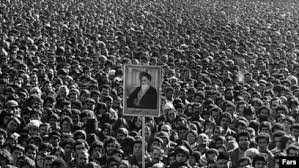
Mohammad Reza Shah left Iran on January 16, 1979, following a year of protests and demonstrations that culminated in the victory of the Islamic Revolution. Before leaving the country, the shah appointed Dr Shapour Bakhtiar as prime minister, who also received a vote of confidence from both Houses of Parliament. Baktiar was a member of the pro-Mosaddeq National Front Party, which had opposed the Shah and was supported by several secular and liberal Iranians.
Ayatollah Ruhollah Khomeini returned in triumph on 31st January and went straight from the airport to Tehran’s main cemetery to mourn the “martyrs of the revolution” for whose death he had been chiefly responsible. One of the first things he did was to appoint Mehdi Bazargan, the leader of the Iran Freedom Movement (Nehzat-e Azadi-ye Iran), as the head of the provisional government, having dismissed Bakhtiar’s government as illegal. On the 10th and 11th of February armed clashes took place between the leftist guerrillas and the Shah’s imperial guard, after the leading generals had declared the army’s neutrality in the contest between Bakhtiar and Bazargan, and the revolution triumphed.
In a very frank article in the New Left Review, entitled “Socialism or Anti-Imperialism? The Left and Revolution in Iran,” Val Moghadam, a sociologist and political activist, speaks about the scope of anti-Shah activities by the leftist forces and their close collaboration with the mullahs in the period leading to the revolution. She writes:
“A spectre is haunting the Iranian Left—the assembled ghosts of orthodox Communism, Maoism and populism. Together, these had converged, on the eve of the Revolution, to construct a Third Worldist discourse and practice that stressed the evils of dependent capitalism and imperialism…. In fact, it was the Left guerrilla groups – principally, the Fedaii [sic] – who broke into police stations and army posts, distributed weapons, and joined the NCO rebels… But in another cruel and ironic twist, the Fedai’s one major strength and advantage over the clerics – their military expertise – facilitated not so much their integration into the political terrain as the assumption of state power by clerics and their collaborator-rivals, the so-called liberals.”[1]
During the post-revolutionary euphoria, there was a period of short-lived unity between Khomeini’s supporters, on the one hand, and the liberals and the leftist forces, on the other. However, as each group tried to claim its share of the revolutionary inheritance, the temporary unity gave way to disagreement and animosity. Although Prime Minister Mehdi Bazargan was nominally in charge of the government, the real power resided with the shadowy “Revolutionary Council”, appointed by Khomeini and dominated by the clerics. In his own words, Bazargan was “a knife without the blade.”
Meanwhile, revolutionary courts were set up, headed by militant mullahs, and hundreds of officials of the former regime were subjected to summary trials, followed by mass execution. A large number of firms, factories, companies and private property belonging to the officials of the former regime were confiscated in the name of Islam, and their owners were jailed or executed. Members of religious minorities, especially the Baha’is, were dismissed from their jobs, and many of their leading members were jailed and killed.[2]
The Jews and Christians also suffered persecution. A leading Jewish industrialist, Habib Elghanian, was executed on trumped-up charges. Anglican churches were closed down, and Missionary hospitals were confiscated. The Iranian Bishop of the Church of England in Iran was summoned to the court and told to hand in all the funds at his disposal, even the money that was part of the pension funds of hospital and mission employees. He refused to hand over the money and left the country. In revenge, his 24-year-old son, Bahram, who had completed his studies at Cambridge University in Britain and George Washington University in the United States and had started to teach at Damavand College in Tehran, was abducted and murdered, and his body dumped by the roadside. The pastor in charge of the churches in Fars province was also murdered, and several church officials were arrested.[3]
Women fared very badly as a result of the revolution. One of the earliest orders issued by Khomeini was that all women needed to observe the Islamic hijab (the long chador that covered all parts of women’s bodies or at least a head scarf). There were many ugly scenes involving young vigilantes who insulted and beat up the women whose hair was not adequately covered. The Shah’s Family Protection Laws were declared null and void, and the children who had been born under the provisions of those laws were declared illegitimate. Meanwhile, polygamy and temporary marriages (taking of concubines) were again made legal, with the age of marriage for girls lowered to nine, in accordance with Islamic laws. Some women were buried down to their waists in the sand and stoned to death on charges of prostitution, the first stone being always thrown by a mullah.
There was also growing harassment of political parties by groups of Hezbollahis (the partisans of the Party of God), and severe censorship of allegedly un-Islamic publications was imposed. The security apparatus was run by “Islamic Committees”, located in mosques and headed by mullahs, enforcing their arbitrary rule through religious vigilantes who had armed themselves during the revolution and called themselves “revolutionary guards”. In short, the revolution was followed by a reign of terror and total lawlessness.
Despite the wishes of many liberal and leftist supporters of the revolution, Khomeini declared that the future government should be an “Islamic Republic.” Contrary to his earlier promises both in his first address after returning to Iran and in the letter that he wrote to Bazargan appointing him as prime minister, where Khomeini had said that a Constituent Assembly would be formed to draft the new constitution, he decreed the formation of an “Assembly of Experts”, dominated by the clerics, to draw the new Constitution which, as expected, gave unlimited power to Khomeini and institutionalized the concept of Vilayat-e Faqih, or the guardianship of the leading cleric. Even some leading members of the clergy objected to this. Indeed, not one of the five leading clerics, the sources of emulation, supported the concept. Ayatollah Seyyed Kazem Shari’atmadari, the leading Marja’ Taqlid (source of emulation), said that not only was Vilayat-e Faqih against the notion of national sovereignty, it was “an innovation, perhaps even a heresy.”[4]
Those people who had hoped that the revolution would result in greater freedom and democracy and would lead to higher living standards and greater social justice were soon disillusioned and felt that they had been cheated. Ethnic clashes soon broke out in various parts of the country, chiefly in Kordestan, Khuzestan and northern provinces. In the wake of the disruptions caused in factories and farms and the mismanagement of the economy, there was mass unemployment, high inflation and a big drop in the standard of living. The regime was faced with growing dissatisfaction, and both the liberals and the leftist forces began to criticise the growing monopolisation of power by the mullahs.
The Occupation of the American Embassy in Tehran
Faced with these insurmountable problems, Khomeini approved the occupation of the American embassy as a diversionary tactic. Initially, it was not clear whether Khomeini had personally sanctioned the attack on the embassy or not. However, Kho’iniha, the leader of the so-called Students Following the Line of the Imam who occupied the embassy, speaking in a radio interview on the anniversary of the takeover of the embassy, said that he was approached by a number of militant Muslim students who asked his view about an attack on the American embassy. He contacted Khomeini’s son, Ahmad, informed him of the matter and asked him to seek Khomeini’s approval for that decision. As no objection was raised to the plan, he instructed the students to go ahead. On 4th November 1979, a group of religious fanatics led by Kho’iniha, who was later appointed as the revolutionary prosecutor of the country, attacked the American embassy in Tehran and seized all the American diplomats in the embassy as hostages.
The mullahs regarded the occupation of the American embassy as a brilliant move that consolidated the power of the mullahs and silenced their opponents. The liberal elements were intimidated by highly selective and even fraudulent leaks from the embassy files about their alleged links with the “Great Satan”, while the leftist forces were jubilant about the audacious “anti-imperialist” move that humiliated America and put an end to the possibility of the return of the monarchists or other rightwing elements to power.
The embassy saga was stage-managed to great effect and was drawn out for as long as any benefit could be derived from it. It assumed the characteristics of some of the passion plays that the mullahs staged each year in the month of Muharram, mourning the martyrdom of Imam Husayn, at which they are past masters. The fact that it destroyed Iran’s international reputation as a law-abiding country and entailed great financial losses was of little consequence to the mullahs, who were purely interested in holding on to power. Their anti-American campaign also won them many friends among the nations and groups that were hostile to the West.
Another event that greatly strengthened the hands of the mullahs and ensured their hold on power was the foolish and disastrous Iraqi attack on Iran. The Iraqi invasion of Iran on 22nd September 1980 produced the effect of uniting all the people behind the regime in power in defence of the homeland. Even many former army officers and pilots who had been dismissed and jailed by the mullahs volunteered to go to the front to fight against the external enemy. Millions of Iranians, including the Revolutionary Guards and some young clerics, fought bravely in defence of their country, and their common sacrifices created a feeling of national unity and solidarity. It united the nation that had been on the verge of rebellion shortly before the war with the mullahs who were running the country. It can be argued that Saddam Hussein’s criminal and illegal invasion of Iran saved the mullahs.
By making use of these events, the mullahs carried out necessary purges and consolidated their power. At first, with the support and collaboration of the leftist forces, they singled out the liberals. Bazargan’s government resigned on the day when the American embassy was occupied. Many moderate opponents of the regime were accused of being the lackeys of the West and were forced out of office. Having isolated and expelled the liberals from power, Khomeini turned his attention to other opponents of the regime.
The Parting of Ways
Shortly after Bazargan’s dismissal, presidential elections were held and Abol-Hasan Bani-Sadr, who called himself Khomeini’s “devoted son”, was elected the first president of the Islamic Republic of Iran. However, soon he encountered the same problems that had paralysed Bazargan’s government, namely the constant interference and growing power of the mullahs. The clergy-dominated Islamic Consultative Assembly, or Majlis, and the influential mullahs who were running the judiciary and many other government departments soon made it impossible for Bani-Sadr to function, while a semi-educated former street-vendor called Ali Raja’i was appointed prime minister and wielded more power than the elected president. The mullahs tightened the noose around Bani-Sadr, the Majlis declared him incompetent, and he was deposed by Khomeini in June 1981 and went into hiding. He was tried in his absence on charges of treason in the conduct of war and was sentenced to death, but he managed to flee to France, where he still lives.
After the destruction of the liberals, it was the turn of the Mojahedin and the Feda’iyan guerrilla movements to be exterminated. During the first presidential election, Mas’ud Rajavi, the leader of the Mojahedin, announced his candidacy for president. However, Khomeini personally disqualified him from running on the excuse that the Mojahedin had boycotted the referendum for the establishment of the Islamic Republic. Mojahedin candidates were also barred from running for parliament. Finding the door to constitutional opposition closed, the Mojahedin opted for armed struggle against the regime. On 28th June 1981, a powerful bomb planted by the Mojahedin shattered the headquarters of the Islamic Republic Party (IRP), where a party meeting was in progress. The bomb killed nearly one hundred persons, including Ayatollah Mohammad Beheshti, the powerful IRP chairman, and many cabinet ministers and parliamentary deputies.
On 30th August, another bomb exploded at the prime minister’s office, killing Mohammad Javad Bahonar, the prime minister, and Raja’i, who had succeeded Bani-Sadr as president, as well as the head of the police. There were many other outrages and assassinations, including the murder of a large number of leading clerics and Khomeini’s representatives in various cities. The regime responded in kind and started the mass arrest and execution of Mojahedin sympathisers. According to the Mojahedin, more than twenty thousand of their members were either executed or killed in street clashes in 1981.[5]
While this merciless suppression of the leftist Mojahedin and Feda’iyan guerrillas was going on, the Tudeh Party continued its support for the “progressive clergy” and “revolutionary Islam”, condemning the activities of the guerrilla movements as “adventurist and opportunistic.” The party’s main theoretician, the well-known writer and scholar Ehsan Tabari, wrote a widely-circulated booklet, entitled The Progressive Clergy and Us, in which he argued: “The program of social development posed by scientific socialism has some affinities with social demands and principles of Islam and Shi’ism… and this fact makes cooperation between supporters of socialism and progressive clergy and its supporters not only possible but imperative.”[6] In another article in World Marxist Review in 1982, entitled “The Role of Religion in Our Revolution”, at the height of the suppression of the Mojahedin, Tabari claimed that Islam “is the ideology of anti-imperialist revolution.” He sang the praises of “Imam Khomeini”, while attacking “liberals” such as Bazargan and National Front members, as well as “extreme leftist groupings.”[7]
As late as March 1983, in another article in World Marxist Review, Kianouri, the Secretary General of the Tudeh Party, praised Imam Khomeini’s “anti-imperialist line”, and lambasted the “divisive activity of the ‘leftists’, Maoist-type extremists and their like.” He added: “The vigilance of the masses and Imam Khomeini’s firm leadership are the most dependable guarantees of defending the achievements of the revolution.”
However, when Vladimir Kuzichkin, the Vice Consul of the Soviet Embassy in Tehran, defected to the West in October 1982, he placed the entire membership list of the Tudeh Party at the disposal of the British and American governments, and they passed it on to the Iranian regime.[8] It was discovered that members of the Tudeh Party had penetrated many sensitive organs of the government, including the armed forces. On 6th February 1983, in one fine swoop, the revolutionary guards arrested some 8,000 members of the Tudeh Party throughout the country, including all their leadership cadres. On 25th February 1984, ten leading Tudeh Party members, including Captain Bahram Afzali, the Navy Commander, were executed, and many other party members are still languishing in jail, and some, including Ehsan Tabari, the party ideologue, died in jail.[9]
Thus, by the end of 1984, all liberal, secular and leftist opposition to the regime was completely suppressed, and the mullahs achieved total control of all the levers of power in the country. The cohesion that had been temporarily achieved between all those who were in power could be clearly seen in the “Irangate” affair. Although the revelation of extensive links existing between Hashemi-Rafsanjani and other leading members of the regime with some members of the American administration, and even the purchase of weapons from Israel, could have been extremely damaging under other circumstances, this time the matter was completely hushed up.
When some radical elements associated with Ayatollah Hoseyn Ali Montazeri, Khomeini’s designated heir, became suspicious of mysterious dealings between Hashemi-Rafsanjani and some American officials and leaked the news of Robert McFarlane’s visit to Tehran to the Lebanese newspaper al-Shira’, they were arrested and executed on charges of numerous cases of murder both before and after the revolution. Hashemi-Rafsanjani even went on the offensive and declared that McFarlane had come to Tehran on a mission on behalf of the American president, but had been arrested and detained, and no Iranian official had agreed to meet him, and he had been sent back empty-handed. A few days later, Khomeini repeated the same story, calling on the officials to remain united and to concentrate all their efforts against America.
Velayat-e Motlaqe-ye Faqih
Ever since the establishment of the Islamic Republic, the religious supporters of the revolution were divided into the traditional, the moderate and the militant groups. When the Islamists came to power and had to run the country, they found it necessary to pass laws to solve some of the pressing social and economic problems of the country, but the more conservative elements among the clergy and especially the members of the Guardian Council, who believed in the strict implementation of Islamic laws, opposed some of the new measures. This has been a major stumbling block on the path of the government for the past twenty years.
Mir-Hoseyn Musavi, who was the prime minister for most of the period of Khomeini’s life and the war years, in an interview, said that in 1981, the Cabinet set up ten committees to draw up plans and prepare draft bills for the solution of some of the major economic problems of the country.[10] The bills that had been prepared by the Cabinet included the bills on the nationalisation of foreign trade, agricultural reform, labour laws, requisition of property, curbs on the power of the merchants and shopkeepers in order to prevent hoarding and profiteering, public debts to banks, and taxation. These issues constituted the very basis of government policies, as they were concerned with the most important political, economic, judicial and social matters and defined the direction that an Islamic government should take.
The Cabinet submitted those bills to the Majlis for ratification. After a great deal of argument and numerous amendments, those bills were eventually ratified by the Majlis and were sent to the Guardian Council to decide on their compatibility with the Shari’a and the Constitution. Without exception, all those major bills were rejected by the Guardian Council as allegedly being contrary to Islamic laws. For instance, the issue of land reform or the requisition of urban land was opposed by the Guardian Council as they were contrary to Islamic teachings about the inviolability of personal property. Labour laws were regarded to be contrary to age-old Islamic laws on contractual employment or the freedom of an employer to come to an agreement with an employee through mutual consent without any third-party interference, or any limitations imposed by the government or any other authority on employers.
Even the issue of taxation aroused a great deal of controversy, as many clerics believed that Islamic taxation was limited to Khums (one-fifth of earnings) and Zakat (charitable donations usually defined as 2.5% of income). In fact, one of Khomeyni’s frequent criticisms of the Shah’s regime had been that it levied taxes beyond those prescribed by Islam. He further categorically stated: “If an Islamic government is achieved, it will have to be administered based on taxes that Islam has established – khums, zakat, jizya and kharaj.”[11] These referred to one-fifth of income, charitable donations, tax imposed on non-Muslims and tax imposed on the vanquished side after a war.
The result was a deadlock, which paralysed any effective government action and, according to Musavi, had led to intense helplessness and frustration among the ministers, and had given rise to a feeling among the public that the Islamic government was incapable of solving any of the contemporary problems. Eventually, on 3rd June 1987, the members of the Guardian Council and Majlis deputies went to see Khomeini to sort out their differences. Akbar Hashemi-Rafsanjani, the powerful Majlis Speaker and one of the advocates of radical measures, made a speech in which he referred to the absolute dead-end faced by the Majlis and the Guardian Council. He said that the country had reached a state of deadlock and only Khomeini’s personal intervention and guidance as Vali-ye Faqih could solve the problem.
Hashemi-Rafsanjani said that although they felt ashamed of taking those problems to Khomeini, the matter needed his “precise and clear intervention.” He added: “This matter needs courage, audacity and decisiveness, which under the present circumstances, no one under the sun except Your Eminence possesses in order to solve our problems. If you do not come to our assistance at this juncture in the history of the revolution and if you do not solve these legislative problems clearly and decisively … we will never be certain of finding someone who will be capable of discharging this important duty in the future.”[12] On that occasion, in a brief speech, Khomeini merely said that he would pray for them.[13]
The deadlock continued and the arguments between the two factions grew more bitter. However, as the issues remained unresolved, after December 1987, Khomeini was forced to personally intervene in the disagreements. Through the exchange of some letters and by issuing a number of important fatwas, Khomeini made dramatic statements and completely shifted the terms of the debates in favour of the radicals. However, in the course of doing so, he also introduced some important new concepts that contravened his earlier ideas about the velayat-e faqih. Khomeini’s new fatwas were promulgated in three letters.
The first letter was in response to a query by the Minister of Labour, Abolqassem Sarhaddizadeh. On 7th December 1987, in a letter to Khomeini, Sarhaddizadeh requested: “… In view of the nature of this ministry’s work in the manufacturing and service units in the private sector, would Your Eminence please guide this ministry on the following question: Is it possible to introduce compulsory regulations for those units that make use of state and public facilities and services such as water, electricity, telephone, fuel, foreign currency, raw materials, ports, roads, jetties, and administrative and banking services, etc. whether they have used these facilities in the past, continue to use them now, or have recently started to use them.”
The purport of this letter was that as the government provides the private sector with certain facilities, such as ports, roads, water, electricity or administrative and banking services, it could be regarded as, in effect, a partner in the dealings of the private sector and impose binding laws on its operations that have not been stipulated in the Shari’a or not. According to Islamic law, the sides to a contract can impose terms and conditions in their transactions that have not been stipulated in the Shari’a. If the government can claim that by providing services to individuals or to the private sector, it is a partner in the enterprise, it can introduce certain laws that are not strictly in keeping with Islamic laws. Khomeini’s brief fatwa was: “In His Exalted Name. In both cases, that is, for the past and for the present, the government can introduce and implement binding regulations.”[14]
This ruling led to a great deal of excitement among government circles, and shortly afterwards, Prime Minister Musavi claimed that Khomeini’s fatwa had wider implications and was not purely confined to labour laws. This interpretation of the fatwa was rejected by the Guardian Council, and it led to a great deal of controversy among the clerics, including both those inside the regime, as well as the influential clerics in the Qom Religious Seminary and elsewhere.
Eventually, on 23rd December 1987, Ayatollah Lotfollah Safi, the Secretary of the Guardian Council, in a letter to Khomeini, voiced the objections of the Guardian Council to some of the implications of the fatwa that could directly contradict Shari’a laws. Ayatollah Safi wrote:
“We are troubling you about the fatwa issued by Your Eminence with regards to the ruling that the government can, in return for the use of public resources and services, introduce and enforce binding terms. Some people have stated that, based on your fatwa, by using this power the government can replace the fundamental and primary laws of Islam with any other kind of social, economic, labour, family, commercial, urban or agricultural laws and systems; and can make the services and facilities that are under government monopoly, which the people have very little or no choice but to utilize, into an instrument for the implementation of general and comprehensive policies. In this way, it can forbid that which is binding and can make binding that which is forbidden or is mubah [permitted but optional] according to the Shari’a.
Obviously, in the case of those facilities in which the state does not have a monopoly and in which the state figures as an ordinary party to the transaction, and in cases that do not relate to public issues, or when it concerns the utilisation of a particular service, your reply concerning this set of circumstances is correct and irrefutable. However, concerning public affairs and services, the provision of which has been placed under the monopoly of the state, the imposition of binding conditions covering a variety of regulations extendable to all cases… have given rise to the anxiety that all Islamic laws regarding muzar’ah [a contract between a landlord and his farmers], rent, commerce, family or other relationships will be practically discarded and will face the danger of being changed or replaced. In short, this fatwa has opened the door to all those who wish to use it to bring about any kind of social or economic order that they desire.”[15]
Ayatollah Safi ended his letter with the prayer: “May your blessings and guidance, and your efforts for the protection of Islam long continue.” He was clearly hoping that Ayatollah Khomeini would discharge his duty as the guardian of Islamic law against the inroads of radical secularists and those who wished to tamper with Islamic laws. However, Khomeini’s reply was as disappointing to his own hand-picked jurists, who had been appointed to the Guardian Council to block any laws passed by the Majlis that did not strictly adhere to the Shari’a or the Constitution, as it was welcome to those who wished to press on with their reforms, regardless of their incompatibility with Islamic principles. The text of Khomeini’s response was as follows:
“In His Exalted Name. In all cases in which the people utilise the facilities and services provided by the government, according to the Islamic terms and even without being bound by the terms of value, the government can take away from the people what is being utilised by them. This is enforceable in all cases that come under the control of the government, and it is not limited to the cases mentioned in the letter by the Minister of Labour. Rather, the government can enforce its terms, without any prior agreement, and can introduce binding conditions in the case of natural resources that are under the power of the government during the entire lifespan of the Islamic government. The honourable gentlemen should not pay any attention to rumours circulated by irresponsible profiteers or those opposed to the Islamic Republic. Rumours can be created regarding any issue.”[16]
Khomeini did not address any of the real objections raised by the Guardian Council to his earlier ruling. On the contrary, he widened the scope of the earlier fatwa and extended it to all government regulations. He even admonished the Council members not to listen to adverse rumours. The latest fatwa created a great commotion, and many religious experts, both from within the ruling circles and outside it, could not believe what they were hearing, because through that fatwa, Khomeini had, at a stroke, declared all the rulings and objections of the Guardian Council ever since its establishment concerning Majlis legislation null and void. In effect, he had disbanded the Guardian Council and had removed its main task to scrutinise the applicability of the Shari’a over government legislation.
The ayatollahs appointed to the Guardian Council were supposed to be the greatest experts in Islamic jurisprudence, and they had been given the task of protecting the Shari’a and the Constitution from the inroads of secular laws. Yet, here they were being told by Khomeini that all their earlier rulings blocking government legislation had been contrary to Islam, and that the government could enact and enforce any law it wished based on what it saw fit for the administration of the society.
Some factions friendly to Khomeini and the Islamic Republic tried to salvage what they could from the situation. In his sermon during the Friday congregational prayers in Tehran, President Ali Khamene’i, speaking about the powers of the government, paid due respect to Khomeini and praised his decisive leadership. Even contrary to the accepted Shi’a belief and practice that any believer is free to follow any marja’-e taqil (source of emulation) whom he regards to be the most eminent and the most qualified, Khamene’i said: “Of course, when we speak of accepted norms and principles in an Islamic society, by that we mean the fatwa of vali-ye faqih, because in an Islamic society, the religious fatwa of vali-ye faqih is the yardstick of the system. The fatwas of other maraji’e taqlid [sources of emulation] are only valid in personal and individual cases for themselves and their followers – if they have any followers. However, in national and governmental matters, only the fatwa of vali-ye faqih is binding. There is no argument about that.”
Khamenei proceeded to defend Khomeini’s latest fatwa, saying that when he empowered the executive to make and to implement laws, he meant laws that are within the framework of Islamic teachings and only regarding the thanawiyya [secondary issues not set out in the Shari’a] issues, not regarding the fundamental laws of Islam that have been clearly set out in the Koran and the traditions. Making use of Khomeini’s remarks about the need to dismiss rumours about the implications of his fatwas, Khamenei deliberately tried to confuse the issue and went on to say: “As the questioner [Ayatollah Safi] had pointed out that some people had misunderstood his [Khomeini’s] fatwas to mean that one can nullify the [Islamic] laws regarding muzari’a, rents, musaqat [laws regarding water rights] and other religious laws and injunctions, and they had imagined that the government could impose conditions contrary to divine laws, the Imam [Khomeini] said: No, these are rumours, and that such issues were basically unrelated to the queries and the answers given to them.”[17]
These developments show that soon after the establishment of the Islamic Republic, it became clear that many Islamic laws were totally inadequate to deal with the complex economic, political and social realities of the present time. Many laws that might have suited primitive, tribal communities in Arabia 1,400 years ago are quite incapable of responding to the challenges of the 20th-century world. Having faced the deadlock between the implementation of the Shari’a and the running of modern society, Khomeini had no choice but to practically throw those laws into the dustbin of history and allow the government to deal with the task of running the country. By issuing a fatwa saying, in practice, that the requirements of the government and the regime take precedence over age-old Islamic laws, he proved the inadequacy of the Shari’a to cope with the needs and requirements of the modern world.
Far from bringing freedom, independence and democracy to Iran, the Islamic revolution introduced a very harsh and reactionary version of Islam, severely limited people’s freedoms, and introduced one of the most oppressive regimes in Iranian history, compared to which even the excesses of the Pahlavi era paled into insignificance. Khomeini’s weakening of national defences, the execution of many former generals, the reign of terror and widespread chaos and division tempted the Iraqi dictator Saddam Hussein to attack Iran across the whole of 1000-km Iran-Iraq borders on 22 September 1980. His excuse was that Khomeini had incited the Iraqis to rise up against him and establish an Islamic government. This might be true, but it did not justify an illegal invasion of a neighbouring country, especially as he had reached an agreement with the Shah over the delineation of the borders, and so his claim of sovereignty over the entire Shat al-Arab, which the Iranians call Arvand Rud, was null and void.
The savage war lasted for eight long years, inflicted massive damage and killed and wounded well over a million people in the two countries. Khomeini rejected any ceasefire offer from Iraq and the international community based on the slogan “the path to Quds [Jerusalem] passes through Karbala [the place where Imam Hussein and his followers were martyred in 680 A.D., and where his shrine is a major centre of pilgrimage for Shi’is from all over the world]”. However, after prolonging the war for six extra years with tens of thousands of casualties, Khomeini was forced to accept an enforced ceasefire which he described as being “worse than drinking poison.” The Iran-Iraq war ended without any gains by either side, but a great deal of death and misery and economic losses ran to hundreds of billions of dollars.
Having had to drink his cup of poison and looking for a scapegoat to distract public attention from his humiliating climb-down, Khomeini was offered a very effective excuse to fire his base again. The renowned novelist Salman Rushdie published The Satanic Verses in Britain in 1988, which was regarded by some Muslims to be insulting to Islam and the Prophet Muhammad. When given the translations of a few pages of the book, Khomeini accused Rushdie of blasphemy and sentenced him to death. This, for a while, galvanised his supporters in Iran and some other Islamic countries, but was the last act of infamy in his life.
Khomeini’s death occurred shortly afterwards, on 3 June 1989, aged 86. A massive crowd of several million, much of it made up of pious believers and members of the IRGC and Basij, took part in the funeral of the founder of the Islamic Republic. The frenzy of the disorderly crowd was such that Khomeini’s body was thrown out of the coffin, and eight people died in the stampede. As it proved impossible to deliver the body to the cemetery through Tehran, it was transferred to a helicopter and was taken to Behesht Zahra, the main cemetery in Tehran, where later on a massive structure was built on the grave, competing with the shrines of Shi’a Imams.
Thus ended the life of a man who put an end to millennia-old Iranian monarchy, who toppled one of the most powerful regimes in the Middle East, and who founded a theocracy instead of a democracy that he had promised and that most people expected to be the outcome of one of the biggest and strangest revolutions in the twentieth century.
Notes
[1] New Left Review, No. 166, November/December 1987. https://newleftreview.org/issues/i166/articles/val-moghadam-socialism-or-anti-imperialism-the-left-and-revolution-in-iran
[2] The Baha’is were even ordered to pay back any salary they had received in the course f their previous employment, and all their assets were seized. For a study of the persecution of the Baha’is in Shiraz see Olya’s Story (Oneworld Press).
[3] For a study of the suppression of the Christian Church, see: Bishop H. B. Dehqani-Tafti, The Hard Awakening (Triangle, 1981).
[4] See: Islamic Revolution and Islamic Republic, op. cit, p 43.
[5] The Mojahedin have provided the names and details of more than seven thousand of their members who were killed in the shoot-outs or executed by the regime, but they claim that the real number of their supporters who were killed is more than 20,000. In an interview, Rajavi, the leader of the Mojahedin, claimed that in one night, Khomeini’s regime executed more Mojahedin supporters than the total number of guerrillas killed during the Shah’s reign.
[6] Quoted by V. Moghadam, New Left Review, No. 166, November/December 1987, p.23.
[7] Ibid. pp 23-24.
[8] Dr Ebrahim Yazdi, a former foreign minister in Mehdi Bazargan’s government, in an interview with an Iranian newspaper, revealed that Askarowladi, a member of the extreme right-wing grouping, the Islamic Coalition Group, who was then the minister of commerce, had been sent to Pakistan on a mission to receive the list of the members of the Tudeh Party. According to Yazdi: “During that trip, the information regarding the activities of the Iranian Tudeh Party and its cooperation with the Russians, and the passing of war information to the Russians, etc, was put at his disposal… The British placed all this information at the disposal of the Iranian government through Pakistan and through Mr Askarowladi.” (Neshat, 16.2.78 [6 May 1999].
[9] For the details of the suppression of the Tudeh Party, see: Farhang Jahanpour, “The Rise and Fall of the Tudeh Party,” The World Today (April 1984), pp 152-159.
[10] Keyhan Hava’i, No 762, 27 January 1988, p 3.
[11] Khomeini, Islamic Government, p 45.
[12] BBC Summary of World Broadcasts (SWB), Part IV, 5 June 1987. At times, the SWB has not published the full text of the speeches or letters referred to below. For the full text, please consult either Keyhan or Ettela’at newspapers one day after the date of the events.
[13] Ibid.
[14] Ibid, 8 December 1987.
[15] Ibid, 24 December 1987.
[16] Ibid, 24 December 1987.
[17] Ibid, 4 January 1988.
 F Jahanpour