

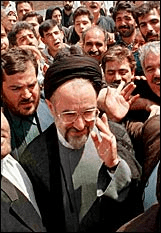
Lecture 6 in a series of lectures given to a group of British and American journalists at the BBC Monitoring on 17 March 1999
Hojjat ol-Eslam Seyyed Mohammad Khatami’s landslide victory in the presidential election on 23rd May 1997 (the handover took place in August) was as unexpected to him as it was to most Iranians and to many foreign observers. A soft-spoken, mild-mannered, moderate cleric who had avoided the limelight and, consequently, was not very well known until recently by the public in Iran, managed to win the largest number of votes in any presidential election since the beginning of the Islamic Revolution.
Undoubtedly, the election of Khatami was the most important event since Ayatollah Ruhollah Khomeini’s death in 1989. Some foreign observers have spoken about the dawn of a new era in Iranian politics, and have even described Khatami as a new Gandhi or Gorbachev, which is definitely a little premature; while others have said that nothing has changed in Iran and that the clerical regime cannot be reformed from within. Some Western analysts have even alleged that he is a kind of decoy to confuse the West and that there is no difference between him and the rest of the mullahs. After President Khatami’s CNN interview on 7th January 1997, many people in the West asked: “Is this a new fold in the Iranian revolution, or is it a Thermidor?”[1]
The truth lies somewhere between the two. He definitely is not an outsider to the regime. He was closely associated with the revolution since the beginning and served as Minister of Culture and Islamic Guidance in the 1980s. However, there is no doubt that the policies he is advocating and the emphasis which he puts on certain key concepts such as “civil society”, “the rule of law” and greater social and political freedom are quite new and distinct, if not revolutionary. The “global context” of the democratic reform in Iran, which Khatami’s election represents, has been rather neglected by journalists and academics in the West.
There were two major differences from the past. The first difference involved the content of the message and its implementation, i.e. gradual and evolutionary progress, rather than violent and revolutionary action. The second difference concerns the source of the reform. This time, in contrast to the past, forces favouring democracy and reform in Iran do not come from the top down as with the White Revolution under the late Shah or even the Islamic Revolution. The latter, although it did achieve public participation, was basically dominated by the ideas and personality of Ayatollah Khomeini. This time, the desire for change and for greater political and democratic reforms has bubbled up from below. There is a groundswell for a change of direction after some 19 years of puritanical rule at home and cultural and diplomatic isolation abroad. The reformist leaders are now trailing the intellectuals, the university students and the public at large.
To give an idea of the scale of Khatami’s triumph, it should be pointed out that the number of votes received by the four candidates was as follows: Mohammad Khatami 20,078,187 votes; Ali Akbar Nateq-Nuri, the establishment candidate who was widely expected to win the election, received only 7,242,859; the Hezbollahi candidate, Mohammad Mohammadi-Reyshahri, received the smallest number of votes at 742,598, even below the number of votes cast for the little-known independent candidate Seyyed Reza Zavare’i who received 771,400 votes. The percentage of the eligible voters who took part in this election stood at 80.16 per cent (29,076,070 out of 36,271,000) compared to 75.41 per cent of those who even took part in the Referendum on the establishment of the Islamic Republic (15,680,000 out of 20,896,000), and only 50.76 per cent (16,789,000) in the sixth presidential election in 1993, which re-elected Hashemi-Rafsanjani for a second term.
Out of 29,076,000 votes cast in the seventh round of the presidential election, Khatami received 20,078,187 or 69.05 per cent of the votes, which was nearly twice the number of votes cast for Hashemi-Rafsanjani in the last election (10,555,000). Khatami’s percentage of the eligible votes (55.35%, compared to only 31.92% in the last presidential election) was higher than that of any other presidential election since 1981, when Hojjat ol-Eslam Ali Khamene’i received 70.96% of the vote after the tragic double assassination of President Ali Raja’i and Prime Minister Mohammad Javad Bahonar when the Iran-Iraq war was at its height.[2]
When one speaks about the democratic nature of these elections, however, one has to bear in mind that, compared to Western democracies, there are several differences, which, according to some Iranian opposition groups, weaken the legitimacy of the elections. For instance, out of the 238 candidates, including nine women candidates, who had been nominated by various groups, the Guardian Council, which supervises the elections, approved the suitability of only four men; without giving any reason for the rejection of all women candidates, although some of them were Majlis deputies. It was not made clear whether the rejection of women candidates was due to the blanket rejection of women running for the presidency, or whether the Guardian Council had simply not found any of the available female candidates suitable for the job.[3] Some prominent candidates from among the liberal opposition, like Habibollah Peyman, Ezatollah Sahabi, Ali Akbar Mo’infar and Dr Ebrahim Yazdi, were also rejected without providing any reason for their exclusion.[4]
A UNIQUE ELECTION
Nevertheless, despite all those shortcomings, the election which resulted in Khatami’s victory was quite an exceptional election. The selection of the candidates by the Guardian Council had persuaded many that the candidate favoured by the establishment was the Majlis Speaker Ali Akbar Nateq-Nuri, the most prominent of the four candidates. Nevertheless, the widely believed favourite establishment candidate lost very badly, and a relative newcomer won. Consequently, it could be argued that the seventh presidential election was different from earlier ones in many ways:
1- The candidates represented real rival groups: Hojjat ol-Eslam Ali Akbar Nateq-Nuri represented the conservative right and the traditional middle class and bazaari supporters of Ayatollah Khomeini’s revolution; Hojjat ol-Eslam Mohammad Khatami was chosen by a coalition of the left of the centre groups; Hojjat ol-Eslam Mohammad Mohammadi Reyshahri was the head of the Iranian Hezbollah and represented the ultra-militant faction closely associated with the worst excesses of the revolution; and Seyyed Reza Zavare’i was an independent candidate, member of a right-wing Coalition Group supporting Hashemi-Rafsanjani and the moderate reformists.
2- The votes of the people could not have been predicted. Indeed, up to the eve of the election, many Iranian and foreign commentators predicted that Nateq-Nuri would win or, at best, none of the candidates would receive a majority vote and the election would go to a second round.
3- Unlike previous elections, when most opposition parties boycotted the election, this time the independent, non-establishment parties and even opposition groups that had either been banned or had boycotted the elections, such as the members of the Freedom Movement who follow the policies of the late Mehdi Bazargan, had announced that they would take the election seriously and declared some candidates of their own.
4- Only the candidacy of Nateq-Nuri was well-known in advance, while the candidates of other factions were not selected till the last few months. Khatami joined the race only three months before the election, and his campaign gained momentum less than a month before the election
5- In contrast to previous rounds, when Khamene’i and Rafsanjani — who were among the most prominent figures since the early days of the revolution — were elected, this time none of the candidates possessed the same prominence.
Yet, given the greater pre-eminence of Nateq-Nuri and the relative obscurity of Khatami, many people at home and abroad assumed that the result of the election was a foregone conclusion and that Nateq-Nuri was the favourite establishment candidate. There were many reasons for this assumption:
1- The name of Nateq-Nuri was first on the list announced by the Guardian Council, and the name of Khatami was third, contrary to the accepted practice and procedure used in previous rounds when names were given alphabetically.
2- The Guardian Council’s explanation for this was that the order of the names on the list was based on the number of votes each candidate had received in the Guardian Council. This assertion made it clear that the Guardian Council favoured Nateq-Nuri over the other candidates.
3- Two speeches by the spiritual leader, Ayatollah Ali Khamene’i, to the clerics who were leaving to take part in Muharram mourning ceremonies and to the staff of radio and television about the election, implicitly supported Nateq-Nuri’s candidacy. In a campaign speech, Khatami had said that the spiritual leader would not have a personal preference among the candidates and would support whoever was elected. Ayatollah Khamene’i, however, in his speech to the staff of radio and television, went out of his way to openly contradict Khatami. He said that, of course, he had a definite preference and, without mentioning any names, he made it clear that he preferred the election of Nateq-Nuri. Indeed, Khamene’i’s position was made abundantly clear through leaks by the supporters of Nateq-Nuri.
4- The professors of Qom religious seminary, the Association of Militant Clergy and the Friday imams of most cities issued statements formally announcing their support for Nateq-Nuri. In other words, nearly all senior members of religious establishments who had in the past assumed the right of guiding the people in these matters had explicitly called on them to vote for Nateq-Nuri.
5- There was a great deal of direct and indirect propaganda by radio and television in favour of Nateq-Nuri, who, as Majlis Speaker, received much publicity during his trips to various provinces. Some said that the amount of attention paid to him by the media went well beyond his status as the Majlis Speaker. He was already treated as a president-in-waiting. This was contrasted with hardly any publicity in favour of Khatami. However, one event, which probably helped Khatami’s cause more than any other, was the series of hour-long campaign speeches and interviews with various candidates during the election campaign. In these public appearances, Khatami’s smiling and relatively youthful appearance and fresh and vigorous ideas came across as being in sharp contrast with Nateq-Nuri’s stern, austere and pro-establishment posture.
6- There were widespread rumours about the intervention of the IRGC in favour of Nateq-Nuri and against Khatami, including a speech by the Guards Corps Commander, Mohsen Reza’i, urging the Revolutionary Guards to vote for Nateq-Nuri.
7- Most sources of emulation (maraje’-e taqlid, or the highest religious authorities in Shi’ism), whose words are to be obeyed by those who emulate them, expressed their support for Nateq-Nuri.
8- Khatami’s opponents openly stated that he was against the concept of velayat-e faqih, the cornerstone of the Islamic government in Iran, while Nateq-Nuri represented the true legacy of Ayatollah Khomeini and was a supporter of the vali-ye faqih (Ayatollah Khamenei). Two of the campaign speeches by Khatami in Mashhad and Isfahan were disrupted by Hezbollahi hooligans who chanted slogans of “death to the enemies of the velayat-e faqih“, and he was prevented from speaking.
Therefore, the massive and unprecedented vote for Khatami was as much a vote of no-confidence in the conservative and traditional religious establishment that backed Nateq-Nuri as it was an endorsement of Khatami’s declared policies. This vote posed a major challenge not only to senior religious figures who supported Nateq-Nuri but also seriously undermined the position of the non-elected Ayatollah Khamene’i as the spiritual leader of the country.[5]
Khatami’s election campaign was conducted around some key issues, the most prominent of which were the establishment of civil society, the rule of law, pluralism, greater political, social and cultural freedoms, equality of the rights of men and women with promises that he would appoint some women to his cabinet for the first time since the beginning of the revolution, greater cultural and educational opportunities for the young, economic development accompanied by greater social justice, and conducting a foreign policy based on the elimination of international tension.
For many people in the West, terms such as civil society, pluralism, the rule of law or social justice may not sound very exciting or novel. However, for many Iranians who daily have to contend with the interference of various vigilantes and Hezbollahi groups about every aspect of their lives, including what they wear, what they read, where they go and whom they are going with, terms such as the rule of law assume enormous importance. In the Iranian context, civil society stands in opposition to a religious society composed of clerics and the umma, the Muslim community. Pluralism means breaking the monopoly of the clerics and their hangers-on in politics and the economy. The rule of law means ending the lawless behaviour of security forces or religious groups that supervise such institutions, as well as breaking the monopoly of the mullahs as judges, and implementing Islamic law instead of laws legislated by the parliament.
Khatami has argued that those who call themselves the supporters of the revolution and the Islamic system are duty-bound to abide by the laws of the Islamic government. He pointed out that if those who are opposed to the Islamic system disrupt society and interfere in people’s lives outside the judicial framework, that could be understood. But those who call themselves the friends of the revolution could not and should not take the law into their own hands and disrupt the lives of the people. If they have a grievance against certain individuals or organisations, they should address them through legal channels. Consequently, a large number of people who had been fed up with the excesses of some over-zealous officials and self-styled guardians of public morality, especially women and young people, were attracted to Khatami’s platform and voted for him in droves.
Measures taken against Khatami:
However, even before Khatami assumed the reins of power, he became the target of attacks by his right-wing opponents who had a great deal of influence in many centres of power. Although Khatami had received a clear mandate from the people, his scope of activity was very limited. The armed forces, the revolutionary guards, the law-enforcement forces, the police and the Basij forces all came under the direct supervision of the Supreme Leader Ayatollah Ali Khamenei, who is the Commander in Chief of the armed forces.
Ayatollah Khamenei also appoints the head of the judiciary, which is mainly dominated by traditional right-wing clerics. He also appoints the head of the radio and television, as well as the Friday imams of Tehran and other provincial cities, who wield a great deal of influence, especially in influencing the minds of the millions who take part in congregational prayers. Traditionally, the supreme leader also has the final word in foreign policy.
The Majlis is also dominated by a right-wing majority, and its Speaker is Ali Akbar Nateq-Nuri, who was the candidate of the hard-liners in the presidential election. All other major centres of power, the Assembly of Experts that appoints the leader, the Guardian Council that ensures that Majlis resolutions are compatible with the Shari’a and with the Constitution and also approves the suitability of candidates for all major national elections and the Expediency Council that arbitrates between the Majlis and the Guardian Council, are all dominated by right-wing extremists.
In short, although President Khatami has received an unprecedented popular mandate, his role resembles more that of a leader of the opposition, rather than the chief executive official of the country. However, Khatami tried to form a cabinet that would push for reforms in the areas that were under his control.
Most of his reforms revolved around greater freedom of expression and the granting of more freedoms to the people and enabling them to participate in national affairs. The two key ministries that could play a major role in these areas where the Ministry of Culture and Islamic Guidance, which supervises the work of the press, and the Interior Ministry, which appoints governors to various provinces and is in charge of organising the elections. For these two key posts, Khatami appointed two leading reformers, Dr Ata’ollah Mohajerani and Abdollah Nuri.
In his first speech in the Majlis in September 1997, Mohajerani declared: “I am in favour of cultural tolerance…. We must create a climate in the Islamic Republic in which individuals will be able to express their views on various issues.” Immediately after Khatami’s election, a large number of reformist newspapers and magazines started publication under the more tolerant and open climate that had been created by the new government. Even the tone of many of the older publications also changed noticeably, and there was a sudden flowering of debate and discussion and much greater openness in the press. Some newspapers that started after the election in a very short time became very popular and managed to have circulations running into hundreds of thousands.
However, this climate of freedom did not last long. Shortly after the election, right-wing gangs known as Ansar-e Hezbollah (partisans of the Party of God) ransacked the offices of the independent Iran-e Farda (Tomorrow’s Iran) magazine, which had adopted a strong pro-reform line. This attack was condemned by the minister of culture and by the president, but although the magazine provided accurate details of some of those who had attacked its premises, no action was taken against them.
The new government tried to deliver on its promises of greater press freedom by restoring licenses to several banned publications. For example, the Ministry of Islamic Guidance lifted the ban, imposed by the previous government, on Aftabgardun (the Sunflower), a youth-oriented newspaper published by the then-mayor of Tehran, Gholam Hoseyn Karbaschi. In October 1997, the ministry restored the license of the radical daily Jahan-e Eslam (the Islamic World) published by Hadi Khamenei, the moderate younger brother of the Supreme Leader Ayatollah Ali Khamenei, after a two-and-a-half-year ban. In November 1997, the newspaper Payam-e Daneshju (Students’ Message), which the Press Court had banned for five years in 1996, was permitted to resume publication.
By the end of 1997, the press was growing in confidence and began to probe the activities of various revolutionary organisations and write about many formerly taboo subjects, but the reaction by right-wing elements was not long in coming. There was a multi-pronged attack on Khatami and his supporters.
1- August 1997: The Trial of Mayors of Tehran. Shortly after the presidential elections, the conservatives began arresting some of the leading municipal officials from different districts of Tehran on charges of corruption and embezzlement. The mayors alleged that they had been tortured in jail, and some of them received prison terms. As Khatami’s message mainly involved political reforms, the conservatives began to target economic concerns and accused the new government of economic mismanagement. The fact that most of those alleged misconducts had taken place under the former administration and that financial corruption and mismanagement were not limited to the Tehran municipality escaped the attention of the hard-liners. Their main aim was to get at Gholam Hoseyn Karbaschi, the mayor of Tehran, who, in his capacity as the head of a reformist party, Kargozaran-e Sazandegi (Servants of Construction), had directed Khatami’s presidential election.
2- August 1997: Attacks on Ayatollah Montazeri’s House. After President Khatami’s election, in several speeches and articles of Ayatollah Hoseyn Ali Montazeri, the former appointed successor to Ayatollah Khomeini and later turned regime critic, expressed his support for Khatami and criticised the excessive powers of the spiritual leader or Vali-ye Faqih. Ayatollah Montazeri, who had incorporated the concept of Velayat-e Faqih in the Constitution, in his role as the Chairman of the Assembly of Experts that drew up the first Constitution of the Islamic Republic, pointed out that the office must be democratic and is not above the law. “Your election was no ordinary one,” Ayatollah Montazeri wrote to Khatami shortly after his victory. Montazeri called the election a “popular revolution against the existing conditions … and a clear message to all the authorities and officials of the country.”
Ayatollah Montazeri’s house was attacked by several Hezbollahi thugs in November 1997, and he was personally beaten up. He was placed under strict house arrest and even prevented from teaching. These restrictions still continue.
3- March 1988: Trial of Gholam Hoseyn Karbaschi. After the trial of the mayors of various districts in March 1988, Gholam Hoseyn Karbaschi, the mayor of Greater Tehran, was arrested and tried. After a long court case that was televised and keenly watched by millions of viewers, in July 1998, Karbaschi was finally sentenced to five years on charges of financial misconduct. The judge who, according to Iranian legal proceedings, also acted as investigator and prosecutor, issued a two-hour verdict in which the mayor was condemned for channelling municipal funds to his political allies. Karbaschi was also heavily fined, banned from public office for 20 years and sentenced to 60 lashes. His jail sentence was reduced on appeal, and the flogging was cancelled.
In the same month, the country’s leading daily newspaper Jame’eh (The Society) was banned by the press tribunal, but the paper immediately reappeared under a different name.
4- June 1988: The Impeachment of Abodollah Nuri. President Khatami’s political reforms advocated fair and open elections, greater freedom for the press and establishing the rule of law in society. These reforms revolved around two main ministries: the Interior Ministry, which was in charge of the elections and issuing permits for meetings and demonstrations, as well as ensuring law and order in the society, and the Ministry of Culture and Islamic Guidance, which was in charge of issuing permits for newspapers and magazines. As a result, one of the first targets of the hard-liners was to restrict the activities of the Interior Ministry. They began to target Abodollah Nuri, the Interior Minister. Several Majlis deputies put forward a motion of no-confidence in him. He was impeached and dismissed from his post on 21 June 1998. Although Khatami went to the defence of his embattled minister and organised a meeting between Majlis deputies and the cabinet, his efforts proved fruitless.
The conservatives won the vote with a small majority – 137 against 117 with 11 abstentions. The main complaint against Nuri was that he had permitted rallies of dissidents and had failed to contain unrest in Qom in support of Ayatollah Montazeri and other dissident clerics. Nuri’s defence was calm but spirited. He maintained that promoting political freedom was “as important as bread for our people. The ministry has to implement the full capacity of the Constitution.” He supported Khatami’s policy of political openness and claimed that it had already enhanced the government’s prestige both at home and abroad. He also stressed that political reforms were the foundations of social stability and economic improvement.
5- August 1998: The closure of Tus newspaper. The next move by Khatami’s conservative opponents was to close down Tus (the name of a city in Khorasan Province, the birthplace of Iran’s nationalist poet Ferdowsi), the successor to the first reformist newspaper Jame’ah that had started publication soon after Khatami’s victory and had openly supported his political reforms. The closure of Tus in August 1998 also served as an unofficial warning against other newly founded newspapers that their critical approach to the establishment would not be tolerated.
6- October 1998: The arrest of Baha’i educators. In early October, up to 36 Baha’is were arrested in 14 cities across Iran, and some 500 homes of Baha’is were raided and their personal possessions seized. By the end of October, details emerged that a privately-run university managed by the Baha’is for educating members of their community who had been prevented from studying in state-run universities was closed down. Since the start of the revolution, Baha’is, constituting the largest religious minority in Iran, have been denied access to higher education — a gross violation of one of their most basic human rights.
In order to provide some form of education to Baha’i students who had been prevented from studying in state-run universities, many former Baha’i university lecturers started a university in 1987, with the aid of the international Baha’i community, to teach the young Baha’is who had been denied access to universities. Textbooks and course materials, as well as laboratory equipment, were donated to the university by Baha’is residing abroad. Most of those arrested were faculty members at this university. By the end of October, all but four of those arrested had been released, but the university was closed down.
The IHRWG issued a statement on October 16, condemning the crackdown on the Baha’i community, saying: “We demand the release of all those who are imprisoned because of their religious beliefs. We demand that Baha’is be given access to higher education. We also demand the return of all confiscated materials to the university.”
7- December 1998: The start of serial murders. Just as had happened before the Islamic Revolution, several independent writers and politicians began to write open letters to President Khatami and some other leading officials demanding greater political freedom. Some writers and poets also campaigned for the establishment of an independent Writers’ Association that had proved so effective in its campaign against the Shah’s regime. All of a sudden, there was a spate of killings of some of the leading political and literary figures who had demanded change and who were trying to set up these independent bodies. The first to come to light was the brutal murder of Daryush and Parvaneh Foruhar, a wife and husband who had been active in politics both before and after the revolution, advocating a nationalist agenda (December 1998). Their murder marked the beginning of what came to be called the serial murders.
President Khatami set up a special commission to look into the serial murders. Despite strong opposition from the conservative elements, with Ayatollah Khamene’i’s support or acquiescence, the commission continued its investigation and came to the conclusion that some “rogue elements” inside the Ministry of Intelligence had been responsible for masterminding the murders. These revelations shook the country, and the reformers called for the identification and punishment of the culprits. The authorities announced that 23 people from the Ministry of Intelligence, including Sa’id Eslami, the deputy minister of intelligence, had been arrested in connection with the murders. Later, it was announced that Sa’id Eslami had committed suicide. Although the conservatives had hoped that with Sa’id Eslami’s alleged suicide, the issue would be forgotten, the reformers had continued their campaign to identify the rest of the culprits and to punish them. A finger of blame has been pointed at Fallahian, a former minister of intelligence, who had recruited and promoted Sa’id Eslami to the post of deputy minister of intelligence, despite warnings about his character and his suitability.
8- February 1999: Mohsen Kadivar was arrested. In February 1999, another major bombshell came. A relatively conservative and learned Muslim cleric, Mohsen Kadivar, had published a book in two volumes on “The Theory of Government in Shi’ism”. In this book and in many articles and interviews, he examined the concept of velayat-e faqih in its historical context. In his thoroughly researched book, he argued that from the inception of Islam right up to the Islamic Revolution in 1979, the concept of the guardianship of the clerics had gone through many different interpretations. Sifting through all the leading Shi’i theological books, he discovered nine different theories about the role of the leading clerics in political and social affairs. He showed that not one of them had called for the involvement of the clerics in government.
The very first person to put forward this theory was Ayatollah Khomeini, who in his famous book Velayat-e Faqih[6] had claimed that it is impossible to implement the Islamic teachings without forming a government, and if an Islamic government is to be formed, the people most qualified to run it are the clerics who are best familiar with the Islamic law or the Shari’a.
Kadivar showed that after Ayatollah Khomeini announced his thesis about the role of the clerics in the government, there had been no less than eight different interpretations of the role of the clergy, ranging from the divinely-ordained role of Vali-ye Faqih as put forward by Khomeini and subscribed to by some hardline supporters of Ayatollah Khamene’i, to a more democratic interpretation of the role of the faqih who has to be elected by the people and should be answerable to them. As a result of these views that were regarded as heretical by religious fanatics, Mohsen Kadivar was arrested in March 1999, tried and put in prison. He is still lingering in jail.
9- March 1999: Zan closed down. At the end of March 1999, the conservative-controlled judiciary closed down the daily Zan (Woman) newspaper managed by Fa’ezeh Rafsanjani, the daughter of the former president Akbar Hashemi-Rafsanjani, for having published a short message of congratulations to the Iranian nation by Farah Diba, the widow of the late shah, on the occasion of the Iranian New Year. Zan was one of the leading newspapers advocating sexual equality and greater rights for women.
10- March 1999: The arrest of 13 Jews from Shiraz on charges of spying for Israel and America. Contradictory statements were made by the former and the present heads of the judiciary. Ayatollah Yazdi, the outgoing head of the judiciary, said that those arrested had been convicted of spying and indicated that they would be executed. The new head of the judiciary, Hashemi-Shabestari, said that they are merely accused and the trial has not taken place yet. After meeting with the Iranian president in Paris, President Chirac said that he had received assurances that they would not be executed.
11- May 1999: Impeachment trial of Ata’ollah Mohajerani. In early May 1999, the impeachment trial of Ata’ollah Mohajerani, the Minister of Culture and Islamic Guidance, started. A group of conservative deputies tabled a private members’ bill to impeach Mohajerani because his liberal strategy was undermining religious and revolutionary values. The Majlis hearing was held in the lunar month of Muharram, and the conservatives were hoping to complete the impeachment when public attention was diverted towards the annual mourning ceremonies on the anniversary of Imam Husayn’s martyrdom. The conservative deputies accused Mohajerani of being anti-Islamic, anti-revolutionary, immoral, unwise, corrupt and deviant. They claimed that his liberal attitude towards the press had undermined Islam and had opened the gates to Western cultural invasion.
The atmosphere in the Majlis was tense and highly emotional. In contrast, Mohajerani’s defence was dignified and elegant. He spoke for nearly three hours without notes and boldly defended his support for political liberalisation. He elaborated on the ideas that had become the hallmark of Khatami’s reform movement, such as greater press freedom, open discussion, the tolerance of opponents, freedom, constitutionalism, the rule of law and civil society. Mohajerani stated that “tolerance does not mean a weakening of values, a thought has to be responded to with another thought. Freedom is as fragile as… a crystal glass.”[7]
He pledged that, whether he was confirmed in his post or not, he would continue with the same policies because they were in the best interest of Islam and of Iran. Surprisingly, his masterly oration seemed to have changed a few minds, and when the vote was announced, it became clear that a large number of independent deputies had voted with the reformers. Out of 263 deputies, 135 had voted against the impeachment. Mohajerani survived, but the vicious campaign by the conservatives against the reform movement showed no sign of abating.
12- July 1999: Amendment to the Press Bill had its first reading in the Majlis. In order to find a legal pretext for muzzling the press, several Majlis deputies submitted a bill to the Majlis in the form of an amendment to the Press Law. According to the Press Bill, all press offences have to be dealt with by a special press tribunal in the presence of a jury. The bill limited the power of the press tribunal and empowered the revolutionary courts to prosecute the press when they judge that some national or revolutionary issues have been violated. Furthermore, in addition to the managing editor of the newspaper, the authors of various articles that are deemed unsatisfactory will also be liable to prosecution.
The bill also restricted the power of the Ministry of Culture and Islamic Guidance in issuing permits for the press. At the beginning of July, the first reading of the bill was approved. The following day, the judiciary took advantage of the amendment and banned the highly popular pro-Khatami Salam newspaper edited by Musavi Kho’iniha, who was one of the closest confidantes of Ayatollah Khomeini, the leader of the so-called Students Following the Line of the Imam, Prosecutor General of the country, as well as Khomeini’s representative in charge of Hajj pilgrims. The pretext for the closure of Salam was that it had published a confidential letter from Sa’id Eslami, the deputy minister of intelligence, to some Majlis deputies stressing the need for amendments to the press law to curb press freedom. Sa’id Eslami was later arrested for involvement in the serial murders and had allegedly committed suicide. Nevertheless, the letter was deemed to have been confidential and, on that basis, Salam was closed down.
13- July 1999: Attacks on the University of Tehran dormitory. The attacks led to extensive riots and disturbances in Tehran and many other towns. The scale of the riots was unprecedented since the triumph of the Islamic Revolution in 1979. 1,500 students were arrested. According to the head of the revolutionary court in Tehran, four of them were sentenced to death. It was later announced that the death sentences would not be carried out.
14- 20 July 1999: Revolutionary Guards commanders warn Khatami. Twenty-four IRGC commanders wrote a letter to Khatami warning him that their patience was near exhaustion. This was followed by a letter of support for Khatami by the supreme commander of the IRGC and by 100 junior Guards commanders.
14- September 1999: Neshat closed down. In September, a reformist newspaper, Neshat, published by the associates of the religious philosopher Abdol-Karim Soroush and enjoying the third-highest circulation in the country, was closed down on the orders of the conservative-controlled and much-feared press court, without the case being heard by a jury as is laid down in the law. Neshat’s crime was to publish an open letter to Ayatollah Khamene’i by a 95-year-old political veteran, calling on Khamene’i to distance himself from the religious hardliners and to get closer to the reformers.
The paper had also published an article by a human-rights activist living abroad, calling on the Iranian government to abolish capital punishment. He even questioned if Islam allowed the state to carry out executions. Conservatives said that the article questioned the legal principles of Shi’i jurisprudence and Koranic law. The conservative daily Resalat wrote: “Is this article not questioning the Qur’an? Is it not the case that these divinely ordained verses are being contradicted?”
A far-right weekly, Jebhe (the Front), went as far as to set a bounty of about $10,000 on the head of the author if a senior religious figure issued a fatwa against him. However, the publishers of Neshat, shortly after the closure of that paper, published a sister paper, Akhbar-e Eqtesadi (Economic News). Later on, on 8th October 1999, the publishers of Neshat announced that they would be publishing a new newspaper called Asr-e Azadegan (The Era of Free People).
The strategy of the hardliners was to ban most of the reformist newspapers during the run-up to the Majlis election and deprive Khatami of the support of public opinion.
These are some of the examples of a concerted campaign by hardliners to defeat Khatami’s reforms and undermine the reformist and more moderate elements in the Islamic Republic.
Some of Khatami’s successes:
Despite so many setbacks and a great deal of pressure from hardline opposition groups, President Khatami managed to have some successes too. They included:
1- Changing the commander of the Islamic Revolution Guards Corps (IRGC), which was supposed to be the prerogative of the Supreme Leader.
2- Removal of the head of the Foundation of the Oppressed, a charitable organisation that confiscated the properties of members of the Pahlavi regime and is also run under the supervision of the Supreme Leader.
3- The removal of the head of the Judiciary, again normally appointed by the Supreme Leader
4- Holding Council elections for the first time since the Islamic Revolution, and insisting that the pro-reform candidates will be able to compete.
5- More open discussion, in most newspapers and public places, if not in the state-run radio and television which remains under the control of the hardliners.
6- The formation of quasi-political parties, like Kargozaran, Ruhaniyon Moborez and Ruhaniyyat Moborez. Although there existed some political groups often revolving around certain individuals, no political parties were competing in the elections.
7- Calling for the Assembly of Experts to supervise the activities of the Supreme Leader Khamenei, as is required by law.
8- As a result of the popularity of the new government, some former hardliners have now turned their allegiance towards the reformers.
9- The development of an intellectual climate, with people openly questioning Islam or at least the Shari’a and some Islamic teachings. There was even an outspoken play that was published in the Mowj about the Hidden Imam, which was regarded as a taboo subject.
10- The discovery of cells inside the Ministry of Intelligence in charge of committing the serial murders, and changing the head of the ministry.
11- The mobilisation of university students and allowing them to get politically active and criticise government officials.
12- Khatami’s main success, however, was to have managed to revive some interest in the Islamic Republic among the public. Although many people had completely lost any hope of change in the system, as a result of Khatami’s presidency, many of them have become hopeful and optimistic about the possibility of change from within, and are demanding more meaningful changes. Discussion of issues such as civil society, press freedom, greater individual freedoms, the accountability of government officials, etc., has formed part of the greater expectations of the people.
13- Ayatollah Khamene’i’s begrudging support for Khatami. Seeing Khatami’s landslide victory in the election and his popularity among the younger and more educated parts of society, Ayatollah Khamenei found it expedient to express support for Khatami and his government.
Khatami’s Strengths and Weaknesses
Khatami’s main, and extremely important, strength is the huge majority of voters (20 million out of 30) who chose him in nearly every province and across class and economic lines. Khatami’s supporters often refer to the “twenty-million-strong army” for change, a reference to Khomeini’s call for an army of 20 million to defend the revolution. Many of those who took part in the last election were first-time voters, inspired by Khatami’s slogans to join the political system and raise their voices for change. Khatami’s “army” should have sway with Majles deputies concerned with their own political futures. Though some Majles deputies are ideologically opposed to him and try to frustrate his policies, others may be reluctant to risk alienating so many constituents who had voted for Khatami. Those same voters will be choosing Majlis deputies as well in a few years.
But his weaknesses are considerable. He has no formal party structure to back him up. He ran as an independent, and the technocrats and leftists who supported him are ideologically at odds with one another, particularly over economic policy. Their support for him is one of convenience and is open to sudden change if they see signs of weakness in him.
The right-wing faction could present serious opposition to the president, particularly over cultural issues. But can Khatami be expected to fare any better against his right-wing opponents than President Hashemi Rafsanjani had been? Despite his more prominent background as one of the main pillars of the revolution, Rafsanjani was repeatedly stymied in his economic and social reforms by the majority of Majles deputies, who were allied with Ayatollah Khamenei. The conservatives are still very powerful in the Majles, but they have lost the overwhelming majority that they enjoyed during Rafsanjani’s second term as president. They are also weaker because their leader, Speaker Nateq-Nuri, has lost much prestige after his poor showing in the presidential race.
Other potential strongholds of opposition to Khatami include the Guardian Council, the Intelligence Ministry, and an unknown portion of the IRGC and Basij militia. Conservative newspapers, particularly Resalat, will continue to oppose him, though the state-run radio and television, which had supported Nateq-Nuri, will probably try to strike a more neutral pose. Several key clerical organisations will be serious opponents, although some younger clerics in Qom may back Khatami.
The Revolutionary Guards have the potential to intervene to protect the status quo if they believe Khatami intends to bring about too much change. The leader, Ayatollah Khamenei, felt obliged to send his representative, Movahhedi-Kermani, to them on June 15 to tell them that they must accept the president-elect and forget about the objections they had raised before the elections.[8]
But the guards remained suspicious of Khatami and his allies: in July, a deputy commander of the IRGC warned Khatami’s “liberals” not to oppose Ayatollah Khamenei and the role of clerics in government.[9] He warned that those who say that clerics cannot meet the needs of the country’s management would face disgrace and their own political death “if one day the esteemed Leader allows it.”[10]
Ayatollah Khamenei remains key. As the leader of the revolution, he is the constitutional head of state. He, not the president, sets broad policy directions, particularly on foreign policy. He had supported Nateq-Nuri for the presidency and could thwart Khatami just as he had manoeuvred against President Rafsanjani over the past eight years.
But it does not necessarily follow that Khamenei will automatically side with Khatami’s hardline opponents. Before announcing his candidacy for the presidency, Khatami obtained consent from Khamenei, who probably saw Khatami as an acceptable candidate who could function as a safety valve for public discontent. Khatami would appeal to disaffected young voters without undermining the system. Khamenei saw Khatami as an acceptable person he could work with, in the unlikely event of an upset victory.
The other remaining problems are the Majlis, the media, especially radio and television, as well as the mob and the IRGC. The Majlis continues to be dominated by more conservative elements, and without its support, Khatami will have great difficulty in implementing his policies. The media has always been dominated by the hardliners, but some reformists have tried to break that monopoly and expand the boundaries of debate and discussion, but as we have seen, they have been opposed and prevented from publishing. Although efforts will be made to keep some reformist media alive, their success is doubtful in the face of the concerted attempts of the hardliners, the judiciary and the IRGC to suppress them. The mob is mainly under the spell of the clerics as they wield great influence on the masses through Friday prayers, mourning ceremonies and other religious activities. The IRGC comes under Ayatollah Khamene’i’s direct control, and it would be extremely unlikely that it would side with the reformers against the Supreme Leader and the hardliners.
In conclusion, although President Khatami has made a bold move at initiating reforms and taking on the hardliners, and although he has achieved some success, the balance of power is on the side of the hardliners. Judging by what has happened so far since President Khatami’s election, it seems that the great effort at change and reforming the regime from within is doomed to failure or, at least, faces formidable obstacles. It remains to be seen whether the middle classes and the younger generation that is thirsty for change and reform can muster enough strength to change the balance in favour of the reformers.
Notes
[1] See article by Nora Boustany, “Assessing a New Iran”, International Herald Tribune, February 5, 1998.
[2] See the tables analysing the results of Iran’s elections in the Appendix.
[3] This gave rise to a heated debate in the Iranian media about the meaning of the term “rijal” in the Islamic Constitution when it refers to the qualifications of presidents. The term could mean “men”, as well as “prominent personalities”.
[4] A few hours after the decision of the Guardian Council was announced, Ms A’zam Taleqani, the leading woman candidate, and Dr Ebrahim Yazdi, the leader of the Freedom Movement and successor to the first revolutionary prime minister, the late Mehdi Bazargan, were interviewed by the BBC’s Persian Service. Both of them strongly criticised the decision of the Guardian Council and said that it reduced the legitimacy of the election. Dr Yazdi compared it to the elections in the Communist Bloc before the collapse of the Soviet Union.
[5] After Ayatollah Khomeini’s death, the Assembly of Experts selects the spiritual leader. However, although the members of the Assembly of Experts are elected by the public, they are elected from among a limited group of religious experts, and their appointment of the Leader is for life, unless the Leader has to be removed through incapacity or grave misdemeanour.
[6] Translated by Hamid Algar as Roots of the Islamic Revolution (Open Press, 1983)
[7] “Iranian moderate escapes impeachment,” BBC News, BBC Online Network, May 1, 1999.
[8] Jomhuri-ye Eslami, June 16, 1997, p. 2.
[9] Resalat, July 7, 1997, p. 5.
[10] ibid
 F Jahanpour