

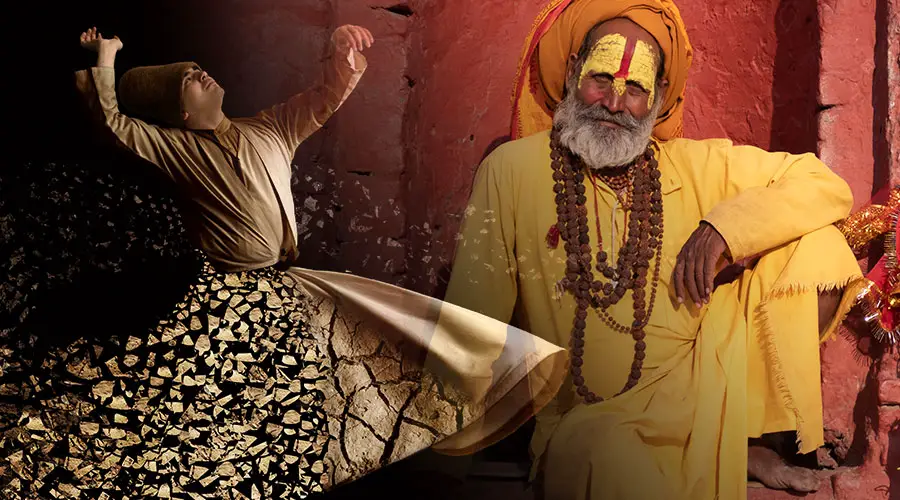
Lecture delivered at the conference on The Heritage of Sufism at the School of Oriental and African Studies (SOAS) at the University of London in 1990
1) SOURCES OF INFLUENCE ON SUFISM
A great deal has been written about various sources of influence on Sufism, chief among them being Greek philosophy, Neo-Platonism, Christianity, pre-Islamic Iranian philosophies derived from Zoroastrianism, Mithraism and Manichaeism, as well as Hindu and Buddhist ideas. Some early Western writers on Sufism have even described it as a reaction of the Aryan mind against a conquering Semitic religion which, according to them, was lacking in mystical insight. This view was motivated by an anti-Islamic outlook and is not supported by facts.
Despite the opposition of the orthodox clergy to Sufism and even though quite many great Sufis, including Mansur Hallaj (executed 922 A.D.), Ain al-Quzat Hamadani (executed 1131), Suhrawardi Maqtul (executed 1191) and others were put to death or were forced to flee due to the opposition of fanatical clerics and rulers, there is no doubt that the vast majority of Sufis regarded themselves as faithful and sincere Muslims who had, in fact, achieved the inner truths of Islam which lay beyond the ken of the superficial clerics and the mob.
It has been conclusively shown that the source of many ideas developed by the Sufis existed in the Koran and the hadith, and that Islam has indeed provided the main source of inspiration for Sufism. [1] One has only to read the works of the leading Sufis to find out their complete reverence for the Prophet and the Koran. The entire Sufi terminology of fana, baqa, tawhid, dhikr, azal, abad, the names and attributes of God, etc., are based on Koranic verses. However, it is fair to claim that in the hands of the Sufis, these terms were stretched beyond the limits acceptable to the orthodox elements and assumed such meanings which often scandalized the bulk of the faithful. Also, as Professor Arberry, a leading proponent of the Islamic nature of Sufism, has pointed out, “When we examine the sayings and anecdotes connected by the Sufis with Muhammad, we find that a substantial proportion of the most telling – from their point of view – is rejected by Bukhari and Muslim.” [2]
The reason for such a wide diversity of views regarding the sources of influence on Sufism is partly to do with the eclectic and universal outlook of the Sufis and is partly because we are dealing with different types of Sufism. One can distinguish between the philosophical Sufism of Ghazali (d. 1111) and Ibn-‘Arabi (d. 1240), who were mainly influenced by Greek philosophy and Neo-Platonic sources, the ascetic and pietistic Sufism of sober mystics such as Hasan al-Basri (d. 728), Abu-Hashim Uthman b. Sharik of Kufa (d. 776), Dhu’n-Nun Misri (d. 861) and others who were probably more influenced by Christianity, and the majority of the intoxicated Sufis of Iran who were most influenced by Hindu and Buddhist ideas.
One can even notice among some eminent Iranian mystics a disparaging attitude towards the more philosophical and pietistic types of Sufism, which lacked the exuberance and the inebriation of divine love, which forced the Iranian Sufis to express their ecstatic feelings mostly in the language of poetry. In his Manaqib Al-‘Arifin, Shams al-Din Ahmad Aflaki relates a story that one day, Maulana Jalal al-Din Rumi was accompanied by a number of his learned disciples. They were discussing Ibn-‘Arabi’s Futuhat Makkiyya, and his learned companions complained: “It is a strange book whose contents are obscure and the secrets of the philosophy of the author unintelligible. All of a sudden, Zaki, the minstrel, entered the room and began striking mystical chords. Maulana said: “For the time being, the Futuhat Of Zaki are superior to the Futuhat Makki,” and he engaged in SAMA’ [the mystic dance]’ [3]
2- LONG HISTORY OF RELATIONS BETWEEN IRAN AND INDIA
Before looking at some Hindu and Buddhist influences on Sufism, it is necessary to point out that the exchange of ideas between Iran and India has a long and distinguished history and goes back to the earliest phases of Iranian and Indian civilisations. Scholars have found a great deal of similarity between the Old Persian and Sanskrit, which are believed to have been derived from the same source. There are many historical and mythical characters which are common to both Iranian and Sanskrit sources. For instance, Jamshid and Kaikavus are names which occur both in the Avesta and the Shah Nameh, as well as in the Mahabharata, the great Indian epic poem. [4]
In more recent times, the Indian Panchatantra was brought to Iran in the sixth century and translated into Pahlavi by Borzuyeh. The original work consisted of only ten chapters, but the Iranian translator added a further eleven chapters to it. This book was translated from Pahlavi by an Iranian, Ibn Muqaffa, into excellent Arabic in the middle of the eighth century, with an introduction attributed to Borzuyeh. The introduction to this great collection of fables and moral tales is in itself of interest to our topic, as it advocated tolerance towards other religions and asserted that all religions are basically one. Maybe it was due to this universalist outlook that Ibn Muqaffa’ was accused of heresy and was cruelly put to death in the year 124/759.
The famous Arabian Nights or A Thousand and One Nights has a similar story. It is believed that some of the stories in the Persian Hezar Afsaneh (A Thousand Stories), which formed the basis for the Arabian Nights, have an Indian source.
Another link between India and the world of Islam was provided by the ministerial family of Barmak. This family originated in Balkh, where an ancestor of theirs had been an official in the Buddhist temple, Nowbahar (nava vahara or the New Temple). The name Barmak is said to be of Indian origin, Paramaka, i.e. the superior or abbot (?of Vahara). After achieving high office at the court of the Abbasids, the Barmak family sent scholars to India to study Indian sciences. They also engaged Hindu scholars to come to Baghdad to be employed as physicians in their hospitals and to translate books on medicine, pharmacology, astrology and philosophy from Sanskrit into Arabic. [5]
It is noteworthy that among the charges levelled against the Barmaks, which led to the massacre of the entire family, were allegedly due to being idol worshippers and adherence to Buddhism.
3- BIRUNI AND SUFISM
Another great source of information regarding Hindu and Buddhist ideas which has not received due attention in connection with its impact on Sufism is Abu-Reihan Biruni’s (973-1050 AD) monumental works dealing with Indian matters, including his Kitab Fi Tahqiq Ma Li’l-Hind [6] and Al-Athar Al-Baqiya ‘An Al-Qurun Al-Khaliya. [7] Contrary to many Muslims who regarded the Hindus as Mushrik (Polytheists), Biruni repeatedly asserts that Hindu philosophies were based on monotheism. He revels in the pure theories of the Bhagavad Gita and is very sympathetic to the idea that all religions are basically one and that different paths to God ultimately lead to the same goal. He even goes so far as to speak of Hindu scholars as “enjoying the help of God,” or being guided by divine inspiration [8]. It is noteworthy that twice he quotes the saying of Vyasa, “Learn twenty-five (i.e. elements of existence) by distinctions. Afterwards, adhere to whatever religion you like, your end will be salvation.” [9] It is interesting to note that he was writing these words under the great religious warrior, Sultan Mahmud, who regarded the Hindus as infidels, many of whom he killed during the holy wars that he waged inside India.
Apart from this book, Biruni composed about twenty books on India, both translations and original compositions, as well as collecting many tales, legends and parables mostly derived from ancient Indian and Iranian sources. According to Sachau, who translated Biruni’s book on India, “His work represents a scientific renaissance in comparison with the aspiration of the scholars working in Baghdad under the first Abbasid Khalifs.” [10]
Although Biruni has included in his book chapters on various Indian sciences such as medicine, astronomy and mathematics, his main intention, as stated by him at the beginning and the end of the book, was to present an impartial description of the Indian theological and philosophical doctrines to his fellow-Muslims. Biruni produced the Samkhya by Kapila and the Book of Patanjali in Arabic translation. He was perhaps the first Muslim to introduce the Bhagavad Gita and the Puranas to Muslim readers. In his chapter on theology and philosophy, he also refers to the Mahabharata and the Ramayana and once quotes Manu’s Dharmasastra. Thus, he introduced some of the greatest gems in Hindu literature to the Islamic world.
In an excellent book on Dara Shikuh, Professor Shayegan refers to him as the founder of the study of comparative religion. [11] In my view, this honour really belongs to Biruni, who lived over six hundred years before the time of Dara Shikuh. Not only was he well versed in Hinduism and Buddhism, but also in Christianity, Manichaeism, Greek philosophy and Sufism. It is remarkable that at almost every point when he describes various aspects of Hindu philosophy, he finds analogies between those ideas and Sufism.
After quoting at length from GITA: “How can a man think of death and being killed who knows that the soul is eternal, not having been born and not perishing; that the soul is something stable and constant; that no sword can cut it, no fire burn it, no water extinguish it, and no wind wither it?” [12], as well as similar passages from Vishnu-Dharma, Mani and Patanjali, Biruni writes: “The same doctrine is professed by those Sufis who teach that the world is a sleeping soul and yonder world a soul awake, and who at the same time admit that God is immanent in certain places – e.g. in heaven – in the Seat and the Throne of God (mentioned in the Koran). But there are others who admit that God is immanent in the whole world, which they call his UNIVERSAL APPEARANCE. To those who hold this view, the entering of the souls into various beings in the course of metempsychosis is of no consequence.” [13]
The Hindu scriptures talk of the soul being eternal and beyond matter, yet going through various stages of the material world from mineral to vegetable, to animal, to human kingdoms to achieve perfection and reach the stage of absolute purity, free from the snares of material existence. It is surely of this concept of spiritual evolution and migration that Rumi speaks in his famous poems:
از جمادی مردم و نامی شدم
وز نما مردم به حیوان برزدم
مردم از حیوانی و آدم شدم
پس چه ترسم کی ز مردن کم شدم
I died from the mineral and became a vegetable
I died from the vegetable and became an animal
I died from the animal and became a human being
Why should I fear death, when was I diminished as the
result of death?
Quoting from Samkhya, Biruni writes: “Therefore, the author of the book Samkhya does not consider the reward of paradise a special gain, because it has an end and is not eternal, and because this kind of life resembles the life of this our world…” Biruni then goes on to say: “The Sufis, too, do not consider the stay in paradise a special gain for another reason, because there the soul delights in other things but the Truth, i.e. God, and its thoughts are diverted from the Absolute Good by things which are not the Absolute Good.” [14]
These words of Biruni, paraphrasing the beliefs of the Hindus and the Sufis, remind one of the beautiful prayer of the woman mystic Rabi’a, who said: “Oh God! If I worship Thee in fear of Hell, burn me in Hell; and if I worship Thee in hope of Paradise, exclude me from Paradise; but if I worship Thee for Thine own sake, withhold not Thine everlasting Beauty.” [15]
Yet again, talking about the nature of the liberation of the soul from the world, Biruni elaborates on the concept of MOKSHA according to Patanjali and says that “According to the Hindus, … the reason of the bond is ignorance and therefore it can only be liberated by knowledge” about his own true soul which is eternal and which is one with the Absolute. Biruni then goes on to say: “The terms of the Sufi as to the Knowing being and his attaining the Stage Of Knowledge came to the same effect, for they maintain that he has two souls – an eternal one, not exposed to change and alteration, by which he knows that which is hidden, the transcendental world, and performs wonders; and another, a human soul, which is liable to be changed and being born.” [16]
Further quoting Patanjali, Biruni writes: “This kind of knowledge is raised above TIME, and he who has it can dispense with names and epithets, which are only instruments of human imperfection. In this stage, the Intellectus and the Intelligens unite with the Intellectum, so as to be one and the same thing.” [17] This is what is meant by Rumi when, in an ecstatic state, he says:
هر نفس آواز عشق میرسد از چپ و راست
ما به فلک میرویم عزم تماشا که راست
ما به فلک بودهایم یار ملک بودهایم
باز همان جا رویم جمله که آن شهر ماست
خود ز فلک برتریم وز ملک افزونتریم
زین دو چرا نگذریم منزل ما کبریاست
At every moment, the voice of Love calls us from the left and from the right
We are going up to heaven. Who is coming for sightseeing?
We have been in heaven; we have been companions of angels
We shall return there; this is not our abode.
Nay, we are greater than angels, we are higher than heaven
Why should we not transcend these two? Our abode is in the placeless. [18]
Biruni quotes from the Gita, “All that which is the object of man’s continuous meditating and bearing in mind is stamped upon him, so that he even unconsciously is guided by it. Since, now, the time of death is the time of remembering what we love, the soul on leaving the body is united with that object which we love, and is changed into it.” [19] After a quotation from Patanjali that the path of liberation is “a process of habituating the senses in a gentle way to detach themselves from the external world, and to concentrate themselves upon the internal one, so that they exclusively occupy themselves with God,” Biruni goes on to say: “For similar reasons the Sufis define love as being engrossed by the creature to the exclusion of God.” [20]
Again, after quoting Patanjali, he says, “The bodies are the snares of the souls for the purpose of acquiring recompense. He who arrives at the stage of liberation has acquired, in his actual form of existence, the recompense for all the doings of the past. Then he ceases to labour to acquire a title to a recompense in the future. He frees himself from the snares; he can dispense with the particular form of his existence and moves in it quite freely without being ensnared by it. He has even the faculty of moving wherever he likes, and if he likes, he might rise above the face of death. For thick, cohesive bodies cannot pose an obstacle to his FORM of existence (e.g. a mountain could not prevent him from passing through). How, then, could his body pose an obstacle to his soul?”
He goes on to say, “Similar views are also met with among the Sufi[s]. A Sufi author relates the following story: ‘A company of Sufi[s] came down unto us, and sat down at some distance from us. Then one of them rose, prayed and on having finished his prayer, turned towards me and spoke: ‘Oh master, do you know here a good place for us to die on?’ Now, I thought he meant sleeping, so I pointed out to him a place. The man went there, threw himself on the back of his head, and remained motionless. Now I rose, went to him and shook him, but lo! he was already cold.” [21]
Finally, quoting from Patanjali about total union with God and renunciation of ought else beside him, Biruni comments: “The doctrine of Patanjali is akin to that of the Sufi regarding being occupied in meditation on the Truth [i.e. God], for they say “So long as you point to something you are not a Monist, but when The Truth seizes upon the object of your pointing and annihilates it, then there is no longer an indicating person nor an object indicated. There are some passages in their system which show that they believe in the pantheistic union; e.g. one of them, being asked what the Truth (God) is, gave the following answer: ‘How should I not know the being which is I in essence and not-I in space? If I return once more into existence, thereby I am separated from him; and if I am neglected (i.e. not born anew and sent into the world), thereby I become light and become accustomed to the UNION. Abu-Bekr Ash-Shibli says: “Cast off all, and you will attain to us completely. Then you will exist, but you will not report about us to others as long as your doing is like ours.” Abu-Yazid Albistami, when asked how he had attained his stage in Sufism, answered: “I cast off my own self as a serpent casts off its skin. Then I considered my own self and found that I was He,” i.e. God. [22]
In this way, we see that one of the greatest Iranian and Islamic scholars not only introduced many Hindu and Buddhist ideas to the Muslims but also pointed out many similarities between those ideas and Sufi concepts.
4- DARA SHIKUJ’S MAJMA’UL-BAHRAYN AND SIRR-I AKBAR
The translation of many important literary, philosophical and religious Indian classics such as Mahabharata, Ramayana, Bhagavad Gita, Atharvaveda, Lilavati and many other Sanskrit works into Persian at the court of Akbar Shah by many skilled translators such as Faizi, the court poet, his brother Abu’l-Fadl, the official court historian, Abdu’l-Qader Bada’uni, Naqib Khan, Mohammad Soltan Thani Sari, Molla Shiri and others belong to a later period. However, the enthusiasm with which these works were received in certain quarters testifies to the close affinity which existed between those ideas and Iranian and Sufi concepts. It was this attitude of finding common grounds between Hindu and Islamic ideas that culminated in the famous work of Prince Dara Shikuh (1615-1659 AD), Shah Jahan’s eldest son and crown prince, Majma’ul-Bahrayn (The Mingling of the Two Oceans), written in 1065 AH/1656 AD.
In the introduction to this book, Dara Shikuh consistently refers to Indian philosophers and mystics as Muwahhid (monotheist) and writes: “Now thus sayeth this unafflicted, unsorrowing Fakir, Muhammad Dara Shikuh, that, after knowing the Truth of truths and ascertaining the secrets and subtleties of the true religion of the Sufis and having been endowed with this great gift, he thirsted to know the tenets of the religion of the Indian monotheists; and, having had repeated intercourse and (continuous) discussion with the doctors and perfect divines of this [i.e. Indian] religion who had attained the highest pitch of perfection in religious exercises, comprehension (of God), intelligence and (religious) insight, he did not find any difference, except verbal, in the way in which they sought and comprehended Truth. Consequently, having collected the views of the two parties and having brought together the points – a knowledge of which is absolutely essential and useful for the seekers of Truth – he (i.e. the author) has compiled a tract and entitled it Majma’ul-Bahrain or “The Mingling of the Two Oceans,” as it is a collection of the truth and wisdom of two Truth-Knowing [Haq Shinas] groups.” [23]
In this book, Dara Shikuh finds an incredible number of similarities between Islamic and Hindu teachings. According to him, the Hindu MAYA is the same as the Sufi “Hubb-i Zuhur,” and the Hindu “cosmic disintegration” is the same as the Islamic QIYAMA or resurrection. Both in Sufism and Hinduism, asceticism and detachment from the world enable one to become “‘Arif-i b’illah” or the liberated soul (JIVAN MUKTI, or emancipated one). The goal of a Muslim ‘Arif (gnostic) is to become extinct to the world and to become permanent in God. The goal of YOGI is also to be released from the bonds of KARMA and to achieve the Absolute. To Dara Shikuh, the goal of the Sufi “baqa’ bi’llah” is the same as the Buddhist Nirvana [24].
Although some of these analogies seem to be rather far-fetched, Dara Shikuh has looked beyond the superficial differences in language and terminology and has found that both the Sufis and Hindu mystics are in search of the Absolute and unification with God. The book is a testimony to the broad vision of the Sufis, who believe that all paths ultimately lead to the same goal.
Dara Shikuh also translated the Bhagavad Gita and fifty of the UPANISHADS into Persian. In his introduction to the translation of the Upanishads, entitled Sirr-i Akbar (The Great Secret), written in 1065/1657, he refers to the Upanishads as “the essence of monotheism, and the highest aspiration of all the lovers of God.” He further says that he found answers to all his questions and all his difficulties in “that ancient book which, without any doubt, is the first divine book, the object of search and an ocean of monotheism, which is in agreement with the Koran; rather, it is a commentary on the Koran.” [25] It was partly due to such unorthodox views, and partly due to the ambitions and intrigues of his fanatical younger brother Aurangzeb, that after the death of Shah Jahan, Dara Shikuh was accused of heresy and apostasy and sentenced to death by the orthodox ulema. He was brutally killed in 1659.
5- KHORASAN’S ROLE IN THE DEVELOPMENT OF SUFISM
It is well known that Iran produced a disproportionate number of early Sufis, and it is no coincidence that by far the largest number of Iranian Sufis come from the province of Khorasan, which was close to India and the farthest removed from the seat of the Islamic caliphate. In those days, Khorasan occupied a vast area stretching from Bastam to the Indian mountains, as well as the upper Oxus towards the Pamir. Balkh, the ancient Bactria of the Achaemenid Empire, was an important cultural and religious centre in Khorasan. Before the Arab conquest, it was famous for its Zoroastrian temples, but the city’s pride was the Buddhist temple Nawbahar (Nava Vahara or the New Temple). In several interesting articles, Assadullah Souren Melikian-Chirvani has drawn attention to the fact that many parts of Khorasan, including Marv, Balkh, Qonduz, as well as the neighbouring cities of Ghazna and Qandahar in Kabulistan and Tirmidh in Transoxiana, were important centres of Buddhism and contained famous Buddhist temples, some of which survived well into the Islamic era. Even now, two huge statues of Buddha can be seen in the Bamyan Valley in Afghanistan. [26]
A glance at the list of prominent Sufis who emerged from Balkh demonstrates the tremendous significance of that town in the history of Sufism. Balkh was the home of many famous Iranian Sufis, including Ibrahim Adham (d. 777), Shaqiq Balkhi (d. 810), Abu ‘Abdu’r-Rahman Hatam, known as Hatam ‘Asam (d. 851), Abu-Hamid Ahmad ibn Khazruyah (d. 854), Abu Muhammad Ja’far ibn Muhammad al-Khuldi (d. 959), and the most celebrated Iranian mystic, Maulana Jalalu’d-Din Rumi (d. 1273). The Sufis emerging from the former capital of Khorasan, Marv, included Abu ‘Abdu’r-Rahman ‘Abdullah ibn al-Mubarak al-Hanzali (d. 797), Abu ‘Ali Fuzail ibn Iyaz al-Taleqani (d. 803), Abu Nasr Bishr ibn Haris al-Hafi (d. 841), and Abu’l-‘Abbas Qasim ibn al-Mahdi al Sayyari (d. 953).
The Sufis who emerged from other parts of Khorasan included Bayazid Bestami (d. 875), al-Sarraj Tusi (d. 988), ‘Abdu’r-Rahman Muhammad al-Sulami (d. 1021) from Nishapur, Abu Sa’id ibn Abu’l-Khair of Maihana near Sarakhs (d. 1049), al-Qushairi from Nishapur (d. 1072), Khaja ‘Abdullah Ansari from Herat (d. 1088), Abu’l-Hasan ‘Ali ibn-‘Uthman al-Hujwiri from Ghazna (d. c. 1089), Abu Hamid Ghazali (d. 1111) and his brother Ahmad Ghazali (d. 1123) from Tus, Abu’l-Majid Majdud Sana’i from Ghazna (d. 1131), and Faridu’d-Din ‘Attar from Nishapur (d. 1220).
To this celebrated list one should add the names of other great Sufis who come from the northern provinces of the country, including Abu-Bakr Kalabadhi (d. 998) from Bukhara, ‘Ainu’l-Quzat Hamadani (executed in 1131), Abu’n-Najib Suhrawardi (d. 1168), Suhrawardi Maqtul (executed 1191) and Shaikh Shihabu’d-Din Suhrawardi (d. 1234) from Suhraward to the west of Sultaniya, near the Caspian Sea, Ruzbihan Baqli (d. 1209), Najmu’d-din Kubra (d. 1221) from Kharazm, Najmu’d-Din Razi from Rayy (d. 1256), Shaikh Fakhru’d-Din Ibrahim Iraqi (d. 1289) from Hamadan, ‘Alau’d-Dawla Simnani (d. 1336), Sa’du’d-Din Shabistari from Tabriz (d. 1340), and ‘Abdu’r-Rahman Jami (d. 1492). The list is endless.
From the above list, it becomes clear that nearly all the greatest Iranian Sufis, including Sana’i, ‘Attar, Rumi, Ansari and Ghazali, emerged from the province of Khorasan, which provided the greatest point of contact between India and Islam. Of course, in both Hinduism and Islam, there existed two tendencies: the orthodox, who stuck to the letter of the law, and the mystics, for whom the spirit of religion was more important than its letter. Although the orthodox of the two communities shunned each other, the Muslim Sufis found a great deal in Hindu and Buddhist mysticism, which corresponded to their views and influenced their version of Islamic mysticism. In turn, Islam exerted a great deal of influence upon Hinduism and Buddhism when it spread to India. Its influence on Sikhism is unmistakable. In return, many Muslim Sufis came under the spell of Hindu and Buddhist mysticism, and their outlook was influenced and enriched by it.
6- SOME HINDU AND BUDDHIST CONCEPTS INFLUENCING SUFISM
One of the Hindu concepts which had the greatest attraction for the Sufis was the concept of “monism”, which was adopted by the Sufis in the form of “Wahdat-e Wojud.” The Hindu MONISM and the Sufi WAHDAT-E WOJUD vary from Islamic monotheism. In Islam, God’s unity is an exclusive notion. The Muslim creed “La Illaha Illa’llah” (There is no god but Allah), and Koranic verses, such as “wahdohu la sharika lah” (He is one and He has no partner), or “qul huwallah-u ahad, allahu’s-samad, lam yalid va lam yulad, wa lam yakun lahu kufuwan ahad.” (Say: He is God, the One and Only; God, the Sublime. He begetteth not, nor is He begotten. And there is none like unto Him) [27] conceive of a God who is the one and only reality, who admits of no partners and no one shares in His divinity. He is one, self-sufficient, all-powerful, all-knowing, all-encompassing, eternal, who existed even before the creation of time and the universe: “Kanallah wa lam yakun ma’ahu min sha’yi'” (There was God and there was nought else beside Him). Concerning the universe, He is the absolute creator (kun fayakun, be and it was); and concerning man, He is the Supreme Lord, and man is His abject slave. Whoever associates other gods with God is regarded as a reprobate (mushrik), the greatest sin imaginable.
However, the Vedic notion of “The Real is One, the learned speak of Him in many ways” fundamentally differs from the Islamic concept. Hinduism identifies diverse gods such as Agni, Indra, Varuna and Shiva. The Hindu God is both transcendent and immanent, outside the universe of existence yet within it, beyond being and non-being. According to the Hindus, the Ultimate Reality cannot be conceived by the senses or by logical reasoning. It is a super-sensuous, super-intellectual, direct experience in the state of Samadhi (trance) or a state of supreme consciousness.
Those who attain the direct transcendental experience of Reality during Samadhi feel united with the Absolute Truth: “Absolute Reality unveils itself to our consciousness in its super-sensuous, super-mental, super-intellectual, transcendent state, in which the subject-object relation vanishes, and the consciousness realises itself as perfectly identified with the Absolute Reality. The Absolute Reality is thus experienced as the Absolute Consciousness, in which all time and space are merged in perfect unity, and the One Infinite, Eternal, Undifferentiated, Changeless Self-Effulgent Consciousness shines as the Ultimate Reality.” [28]
Coupled with this idea of God or Brahman is the concept of Atman (Self) and its identification with Brahman. Atman is the eternal soul of man, the part which is stable and unmoved by the changes which affect our mortal self. It is, in fact, the realisation of the unity of Atman and Brahma which constitutes man’s salvation. According to the refrain of the Chandogya Upanishad, “This whole world has that being for itself. That is reality. That is the self. That art thou.”
Both these concepts of the oneness of God with His creation and the identification of man’s soul with God had a great appeal to many Sufis. It was this concept of the merging of the human self with the Divine Self which made Hallaj declare “Ana’l-Haqq” (I am the Ultimate Truth, or God) and which led to his death. Hallaj refers to the two natures of God, His Absolute Existence and his existence in the realm of being: “Glory to God who revealed in His humanity the secret of His radiant divinity. And then appeared to His creatures visibly in the shape of one who eats and drinks.” In his poems, his own spirit and the Spirit of God seem to merge together into a complete unity:
“I am He whom I love, and He whom I love is I,
We are two spirits dwelling in one body.
If thou seest me, thou seest Him,
And if thou seest Him, thou seest us both.” [29]
Another concept which found many adherents among the Sufis was the Hindu concept of MAYA, or the illusory nature of existence. The Hindus do not believe that the physical world is a delusion, but they declare that the physical world has an illusory nature which veils the face of the Absolute. The relationship between the Spirit of God and its physical manifestation is like the analogy of water and bubbles. Bubbles appear on the surface of the water; then, both bubbles and water merge with each other, the bubbles losing their ephemeral identity in the ocean. However, the changing multiplicity of bubbles fails to separate them from the water. Thus, Akula (the noumenal essence of Reality) embraces Kula (the phenomenal self-expression of Reality) [30]
The concept of bubbles as symbols for the ephemeral world, which is so popular with the Hindus, finds many echoes in the works of the Sufis. A most wonderful description of this concept can be found in the following Sufi couplets attributed to Mirza Esma’il Dulabi:
عالم چو حباب است و لیکن چه حباب
نی بر سر آب بلکه بر روی سراب
وان خود چه سراب آنکه بینند بخواب
وان خواب چه خواب، خواب بد مست خراب
“The world is like a bubble
Not on water, but on a mirage
Not a mirage seen in waking, but in a dream
Not the dream of a sober person, but of one who is dead drunk” [31]
In other words, our perception of the world around us is an illusion similar to a bubble in a mirage seen in a dream by a drunkard. This extreme notion of the insubstantiality of the material world goes beyond the Hindu concepts of Maya and Samsara, which see the world as an illusion, not a delusion, but it provides a counterbalance to the dogmatic certainties of Abrahamic religions.
Another Hindu idea which had an attraction for the Sufis was the concept of Jivan Mukta (liberated while living), or spiritual awakening. Both Hindus and Buddhists believe that through self-mortification and the suppression of carnal desires, one can overcome the body and attain the state of Nirvana, or spiritual awakening. This is why some yogis go through very elaborate exercises and acts of physical hardship to gain mastery over the body. Several early Sufis are also known to have engaged in acts of self-mortification. For instance, Abu Sa’id Abu’l-Khair spent seven years as a hermit and practised ascetic exercises, as well as meditation. He is also believed to have practised Salat-e Ma’kus, prayers being performed hanging upside down with the legs being suspended from the roof or a branch of a tree [32]
The Hindus were the first to develop doctrines of mystic practices, which would lead towards unification with God. The five stages or Bhavas identified by this mystical journey were resignation, obedience, friendship, tenderness and love. The process of training in devotion implied: 1- worship of the Absolute One, 2- Sorrow for one’s sins, 3- doubts of all objects other than He, 4- celebration of His praise, 5- living for His sake, 6- assigning of everything to Him, 7- resignation to His will, 8- seeing Him in all things, 9- renouncing anger, envy, greed and impure thoughts.
These states and processes bear comparison with what the Sufis taught concerning HAAL and MAQAM (states of rapture and stages of ecstasy). For instance, Abu-Nasr al-Sarraj al-Tusi (d. 988), the author of one of the oldest treatises on Sufism, Kitab Al-Lum’ Fi Al-Tasawwuf, recounts the seven stages, viz. 1- Repentance, 2- Abstinence, 3- Renunciation, 4- Poverty, 5- Patience, 6- Trust in God, and 7- Satisfaction; and the ten psychic states, namely (1) Meditation, (2) Nearness to God, (3) Love, (4) Fear, (5) Hope, (6) Longing, (7) Intimacy, (8) Tranquility, (9) Contemplation, and (10) Certainty. [33]
Coupled with the idea of the oneness of truth was an unbounded tolerance towards other religions and philosophies. Mundaka Upanishad expresses this doctrine in the following words:
As from a well-blazing fire, sparks
By the thousand issue forth of like form,
So from the Imperishable, my friend, beings manifold
Are produced, and thither also go.” [34]
In another Upanishad, we read: “My names are many as declared by the great seers.” Again, “Him who is the One Real sages name variously.” The Chandogya Upanishad teaches us that “The man of action finds his God in fire, the man of feeling in heart, and the feeble-minded in the idol, but the strong in spirit finds God everywhere.” Again, “The worshippers of the Absolute are the highest in rank; second to them are the worshippers of the personal God; then come the worshippers of the incarnations like Rama, Krishna, Buddha; below them are those who worship ancestors, deities and sages, and lowest of all are the worshippers of the petty forces and spirits.” [35]
One can find many examples of this unbounded tolerance and respect for other people’s beliefs in the works of the leading Sufis. In the words of Emad Khorasani:
پیش ما سوختگان مسجد و میخانه یکـیست
حرم و دیر یکی، سبحه و پیمانه یکیست
اینهمه جنگ و جدل حاصل کوتهنظری است
گر نظر پاک کنی کعبه و بتخانه یکیست
گر زمن پرسی از آن لطف که من میدانم
آشنا بر در این خانه و بیگانه یکیست
عشق آتش بود و خانه خرابی دارد
پیش آتش دل شمع و پر پروانه یکیست
“To us who are burned in the love of God, the mosque and
The tavern, the rosary and the wine cup are the same.
All this fighting and dispute is the result of shortsightedness,
If you clear your vision, you will see that the Ka’ba and the house of idols are all the same.
If you ask me about the divine grace which I know of,
The stranger and the friend are the same at that door.
Fire burns and devours all in its path
To the flames of the candle, the wings of the moth and the
heart of the candle are the same.” [36]
This is why Rumi can claim that he belongs neither to the East nor to the West; that he is neither a Muslim nor a Zoroastrian. [37].
چه تدبیر ای مسلمانان که من خود را نمی دانم
نه تـرسا و یهودیـم نه گبرم نه مسلمانم
نه شـرقیم نه غـربیم نه بـریم نه بـحریم
نه ارکـان طبـیعیم نه از افـلاک گـردانم
نه از خاکم نه از بادم نه از آبم نه از آتش
نه از عرشم نه از فرشم نه از کونم نه از کانم
It is based on this concept that Hafiz says
همه کس طالبِ یاراست چه هشیار و چه مست
همه جا خانهٔ عشق است چه مسجد چه کِنِشت
(everyone is seeking the Beloved, whether sober or drunkard
Everywhere is the House of the Beloved, whether the mosque or the fire temple.)
This feeling of direct communion with God also leads to a concept of looking for the essence of religion and being rather unmindful of the outward observances of religion. This is what is meant by Rumi, who in a poem ascribed to him says
ما ز قرآن مغز را بر داشتیم
پوست را نزد سگان بگذاشتیم
(We took the essence of the Koran, we left its skin to the dogs).” This is why, again, Rumi, in this famous poem, admonishes Moses for having severed the link of love between a simple shepherd and God by trying to teach him about the formal aspects of religion. God tells him
تو برای وصل کردن آمدی نی برای فصل کردن آمدی
(You have been sent to unite my servant with me, not to cut him off from Me).
7- REFLECTIONS ON SOME HINDU AND BUDDHIST IDEAS IN THE WORKS OF EARLY SUFIS
Ibrahim Adham (c. 730-778) is the first known Sufi from Balkh. According to al-Kalabazi, he was a prince who renounced his throne due to a vision he received while hunting, which led him to turn towards Sufism [38]. As time went by, the legend of Ibrahim Adham became more fanciful and many supernatural powers were ascribed to him. Goldziher was the first scholar to point out the similarity of the story of Ibrahim Adham’s conversion with the Buddha’s Enlightenment. [39] Like Buddha, Ibrahim also advocated celibacy for mystics. A dervish who married, said Ibrahim, could be compared with someone embarking on a sea voyage; when children were born, he drowned.” [40] According to Ibrahim, the world should be enjoyed by worldly people, and the rewards of paradise should be given to those who long for them. For himself, he only wanted to remember God and, in the next world, to be with Him. [41]
Another early Sufi from Balkh was Abu ‘Ali Shaqiq (d. 810). It was the example of Ibrahim which had prompted Shaqiq to embrace Sufism. His most significant contribution to Sufi philosophy was on the subject of tawakkul, or resignation to the will of God and renunciation of the world. According to him, a devotee expressed renunciation through the tongue, while a Sufi would reveal it through his action. Commenting on the religious people of his time, Shaqiq says: “When the learned man is covetous… whom can the ignorant man imitate? And when the poor man (faqir) is famed for his poverty and is desirous of this world… whom can the covetous man find to imitate, to escape from his greed? When the shepherd is the wolf, who will care for the sheep?” [42]
Close to Balkh was Tirmidh, the home of the celebrated ‘Ali ibn al-Husayn al-Hakim al-Tirmidhi (d. 898), whose numerous works influenced both Ghazali from Tus to Ibn al-‘Arabi from Spain. Among his works, the most famous are the Khatam AL-Awliya (Seal of Saints), Kitab Al-Nahj (Book of the Highway), Nawadir Al-Usul (Choice Principles), Kitab Al-Tawhid (Book of Monotheism), and Kitab ‘Adhab Al-Qabr (Book of the Torture of the Grave).
One significant concept of Tirmidhi is that God’s revelation and the outpouring of his inspiration are continuous and cannot be confined to a single revelation and to a single historical occasion. He expresses the idea in the following way: “Who can prevent the mercy of God from prevailing over people even in these modern times? Nobody can check it, for it is continuous. Do they think that there is no siddiq, no muqarrab, no mujtaba, no mustafa nowadays? Is it not known that the Mahdi will come towards the end of the world? Is it not said that the Seal of Saints will also come and bear witness on the Day of Judgement, that all the saints are recipients of the mercy of God?” [43]. Tirmidhi’s teachings brought him into conflict with the orthodox mullahs and rulers of the time, and he retired to Nishapur, where he died in about 285/898.
Nishapur had also produced several important Sufis, including Abu-Haf Amr ibn Salama al-Haddad (d. 879), and Abu-Salih Hamdun ibn Ahmad ibn Umar al-Qassar (d. 884). Hamdun was one of the early founders of the Malamatiya movement in Sufism. He maintained that malamat (Blame) was the abandonment of all concern for one’s welfare. The more the Sufi renounced the pleasures and the more he became separated from mankind, the more he would become united with God. Blame has a great effect on making love sincere. Hujwiri sums it up like this: “In true love there is nothing sweeter than blame, because blame of the Beloved makes no impression on the lover’s heart: he heeds not what strangers say, for his heart is ever faithful to the object of his love.” “It is sweet to be reviled for passion’s sake.” [44].
The most well-known of all the Khorasan Sufis was Abu-Yazid Tayfur of Bastam, better known as Bayazid. His grandfather had been a Zoroastrian, but he spent some thirty years wandering from country to country in ascetic pursuits. He eventually returned to his native Bastam, where he died in 875 or 877. He, too, was forced to hide due to the enmity of fanatical elements in Bastam. Ritter sums up Bayazid’s teachings as follows: “When he has finally shed his ‘I’ in FANA ‘as snakes their skin’ and reached the desired stage, his changed self-consciousness is expressed in these famous hybrid utterances (Shatahat) which so scandalised and shocked his contemporaries: ‘Subhani! Ma a’zama sha’ni’ – ‘Glory be to Me! How great is My Majesty!’ ‘Thy obedience to Me is greater than my obedience to Thee,’ ‘I am the throne and the footstool!’ ‘I am the well-preserved Tablet,’ ‘I saw the Ka’ba walking round me,’ and so on. In meditation, he made flights into the supersensible world; these earned him the censure that he had claimed to have experienced a MI’RAJ [the mystic journey to heaven] in the same way as the Prophet.
He was in the course of them decorated by God with His Singleness (wahdaniyya) and clothed with His ‘I-ness’ (ananiyya), but shrank from showing himself in that state to men; or flew with the wings of everlastingness (daymumiyya) through the air of ‘no-quality’ (la-kayfiyya) to the ground of eternity (azaliyya) and saw the tree of ‘One-ness’ (ahadiyya), to realise that ‘all that was illusion’ or that it ‘was himself’ who was all that, etc. In such utterances, he appears to have reached the problem of all mysticism.” [45]
Bayazid’s theory of fana, or the total destruction of the empirical self in God, is not the only point of similarity between his teachings and those of the Upanishads. His advocacy of understanding the controlled use of breath was also Indian. Some of Bayazid ‘s biographers suggest that he learned the doctrine of fana from his teacher Abu ‘Ali Sindi. [46]
CONCLUSION
Iranian Sufism developed mainly in the province of Khorasan, which for centuries had been a centre for the meeting of Iranian and Indian cultures and which had been a breeding ground for Zoroastrian, Manichaean, Mithraic, Hindu and Buddhist ideas. The Sufis came under the influence of these ideas, especially those of Hinduism and Buddhism. Many Hindu and Buddhist ideas, including the concept of Monism, the identification of the soul of man with God, the illusory nature of the physical world, the need for the renunciation of the physical world in order to achieve spiritual salvation, the basic unity of different paths leading to God, the need for the adoption of ascetic exercises and the choosing of a Pir or a guide on the path of the spiritual quest, and many other ideas seemed attractive to the Sufis and exerted a great deal of influence on their works.
These concepts led many Sufis to interpret Koranic teachings in the light of these mystical insights, something which got many Sufis into trouble with the more orthodox believers and occasionally led to their death. However, many other Sufis managed to merge and marry those Hindu concepts with Islamic ideas in such a way that they could escape the censure of the more orthodox elements. The result was the creation of a deeply spiritual and profound mysticism, expressed in Islamic language, making use of many Koranic terms.
FOOTNOTES:
1. See: A.J. Arberry, An Introduction To The History Of Sufism (Oxford, 1962); Sufism, An Account Of The Mystics Of Islam (London, 1950), R.A. Nicholson, The Mystics Of Islam (London, 1914), and S. H. Nasr, Sufi Essays (London, 1972).
2. A. J. Arberry, Sufism (London, 1950), p. 25.
3. Manaqib al-‘Arifin, ed. by Tahsin Yaziji, Ankara, 1959, I, 470, quoted in Faridu’d-Din ‘Attar, Mokhtar-Nama, ed. by Shafi’i Kadakani (Rose Publications, Tehran 1358/1979), introduction, p. 21.
4. Mohammad Ja’far Mahjub, Iran-Nameh, vol. VIII, No. 2, Spring 1990.
5. See: Alberuni’s India, translated by E. C. Sachau (London, Kegan Paul, 1910), pp. xxxi and xxxii.
6. Published in Hyderabad, 1958.
7. Translated by E. C. Sachau, The Chronology Of Ancient Nations (London, 1879). also see: E. C. Sachau, Alberuni’s India (London, 1910).
8. Sachau, op. cit. II, 108.
9. ibid, I, 44 and I, 104.
10. ibid, I, xxxvii.
11. Daryush Shayegan, Hinduisme Et Sufisme D’apres Le Majma’ Al-Bahrayn De Dara Shokuh, Edition de la Difference, Paris, 1979.
12. Sachau, op. cit., I, p. 52.
13. ibid. I, pp. 57-58.
14. ibid, I, pp. 62-63.
15. Quoted by A.J.Arberry, Sufism.
16. Sachau, op. cit. I, pp. 68-69.
17. ibid, I, p. 70.
18. Ghazal by Rumi from Divan-E Shams-E Tabrizi, starting with “Miresad avaz-e eshq dambedam az chapp-o rast, ma be falak miravim, ‘azm-e tamasha kerast.”
19. Sachau, op. cit. I, p. 75
20. ibid, I, 77.
21. ibid, I, 82-83.
22. ibid, I, 77-78.
23. Dara Shikuh, Majma’ul-Bahrain, text and translation by M. Mahfuz al-Haq, published by the Asiatic Society, Calcutta, 1929, reprinted 1982, p. 38.
24. For an excellent study of Majmau’l-Bahrayn, see: Daryush Shayegan, Hindusime Et Sufisme D’apres Le Majma’al-Bahrayn De Dara Shokuh, Edition de la Difference, Paris, 1979; and an article by the same author entitled “Prince Dara Shikuh: Pioneer in Comparative Mysticism,” Iran Nameh, vol. VIII, No. 2, Spring 1990, pp. 196-224.
25. Muhammad Dara Shikuh, SIRR-I AKBAR, ed. by Seyyed Muhammad Jalali Na’ini (Tehran, 1358/1979), second edition, p. five.
26. See: Assadullah Souren Melikian-Chirvani, “L’évocation littéraire du bouddhisme dans l’Iran musulman,” in Le Monde Iranien Et L’islam, Tome II, Centre de recherches d’Histoire de Philologie de la IVe Section d’EPHE, Librairies Drouz, Genève, 1974; also “Baztabha-ye Adabi-ye ‘A’in-e Buda’i dar Iran-e Eslami,” Iran Nameh, VIII, No. 2, Spring 1369/1990, pp. 273-280.
27. Koran, CXII.
28. A. K. Banerjea, Philosophy Of Gorakhnath, (Gorakhpur, n.d)., p. 36, quoted in Rizvi, I, p. 333
29. Quoted in R.A. Nicholson, The Idea Of Personality In Sufism (Cambridge, Cambridge University Press, 1923), p. 30
30. Banerjea, op. cit., p. 69, quoted in Rizvi, I, p. 334.
31. Quatrain attributed to Abu-Sa’id Abil-Khair
32. Rizvi, p. 336.
33. Quoted in The World Of The Sufis, ed. by Idries Shah (Octagon Press, London, 1979), pp. 101-102.
34. S Radhakrishnan, The Principal Upanishads (London, George Allen and Unwin, 1953) p. 680.
35. Quoted by Radkhakrishnan, op cit
36. Poem from “Divan” of ‘Emad Khorasani, starting with: “Bar-e ma sukhtegan masjed-o meykhaneh yekist…”
37. Poem by Rumi, “Na sharqiyam, na gharbiyyam, na gabram, na mosalmanan.”
38. A. J. Arberry, The Doctrine Of The Sufis (Cambridge, 1935), p. 108.
39. Journal Of The Royal Asiatic Society, 1904, pp. 132-133.
40. Arberry, op. cit. pp. 66-70.
41. For Ibrahim’s life, see: al-Sulami, Tabaqat Al-Sufiyya, Leiden, 1960, pp. 13-22; Arberry, op. cit. pp. 62-79.
42. Margaret Smith, An Early Mystic Of Baghdad (London, 1935), p. 75.
43. M. I. al-Geyoushi, “al-Tirmidhi’s Theory of Saints and Sainthood,” Islamic Quarterly, XV, No. 1, London, January-March 1971, p. 37.
44. Nicholson, op. cit. pp. 65, and 125-26.
45. Encyclopaedia of Islam, New Edition,v. I, pp. 162-163.
46. See: Nicholson, op. cit. pp. 106-8, 184-88, and R. C. Zaehner, Hindu And Muslim Mysticism (London, 1960), pp. 93-134, 198-218.

