

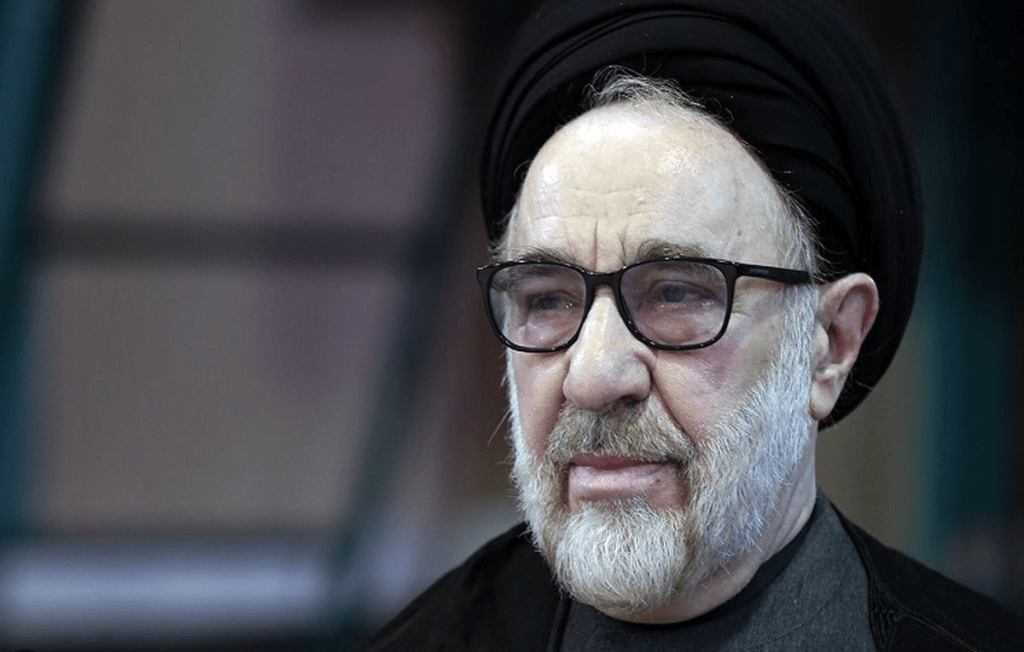
Following the violent crackdown of nationwide protests that followed the tragic death of Mahsa Amini in police custody, many Iranians at home and abroad have lost faith in Iranian leaders, past and present, and are looking for alternatives to the oppressive clerical regime. Yet, some Iranian officials are still trying to persuade the current right-wing Iranian government to change course and adopt more rational policies. The following document published by the reformist newspaper, E’temad Online, on 31 July 2023 contains the result of proposals by a number of Iranian scholars and religious figures, with an introduction by former reformist president, Mohammad Khatami. Here, is my translation of Khatami’s introduction, but the whole document also contains some interesting remarks.
“The main problem with the hijab issue is that it has become an identity and symbolic issue for the government, while it is not necessarily the case for many citizens and for the society at large. The government should accept that a large section of society is opposed to mandatory hijab.
Although the issue of hijab was the starting point of Iran’s protests in 1401 (2022), nevertheless, it is a symbol of bigger problems. It has deep roots in history and it demonstrates the gap between the government and society. In other words, it shows the retarded governance methods used in dealing with current social changes.
In the prognosis phase, this research has analysed the background and the roots of this issue. In the diagnosis phase, it has examined the opinions of jurisprudents, and legal and sociological experts and, finally, it has examined the hijab issue from the perspective of women’s lived experience.
Regardless of what opinion we have about the government in terms of its meaning, purpose, scope of powers and duties, including its relationship with religion, we should be able to reach an agreement on the criterion that makes governance good or bad. Based on this criterion, we should agree on what is the status and the role of governance concerning the fate of society, recognising and providing for its needs, strengthening the economic and cultural foundations of society, improving the living conditions, maintaining and increasing the social capital, and also having the ability to correctly recognise the critical issues and to adopt the necessary measures for preventing them from turning into crises. This is one criterion, among many others, by which we can judge the Islamic Republic.
The issue of women’s hijab, at least at the present time, is one issue that has been turned into a crisis due to the official way of dealing with it. The question is not about whether hijab is obligatory based on religious teachings and tradition, and whether a religious person must observe it or not. The first question is whether making it mandatory by the government is reasonable and fruitful. Secondly, we should take into account all aspects and many values that are more important, and which are harmed as the result of the way that this issue has been dealt with, and also the harm that is done to the collective interests of society. In view of all this, is it permissible to enforce this ruling, especially with unfair methods and actions?
Today, we are facing a diverse and pluralistic society that is different from the past, which we must get to know correctly and look for realistic and forward-looking solutions to the challenges, issues and bottlenecks arising from this vast and undeniable transformation. The most correct and effective way (to resolve the issue) is to seek help from enlightened elites and scientific and specialised groups of society, instead of adopting narrow-minded approaches and adopting counter-productive and self-destructive methods and harmful behaviours.
To this end, I requested a group of elites and experts in the fields of social sciences and law, as well as seminary researchers, to collaborate and find a solution following the protests of last autumn regarding the compulsory observance of the hijab, which is a manifestation of a wider crisis in the relations between the government and the society. Additionally, I asked a group of eminent religious scholars and researchers in religious seminaries to comment on the text of the dialogue in terms of its academic strength and even its conformity with basic religious standards.
They have expressed very valuable opinions, and the widespread publication of those views could be very useful for our society, whether those who believe in religious standards or those compatriots who don’t, especially for a government that attributes its behaviour to religion. Our conversations in this group have been based on scientific, pioneering and reforming foundations and frameworks and, above all, they have been organised from the perspective of understanding the social reality and reaching a solution to the problem.
The points that have been emphasised in different parts of this report stress the necessity of recognising a diverse, varied and pluralistic range of interests, beliefs and tastes in Iranian society, not standing on one or the other side of the identity politics and the conflicts that the current policies provoke.
The variety of religious beliefs and behaviours that appear in various forms in the lived experience of religious people in Iran today is an undeniable reality of our society. What is controversial is the government’s coercion in trying to put a tight straightjacket on the body of the reality of a pluralistic and diverse society. Various generational, class, religious, ethnic, gender and taste differences in our society cannot be confined to any homogenising discourse. Relying on the means of legal coercion and various methods to ensure uniformity in the public arena has not been successful, as evidenced by repeated past experiments, but has led to protests, movements and behaviours that have given rise to symbolic opposition on a wide scale.
Objecting to the mandatory hijab is a manifestation of a more fundamental issue in the relationship between the government/state and society in different areas of social, economic and cultural life. Objecting to the issue of compulsory hijab is a step to open a dialogue about the foundations of social order and political legitimacy [of the government]. If the government in its general sense is not regarded as the custodian of the collective interest and the facilitator of achieving the common welfare of all or at least the majority of the citizens, or if the government’s policies in the eyes of the majority of the society are considered to benefit and empower a minority of the population, while the proportion of less privileged and poorer groups (both relatively and in absolute terms) has increased in society over a relatively long period of time, the entire social contract and government policies will become the subject of protests.
The main theme of the text resulting from these conversations (which also contains a strategic summary) is to deal with this form of politics and policy-making through the channel of exploring the issue of forcing the mandatory hijab. At the end of the text, in the Conclusion, some clear solutions have been put forward for resolving the current issue.
It is possible (and indeed necessary) to adopt the methods of scientific and constructive dialogue and to seek help from elites and well-meaning experts regarding other issues that our country is facing. Let’s hope that political, cultural, economic and social experts and leaders will step forward in this direction and engage in a dialogue with society. It is expected that as the result of such a dialogue, the range of crises, complications and bottlenecks that have put pressure on all classes and sections of society may be curbed and resolved, or at least their intensity will be reduced by collective efforts and national action.
[Signed] Seyyed Mohammad Khatami”
Here is the link to the full report:

