

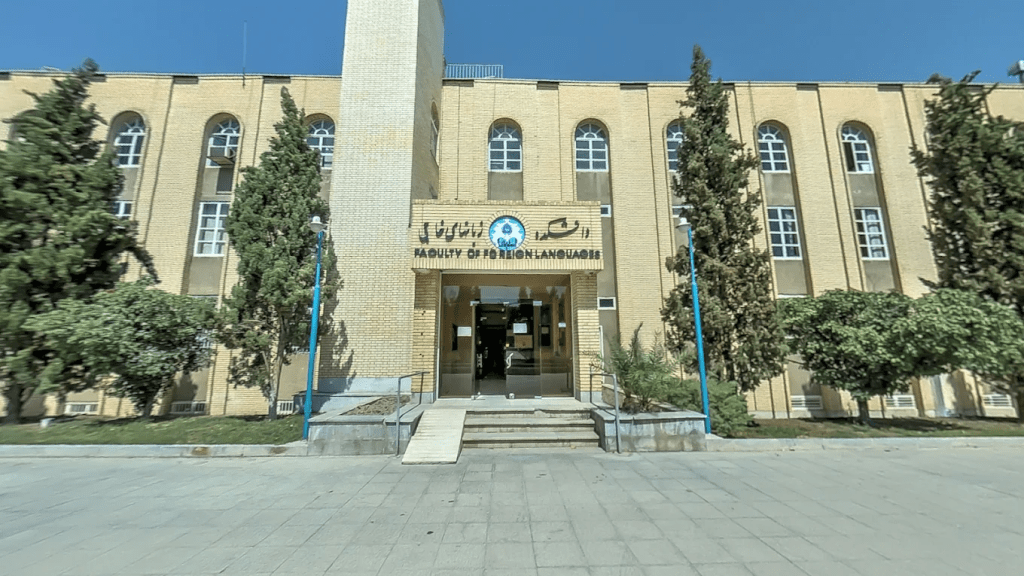
While teaching at the University of Isfahan (1970-78), I first served as Associate Professor and Chairman of the Department of Languages, and later as Professor and Dean of the Faculty of Foreign Languages. In August 1974, I founded the first Faculty of Foreign Languages and the first Department of American Studies in Iran as one of the new faculty’s departments. In recognition of those efforts, the University Senate honoured me by naming me as a Distinguished Professor of the University of Isfahan.
In August 2014, the University of Isfahan hosted a special conference commemorating the 40th anniversary of the Faculty of Foreign Languages’ founding. The dean of the faculty invited me to participate in that conference, but as I was unable to travel to Iran at the time, he asked me to write about the history of the faculty’s founding, some of its original staff, and the languages taught.
The following is the text of what I wrote in August 2014 about the establishment of the Faculty of Languages at the University of Isfahan, its various departments, the languages that were taught at the faculty and some of the original lecturers and professors.
I am very honoured and grateful that, on the 40th anniversary of the establishment of the Faculty of Foreign Languages of the University of Isfahan, which I also had a small part in establishing, I have been asked to write a brief account of the history of this faculty. I am also very happy that this faculty still continues its valuable activities and is one of the most successful faculties of the University of Isfahan. During these long years, it has educated thousands of young students and scholars who have become familiar with the languages, cultures, and civilisations of other countries and have undoubtedly rendered valuable services to the country.
In my opinion, the Faculty of Foreign Languages is one of the most important faculties of the university, as it opens a window to the outside world and familiarises us with the sciences, literatures, arts, cultures, history, opinions, and beliefs of other nations. Iran’s unique geographical location, its ancient history, and rich culture and literature have turned it into a bridge between the East and the West and the North and the South of the region. Throughout history, especially before the era of global navigation and the discovery of the New World, Iran provided the only way to travel between China and India in the East and the Balkans and Europe in the West. It also formed a bridge between Russia, Central Asia, and the Caucasus in the North, the Arab world, and Africa in the South.
This is why Iran has long had close and deep cultural and political relations with China and India in the East, Central Asia and the Caucasus in the North, Greece, Rome and Byzantium in the West, and the Babylonian and Assyrian civilisations in the South and Southwest.
There are many historical and mythical characters which are common to both Iranian and Sanskrit sources. For instance, Jamshid and Kaikavus are names which occur both in the Avesta and the Shah Nameh, as well as in the Mahabharata, the great Indian epic poem. The old Persian language was very close to Sanskrit. The language of the Zoroastrian Gathas is believed to be even older than the language of the oldest religious text in India, the Rig Veda. Many scholars believe that Zoroastrianism played a significant role in the development of Buddhist beliefs, especially in the emergence of the Hinayana school.
In return, Iran benefited greatly from Indian literature and culture. Borzuyeh Hakim (also known as Burzoe or Borzūya), who was a prominent 6th-century Sasanian physician and philosopher during the reign of King Khosrow I (Anushravan), translated the old Sanskrit book of animal fables, Kalila Wa Dimna (known in Sanskrit as Panchatantra or Five Treatises) into Pahlavi in 550 AD. The book, which later gained great fame in the West, was a major example of literary contacts between India and Iran. The original work consisted of only ten chapters, but the Iranian translator added eleven more.
The Pahlavi text of the book was translated into Arabic by another Iranian scholar, Abdullah Ibn al-Muqaffa, in 750 AD. A new Persian version of the book was produced by the famous poet and musician Rudaki in the 9th century AD, which formed the basis of Kashefi’s 15th-century Anvār-i Suhaylī (The Lights of Canopus), which was translated into Turkish and several European languages, known as The Fables of Bidpai.
Iran-China relations also date back to ancient times, since at least 200 BC, under the Iranian Ashkanid or Parthian dynasty. The Han dynasty diplomat and explorer Zhang Qian, who visited Bactria and Sogdiana in 126 BC, made the first known Chinese report on Parthia, which he identified as an advanced urban civilisation. Following Zhang Qian’s embassy and report, the Han conquered Dayuan and opened the Silk Road. Commercial relations between China, Central Asia, and Parthia flourished, as many Chinese missions were sent throughout the 1st century BC.
The Parthians were intent on maintaining good relations with China and sent their own embassies, starting around 110 BC. According to Chinese sources, “When the Han envoy first visited the Kingdom of Anxi [Parthia], the King of Anxi dispatched a party of 20,000 horsemen to meet them on the eastern border of the Kingdom. When the Han envoys set out again to return to China, the King of Anxi dispatched envoys of his own to accompany them. The [Chinese] Emperor was delighted at this.”
Parthians also played a role in transmitting Buddhism from Central Asia to China. An Shih Kao, a Parthian nobleman and Buddhist missionary, went to the Chinese capital in 148 AD, where he established temples and became the first man to translate Buddhist scriptures into Chinese. The kingdom of Kushan, encompassing much of what is now Eastern Iran, Afghanistan, India, Tajikistan and Uzbekistan, became the crossroads for Buddhist transmissions, with many Iranians translating Sanskrit sutras into Chinese.
At the same time, contrary to the opinions of some Western nationalists who believe in cultural separation between ancient Iran and Greece and consider Greek civilisation independent and separate from Iranian civilisation, there was a deep and continuous connection between the two countries. Even centuries before the Greco-Persian wars from 492-490 BC, the two ancient civilisations had a scientific and cultural connection. The ancient Ionian philosopher and polymath Pythagoras (c. 570-495 BC) is believed to have travelled to Iran and lived in the capital of the Persian Empire for ten years, where he studied the teachings of the Iranian Prophet Zoroaster. After returning to Greece, he compiled his important scientific works.
Heraclitus (fl. c. 500 BC), another great Greek scientist, was born in Ephesus, which was then part of the Iranian Empire, and was invited to live in Iran as a philosopher at the Achaemenid court. Herodotus (c. 484-425 BC), the father of historiography in the ancient world, was born in Halicarnassus (now Bodrum), which was a part of the Iranian Empire. He speaks warmly of Iran and Iranian civilisation in his works. Another Greek historian, Xenophon (c. 430-355 BC), fought with the army of Cyrus the Younger, known as the “Ten Thousand”, and his famous book, “Anabasis“, was mostly about Cyrus the Younger’s failed campaign to gain the Achaemenid throne from Artaxerxes II.
In addition to its contacts with Hinduism and Buddhism, ancient Iran also had a major impact on the development of Judaism and Christianity. In 586 BC, the Babylonian Emperor Nebuchadnezzar (reigned from August 605 BC – 7 October 562 BC) conquered Jerusalem, destroyed the Jewish Temple and carried off a large number of Jews into exile. This “Babylonian captivity” lasted almost fifty years. In 539 BC, the Achaemenid King Cyrus conquered Babylon, and in 538, he issued a decree stating that the Jews would be allowed to return to their homeland. Not only were the exiles released, but Cyrus and Darius also supported the rebuilding of the Temple in Jerusalem. Due to his great services to the Jews, Cyrus was praised more than any other non-Jewish historical figure in the Bible.
Fourteen books of the Hebrew Bible, or the Old Testament, have either directly dealt with an event that happened in Iran or have references to Iran. There are seven books out of the 14 which are in the form of memoirs of the Jews in the courts of the Medes and the Achaemenids, while seven others refer to events which happened in Iran.
Later on, with the emergence of Christianity, Iran again had a significant impact on the development of Christian beliefs. According to the Bible, after the birth of Jesus Christ, the “three wise men” or three Zoroastrian priests (the Magi) visited the newborn child. Also, September 25, which is celebrated as the anniversary of Jesus’ birth, coincides with the birthday of Mithra, one of the gods of ancient Iran, who had found many followers among Roman soldiers. That day was chosen as Jesus’s birthday from among several different dates given for his birth because of the influence of Mithraism on the Roman Empire and then on the Christian Church.
Nestorian scholars and philosophers had produced many translations and commentaries of Greek philosophy in the libraries and schools in Edessa. In 529 AD, they were attacked and banished by the royal decree of Justinian. A large number of those who had survived the attacks took refuge in the Sasanian court. In the early 6th century AD, Khosrow I, known as Anushirvan (the immortal soul), established a school of philosophy in Iran and invited scholars from the Greek school to Iran. They taught at the University of Jundishapur, which served as the first academic centre of the world, closest in foundation to the modern-day concept of “University”. The Greek scholars who found refuge in that university translated Greek works into Pahlavi, which later became the basis for translations from Pahlavi into Arabic.
After the Arab invasion and the Iranians’ conversion to Islam, Iran became the cultural and scientific centre of the Islamic world. If Arabic was the language of revelation and the dominant religious language in the Middle East and North Africa, the message of Islam was conveyed to the East of the Islamic world through Persian. For centuries, Persian was the court language of the Ottoman Empire in the West, and the official and literary language of the Indian subcontinent, and its range extended even to Kashgar and the borders of China.
Iranian scientists, writers, commentators and philosophers brought Islamic civilisation to the peak of its greatness, and the names of scientists such as Biruni, Al-Khwarizmi, Abu Ali Sina, Farabi, Omar Khayyam, Esfezari (or Al-Fazari) and dozens of others not only became famous in the Islamic world, but their scientific works were even taught in many prestigious European universities for centuries. The Iranians even played an important role in the compilation and development of Arabic grammar, and compiled books of Hadith or the sayings of the Prophet and the Imams.
Some of the most important Sunni and Shia books of hadith were compiled by Iranian scholars. Four of the “Six Books” of Sunni Islam, Sahih al-Bukhari by Bukhari, Sunan Abu Dawud by Abu Dawud, Sunan al-Tirmidhi by Tirmidhi, and Sunan Ibn Majah by Ibn Majah, were compiled by Iranian scholars. Also, the “Four Books” of Shia Islam, al-Kafi by al-Kulayni, Man la yahduruh al-Faqih by al-Shaykh al-Saduq, Tahdhib al-Ahkam by Shaykh Tusi, and al-Istibsar also by Shaykh Tusi, were compiled by Iranian religious scholars.
While Iranian scholars, merchants and travellers introduced Islam to India, they also borrowed many Hindu and Buddhist ideas. Iranian Islam, especially Sufism, which constitutes Islamic mysticism, was deeply influenced by Hindu and Buddhist ideas. The great Iranian scholar and polymath Abu-Reihan Biruni (973-1050 AD) travelled to India, lived there for some years and made a close study of both Hinduism and Buddhism. His monumental works dealing with Indian matters, including his Taḥqīq mā li-l-hind min maqūlah maqbūlah fī al-ʿaql aw mardhūlah (Verifying All That the Indians Recount, the Reasonable and the Unreasonable) and Al-Athar Al-Baqiya ‘An Al-Qurun Al-Khaliya (The Remaining Traces of Past Centuries), were the first books by Muslim scholars making a deep and unbiased study of Indian religions and philosophies.
Biruni wrote favourably about “the pure theories” of the Bhagavad Gita and was very sympathetic to the idea that all religions were basically one and were different paths that ultimately led to the same goal. He even goes so far as to speak of Hindu scholars as “enjoying the help of God,” or being guided by divine inspiration. Remarkably, such views were expressed by a prominent Muslim scholar in the 11th-12th century.
Biruni wrote about twenty books on India, both translations and original compositions, as well as collecting many tales, legends and parables mostly derived from ancient Indian and Iranian sources. He was the first Muslim scholar to provide such favourable accounts of Hindu and Buddhist beliefs for the Muslim world. In a way, Biruni can be regarded as a forerunner of both comparative religion and comparative literature, as well as a scientist and astronomer. Of the 146 books written by al-Bīrūnī, 95 are devoted to astronomy, mathematics, and related subjects.
Iranian literature is regarded as one of the richest and most beautiful literatures of the world, and the names of poets such as Ferdowsi, Nezami, Omar Khayyam, Sanai, Attar, Rumi, Sa’di, Hafiz, Jami and many others are known throughout the Islamic world. The Gulistan of Sa’di was a textbook for elegant writing and moral and ethical guidance in Indian universities right up to the 19th century. The Sassanian Pahlavi book of tales, love stories, tragedies, comedies and adventure, “Hezar Afsan” or “Hezar Afsaneh” (A Thousand Tales), which was translated into Arabic, formed the basis of One Thousand and One Nights, and became a classic of world literature. The Persian words, such as Shahryar and his wife Shahrzad or Scheherazade, Dinazad, Shahzaman, vizier, etc., attest to the Persian source of the book.
In the tenth century, the great Iranian-Arab bibliographer, biographer and literary historian Ibn al-Nadim compiled a famous catalogue of books (the “Fihrist”) in Baghdad. In that book, he wrote about Hezar Afsaneh and noted that the Sassanian kings of Iran enjoyed “evening tales and fables”, and these tales were narrated at the court for their entertainment. Hezar Afsaneh and its Arabic translation, One Thousand and One Nights, exerted a profound and lasting influence on world literature and provided a model for later novels and romances.
A country with such a rich cultural and scientific heritage, and with such a brilliant history of interaction with the East and the West, cannot withdraw into itself and cut off or limit its contact with the outside world. At the same time, this culture cannot consider itself independent of other cultures of the world. In the Middle Ages, when the West wanted to renew its contact with the Islamic world and other civilisations, it first studied the languages, sciences and cultures of other countries. From 1312 onwards, chairs of Arabic, Greek, Persian and Hebrew languages were established at the universities of Vienna, Paris, Oxford, Bologna, Avignon, Cambridge and Salamanca, and thus a new era in the contact between Europe and other civilisations of the world began, and this was the prelude to Europe’s cultural and scientific leap.
During the past few centuries, with great religious, philosophical and scientific advancements in the West, such as the Renaissance, the Reformation and the Age of Enlightenment, Western languages, especially English, have become the repositories of great learning and scholarship. English has become a global lingua franca and is a means of communication and exchange of ideas among the nations of the world. In order to keep up with new scientific and cultural developments, Iranians and other Asian and African nations have no option but to familiarise themselves with other languages and, through them, with other cultures and civilisations.
At a time when extensive contacts have been established between Iran and the world and Iran has become the centre of attention of both the East and the West, Iran must open its cultural doors to the world and exchange ideas with other nations and cultures. It is equally important to welcome and learn from other cultures and civilisations. As the world is marching ahead with great scientific and technological strides, Iran cannot isolate itself from the world and be left behind in the scientific and cultural fields.
This is why, in my opinion, the Faculty of Foreign Languages is one of the most important faculties of any university. Given this cultural mission, the Faculty of Foreign Languages should not limit itself to teaching foreign languages, but should also use foreign languages as bridges to connect Iran to the cultures, civilisations, literatures, and artistic, philosophical, religious and scientific works of other cultures of the world. We should also use these contacts as the means for introducing the Iranian language, culture and civilisation to others, and turn Iran into an active member of the international community in keeping with the role it has played in the past.
It was in light of this great mission of establishing cultural connections with the outside world that, after returning to Iran, I proposed the establishment of a Faculty of Foreign Languages to Dr Ghasem Motamedi, the then president of Isfahan University. With his approval and the endorsement of the university council, and the cooperation of all the professors of the Department of Foreign Languages at Isfahan University, this faculty was established as the first faculty of foreign languages in Iran forty years ago. To get acquainted with the situation at that time before the establishment of this faculty, it is necessary to recount some of my memories of the beginning of my teaching at Isfahan University.
I was born in Shiraz, but I spent a few years of my primary education in Sirjan, Kerman Province, and returned to Shiraz for my secondary education. I received the highest grades in the entrance exam of Shiraz University and began my studies in English language and literature at that university in 1956. After graduating from Shiraz University, I went to England to continue my studies and received a BA Honours Degree in English Literature from the University of Leeds, an MA Degree in American Literature from the University of Hull, and a PhD Degree in Oriental Studies and Comparative Literature from the University of Cambridge. In the meantime, I taught Persian language and literature at the University of Cambridge for five years.
My return to Iran started unexpectedly. A friend of mine who had just finished his PhD in geology from the University of Cambridge told me that he had been invited to the Iranian Embassy in London to meet with the president of the University of Isfahan, who had come to England to recruit professors for that university. He said that he did not want to go alone to the meeting and insisted that I go with him. Although I had not thought of returning to Iran at that time, I went to London only to accompany my friend. At that time, Mr Emami Ahari was the cultural attaché at the Iranian Embassy in London.
A large number of students who were eager to return to their homeland and teach at the University of Isfahan had gathered in a large room in the embassy. My friend and I stood near the entrance of the hall and started talking to a friendly man who was a little older than us. He was an educated, calm, and friendly person who had completed his medical studies in the United States. I was very impressed by his calm, simple manners and friendly demeanour.
A little later, Mr Emami Ahari introduced Dr Ghasem Motamedi, the president of Isfahan University, and I noticed that the person I was talking to was the president of Isfahan University. I was very surprised that a relatively young, modest, courteous and friendly person was the president of the university, because when I had left Iran a decade earlier, university presidents were usually elderly and somewhat cold and distant.
After Dr Motamedi spoke to many students who were applying for posts mainly in science subjects, he came to me and said that he wanted to talk to me. I went with him to the interview room. He said that although he had come mainly to hire graduates in science and medicine, Isfahan University had a large Department of Foreign Languages, and he was looking for someone to run that department. He added that Isfahan University was a dynamic and expanding university and had a great need for educated and young professors. He asked me to send a photocopy of my documents with a job application to the university so that the Faculty of Literature, of which the Foreign Languages Department was a part, could decide on the matter. After consulting with my British wife, I decided to send in my application, and fortunately, shortly afterwards, I received a positive response, and in September 1970, my wife and I left for Isfahan.
Although I had passed through Isfahan several times during my childhood and youth, I did not know Isfahan well. This charming, beautiful, historical city, which is in fact the artistic and cultural centre of Iran, became our home for eight years, and our eldest son and daughter were also born in Isfahan. We spent eight memorable, exciting and tumultuous years in that artistic city, with its hardworking, industrious, warm and hospitable people.
As mentioned, at that time, the Foreign Languages Department, which had a few full-time professors and several part-time lecturers and instructors, was a part of the Faculty of Letters and Human Sciences. In addition to foreign languages, the faculty also consisted of Persian literature and linguistics, history, geography, and sociology departments.
At that time, Dr Abdul-Baqi Nawab was the dean of the Faculty of Literature. Although Dr Nawab was a physician, he was very interested in literature, had a phenomenal memory for Persian poetry, and most days when he was at the faculty, poetry readings were held in his office. I still remember the names of some of the professors who taught in the Department of Languages, including Professor Farzam, Dr Pouran Shoja’i, and Dr Jalil Doostkhah, who taught Persian literature; Dr Sasan Spanta, who taught linguistics; and Dr Farhad Abadani, who taught ancient Persian.
Other university professors included Dr Firoozi, director of the Geography Department; Dr Lotfollah Honarfar, the author of the book “The Treasure of the Historical Monuments of Isfahan”, director of the History Department, and Dr Ali Shariatmadari, director of the Philosophy Department.
Upon my arrival in Isfahan, I contacted the heads of English departments at other universities in the country, and with the cooperation of several people, including Dr Parviz Amouzgar, head of the English department at the University of Tehran (who later became the president of Ferdowsi University in Mashhad and deputy minister of higher education), Dr Mahnaz Afkhami, head of the English department at Melli University, Dr. Lotfollah Yar Mohammadi, head of the English department at Shiraz University, Dr Saeed Arbab Shirani, head of the English Department at Ahvaz University and Dr Hamid Sarhangian, head of the English Department at the University of Tabriz, in the academic year 1970, we founded the first Association of English Professors in Iran.
We organised annual conferences with the participation of hundreds of lecturers and professors in the English language and English and American literature from all over the country. The first conference of English professors was held at the University of Tehran, and subsequently they were held at the Isfahan, Shiraz, Ahvaz, Mashhad, and Tabriz universities.
Since the Foreign Languages Department was the largest department in the Faculty of Literature and space in the faculty was limited, it was decided to separate this department from the faculty and move it to a new building that used to be a student dormitory. Initially, English, French, German, Russian and Arabic were taught in the Language Department. In addition to hundreds of students majoring in one of those subjects, each day we had to organise more than 100 classes to teach English for an hour every day to more than 2,000 first-year students of the university.
From the beginning, the Faculty of Languages benefited from the presence of some knowledgeable and dedicated lecturers and professors. In the English department, the lecturers included Dr Ali Akbar Azima, who was previously the head of the English Department, Dr Masoud Fracyon, Mr Faghihian, Amir Foroughi, and several foreign professors and instructors whom we recruited mainly from Great Britain and the United States.
The Basic English Department was headed by an American couple, Robert and Jane Stevenson, who had written many books on teaching English as a foreign language and were experts in this field. This couple had left the United States in protest against the Vietnam War and had come to Iran. After living in Iran for a few years, they obtained Iranian citizenship, and their son did his military service in Iran.
After the establishment of the faculty, we started a programme of exchanges of students and professors with several foreign universities, including the University of Durham in England and the University of Texas at Austin. Every year, a number of the best students of the Faculty of Foreign Languages went to those universities to continue their postgraduate studies, and in the following years, some of them, including Dr Koosha, Dr Mohammad Reza Talebinejad, Dr Manouchehr Tavangar, and Dr Farideh Pourgive, became professors at the Universities of Isfahan and Shiraz. Dr Mohammad Reza Ghanoonparvar, who was one of our exchange students with the University of Texas at Austin, became a distinguished professor emeritus of Persian literature at the University of Texas at Austin, with several major books on the subject. In return, several English and American students came to the University of Isfahan to study Persian. We also benefited from the services of several Fulbright professors teaching English literature.
In the Arabic Department, the faculty benefited from the presence of learned professors such as Dr Gholam Ali Karimi, Dr Kamal Mousavi, Dr Abdol-Khalil Refahi and several other eminent professors. In the German department, Dr Fekri Ershad, Dr Fereshteh Mehrabi and several German lecturers who lived in Isfahan taught German language and literature. The French department benefited from the teaching of learned professors such as Dr Hossein Karimi, Dr Abbas Agahi, and Dr Akbar Asghari Tabrizi, all of whom had received their doctorates from the Sorbonne University, as well as some French lecturers.
Since a large number of Armenians had settled in Isfahan since the Safavid era, and there were close relations between Iran and Armenia, it was felt that the existence of an Armenian department at the University of Isfahan would be very appropriate. Therefore, it was agreed to establish an Armenian department in the Faculty of Foreign Languages. The head of this department was Mr Khajak Der Gregorian. This department also benefited from the cooperation of several Armenian scholars residing in Isfahan, including Mr Shah Nazarian, Arad Matian, and Aram Yermian. An Armenian architect provided the plan for the Armenian department free of charge, and the centre was built while I was still in Iran. The new building of the Faculty of Languages started before the revolution, but it was not completed by the time I left.
Considering the cultural ties between Iran, Pakistan, and India, it was decided to establish an Urdu Department in the faculty, and Dr Heidar Shahriar Naqvi, a Pakistani scholar who was very interested in Iran and the Persian language and had written many books on the cultural relations between the two countries, was put in charge of teaching Urdu with another scholar named Mr Soroush.
The faculty also had a small department for teaching the Russian language and literature. With the expansion of relations between Iran and Russia, a few dozen students studied Russian, and a Russian woman living in Isfahan was in charge of teaching Russian.
Also, considering the importance of America in international relations and politics and the large number of Iranian students who had gone to America for education and felt a great affinity with that country, for the first time in Iran, the American Studies Department was established in the Faculty of Foreign Languages. Currently, there are dozens of Persian Studies Centres in prestigious American universities, and a large number of American professors teach in the fields of Iranian language, literature, history, culture, arts and civilisation, and have published valuable works in the field of Iranian studies. It is not fitting for Iran not to have a department of American Studies in our country.
A year after the establishment of the Faculty of Foreign Languages, the Isfahan University Council awarded three of the university’s professors the title of Distinguished Professors. Dr Kambiz Hazeqi from the Faculty of Medicine, Dr Ali Shariatmadari from the Faculty of Educational Sciences, and I were honoured to receive that title.
In addition to publishing numerous articles in Persian and English on Persian, English and American literature, when teaching at Isfahan University, I wrote a chapter of a book titled “Other Voices, Other Views” in English, published as a collection of articles on America’s bicentennial celebrations, which were held at Shiraz University. I also translated one of the famous books by the English historian Arnold Toynbee, entitled “Civilisation on Trial,” into Persian, and that book was published by Isfahan University Press. I also compiled Nuzhat Nameh Ala’i, an 11th-century encyclopaedia of natural sciences written by Shahmardan Abu al-Khairi Razi. This book was published by the Iranian Culture Foundation and was selected as the best research book of the year in 1982.
Throughout history, Iran has been a pioneer in scientific and cultural issues, and the establishment of the Faculty of Foreign Languages for the first time in Iran was a new and progressive move by the University of Isfahan. All the administrators and professors who continue to teach in that faculty and all the students who study in that faculty should be greatly appreciated.
I wish for the success of the managers, professors and students of the Faculty of Foreign Languages. I also hope to witness the increasing academic and literary advancement of this faculty and its staff from afar.
Farhang Jahanpour
26 August 2014


Wonderful post
LikeLiked by 1 person
Many thanks
LikeLike