

Text of a lecture delivered at a Day School on the Middle East in Rewley House, University of Oxford, in December 1998
A few months ago, when my colleagues and I in the Department of Continuing Education were planning this Day School, the situation in the Middle East seemed quite different from now. The Arab-Israeli peace process was in full swing, and many people were considering the lessons which could be derived from the success of the Arab-Israeli agreement for the rest of the region.
Although some of us thought that the euphoria generated after the famous handshake on the White House lawn three years ago was a little misplaced, nevertheless, there was cause for some genuine optimism about the resolution of one of the most intractable problems in the world. Saddam Hussein seemed to have been tamed, and no further problem was expected from that quarter. The Persian Gulf region seemed fairly tranquil. Yet, in order to be on the safe side, we decided to put a question mark in front of the Peace in the Middle East. I am very glad that we did that.
There is a comic character in Iranian folklore called Mullah Nasreddin. There are many collections of jokes ascribed to him, which are also supposed to have a serious side to them. One day, he left his house to go to his shop and told his wife that he would be back at 5 PM as usual. His wife admonished him, saying, “You must always say insha’allah, God willing, as customary.” Mullah Nasreddin insisted that there was no need to say God willing, as he only intended to go the few yards to his shop in the bazaar, and he would return as usual in the afternoon.
However, as he was returning home, a group of bandits and thugs attacked him, took all his money, beat him up and dumped his semi-conscious body in a ditch. In the middle of the night, when he finally managed to drag himself back to his house, he knocked on the door. His wife asked, “Who is it?” Mullah replied: “Insha’allah, God willing, it is I.”
Now, in the Middle East, everything is dependent upon the will of God, or even upon the will of some foreign powers, and any wise person who comments about the Middle East should say Insha’allah. For the past few decades, I have been following the developments in the Middle East, and I can honestly say that there has never been a dull moment.
After a period of relative calm, earlier this month, from 16-19 December, US forces launched a massive attack on Iraq, with the codename of Operation Desert Fox. This four-day operation involved hundreds of cruise missiles and air strikes targeting military sites in response to Iraq’s alleged obstruction of UN weapons inspectors. However, UN arms inspectors had not complained of any major obstruction. President Bill Clinton’s detractors at home and many international observers have accused him of using the bombing to direct attention away from the ongoing impeachment proceedings he was facing in the wake of the Monica Lewinsky affair. These massive attacks could even be a prelude to a much more extensive attack or even an invasion of Iraq.
No part of the world has ever meant so much to the West or has played such an important role in shaping the history of the West as has the Middle East. The Middle East has been home to some of the oldest civilisations known to humanity, including the Sumerian, Egyptian, Babylonian, Assyrian, Persian, Islamic, Ottoman, and Safavid civilisations, among many others. The four major monotheistic religions, which have played such an important role in the history of the world — Zoroastrianism, Judaism, Christianity and Islam — have originated in the Middle East. Christianity and Islam, between them, command the allegiance of nearly half of the human race.
During the past few millennia, both during the rivalry between the Roman and the Persian empires, and later after the rise of Islam, the expansion of Islam in the Byzantine Empire, the Crusades and the colonial history of the past two centuries have shown that the Middle East and the West have been in constant contact and occasionally in conflict with each other.
Both in view of the fact that more than 65 per cent of oil reserves of the world are concentrated in the Persian Gulf region, as well as in view of the explosive nature of the events in the Middle East, not least the Arab-Israeli conflict, whatever happens there is of enormous importance to the rest of us, and we should be rightly concerned about the turn of events there.
President Ronald Reagan, a man who held the destiny of the world in his hands, once said that he believed in the prophecy that Armageddon would start in the Middle East and would spell the end of the world. Such views by people in such positions of power and authority are frightening and hold great danger to the rest of us, and can be self-fulfilling prophecies.
Contrary to public perception, the Middle East is not one of the most violent and unstable parts of the world. In fact, many Middle Eastern and Islamic empires and governments have been among the most stable and enduring in the world. The earliest phase of the Egyptian civilisation lasted for over 2,000 years. In Iranian history, from 555 BC when Cyrus founded the Achaemenian empire until the Islamic conquest in 650 AD, only three empires ruled over those vast territories, except for a short rule by Alexander and his descendants, the Seleucids. The Abbasid caliphate ruled the vast Islamic Empire, which stretched from India to Spain, for five hundred years. The Ottoman Empire ruled a vast territory from the 12th to the 20th century.
In this dreadful century, which is coming to an end, more than 130 million people have been killed in various wars, more than eighty million in the First and Second World Wars alone. Apart from the two World Wars, the biggest area of killing has been in the Far East, in the Korean War, in Vietnam, and in Cambodia, where millions were killed by the US invasions and later on by the Pol Pot regime.
Less than two years ago, in just over one month, nearly one million people were hacked to death in Rwanda, incidentally not a Muslim or Jewish state but a mainly Christian country. During the past four years, perhaps two hundred thousand people have died in the Bosnian war, and 2-3 million people have been made permanently homeless. Over 40,000 Muslim women were gang-raped, and there was massive ethnic cleansing and genocide, the massacre of thousands of civilians. All this in the heart of Europe, and the problem is not over yet.
To understand the roots of the problems in the Middle East, it is essential to go back a bit and look at the history of the different peoples who compose the Middle East today. In the Middle East, history is always at the back of people’s minds and past events from centuries ago are much more vivid in public imagination than is the case elsewhere in the world.
As a justification for the state of Israel, the Jews refer to Biblical stories when God allegedly promised Abraham over 3,500 years ago that he and his descendants would inherit the land of Canaan. When Saddam Hussein invaded Iran in September 1980 and started the disastrous eight-year war, he called his operation the Second Qadisiyya, a reference to the battle fought in 637 AD between the Arabs and the Persians, which was the beginning of the Islamic conquest of Iran. Some Iranian military operations were also called Ashura, a reference to the day when Imam Hussein was martyred in 680 AD, or with the names of one of the Imams who lived some 1200-1400 years ago.
The Middle East is made up of three main ethnic groups. The Semites, the Iranians, and the Turks. The term Semitic in a racial sense was coined by members of the Gottingen School of History in the early 1770s. It refers mainly to modern Arabs and Jews, but also includes Akkadians, Canaanites, Hebrews, some Ethiopians and Aramaean tribes who lived in the Arabian Peninsula, the Western coast of the Mediterranean and the Horn of Africa. By 2500 BC, Semitic-speaking people had become widely dispersed throughout western Asia.
The Indo-Iranian or Aryan tribes emigrated to Iran and India at about 2,000 BC. At the peak of their expansion in the mid-6th century BC, they occupied an area stretching from the Black Sea to present-day Iran, Afghanistan, Central Asia and most of India.
The Turks are relative newcomers and came to the Middle East in big waves after the Islamic conquests in the seventh century, and settled in Anatolia in the 11th century. At the moment, they are the largest ethnic group in Turkey as well as in Central Asia.
The history of the past few thousand years in the Middle East has been partly a record of conflicts between the Persians, the Arabs and the Turks.
Added to that was the emergence of Islam, which eventually won the allegiance of most of the Middle Eastern people, giving rise to wars between mainly Christians in Greece and the Byzantine Empire and the Muslims in most of the Middle East. The Crusades were an example of wars fought on religious grounds between Muslims and Christians.
To add to this religious conflict, one should look at the Sunni-Shi’i divide. Most Iranians were not only racially different from the Arabs or the Turks, but, especially after the establishment of the Safavid Empire in the 16th century, they also adhered to the minority Shi’i faith, and there have been many conflicts fought between Shi’is and Sunnis, very much like the conflicts between Catholics and Protestants.
In the 20th century, the creation of the State of Israel added another element to the Middle East equation, and in the past fifty years, we have witnessed and are still witnessing many conflicts between the Arabs and the Jews. While these divisions have historical roots, many of them have repercussions in our own days and are behind many of the present conflicts, very much as ancient events constitute the root of the conflict in Northern Ireland.
At the moment, we are faced with four major problems in the Middle East: An inconclusive Iran-Iraq War, A half-finished Gulf War, a never-ending Arab-Israeli conflict, a continuous “peace process”, and a fabricated clash between Islam and the West.
When talking of the sources of tension in the Middle East, we should not ignore the role of foreign powers in the region, which constitutes a fifth and perhaps the most important factor in the tension in the Middle East. After all, many of the present boundaries in the Middle East were drawn by colonial powers, and these borders constitute an important element of dispute in the Middle East, between Yemen and Saudi Arabia, between Iraq and Kuwait, and between Qatar and Saudi Arabia. There are disputes over the three Persian Gulf islands between Iran and the United Arab Emirates, and of course, there is the fifty-year dispute between the Israelis and the Palestinians, etc.
If we go back to the beginning of the century, instead of the present Iran, Turkey, Iraq, Egypt, Syria, Lebanon and Israel, and the six GCC countries, you only had two independent countries instead of the present thirteen. The British and the French in the past century and the beginning of this century, the Soviet-Western rivalry during the period of the Cold War, and now the influence of the sole remaining superpower, which has important interests in the Middle East, have shaped the destiny of the present Middle East, and it is clear that in this period of readjustment, there are still many unresolved problems.
After the Monroe Doctrine, declaring Latin America as an area of exclusive American influence, as a result of the Carter Doctrine of 1979 and especially after the Second Gulf War, we now have the Middle East also added as another region of exclusive American influence. The Persian Gulf has been turned into an American lake. Consequently, we cannot talk about any of the Middle Eastern conflicts without reference to the legacy of colonial rule, the Cold War, and now, the overwhelming influence of the United States in the region.
With the pre-positioning of American forces and war material in Saudi Arabia and Kuwait, and especially as the result of the establishment of the Fifth Fleet based in Bahrain, America has a direct, and it seems a permanent, presence in the Middle East — at least for as long as the oil lasts. Therefore, the United States should be discussed as the most important player in the affairs of the Middle East.
Today, the United States of America is the only global empire left, with its reach extending from South Korea to the Middle East, to Europe, and to Latin America. However, by instinct, the American people are anti-imperialist and anti-colonialist. There seems to be a dichotomy in the American psyche between nationalism and internationalism, between inward-looking policies and global involvement. While its head is dictating to it that it should be involved in all the trouble spots in the world, at heart, the United States is isolationist. Part of the reason for this isolationism may be American history, as well as its size and geography, being separated from Europe and Asia by two vast oceans. Being the size of a continent, it is – or has been so far – very self-contained. Unlike Japan or Britain, or most of Europe, America does not have to rely on foreign trade for its survival.
In any case, it does not seem to have the grand imperial designs of the past European empires, with the belief in the white man’s burden, and also a sense of responsibility that seemed to go with imperial power. The other problem with America is that a great deal of its foreign policy, especially in the case of the Middle East, is based upon short-term domestic and electoral considerations, mainly dictated by special pressure groups, instead of having a coherent global strategy. The Jewish Lobby strongly influences American policy toward the Middle East, to the detriment of many Middle Eastern countries, as well as being against the greater US interests.
Partly because of this short-term and haphazard nature of American policies in the Middle East, within the past two months, we have witnessed the unravelling of most of American policies in the region, and even the one example which might be regarded as an American success story may turn out to be a failure.
In this talk, I wish to refer briefly to various conflicts raging in the Middle East, the US attacks on Iraq, a new age of militarism and US arms sales to Middle Eastern countries since the end of the Cold War, the effect of the Gulf conflict on the Kurdish issue and Turkish and Iraqi incursions into the Kurdish areas.
The first phrase in the Preamble to the UN Charter reads: “To save succeeding generations from the scourge of war.” In fact, war has scourged different parts of the world over 200 times since 1945, and as I speak, war is scourging away in 30 to 40 places in the world. The death toll since 1945 is now estimated at between 25 and 30 million, not to mention tens of millions more people permanently maimed, and tens of millions of people made homeless. Most of these people have been killed by conventional weapons, mainly emanating from the United States, the Soviet Union, France, Britain and China, with the lion’s share going to the United States, which at the moment accounts for as many arms exports as the rest of the world put together.
In 1993, according to a congressional research report, the US sold arms worth 15 billion, more than all other exporters combined, and negotiated another $21 billion of future sales. In 1995, a House international relations committee report said the US sold arms worth $14.5 billion and signed agreements worth another $40 billion over five years. As Martin Walker wrote in the Guardian: “The United States is now selling more arms than the rest of the world’s weapons exporters combined and is a major supplier in 45 of the 50 regional conflicts going on. The Pentagon Research and Technology Section predicts that the US will command between 50 and 60 per cent of the arms trade to both developed and developing countries by the year 2000.”
US manufacturers commanded 72 per cent of the Third World arms market by the end of last year, says another report published by the New York-based World Policy Institute. The report written by William Harting, a senior fellow at the Institute, claims that US weapons have dominated conflicts in Haiti, Guatemala, Mexico, Colombia, Turkey, East Timor, the Philippines, Somalia and Kenya.
The five permanent members of the Security Council are responsible for 85 per cent of arms exports worldwide. This is even though, as permanent members of the Security Council, they have the “primary responsibility for the maintenance of international peace and security.” I am quoting from Article 24 of the Charter. Now, if that isn’t irony, I would like to know what is.
Impact of the Cold War
It is possible to identify three important negative effects of the Cold War on the UN. To begin with, it prevented any attempt to develop the military teeth that would have differentiated the UN Charter from the League of Nations Covenant.
The second negative effect was that the Cold War made nonsense of Article 26 of the Charter, which envisaged: “The establishment of a system for the regulation of armaments.” Instead, we have lived through the most grotesque and extravagant arms race that the world has ever known, either in peacetime or indeed in wartime, both of a nuclear and a conventional nature. Since the end of the Gulf War, the six GCC countries of the Gulf alone have imported on average 24 billion dollars worth of weapons per year, most of it from the United States. Harting says that Turkey, which has received more than $5 billion in US military aid in the past 10 years and gets 75 per cent of its arms from the US, is a classic example of the way arms sales do not provide diplomatic leverage. Turkey pushed on with its invasion of northern Iraq despite US disapproval.
Thirdly, the Cold War infected the Security Council agenda with a virus of East-West competition. What happened was that the two superpowers were disposed to champion opposing sides in what were known as regional disputes. This competition between the two super-powers created many conflicts that would not have taken place, or intensified some of the existing conflicts. If North Korea allied itself with the Eastern bloc, the United States had to go to the assistance of South Korea and give rise to a conflict that is still with us. If North Vietnam went communist, the United States had to ensure that South Korea would not go the same way, with incalculable cost to both the Korean and Vietnamese people as a whole.
I would go so far as to say that, with the decolonisation in 1991 of the Russian Empire, which was functioning as the Soviet Union for seventy years, imperialism that had lasted for rather more than four thousand years since the death of King Sargon I of Akkad (2400-2350 BC), we have been living in an empire-free world. Now, the wheel has come full circle, and the United States is dominating the Security Council in the way that it did in the first few years of the UN’s life. Sir Anthony Parsons, the former British envoy to the UN, in his last published paper written shortly before his death, wrote: “To put it crudely, the Security Council has been hijacked by the United States and it has become more or less an extension of the State Department and by that token an ingredient in the American domestic scene.”
The permanent membership represented the five victorious allies of 1945 in a United Nations of 51 states. The present membership is 185. Of the original 51, there were four African states, and there are now 55. There were eight Asian founder members; there are now 48. There was not a single founder member from the Caribbean; there are now 13. Although now there are 55 African member states, there is no African permanent member in the Security Council. There are 48 Asian states, where most of the world’s population lives; there is only one permanent Asian member. There are thirty-odd Caribbean and Latin American states, yet there are no Latin American permanent members. Germany and Japan, between them, contribute about 25 per cent of the UN’s budget. Neither of them has permanent membership. 56 countries are members of the Islamic Conference Organisation, representing nearly a quarter of the human race, yet there is no permanent Muslim member in the Security Council. India has the world’s second-largest population, more than Europe and the United States combined, yet it has no permanent membership in the Security Council.
EVENTS SINCE THE DESERT STORM:
These are some of the most important events since the Desert Storm:
February 28, 1991: Gulf War cease-fire
March 2: Shi’ite Muslims and Kurds, who account for two-thirds of Iraq’s population, rebelled against the central government. Their revolt was crushed, but Kurds, protected by the allies, took control of a large swath of the north.
August 27 1992: No-fly zone imposed in the south.
January 7 1993: Baghdad refused to remove surface-to-air missiles from the South. Allied warplanes attacked missile sites, and cruise missiles were fired at a nuclear facility near Baghdad.
April 13: 14 arrested for allegedly plotting to assassinate George Bush in Kuwait; Washington says plot organised by Iraq.
June 27: US warships fired 24 cruise missiles at the intelligence headquarters in Baghdad in retaliation.
October 7 1994: Iraqi troops move towards Kuwait but pull back when the US dispatches troops and planes to the Persian Gulf.
August 31 1996: Saddam sent tanks, troops and helicopters into Erbil.
September 3: The US launched 27 conventionally armed Tomahawk cruise missiles into southern Iraq, from B-52 bombers. 13 CALCM (Conventional Air-Launched Cruise Missile) were fired at Iraq from bombers that had flown for 19 hours from the US base in Guam in the Western Pacific. Six Tomahawks were launched from the US Navy cruiser Shiloh and another eight from the cruiser Laboon, both in the northern Gulf. Iraq claimed that five were killed and 19 were wounded as a result of those raids.
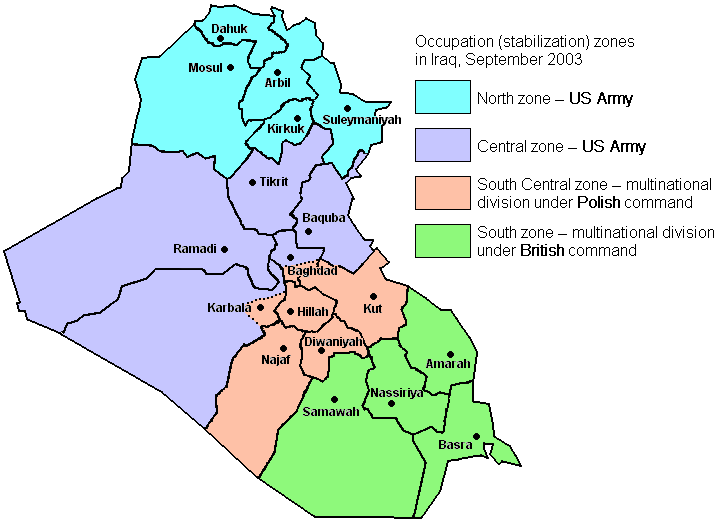
September 3: In a speech, President Clinton extended the no-fly zone from the 32nd to the 33rd parallel. The US has widened its military protectorate in the Persian Gulf from the Indian Ocean northwards to within 30 miles of Baghdad. It now includes the two biggest Iraqi air bases, Habbaniyah and Kut, and its flying training centre. In a speech, Saddam said that he did not recognise the no-fly zones.
Although Saddam Hussein’s offensive was against the Kurds in the north, the strategic thrust of the US attack was in the south, to reassure nervous Persian Gulf allies such as Saudi Arabia that Saddam would be unable to mount any serious ground military threat in the foreseeable future.
September 4: More cruise missiles were launched against Iraqi air defences and airports in a mopping-up operation to take out what had not been destroyed the previous day.
December 1998: Desert Fox, the most intense missile attack and bombing of Iraqi targets since Desert Storm. This was followed by almost daily bombing of allegedly Iraqi anti-aircraft sites.
These developments show that the United States is waging a war of attrition against Iraq, with the declared aim of toppling Saddam Hussein.
THE KURDS:
There are about four million Kurds in Iran, about four million in Iraq, and up to 10 or 12 million in Turkey, with smaller numbers in Syria and elsewhere, altogether some 18-20 million Kurds. The Kurds are ruled by several political parties, which include:
Kurdistan Democratic Party (KDP), backed by Iraq
Leader: (since 1979) Massoud Barzani.
Founded: 1946, by Barzani’s father, Mustapha, who died in exile in the US in 1979.
Base: Solid support among mountain tribes and many educated, urban Kurds who see a policy of reconciliation with Iraq as the only realistic choice. This party controls the North West, including the border with Turkey, where it charges duties on the lucrative illicit oil trade from Iraq.
Patriotic Union of Kurdistan (PUK), backed by Iran.
Leader: Jalal Talabani, a leading KDP member who often quarrelled with Mustapha Barzani in the 1960s, accusing the party of being backward and tribal.
Founded: 1975. Talabani linked up with Iraqi forces to fight the KDP in a feud which lasted into the 1980s.
Base: Controls the centre and the South-East. Took the regional capital, Arbil, after an assault in December 1994. It controls around half of Iraqi Kurdistan territory and 70 per cent of its population. The KDP says the PUK has recently received support from Iran.
Recent relationships: The factions had administered the safe haven on a 50:50 basis with surprising success.
So, what went wrong? Things began to unravel last winter. Fierce fighting broke out between the PUK and an Islamic group backed by Iran. Barzani intervened and quarrelled with Jabar Farman, the PUK defence minister in a nominally united administration. Farman may have been largely responsible for the escalation of what started on 1 May as a local vendetta about a piece of land. US attempts to broker a peace fell apart in London on Friday, 30th August, the day before Saddam’s forces helped the KDP to take Arbil and Sulaymaniyeh.
After the end of the Gulf War, as a result of Western encouragement, there were two major revolts against Saddam Hussein. In the south, the Shi’is rose up in large numbers against the central government and were crushed by the Iraqi forces in Basrah and other southern towns, sustaining great casualties. The other revolt was in the North by the Kurds, who saw the opportunity at last to declare their independence from Iraq. Saddam Hussein moved against them. Hundreds of thousands of Kurdish refugees fled to Iran and to the mountains in Iraqi Kurdistan. The scenes of misery of thousands of desperate women and children with no shelter and no food in the snow-covered mountains were brought to our sitting rooms through television pictures. It became obvious that the West had to do something.
The first person to come up with the idea of a safe haven for the Kurds was the late Turkish President Turgut Ozal, who had his own reasons for wanting to exclude the Iraqi forces from the territory, which was part of the Ottoman Empire and which Turkey has never officially renounced as part of its territory. In view of its own problems with the Kurdish forces of the PKK, who have been waging a long and deadly campaign against Turkey for many years from inside the Iraqi territory, Turkey wanted to have a free hand in northern Iraq to crush the PKK guerrillas. Ozal’s idea of a safe haven for the Kurds was soon adopted by both UK Prime Minister John Major and President Bush, both of whom took credit for the idea. A no-fly zone and a safe haven for the Kurds were declared north of the 36-degree parallel.
Initially, there was some humanitarian support for the safe haven. Meanwhile, the West turned Northern Iraq into a base for anti-Saddam forces and organised them under the Iraqi National Congress. There were even elections among the Kurds, who were split almost half and half between Massoud Barzani’s Kurdistan Democratic Party (KDP), which controlled the North West, including the border with Turkey, and Jalal Talabani’s Patriotic Union of Kurdistan (PUK), which controlled the centre and the South East, bordering Iran. Unfortunately, the two factions soon fell out, and Talabani’s forces took the regional capital Arbil after an assault in December 1994. With the drying up of foreign aid, the main cause of friction was financial. Massoud Barzani controlled the lucrative tariffs from the illicit trade in Iraqi oil to Turkey and cigarettes and other goods moving from Turkey to Iraq. Talabani’s forces claimed that, as part of supposedly one government, they should also receive some of the revenue, but Barzani declined to share the loot.
Early in August, Iranian Revolutionary Guards, waging a campaign against their own Kurdish dissidents, swept 50 miles into the enclave to attack the bases of Iranian Kurdish rebels in Iraqi Kurdish soil. As far as one can say, there was no actual Iranian support for the PUK. No evidence of such support has been provided. However, Barzani used the Iranian incursion into Iraqi Kurdistan as an excuse to invite Saddam Hussein to send forces to the north to support the KDP in its push against Arbil.
So, as we can see, many Middle Eastern countries, including Iran, Turkey and Persian Gulf states, are involved in the conflict against Iraq, with the United States pulling the strings. The resolution of these conflicts requires a comprehensive strategic plan for the whole of the Middle East, which ensures peace among these conflicting forces. Unfortunately, the United States either lacks such a strategy or is intent on fostering conflict and disunity in the Middle East to achieve its aim of maintaining its control of the region.

