

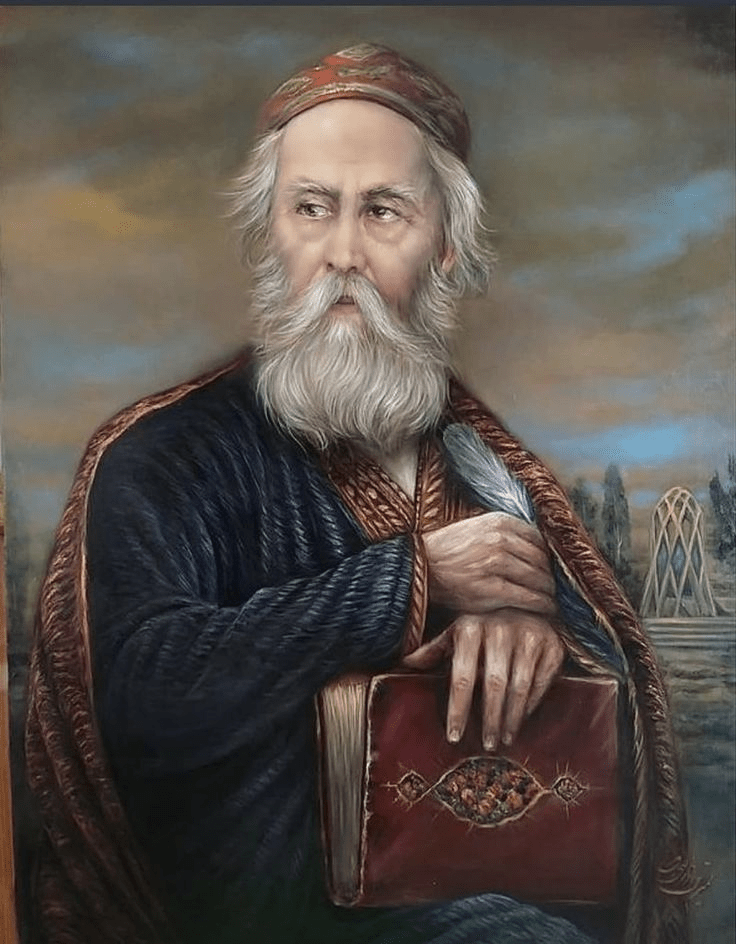
Portrait of Omar Khayyam from the inside of his Quatrains | Flickr
On 31 January 2021, the Iran-Denmark Cultural Society at Copenhagen University asked me to lead a Webinar on Omar Khayyam. This is the edited English text of my speech, which was in Persian.
Tonight, we have come together to talk about the great Persian scientist, philosopher, astronomer and poet Omar Khayyam (1048-1131) and his Rubaiyat, as translated by Edward Fitzgerald (1809-1883), which has become the best known and the most popular translation of any poetic work from any language into English.
Fitzgerald’s translation was not the first translation of the Rubaiyat into a European tongue. There had been scattered translations of quatrains into English by Gore Ouseley (c. 1770-1844) and the Rev. Henry George Keene (1781-1864).[1] The French scholar Nichola published a French translation of the Rubaiyat in 1867 in Paris, which contained 464 Rubais, but received very little attention, apart from the scholars of Persian literature.
On the contrary, Fitzgerald’s translation made Omar Khayyam a household name in England and the English-speaking world. The first publication of the Rubaiyat in 1859 – the same year as Charles Darwin’s On the Origin of Species and J S Mill’s On liberty – went completely unnoticed. It did not sell a single copy in its first two years, but like those two other great books it subsequently had a remarkable impact on literature and society. By the First World War, there were 447 editions of FitzGerald’s translation in circulation.
His translation led to many other translations of the Rubaiyat, but none of them achieved the same fame or popularity. The American poet and essayist Ralph Waldo Emerson translated three of Khayyam’s quatrains into English from German and predicted that he would become more famous in the future. Fitzgerald dedicated the first edition of his Rubaiyat to Emerson.[2]
In this lecture, while speaking mainly about Omar Khayyam, I also wish to pay homage to the genius of Fitzgerald and his lasting service to Persian and English literature. Culture and literature are intangible phenomena, and while one can point to similarities between various literary works, every single work of art is a unique and individual creation and stands on its own. Literature has more to do with inspiration and the inner feelings of the poet and the writer than with outside influences. In the words of Shakespeare, spoken by a minor character in one of his less familiar plays – the Poet Timon of Athens – we get a brilliant, partly ironical image of the poetic process:
Our poesy is as a gum, which oozes
From whence ‘tis nourished: the fire i’ the flint
shows not till it be struck; our gentle flame
Provokes itself, and, like the current flies
Each bound it chafes…
Although, as Shakespeare says, great poetry “oozes from whence ‘tis nourished,” yet, to use his own beautiful image, the fire in the flint also requires to be struck. In that sense, all great literature sustains and inspires the works of those who come into contact with it. Persian literature provided such a function for a number of English and American poets and writers, and when it was first introduced to the West, it was received with intense enthusiasm and interest.
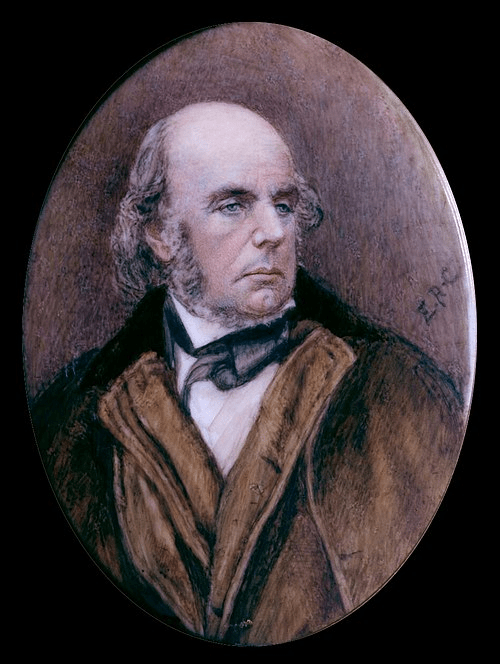
Edward Fitzgerald (1809-1883)
Fitzgerald was born into a wealthy Anglo-Irish family and educated at King Edward VI Grammar School in Bury St. Edmunds, Suffolk, and Trinity College, Cambridge. He did not shine academically at Cambridge but it was there that he made friends with Alfred Tennyson (1809-1892), who would become the poet laureate and the foremost poet of Victorian England, William Makepeace Thackeray (1811-1863), who later became a major novelist, and also with Thomas Carlyle (1795-1881), the Victorian essayist and historian. After graduating, he returned to Suffolk, where he lived out the rest of his long life in relative seclusion.
So, by the time Fitzgerald became acquainted with Persian poetry, he had developed a deep interest in English literature and had become friends with a number of leading English poets, novelists, and literary critics.
Fitzgerald studied the Bodleian manuscript of the Rubaiyat of Omar Khayyam with Reverend Edward Byles Cowell (1826–1903), who was the first professor of Sanskrit at Cambridge University and a noted translator of Persian poetry. Cowell became interested in Oriental languages at the age of 15 and started to learn Persian when he came across the extensive works of Sir William Jones on Persian literature, including his Persian Grammar. He began translating and publishing Persian poetry, including poems by Hafiz, within the year. In 1850, he enrolled at Magdalen College, Oxford, where he studied and catalogued Persian manuscripts for the Bodleian Library.
Fitzgerald also read the Divan of Hafiz with Cowell, and even tried his hand at translating some poems by Hafiz, but he gave it up, saying that Hafiz cannot be translated adequately into English.
Cowell encouraged Fitzgerald to study Spanish and in 1853, under his friend’s instruction, and published Six Dramas of Calderon, Freely Translated by Edward FitzGerald. In addition to his translations from Persian and Spanish, Fitzgerald also produced some original compositions. In 1851, he published a quasi-Platonic dialogue, Euphranor, a Dialogue on Youth, in which he contrasted the two types of manhood he admired (the athlete and the intellectual). In 1852, he published Polonius: A Collection of Wise Saws and Modern Instances, an anthology of aphorisms, some original but most culled from his very wide reading.
Strangely enough, Fitzgerald’s translation of Khayyam’s Rubaiyat initially failed to sell, but the work’s popularity increased steadily over the next decade until it achieved unprecedented success as a translation from an Oriental language. The Rubaiyat, both in English and Persian, is also one of the most frequently and widely illustrated of all literary works.
Fitzgerald enhanced the popularity of the Persian poet throughout the world and encouraged others to translate the Rubaiyat into different languages. In an article written as early as 1925, when the “Cult of Omar” was still at its peak, Professor Sa’id Nafisi, a leading Iranian scholar, wrote:
“So far as I have been able to gather in my research, Khayyam has been translated 32 times into English, 16 times into French, 11 times into Urdu, 12 times into German, 8 times into Arabic, five times into Italian, 4 times into Turkish, 4 times into Russian, 2 times into Danish, Swedish and Armenian; while Fitzgerald’s translation has gone through 139 new editions by 1925.”[3]
The number of translations increases daily, and only in recent years I have heard of new translations into English. In fact, by now there are nearly one hundred English translations of the Rubaiyat.
Although Fitzgerald’s translation has been the most successful, I have had some Arab and Turkish colleagues who have recited with great appreciation translations of Khayyam into their native tongues, which shows that the translation of the Rubaiyat into those languages has also had a wide appeal.
Like Fitzgerald, Lord Tennyson also became very interested in Persian literature, and he read the whole Divan of Hafiz with Cowell, Fitzgerald’s Persian tutor. In fact, it is believed that the publication of the Rubaiyat encouraged Tennyson to return to publishing new books of poetry after a relatively long period of having given up publishing, mainly due to poor reviews of his earlier works.
Some of Tennyson’s poems show clear signs of borrowing from Persian literature. They include pseudo-Oriental poems, such as “Written by an Exile of Bassorah”, “The Expedition of Nadir Shah”, “Babylon”, “Egypt”, “Persia”, and “Maud”. In his later life, he was so imbued with the influence of Persian poetry that some of his own poems read almost like translations of Hafiz.
Fitzgerald’s other friend, Thackeray, who had been born in India, knew a lot about the British involvement in the East India Company, as both his parents worked as employees of the company. After returning to England and finishing his studies at Cambridge, he turned to journalism and writing novels. He can be described as a rebel and a critic of the values of the Victorian era. His novels contained savage attacks on high society, military prowess and hypocrisy.
Thomas Carlyle was also a very significant figure of his time. During a period of strong anti-Islamic sentiments, Carlyle was the first person to speak highly of the Prophet of Islam. In his Heroes and Hero Worship, he included Prophet Muhammad among his great heroes and as one of the most significant and most influential figures in history.
So, Fitzgerald was a member of a group of innovative and revolutionary English poets and writers who were looking for new ideas and models outside the normal traditional circles. This is what attracted Fitzgerald to Omar Khayyam, who was also a revolutionary thinker who spoke against the religious norms and dogmas of the time. Clearly, this touched a nerve in British and Western readers who were rebelling against religious dogmatism and were searching for new ideas.
At the height of the popularity of Fitzgerald’s translation of the Rubaiyat, the book went through some 60 editions in England and some 80 editions in America in two decades. Fitzgerald also translated Jami’s Salaman o Absal (Salaman and Absal) and Attar’s Manṭiq al-Tayr (Bird Parliament). However, although both books are famous Sufi poems by two leading Iranian poets, neither of them achieved the fame of the Rubaiyat, which had a considerable influence on the development of late Victorian and Edwardian British poetry, as well as the awakening of a much wider interest in Persian literature than had previously been the case.
The history of Fitzgerald’s translation of the Rubaiyat is also interesting and shows the sensitivity of the people towards agnostic and even blasphemous sentiments expressed in the Rubaiyat. This is why Fitzgerald did not reveal his name in the first edition ofthe Rubaiyat. The journalist Whitley Stokes (1830-1909) picked up one of Bernard Quaritch’s 200 copies of the 1859 edition of the Rubaiyat, which had been published anonymously.
After showing the poem to Dante Gabriel Rossetti, he proceeded to publish a pirated edition of the poem in India. Rossetti, in turn, led Swinburne to it, whereupon Quaritch’s shop was raided for more copies. George Meredith has told of Swinburne reading the poem to some friends in the summer of 1862, “much as if it were a Methodist tract”, and then writing a portion of “Laus Veneris” in the heat of inspiration.[4]
In 1863, the famous literary critic, John Ruskin, fired by Rossetti’s ardour, dispatched the following letter of praise to the unknown author of the Rubaiyat, begging him to produce more translations of Omar Khayyam:
“2nd September 1863
My dear and very dear sir,
I do not know in the least who you are, but I do with all my soul pray you to find and translate some more of Omar Khayyam for us: I never did — till this day — read anything so glorious, to my mind, as this poem…”[5]
Ten years later, the bearer of the letter, Mrs Burne-Jones, wife of the pre-Raphaelite artist, was still looking for the author. When Charles Eliot Norton, who had received a copy of the Rubaiyat, came to England in 1873, he told Thomas Carlyle that reputedly a “Reverend Fitzgerald” had produced the translations. That was the first time Carlyle had heard about the poem. He nearly exploded, protesting that Fitzgerald was his own friend and no more a reverend than he was. It was shortly after that date that Fitzgerald finally admitted the authorship of the translation.
When one bears in mind that even in nineteenth-century England, Fitzgerald was reluctant to be associated with the outspoken and blasphemous views of the Rubaiyat, one becomes more impressed by Omar Khayyam’s revolutionary character and his bold ideas some eight hundred years earlier. It is also important to bear in mind that a significant number of Fitzgerald’s contemporaries showed a keen interest in his poems, although others strongly disapproved of them. This shows a strong anti-clerical or rationalist outlook among a large segment of educated Iranians.
Right to the end of his life, Reverend Cowell, who had taught Fitzgerald Persian and had introduced him to Omar Khayyam, felt remorseful for the great mistake that he had made. After Fitzgerald’s death, in a letter to Edward Heron-Allen, Cowell wrote:
“I unwittingly incurred a grave responsibility when I introduced his poems to my old friend in 1856. I admire Omar as I admire Lucretius, but I cannot take him as a guide. In these grave matters, I prefer to go to Nazareth, not to Naishapur.”[6]
However, Tennyson had no doubts about the literary merits of the Rubaiyat. In the introductory lines to “Tiresias,” Tennyson spoke of Fitzgerald:
… golden Eastern lay
Than which I know no version done
In English more divinely well;
A planet equal to the sun
Which cast it, that large infidel
Your Omar; and your Omar drew
Full-handed plaudits from our best
In modern letters…[7]
Different Manuscripts of the Rubaiyat:
Here are some of the most important manuscripts of the Rubaiyat:
Bodleian manuscript, copied in 856/1460, has 158 Rubai.
Undated Calcutta manuscript, 516 Rubai.
(Both manuscripts formed the basis of Fitzgerald’s translations).
Another manuscript copied in 860/1464 has 131 Rubai.
Tarabkhaneh manuscript, dated 867/1472, has 559 Rubai.
A manuscript in Istanbul, contemporary with the Bodleian manuscript, has 315 Ruba’i.
The manuscript, which was published by Nichola in 1867 in Paris, has 464 Rubai.
The manuscript published by Friedrich Rosen in 1925, dated 721/1321, has 201 Rubai.
A later manuscript in Bankipur has 604 Rubai.
An undated manuscript in Lucknow, which was published in 1794, has 770 Rubai.
Sadeq Hedayat’s edition, published in 1313/1954 and based on his selection of what he regarded as authentic Rubais by Khayyam, has 142 Rubais.
All this shows the widespread popularity of the Rubaiyat during the Medieval and subsequent periods, even before Khayyam became a universally popular poet as a result of Fitzgerald’s translations.
Fitzgerald’s translations:
Fitzgerald produced several versions of the Rubaiyat as he tried to improve his translations. Here are the main editions that he produced:
First edition in 1859: 75 Rubai
Second edition in 1868: 110 Rubai
Third edition in 1872: 101 Rubai
Fourth edition in 1879: 101 Rubai
Fifth edition in 1889: 101 Rubai
It is important to point out that Fitzgerald’s translations of the Rubaiyat were not literal translations of every line in the original. Like any good translator, he tried to convey the essence of the original verse in English. Some Persian expressions sound strange in English or do not convey the same meaning when taken out of their own context. Therefore, Fitzgerald substituted them with the terms and expressions that were more familiar to English readers. Sometimes, he condensed two original quatrains into one, and at other times, he expanded a single Persian quatrain into two English ones. In a letter to his teacher, E. B Cowell, Fitzgerald admits that at times he has taken liberties with his source material. He writes:
“My translation will interest you from its form, and also in many respects in its detail: very un-literal as it is. Many quatrains are mashed together: and something lost, I doubt, of Omar’s simplicity, which is so much a virtue in him.
I suppose very few people have ever taken such Pains in Translation as I have: though certainly not to be literal. But at all Costs, a Thing must live: with a transfusion of one’s own worse Life if one can’t retain the Originals better. Better a live Sparrow than a stuffed Eagle.”[8]
However, it would be wrong to assume that Fitzgerald’s translation of the Rubaiyat was basically an original work, loosely based on Omar Khayyam’s original verse. As Fitzgerald himself has pointed out, very few people have taken so much pain in translation as he has, but clearly it is not a literal translation and has sometimes twisted the literal text of the poems in order to express the original sentiments in a way that could be understood by an English reader. As he modestly says, “Better a live Sparrow than a stuffed Eagle.”
In his scholarly book published in 1899, Edward Heron-Allen compared Fitzgerald’s quatrains with Omar Khayyam’s original Rubais and concluded that the vast majority of Fitzgerald’s quatrains were based on a single or multiple Rubais by Khayyam, with only two quatrains not based on Khayyam’s poems and four of them being based on poems by Hafiz or Attar.[9]
This is how he summed up his findings:
49 Quatrains are free translations from one Rubai of Khayyam from either the Bodleian manuscript or the Calcutta manuscript.
44 Quatrains are based on two or more Rubais.
2 Quatrains are based on the edition by Nichola.
2 Quatrains convey the spirit of some of Khayyam’s Rubais
2 Quatrains are influenced by the Mantiq al-Tayr of Attar.
2 Quatrains are based on the poems of Hafiz.
2 Quatrains in the first and second editions of the Rubaiyat do not seem to be based on a Rubai from Khayyam.
In his Romance of the Rubaiyat, Professor A. J. Arberry gave the Persian sources for each of the 75 quatrains FitzGerald translated in his first edition.[10] He also showed that some 40 were loose translations of a single stanza in either the Bodleian or Calcutta manuscripts, while others were “mashed together” from two quatrains.
Therefore, contrary to the views of some literary critics who have downplayed the extent of the similarity between Omar Khayyam’s Persian version and Fitzgerald’s translation of the Rubaiyat, it is clear that nearly all the ideas and most of the images and poetic devices used by Fitzgerald were inspired by or faithfully translated from the original poems of Omar Khayyam. In fact, the larger number of quatrains in various Persian manuscripts contain a much wider range of ideas than the ones included in Fitzgerald’s version.
However, while most of the original quatrains are independent and are not connected with one another in a single continuous poem, Fitzgerald’s main innovation was that he organised them in the form of an eclogue, starting with the rubais about the beginning of the day, leading to blasphemous rubais that are allegedly the result of drunkenness as the day went on, and ending with those dealing with the end of life and the poet’s plea for the readers to “turn down an empty glass” on his grave or on the spot where he drank.
Omar Khayyam’s Life
Abu’l-Fath Omar ibn Ibrahim Khayyam was born in the district of Shadyakh of the city of Nishapur in Khurasan, in the northeastern part of Iran. The title of Khayyam – meaning the “tent maker” – in all likelihood was inherited from his father Ibrahim, an illiterate tent maker who realised the intelligence of his son Omar and, from his early life, sent him to study with a few great masters of his time. In one of his quatrains, he refers to himself as someone who “stitched the tents of science”
Khayyam, who stitched the tents of science,
Has fallen in grief’s furnace and been suddenly burned,
The shears of Fate have cut the tent ropes of his life,
And the broker of Hope has sold him for nothing!
Some early reports indicate that Omar’s father was a Zoroastrian who converted to Islam.[11] So, Khayyam was a first-generation Muslim from a Zoroastrian background, and this might have some bearing upon his later religious and philosophical views, and also his fondness for Iran’s pre-Islamic history.
Until fairly recently, there used to be a great deal of controversy about Omar Khayyam’s date of birth. But in 1941, Swami Govinda Tirtha published The Nectar of Grace: Omar Khayyam’s Life and Works.[12] In it, he established that Omar Khayyam was born on 2nd Zi-Hijjah 439/18 May 1048 and died on 12th Muharram 526/4 December 1131. He lived a little more than 83 years and six months. This date was ascertained based on a horoscope for him contained in one of the earliest biographical notices of him, but long ignored by scholars. The Soviet Academy of Sciences Institute of Theoretical Astronomy found the calculations correct.[13]
In his late forties, Khayyam went on an extensive journey, visiting Mecca (apparently in order to escape censure for his agnostic views) and Baghdad before finally returning to his birthplace in Nishapur, where he spent the rest of his life teaching and leading a quiet life. He died there as a renowned scientist and astronomer and was loved by his friends as an unorthodox poet.
Early references to Khayyam
The first writer who refers to Khayyam is Nezami Aruzi, the author of the Chahar Maqala (Four Treatises), written about 1150, 19 years after Khayyam’s death. As far as Nezami was concerned, Khayyam was a leading scientist, astronomer and philosopher, with no reference to his Rubaiyat. But he quotes a delightful account of Khayyam’s resting place. He says that he met Khayyam a year before his death, and he recalls that Khayyam said that when he dies, he would like his tomb to be covered with flowers. A year later, when Nezami returned to Nishapur, Khayyam was dead. He went to visit his tomb and saw that it was placed at the foot of a wall below a flowering shrub, and his entire tomb was covered with flowers and petals that had fallen from the tree.
One of the earliest specimens of Omar Khayyam’s Rubiyat is from Fakhr al-Din al-Razi. In his work al-Tanbih ‘ala ba‘d asrar al-maw‘dat fi’l-Qur’an, c. 1160, or less than 30 years after Khayyam’s death, Razi quotes a Rubai by Khayyam. Najm al-Dīn Dāya in his Mirṣād al-‘Ibad, c. 1230, quotes two quatrains, one of which is the same as the one already reported by Razi. An additional quatrain is quoted by the historian Ata-Malik Juvayni in his Tarikh-i Jahangushay (History of World Conqueror, c. 1226–1283). In 1340, Muhammad ibn Badr Jajarmi includes thirteen quatrains of Khayyam in his work containing an anthology of the works of famous Persian poets (Mu’nis al-ahrār), two of which have hitherto been known from the older sources. As time goes by, the number of quatrains attributed to Khayyam increases until we come to the Bodleian Manuscript written in Shiraz in 1460, which contains 158 quatrains.
Omar Khayyam’s books:
We have considerable information about Khayyam, the scientist and philosopher. We possess three of his scientific works. In 1072, when he was only 24, he wrote a pioneering work on Algebra. He entered the service of the Seljuq Emperor Malek Shah in 1074, when he was employed with some other distinguished astronomers and tasked with the compilation of a set of astronomical tables as the basis of a revised calendar (known as the Jalali Era). Experts regard this calendar, which is still in use in Iran, as even more accurate than the Gregorian calendar compiled in Europe some 500 years later. He calculated the duration of the solar year with remarkable precision and accuracy, with a very precise 33-year intercalation cycle.
Khayyam measured the length of the year as 365.24219858156 days. It shows incredible confidence to give the result to this degree of detail, and it is outstandingly accurate. According to the latest scientific calculations, the length of the year is 365.242190 days. Khayyam’s computation was far ahead of his time.
His other books that have reached us are:
1- Commentary on the Difficulties Concerning the Postulates of Euclid’s Elements (Risāla fī Sharḥ mā Ashkal min Muṣādarāt Kitāb Uqlīdis), completed in December 1077.
2- Treatise On the Division of a Quadrant of a Circle (Risālah fī Qismah Rub‘ al-Dā’irah).
3- Treatise on Algebra and Mathematics (Risālah fi al-Jabr wa’l-Muqābala), most likely completed in 1079.
4- A translation of Ibn Sina’s “Lucid Discourse” (Khutbah al-gharrā’)
5- A Treatise “On Being and Obligation” (Risālah fī’l-kawn wa’l-taklīf).
6- “The Response to Three Problems: The Necessity of Contrariety in the World, Predeterminism and Persistence” (Al-jawāb ‘an thalāth masā’il: Ḍarūrat al-taḍād fi’l-ʿālam wa’l-jabr wa’l-baqā’).
7- “The Light of the Intellect on the Subject of Universal Knowledge” (Risālah al-ḍiyā’ al-‘aqlī fī mawḍū‘ al-‘ilm al-kullī).
8- A book in Persian, “Treatise on the Science of Universal Principles of Being (Risala dar Ilm Kolliyat-e Vojud). In this book, Khayyam lists different categories of knowledge or the main types of inquiry in “philosophy” along the Peripatetic line, namely, first ‘is it?’, second, ‘what is it?’, third, ‘why is it?’.
For Khayyam, these categories have a wider range of philosophical implications, especially about the following topics:
- The existence of God, His attributes and knowledge
- Hierarchy of Existents and the problem of multiplicity
- Eschatology
- Theodicy
- Predeterminism and free will
- Subjects and predicates
- Existence and essence
9- Another book in Persian, “Nowruz-Nameh” about the ancient Iranian New Year festival of Nowruz. There is some uncertainty about Khayyam’s authorship of this book, although personally, I believe that there are some strong indications, including his great interest in pre-Islamic Iranian history and festivals, that he is the author of this book.
10- Khayyam also wrote a short treatise dealing with musical theory, in which he discussed the connection between music and arithmetic. His main contribution in this field was in providing a systematic classification of musical scales, and discussing the mathematical relationship among notes, minor, major and tetrachords.
From the few works that have survived and the accounts that we have received about Khayyam’s life, we get the impression of a rather reclusive and unpretentious scientist who was deeply at odds with the religious and scientific thinking of his time. In the introduction to his essay on Algebra, he reveals his dislike of hypocrisy and religiosity, the prevailing religious views of his time, and public opposition to free thinking and scientific explorations.
We may assume that Khayyam was writing from personal experience. We can perhaps visualise a man of Khayyam’s intellectual, solemn and taciturn nature relaxing with a few intimate friends, perhaps over a bottle of wine, and tossing out an occasional witty epigram by way of summing up the theme of the conversation. This perhaps gives us a clue to the composition of the Rubaiyat.
Was Khayyam a poet?
In view of the limited number of contemporary references to Khayyam as a poet, and also due to the small number of poems that were attributed to him during his lifetime or in the early decades after his death, some scholars have doubted whether he was in fact a poet and whether he was the author of the Rubaiyat.
Some foreign, and even some Iranian scholars, have openly questioned whether the poems attributed to Omar Khayyam were written by the famous Iranian scientist and mathematician. Professor Dick Davis, one of the best scholars and an award-winning translator of Persian poetry, writes: “For what it is worth, and I admit it is not worth much because everything that can be said about the attribution of these poems is speculative, I rather doubt that the historical Khayyam wrote poems in Persian at all.”[14]
Professor Juan Cole, one of the most learned and prolific historians of Iran, the Middle East, Islam and Persian literature, in the introduction to his new translations of the Rubaiyat, writes: “The poems attributed to Khayyam for the most part were actually composed by many hands in the 1200 through 1400, during and after the Mongol era, and so formed contributions to a well-established genre.”[15]
Of course, one has to take the views of such eminent scholars seriously, but I believe there is plenty of evidence to show that a large number, but certainly not all, of the quatrains attributed to Omar Khayyam were written by the historical scientist and philosopher. One should not be too surprised either by the fact that there were not many contemporary manuscripts of the Rubaiyat, or by the fact that Khayyam was not included in the list of professional poets of his time.
The reason for the scarcity of early manuscripts is very clear. Apart from the fact that even in the case of more orthodox poets, it is difficult to find contemporary manuscripts of their works, it would have been very strange to see Khayyam’s atheistic and anti-religious quatrains to be widely copied and read, given the religious climate of the time.
Even in the case of many early Western poets, it is often difficult to find contemporary manuscripts of their works. The important Old English poem Beowulf (disputed date, c. 700–1000 AD), or Middle English poem Sir Gawain and the Green Knight (c. 14th century), or the Middle English poem Pearl (late 14th century), two of which definitely belonged to a later date than the Rubaiyat, have survived in a single copy and their authors are unknown. The same is true of French literature. The oldest surviving work of French literature, The Song of Roland (La Chanson de Roland) by an anonymous author, has survived in a single manuscript, transcribed between 1129 and 1165. Contrary to those works, there are many surviving manuscripts of the Rubaiyat, and there is much greater information about its author and the time of its composition.
Regarding the small number of contemporary references to Khayyam as a poet, it must be pointed out that in Iran, most professional poets resided at the court of some monarchs or rulers and wrote different forms of poems. A professional poet would be expected to compose qasida or odes mainly in the form of panegyrics for their patrons, ghazals or sonnets, mathnavi, long poems in couplet form that were very popular with many poets, etc, as well as Rubais, while Omar Khayyam only wrote in the Rubai form as a way of private amusement, rather than making a living as a poet.
Khayyam lived at a time of great religious fanaticism and political uncertainty. The Seljuq Turks, who had invaded Iran and who were recently converted to Islam and were consequently quite fanatical, were ruling over the country. At the beginning and at the end of the same century when Khayyam was alive, two of the greatest Sufis who were among the most interesting and learned Muslim scholars, Ayn al-Quzat Hamadani (1098–1131) and Shihab al-Din Suhrawardi (1154–1191), were brutally killed. About a century before the time of Khayyam, Husain ibn-Mansur al-Hallaj (c. 858–922) was executed on charges of blasphemy, based on some of his Sufi poetry.
In one of his quatrains, Khayyam defends himself against those who accuse him of being an atheistic philosopher, but points out that, as someone with an intellect, he would like to know who he is and where he comes from:
دشمن به غلط گفت که من فلسفیام
ایزد داند که آنچه او گفت نیام
لیکن چو در این غمآشیان آمدهام
آخر کم از آنکه من بدانم که کیام
“A philosopher I am,” my enemies falsely say,
But God knows I am not what they say;
While in this sorrow-laden nook, I reside
Need to know who I am, and why Here stay
(Translation by Mehdi Aminrazavi)
The Rubai
Rubai is a form of poetry that was devised by Persian poets, going back to the 9th century. Rubáiyát means “quatrains,” and in Persian poetry they consist of four lines with an aaba and occasionally with aaaa rhyme scheme. The earliest Rubais that we have from Abu-Sa’id Abul-Khair (967-1049) and Baba Taher Oryan (11th-century Dervish poet) mainly deal with mystical ideas, but in the hands of Omar Khayyam, this poetic form was used for philosophical speculation. The first, second and last of the four hemistichs must rhyme, but the third need not rhyme with the other three. Here is a typical example of a Rubai:
مهتاب به نور دامن شب بشکافت
می نوش دمی بهتر از این نتوان یافت
خوش باش و میندیش که مهتاب بسی
اندر سر خاک یک به یک خواهد تافت
Dreaming when Dawn’s Left Hand was in the sky
I heard a Voice within the Tavern cry,
‘Awake my little ones, and fill the Cup
Before Life’s Liquor in its Cup be dry.’
(Fitzgerald’s translation, First Edition, II)
As can be seen from the above example, Rubai is a short poem, and due to its simplicity, it is easy to imitate it. Therefore, it is no surprise that there were many others after Khayyam who imitated his verse and tried to express similar ideas in this easy format.
I believe that there are a number of points that conclusively prove that Khayyam was a poet and that he wrote most of the original poems that have been ascribed to him in early sources.
1- Khayyam’s Arabic poems. The first indication is the number of Arabic poems that are recorded in some early texts in his name, and that show similarities to his Persian poems.
The first person who has made a reference to Khayyam’s poems is ‘Imad al-Din Katib Qazwini. In his famous book called Kharidat al-Qasr, which was published circa 570/1174 (about 44 years after Khayyam’s death), in a chapter devoted to the poets of Khorasan, he writes: “In his age, Omar Khayyam was without a peer, and he was unique and a byword in sciences, in astronomy and in philosophy. I have found the following poems by him in Isfahan:
| اذا رضیت نفسی بمیسورُ بلغةِ یحملها با لکدّ کفیّ و ساعدی | |
| امنت تصاریف الحوادث کلها | |
| فکن یا زمانی موعدی او مواعدی |
If I am content with what can be obtained
With the toil of my palm and forearm.
I am immune to all the turns of fate.
So let it be my time and my fortune.
In other words, “If I can be content with what the toil of my hands and arms can provide me, I will not have to rely on anyone else.” This sentiment is similar to at least two of the later Persian quatrains ascribed to him:
هر کو بسلامت است و نانی دارد
وزبهر نشستن آ شیانی دارد
نه خادم کس بود نه مخدوم کسی
گو شاد بزی که خوش جها نی دارد
Whoever enjoys health and has a loaf of bread
Who has a roof over his head
Who is no one’s servant and no one’s master
Tell him to live happily, for his is a beautiful world
And
یک نان به دو روز اگر شود حا صل مرد
وز کوزه شکسثه ای دمی آبی سرد
مخدوم کم از خودی چرا باید بود
یا خدمت چون خودی چرا با ید کرد
If one can have a loaf of bread every other day
If he can have a sip of cold water from a broken jug
Why should he be a master to someone who is below him
Or be the servant of someone just like him?
These sentiments express common themes in many of Khayyam’s other quatrains about the importance of dignity, self-sufficiency, self-reliance, and not bowing to others for the sake of some material gain.
Another quatrain of Khayyam became the source of the following quatrain by Fitzgerald:
گر دست دهد زمغز گندم نانی
وز می دو منی زگوسفندی رانی
با دلبرکی بگوشه ویرانی
عیشی است که نیست حد هر سلطا نی
If one can have a loaf of bread from the kernel of wheat,
Two jugs of wine, and a leg of a mutton,
With a sweet-heart in a wilderness
This is a boon that is beyond any sultan’s limits
The following quatrain expresses the same sentiments in a different form:
تُنْگی میِ لَعْل خواهم و دیوانی
سَدِّ رَمَقی باید و نصف
وانگه من و تو نشسته در ویرانی
خوشتر بُوَد آن ز مُلْکَتِ سلطانی
A book of poetry, some ruby wine, and you,
and half a loaf of bread — I don’t need any more;
when you and I are curled up in the great outdoors,
our bliss outshines the glories of an emperor.
(Juan Cole’s translation, quatrain 148)[16]
This is how Fitzgerald translated it by borrowing elements of both quatrains:
Here with a Loaf of Bread beneath the Bough,
A Flask of Wine, a Book of Verse – and Thou
Beside me singing in the Wilderness –
And Wilderness is Paradise enow.
(First Edition, XI)
In this quatrain, Khayyam contrasts the joys of a simple life in tune with nature with the limited experience of a king confined to his palace. Enjoying a loaf of rustic bread, plentiful wine, a leg of mutton, and a beautiful beloved in one’s arms, in a quiet wilderness, is something that no king in his palace can dream of.
As there are numerous early references to Khayyam’s poems in Arabic, it would be very odd that he would not write poems in his native tongue. In fact, the similarity of themes between his Arabic poems and many of his Persian poems shows that he was the author of both the Arabic and Persian verses.
2- Khayyam’s Persian poems. In addition to many early references to Khayyam’s Arabic poems, we also have some early references to his Persian poems. A very early reference to Omar Khayyam as a poet who wrote poems in both Persian and Arabic is in Nuzhat ol-Arwah by Shahrzuri (died c. 687/1286), where it says: “He has some beautiful poems in Persian and Arabic, such as…” Then he quotes a few lines of poetry in Arabic. The date of the composition of this book is a little later than Kharidat al-Qasr, or about fifty years after Khayyam’s death.
The first time that we have Persian poems quoted from Omar Khayyam is the following quatrain quoted in al-’Azim by Imam Fakhr Razi (d. 606/1261).
داننده چو تر کیب طبایع آراست
ازبهر چه او فکند ش ا ندر کم و کاست
گر نیک آمد شکستن از بهر چه بود
ور نیک نیامد این صور عیب کراست
As the All-Knowing created different forms
Why did he then make some faulty and defective?
If they were made perfect, why break them?
If they were faulty, whose fault was it?
Fitzgerald translated this quatrain in the language of one of the pots in the potter’s shop, as follows:
Another said, ‘Why, ne’er a peevish Boy
Would break the Cup from which he drank in joy;
Shall He that of his own free Fancy made,
The Vessel, in an after-rage destroy!’
(First Edition, LXII)
About the same time as al-Tanbih by Imam Fakhr-e Razi, we have another book, Sandbad Nameh by Muhammad bin-Ali Zahiri Samarqandi, which quotes five Persian Rubais by Khayyam. Then, there is Mersad al-Ibad by Najm al-din Daye, which quotes two “blasphemous” Rubais by Khayyam, but goes out of his way to reject his views. Later, we have individual Rubais from Khayyam quoted in various books on history, including Tarikh-e Jahangosha, Tarikh-e Gozideh, Tarikh-e Wassaf, and Ferdows al-Tawarikh.
From the beginning and the middle of the 14th century, or nearly two hundred years after Khayyam’s death, we have two manuscripts, one called Nuzhat al-Majalis (written in 731/1330), which quotes 31 Rubais and Munis al-Ahrar (written in 740/1339), which has 13 Rubais ascribed to Khayyam. Lum’at-al-Seraj, which came to light a few years ago and was written in 695/1295, also quotes a few quatrains from Khayyam. An anthology of verse compiled some 50 years after Khayyam’s death quotes some Arabic verses, which, added to other works of the early 13th century, make some 25 Rubais altogether. They contain astronomical references, such as one would expect from a professional astronomer.
So, by about 200 years after his death, we have about 50 quatrains which have been definitely attributed to him. It would be strange to believe that someone or a group of people went out of their way to write Rubais on the themes that Khayyam made popular in his early poems and falsely ascribed them to him, if he was not known as a poet.
Three leading Iranian scholars used the few authentic Rubais that we have to decide which other quatrains could have been composed by the same poet. They have ended up with some 253 Rubais, out of more than two thousand quatrains to choose from. The eminent Danish scholar, Arthur Christensen, professor of Persian Literature at Copenhagen University, was one of the earliest European scholars to do a comprehensive study of Omar Khayyam’s Rubaiyat. He wrote his PhD thesis in 1903 on Khayyam’s poems. In his Critical Studies in the Rubaiyat of ‘Umar-i-Khayyam (Copenhagen, 1927), he wrote about what he called Khayyam’s “wandering Rubais”. He consulted 18 manuscripts of the Rubaiyat, which altogether contained 1213 separate Rubais, and he chose only 121 Rubais as definitely belonging to Khayyam.
3- Criticism of Khayyam’s views by his contemporaries. The third indication that Khayyam was the author of some of the poems attributed to him is the way that some of his contemporaries or those who lived shortly after his time have criticised his views. The great Egyptian scholar, historian, biographer and encyclopaedist, Al-Qifti (c. 1172 –1248), makes a brief but telling reference to the views of Khayyam’s contemporaries about him. In his Tarikh al-Hukama (The History of Philosophers), written in 646/1255, he writes:
“Later Sufis [Muslim mystics] were deceived by the superficial reading of his poems, and interpreted them according to their own traditions. In their circles and gatherings, they [Khayyam’s poems] became subjects of conversation and discussion. They were not aware that, like a snake with pretty shapes on its skin, his poems seemed attractive on the surface, but contain poisonous bites that harm the Shari’a. As his contemporaries began to have doubts and suspicions about the firmness of his religious beliefs, they began to question them and murmured among themselves.
Khayyam began to fear for his life. He withdrew from writing, and in fear of rebellion by the people, he went on the Hajj pilgrimage. When he arrived in Baghdad, members of Sufi traditions and believers in primary sciences came to him and courted him. He closed the door on himself and refused to meet with his followers and supporters. After returning from his pilgrimage, he returned to his native land, kept his secrets to himself, and pretended to engage in prayers. He was unique in the science of astronomy and hikmah (philosophy), and became an exemplar. It would have been good if his religious beliefs were also firm. He has some fine poems which, despite their beauty, cannot hide his spiritual darkness.”[17]
There can be no stronger proof of the existence of Khayyam’s anti-religious poems than the strong criticism that he received from many of his contemporaries. What they objected to was not his philosophical or scientific ideas, which were highly praised by all his contemporaries, but his poetry. Although Khayyam was lauded for his knowledge of astronomy and philosophy, many people objected to his religious beliefs, as expressed in his Rubais. None of his scientific and philosophical works provides any clue to his religious beliefs, which are only laid bare in his Rubais.
4- Similarity of concepts in different poems. Many Persian literary scholars have taken the ideas and concepts that form the basis of Khayyam’s early works and what they regard as genuine Rubais as a guide for judging the authenticity of some doubtful Rubais. Many scholars have pointed out that the quatrains that have been quoted as having been written by Khayyam, a long time after his death, must be regarded with some suspicion. Clearly, the Rubais which can be proved to have been written by earlier poets must certainly be discarded. Also, some of the Rubais that have been attributed to various other poets, as well as to Khayyam, must be treated with great scepticism.
This leaves a few dozen Rubais, which have been exclusively attributed to Khayyam and which contain concepts that are common in some of his genuine early Rubais. Many Iranian scholars also maintain that Khayyam has a distinct style of his own, and it is possible to judge if some later Rubais pass this test or not. Using these yardsticks for judging the authenticity of many later quatrains attributed to Khayyam, it is easy to conclude that at least around 200 of the quatrains could be regarded as genuine poems of Khayyam. On that basis, the Bodleian Manuscript, copied in 856/1460, that contains 158 Rubais could be regarded as a genuine collection of Khayyam’s poems.
5- Khayyam’s complaints about the climate of hypocrisy and persecution. The fifth and perhaps the most persuasive argument that proves that Khayyam was the author of many of the rationalist and brave Rubaiyat attributed to him is what he says about the restrictions and the climate of falsehood and hypocrisy at the time that he lived. Writing in the introduction to his “Epistle on Algebra and Mathematics” (رساله ی جبر و مقابله), he complains:
“We are living in such a time when the people of learning are rejected and only a few of them are left who are capable of engaging in discussion and scientific research. Our philosophers spend all their time in mixing the truth with falsehood, and are interested in nothing but outward show. Such little learning that they have they spend on material ends. When they see a man sincere and unremitting in his search for the truth, one who will have nothing to do with falsehood and pretence, they mock and despise him.”[18]
The bitter tone of his remarks about pseudo-scientists and fake scholars whose only job is to engage in falsehood, hypocrisy and deceit shows how much he suffered from the insincerity and superficiality of many of his contemporaries. That climate of falsehood and deception was in sharp contrast with his honesty, search for truth, rational outlook and scientific predisposition. It is precisely such ideas that he raises and condones in his free-thinking quatrains.
Khayyam was not a Sufi poet. Some scholars have tried to interpret Khayyam’s poems as representing Sufi ideas and allusions. This was not only the case with some of his contemporaries or those coming shortly after him, as Al-Qifti pointed out; some modern authors and translators have also made the same mistake. Robert Graves and Omar Ali Shah, who jointly translated the Rubaiyat, claimed that Khayyam had been misunderstood by Fitzgerald, and his poems have many Sufi allusions.[19]
This reading of Khayyam is quite wrong, as his poetry openly rejects any religious or mystical concepts. One of the best early indications of the way that leading Sufis saw Khayyam is in a clear description of Khayyam by Farid al-Din Attar, a Sufi master and the author of the famous Mantiq al-Tair or Discourse (or Parliament) of the Birds. In his Elahi Nameh (Section 17), Attar writes about a great seer who could tell about the condition of the souls of the dead by visiting their tombs. He was taken to Khayyam’s tomb to see how his soul was faring:
یکی بینندهٔ معروف بودی
که ارواحش همه مکشوف بودی
دمی گر بر سر گوری رسیدی
در آن گور آنچه میرفتی بدیدی
بزرگی امتحانی کرد خردش
بخاک عمر خیّام بردش
بدو گفتا چه میبینی درین خاک
مرا آگه کن ای بینندهٔ پاک
جوابش داد آن مرد گرامی
که این مردیست اندر ناتمامی
بدان درگه که روی آورده بودست
مگر دعویِ دانش کرده بودست
کنون چون گشت جهل خود عیانش
عَرَق میریزد ازتشویر جانش
میان خجلت و تشویر ماندست
وز آن تحصیل در تقصیر ماندست
There was once a famed seer
Who knew clearly all there was to know about departed souls
If he visited the tomb of a deceased person
He could discover whatever was going on in the tomb.
A great man tried to test him
And took him to Omar Khayyam’s tomb.
He asked him, “What do you see in this tomb?
Please inform me of it, O thou noble seer.”
That honourable man replied to him
“Here lies a defective man,
When he turned to that position
He boasted of being a learned man.
Now, sweat drips from his soul
Due to the remorse that he feels.
He is caught between feelings of shame and remorse
Seeing that all his education has failed him.
There can be no stronger denunciation of Khayyam’s agnostic views by a leading Sufi poet. It seems that Khayyam’s strong anti-religious poems not only infuriated orthodox Muslims but also raised the ire of normally tolerant Sufis. Khayyam was a brave and uncompromising agnostic, even an atheist, and his poems antagonised all those who could not rise above religious dogmatism and superstition.
In fact, in the following quatrain, Khayyam clearly explains the reasons for not making his quatrains and rationalist ideas public:
The secrets which my book of love has bred,
Cannot be told for fear of loss of head;
Since none is fit to learn, or cares to know,
‘Tis better all my thoughts remain unsaid.[20]
The first point to be noticed about Khayyam’s Rubais is their conciseness and pithiness. This, of course, is characteristic of the genre, but Khayyam was particularly skilful in this respect. His quatrains observe the structure of the Rubai. The first two lines set the theme of the poem. They build up to the climax of the third line, followed by the fourth punchline that rounds off the thought and leaves nothing further to be said.
The language is simple, almost earthy, and he avoids the use of flowery imagery so beloved of later poets. Nor is he inclined to make use of metaphysical symbolism that one finds among many classical poets, particularly those of a Sufi bent. In fact, his style is what one would expect of a rationalist, sceptical scientist with no time for frills. There are often references to astronomical phenomena and scientific matters that Khayyam would have been familiar with in his daily work.
A Summary of Khayyam’s main views:
Bearing in mind that Khayyam’s Rubais were detached, separate epigrams, composed in times of leisure on many different occasions and contexts, they nevertheless convey some kind of consistent philosophy of life.
1- The mystery of creation. The first point that concerns Khayyam is to unravel the mystery of life. There are many quatrains devoted to this theme. It is not easy to convey these characteristics in a translation, but a few examples may not be out of place. He is puzzled and perplexed by the complex and fascinating universe that he is facing:
دوری که در و آمدن و رفتن ماست
آن را نه بدایت نه نهایت پیداست
کس مینزند دمی در این معنی راست
کین آمدن از کجا و رفتن به کجاست
The sphere upon which mortals come and go,
Has no end nor beginning that we know;
And none there is to tell us in plain truth:
Whence do we come and whither do we go.
(translated by Ahmad Saidi, quatrain 75)[21]
این بحر وجود آمده بیرون ز نهفت
کس نیست که این گوهر تحقیق بسفت
هرکس سخنی از سر سودا گفتند
زان روی که هست کس نمیداند گفت
The sea of life from secret well has sprung,
This pearl of inquiry no one has strung;
And fancies are the thoughts learned men expound—
Unheard is yet the truth from any tongue.
(Saidi, quatrain 74)
اسرار ازل را نه تو دانی و نه من
وین حرف معما نه تو خوانی ونه من
هست از پس پرده گفتگوی من و تو
چون پرده برافتد نه تو مانی و نه من
Not you nor I have known the secrets of eternity.
Not you nor I have solved the riddle that the letter hides.
For there behind the curtain there is talk of you and me,
but when at length the curtain’s drawn, not you remain nor I.
(Juan Cole’s translation)
This is how Fitzgerald translated this Rubai:
There was the Door to which I found no Key;
There was the Veil through which I might not see:
Some little talk awhile of Me and Thee
There was—and then no more of Thee and Me.
(First Edition, XXXII)
2- The mystery of human life. Allied with the mystery behind the existence of the universe is the fact that we do not even know what our life is about, where we have come from, where we are going, and what the meaning and purpose of our lives are. Here are a few quatrains which deal with the mystery of individual life:
از آمدنم نبود گردون را سود
وز رفتن من جلال و جاهش نفزود
وز هیچ کسی نیز دو گوشم نشنود
کاین آمدن و رفتنم از بهر چه بود
What gain did Heaven get from making me?
What kudos did it earn from my demise?
Yet I have never heard from anyone
Why I was brought here, and why taken away.
(Elwell-Sutton, In Search of Omar Khayyam, quatrain 20, p. 190)
This is Fitzgerald’s translation:
Into the Universe, and why not knowing,
Nor whence, like water, willy-nilly flowing
And out of it, as Wind along the Waste,
I know not whither, willy-nilly blowing
(First Edition, XXIX)
هر چند که رنگ و بوی زیباست مرا
چون لاله رخ و چو سرو بالاست مرا
معلوم نشد که در طربخانهٔ خاک
نقاش ازل بهر چه آراست مرا
Though fair and sweet, drawn I am
Fetching like a tulip, as tall as a cypress, drawn I am
It’s never revealed in this earthly banquet
To what purpose by the eternal painter drawn I am
Or
بر من قلم قضا چو بی من رانند
پس نیک و بدش ز من چرا میدانند
دی بی من و امروز چو دی بی من و تو
فردا به چه حجتم به داور خوانند
They did not ask me when they planned my life;
Why then blame me for what is good or bad?
Yesterday and today go on without us;
Tomorrow, what is the charge against me, pray?
(Translated by Ehsan Yarshater)
چون آمدنم به من نَبُد روز نخست
وین رفتنِ بیمراد عَزمیست درست
برخیز و میان ببند ای ساقی چُسْت
کاندوهِ جهان به می فرو خواهم شست
Fitzgerald’s teacher, Cowell, provides a literal translation of this quatrain:
My coming was not of mine own design,
and one day I must go, and no choice of mine;
Come, light-handed cupbearer, gird thee to serve,
We must wash down the care of this world with wine.
And this is how Fitzgerald translates it:
What, without asking, hither hurried whence?
And, without asking, whither hurried hence!
Another and another Cup to drown
The Memory of this Impertinence!
(First Edition, XXX)
In these quatrains, Khayyam reprimands the universe for having brought him into being without asking him and takes him away without his agreement. He regards this as impertinence and asks why, then, he is responsible for any good or bad that he might have done during his life. This is how Fitzgerald conveys the feeling of man’s frustration at his unfair treatment and adds that if God wishes to be forgiven of this impertinence, he should forgive man first:
Oh Thou, who Man of baser Earth didst make,
And who with Eden didst devise the Snake;
For all the Sin wherewith the Face of Man
Is blacken'd, Man's Forgiveness give—and take!
(First edition, LVIII)
3- The limitations of man’s knowledge. Although a great scientist and scholar and a great advocate of learning and rationality, Khayyam was humble enough to be aware of the limitations of human knowledge and the vast ocean of mystery that is not clear to us. He often speaks about the inadequacy of human knowledge in relation to what we do not know. He agrees with his fellow scientist Abu Ali Sina (Avicenna, c. 980-1037), who died almost a century before him, who famously said:
“تا بدان جا رسید دانش من که بدانم همی که نادانم”
“My knowledge has reached a point to know that I am ignorant.” The following quatrains provide some examples of Khayyam’s awareness of the inadequacy of human learning:
هرگز دل من ز علم محروم نشد
کم ماند ز اسرار که معلوم نشد
هفتاد و دو سال فکر کردم شب و روز
معلومم شد که هیچ معلوم نشد
Of knowledge naught remained I did not know,
Of secrets, scarcely any, high or low;
All day and night for three score and twelve years,
I pondered, just to learn that naught I know.
(Rubā‘iyyāt, Sa‘idī 1991, 125)
یک چند به کودکی به استاد شدیم
یک چند به استادی خود شاد شدیم
پایان سخن شنو که ما را چه رسید
از خاک در آمدیم و بر باد شدیم
In my youth, I studied for a little while;
Later, I boasted of my mastery.
Yet this was all the lesson that I learned:
We come from dust, and with the wind are gone.
(Translated by Ehsan Yarshater)
Fitzgerald’s translation:
Myself when young did eagerly frequent
Doctor and Saint, and heard great Argument
About it and about; but evermore
Came out of the same Door as in I went.
(First Edition, XXVII)
Khayyam boasts of his achievements, yet bemoans the limitations of our understanding of the mysteries of life:
از جر حضيض خاک تا اوج زحل
کردم همه مشکلاتِ گردون را حل
بیرون جستم ز بند هر مکر و حَیَل
هر بند گشاده شد مگر بند اَجل
From earth’s dark depths to Saturn’s pinnacle
I solved the puzzles of the turning skies.
I slipped the bonds of every trick and sham;
Each shackle was removed except for death.
(Juan Cole’s translation)
And this is Fitzgerald’s translation:
Up from Earth’s Centre through the Seventh Gate
I rose, and on the Throne of Saturn sate,
And many Knots unravel’d by the Road;
But not the Knot of Human Death and Fate.
(First edition, XXXI)
As a rationalist scientist, he is sceptical about human capacity to know and understand the mysteries of the universe:
در دایرهای که آمد ن و رفتن ماست
او را نه بدایت نه نهایت پیداست
کس مینزند دمی در این معنی راست
کاین آمدن از کجا و رفتن به کجاست
The circle within which we come and go
Has no clear origin nor final end.
Will no one ever tell us truthfully
Whence we have come, and whither will we go?
His contempt for the boastful and pretentious scholars of his day and of earlier ages comes out strongly in the following quatrain:
آنان که محیط فضل و آداب شدند
در جمع کمال شمع اصحاب شدند
ره زین شب تاریک نبردند برون
گفتند فسانهای و در خواب شدند
Those who mastered all knowledge and all lore,
Who, in the realm of perfection, shone like a candle among their apostles
Yet, they could not find their own way out of darkness,
They told a tale, and then went to sleep.
This is Fitzgerald’s translation:
Why, all the Saints and Sages who discuss’d
Of the Two Worlds so wisely—they are thrust
Like foolish Prophets forth; their Words to Scorn
Are scatter’d, and their Mouths are stopt with Dust.
(First Edition, XXVI)
This quatrain even makes an indirect reference not only to ordinary scholars who boast of knowledge and learning, but also refers to Prophet Muhammad himself. The term that Khayyam uses for apostles is Ashab, which in this Persian form or as the Arabic Sihaba refers exclusively to the Prophet’s Apostles or Companions. So, he is implying that even the Prophet who shone like a candle among his apostles could not discover the mystery of human existence, but, like many other seers and prophets, he too told a tale and then went to sleep.
He even dares to compare the Koran to a wine cup, saying that people return more often to the latter than to the former.
قرآن که مهین کلام خوانند آن را
گهگاه نه بر دوام خوانند آن را
بر گِردِ پیاله، آیتی هست مقیم
کاندر همهجا مدام خوانند آن را
The Koran which is said to be the greatest Book,
Is read only from time to time, not constantly.
But there is a verse around the rim of the winecup
Which is recited always and everywhere.
He makes a comparison between the Koranic verses which are read occasionally, and the verses or the message around the rim of the winecup, which refers to wine and all its unique qualities and its happy effects, which people return to at all times and everywhere.
The following quatrain conveys the sense of the superiority of wine to vain disputes:
ماییم و می و مُطْرِب و این کنجِ خراب
جان و دل و جام و جامه پُر دُردِ شراب
فارغ ز امیدِ رحمت و بیمِ عذاب
آزاد ز خاک و باد و از آتش و آب
Here we are with wine, minstrel, and this cosy corner,
Our life, our heart, our cup and our clothes stained with the dregs of wine
We are free from the hope of divine mercy or the fear of retribution
Free from earth, wind, fire and water.
The last line of the verse is a reference to the four elements that scholars believed formed the basis of life. The quatrain expresses a sense of liberation from religious dogmatism and embraces the present moment.
Here is how Fitzgerald interprets this and some similar Rubais:
Waste not your Hour, nor in the vain pursuit
Of This and That endeavour and dispute;
Better be jocund with the fruitful Grape
Than sadden after none, or bitter, Fruit.
(First edition, LIV)
And lately, by the Tavern Door agape,
Came shining through the Dusk an Angel Shape
Bearing a Vessel on his Shoulder; and
He bid me taste of it; and 'twas—the Grape!
(Fifth edition, LVIII)
4- The transitory nature of life and the tragedy of impermanence. Not only is Khayyam puzzled by the mystery of individual life, but he is also unhappy about the impermanence and fleeting nature of human life. He complains about the loss of his friends
یاران موافق همه از دست شدند
در پای اجل یکانیکان پست شدند
خوردیم ز یک شراب در مجلس عمر
دوری دو سه پیشتر ز ما مست شدند
Our darling friends have vanished one and all;
Before Death’s feet they grovelled and were still.
‘Twas the same wine we drank in life together,
But they were drunk a round or two before.
And this is Fitzgerald’s translation of the same quatrain:
For some we loved, the loveliest and the best
That from his Vintage rolling Time hath prest,
Have drunk their Cup a Round or two before,
And one by one crept silently to rest.
(Fourth edition, XXII)
از آمدن و رفتن ما سودی کو؟
وز تار امید عمر ما پودی کو؟
چندین سر و پای نازنینان جهان
میسوزد و خاک میشود دودی کو؟
What’s the benefit of us coming and going
And where is the woof for the web of our life’s hope?
Heads and limbs of so many lovely people in the world
have burnt and turned to ashes, now where is the smoke?
And this is Fitzgerald’s translation:
And those who husbanded the Golden grain,
And those who flung it to the winds like Rain,
Alike to no such aureate Earth are turn’d
As, buried once, Men wont dug up again.
(Fifth Edition, XV)
And we, that now make merry in the Room
They left, and Summer dresses in new bloom,
Ourselves must we beneath the Couch of Earth
Descend—ourselves to make a Couch—for whom?
(Fifth Edition, XXIII)
5- The creation’s imperfections. Unlike many who claim that we live in the most perfect of all possible worlds, Khayyam cannot hide his awareness of many defects and shortcomings in the creation, and he asks why there are so many imperfections in the world, and whose fault it is.
دارنده چو ترکیب طبایع آراست
از بهر چه او فکندش اندر کم و کاست؟
گر نیک آمد شکستن از بهر چه بود؟
ور نیک نیامد این صوَر عیب کراست؟
Since mortal compositions are cast by Hand Divine,
Why then the flaws that throw them out of line?
If formed sublime, why must He shatter them?
If not, to whom would we the fault assign?
(Saidi, quatrain 35)
He is unwilling to overlook the problems associated with the existence of God. If there is a wise and powerful Creator, then why are the happenings in the world so arbitrary and so imperfect? Sometimes, he seems to equate God with blind Fate or with limitless and inexorable Time:
از آمدنم نبود گردون را سود
وز رفتن من جلال و جاهش نفزود
وز هیچ کسی نیز دو گوشم نشنود
کاین آمدن و رفتنم از بهر چه بود
What did Heaven gain from making me?
What kudos did it earn from my demise?
Yet I have never heard from anyone
Why was I brought here, and why taken away?
گر کار فلک به عدل سنجیده بُدی
احوال فلک جمله پسندیده بُدی
ور عدل بُدی به کارها در گردون
کی خاطر اهل فضل رنجیده بُدی!
If the universe had fashioned things based on reason
All aspects of life would have been praiseworthy.
If the working of the universe had been based on justice
Why would so many learned people feel so aggrieved?
It is clear that man is fairly powerless and insignificant in the scale of things, unable to change or affect his own destiny:
امروز تو را دسترس فردا نیست
واندیشهٔ فردات بجز سودا نیست
ضایع مکن این دم ار دلت شیدا نیست
کاین باقی عمر را بها پیدا نیست
Since there is no changing life a single jot,
There’s little point in grieving over tomorrow.
Do not waste the present moment if you are wise
For one does not know what the rest of life will bring.
6- The material nature of the universe. Many religious people see our life in this world as a prelude for our spiritual existence in the afterlife. They believe that while living in this world we are living in a cage or behind a veil, which separates us from our divine origins. Death is an escape from the material world and a return to God. As the Koran says, “From God we come and to Him will we return.”
Many mystics see our lives as drops of water which have been separated from the divine ocean, to which they will eventually return, or rays of light which will be united with the eternal source of light.
Khayyam uses the same imagery of a drop of water and the ocean, but rejects the idea of reunification with God. He believes that our connection with the universe is similar to a drop of water that evaporates or a speck of dust that returns to dust or a tiny gnat that appears and disappears. He does not see any spiritual connection between our life and some deity or eternal existence. He argues that our significance in the universe is the same as the significance of a gnat that lives for a while and then disappears.
یک قطرهٔ آب بود و با دریا شد
یک ذرهٔ خاک و با زمین یکتا شد
آمد شدن تو اندر این عالم چیست
آمد مگسی پدید و ناپیدا شد
A drop of water fell into the sea,
A speck of dust came floating down to earth.
What signifies your passage through this world?
A tiny gnat appears – and disappears.
So, contrary to those who see a great deal of meaning behind everything and regard God as the creator of the most perfect world, Khayyam cannot hide his uncertainty about eternal life and reunion with God. He does not see our lives as drops in a divine ocean to which we will ultimately return and become one with it. On the contrary, to him, man’s brief existence on earth is similar to that of a gnat and many other forms of life that appear and then disappear with no trace.
Life is transitory, and all the pressing and urgent questions that preoccupy the mind are ultimately unimportant in the great scheme of things. Looking at the past and present, all we see is those who have not yet been born and those who have departed:
بر مفرش خاک، خفتگان میبینم
در زیرِ زمین، نهفتگان میبینم
چندان که به صحرای عدم مینگرم
ناآمدگان و رفتگان میبینم
I see men sleeping on the carpet of earth,
I see men hidden deep beneath the ground;
But when I view the wastes of nothingness,
Only the departed I see, and those to come.
ای بس که نباشیم و جهان خواهد بود
نی نام ز ما و نی نشان خواهد بود
زین پیش نبودیم و نَبُد هیچ خِلَل
زین پس چو نباشیم همان خواهد بود
Long will the world last after we are gone,
When every sign and trace of us is lost.
We were not here before, and nothing was amiss;
Once we have gone, the world will be the same.
7- Aspiring for a better world. Contrary to those who have a totally pessimistic view of the world and believe that life is miserable and there is nothing we can do about it, Khayyam at least dreams of a better world. He says that he would endeavour to create a better and more perfect world, in which people could achieve their hearts’ desire.
گر بر فَلَکَم دست بُدی چون یَزدان
برداشتَمی من این فَلَک را زِ میان
اَز نو فَلَکی دِگَر چنان ساختَمی
کآزاده به کامِ دل رسیدی آسان
Ah Love! could you and I with Him conspire
To grasp this sorry Scheme of Things entire,
Would not we shatter it to bits—and then
Re-mold it nearer to the Heart's Desire!
(Fitzgerald, Fifth Edition, XCIX)

This bold and ambitious outlook, this amazing self-assurance, refusing to give in to nihilism and aiming to reform the world and improving human life is a distinguishing mark of genius and the true calling of a great poet and thinker.
8- Contradicting the scriptures. A fairly large number of Khayyam’s quatrains contain the formula of گویند (they say) and من میگو یم (I say).
Clearly, “they” refers to the Koran and religious texts, which he boldly debunks. Here are a few examples:
گویند کسان بهشت با حور خوش است
من میگویم که آب انگور خوش است
این نقد بگیر و دست از آن نسیه بدار
کهآواز دهل شنیدن از دور خوش است
They say that the Garden of Eden with houris is delightful;
I say that the elixir of the grape is delightful.
Take the cash on the barrel head and don’t seek out a loan–
Since, brother, drumming is only pleasant when heard from afar.
(Juan Cole’s translation)
گویند مرا که دوزخی باشد مست
قولیست خلاف، دل در آن نتوان بست
گر عاشق و میخواره به دوزخ باشند
فردا بینی بهشت همچون کف دست
They say a drunkard will go to hell.
It is a false assertion, we should not take it to heart.
If lovers and drunkard will go to hell,
The paradise will be as empty as the palm of the hand
گویند بهشت و حورعین خواهد بود
آنجا می و شیر و انگبین خواهد بود
گر ما می و معشوق گزیدیم چه باک
چون عاقبت کار چنین خواهد بود
They say there will be a paradise with beautiful Houris.
There will be wine, milk and honey.
Why blame us if we have chosen wine and beloved ones now,
Because this will be what we are promised at the end of life.
This is Fitzgerald’s version of these quatrains:
"How sweet is mortal Sovranty!"—think some:
Others—"How blest the Paradise to come!"
Ah, take the Cash in hand and waive the Rest;
Oh, the brave Music of a distant Drum!
(First Edition, XII)

It is clear that he juxtaposes religious verses about paradise, Houris, wine, milk and honey with his rejection of those promises, advising us to enjoy those pleasures while we are alive. He cannot give in to superstition and forsake his rationality:
خورشید به گِل نَهُفت مینتوانم
و اسرار زمانه گفت مینتوانم
از بحر تفکرم برآورد خرد
دُرّی که ز بیم سُفت مینتوانم
 I cannot cover the face of the sun with mud
 I cannot speak about the secrets of the universe
 My reason enjoins me to think
 But this is a pearl that I fear to string.


9- Rejection of clerics and their hypocrisy. In many of his quatrains, Khayyam openly denounces the hypocrisy and insincerity of leading clerics. A clear characteristic of Khayyam is his open hostility to religious leaders who use religion as a means of achieving fame and fortune. In one of his quatrains, he admonishes leading clerics, the mujtahids, who are qualified to issue fatwas or religious ruling on religious and social issues of hypocrisy and not living according to what they preach.
ای صاحب فتوا، ز تو پرکارتریم
با اینهمه مستی، از تو هشیارتریم
تو خونِ کَسان خوری و ما خونِ رَزان
انصاف بده، کدام خونخوارتریم؟
O eminent cleric who issues fatwas, we are more studious than you,
Despite our drunkenness, we are more sober than you.
You shed people’s blood and we drink the blood of the vine
Be fair, which of us is more bloodthirsty?
In the following quatrain he criticises the hypocrisy of clerics who say one thing in public but behave differently in private:
شیخی به زنی فاحشه گفتا مستی
هر لحظه به دامِ د یگری پابستی
گفتا شیخا! هر آنچه گویی هستم
آیا تو چنان که مینمایی هستی؟!
A high priest told a prostitute, “You are drunk.
Each night you are in a different person’s embrace.”
The woman replied, “Your Eminence! I am all that you say I am,
But are you who you pretend to be?”
10- Nostalgia for Iran’s past glory. Clearly, as the son of a Zoroastrian convert to Islam, Omar Khayyam had strong feelings of pride and nostalgia for Iran’s former glory. In a few quatrains, Khayyam talks with sadness about the decline of the Persian empire and presumably the triumph of the Arab army in the middle of the seventh century AD. These quatrains are partly about the impermanence of life and of the emptiness of worldly glory, but they also reveal a feeling of regret for the demise of Iran’s former empires.
آن قصر که با چرخ همی زد پهلو
بر درگه آن شهان نهادندی رو
دیدیم که بر کنگرهاش فاختهای
بنشسته همی گفت که کوکو کوکو
I saw a ruined palace towering high,
Where monarchs once in splendour ruled supreme;
Now on its walls, a mournful ring-dove sat
And softly murmured cooing, “Where? Where? Where?”
(Elwell-Sutton’s translation, the ringdove’s call which in Persian is said to sound like ‘coo, coo’ also means where, where)[22]
آن قصر که جمشید در او جام گرفت
آهو بچه کرد و روبَه آرام گرفت
بهرام که گور میگرفتی همه عمر
دیدی که چگونه گور بهرام گرفت؟
They say the Lion and the Lizard keep
The Courts where Jamshyd gloried and drank deep:
And Bahram, that great Hunter—the Wild Ass
Stamps o'er his Head, and he lies fast asleep.
(Fitzgerald, First Edition, quatrain 17).[23]
در هر دشتی که لالهزاری بودهست
از سرخی خون شهریاری بودهست
هر شاخ بنفشه کز زمین میروید
خالیست که بر رخ نگاری بودهست
I sometimes think that never blows so red
The Rose as where some buried Caesar bled;
That every Hyacinth the Garden wears
Dropt in her Lap from some once lovely Head.
(Fitzgerald, first edition, XVII)
مرغی دیدم نشسته بر بارهٔ طوس
در پیش نهاده کله کیکاووس
با کله همیگفت که افسوس افسوس
کو بانگ جرسها و کجا ناله کوس!؟
I saw a bird perched on the parapets of Tus Castle,
It had in front of it the skull of Kaikavus.
He told the skull, O Alas and Alack
Where are the jingles of the camel bells,
Where is the wailing of the drums?
این کهنه رباط را که عالم نام است
وآرامگه ابلقِ صبح و شام است
بزمیست که واماندۀ صد جمشید است
قصریست که تکیهگاه صد بهرام است
This ancient caravanserai whose nickname is “the world”
provides a dappled refuge for each morning and each eve.
It is a banquet that left a hundred Jamshids behind.
It is a palace where a hundred Bahrams took their rest.
(Juan Cole’s translation, No. 98 in the Calcutta manuscript)
And this is Fitzgerald’s translation:
Think, in this batter’d Caravanserai
Whose Doorways are alternate Night and Day,
How Sultán after Sultán with his Pomp
Abode his Hour or two, and went his way.
(First Edition, XVII)
Iram indeed is gone with all its Rose,
And Jamshyd's Sev'n-ring'd Cup where no one knows;
But still the Vine her ancient Ruby yields,
And still a Garden by the Water blows.
(First Edition, V)
11- Once we depart, we will not return again. Some scholars have wrongly accused Khayyam of believing in reincarnation or transmigration of the soul from one form into another until achieving perfection. Not only is there no indication of the belief in reincarnation in Khayyam’s poetry, on the country, he is quite opposed to it because he does not believe in the concept of the soul. There are several quatrains which emphatically state that once we die, there is no returning in any form. There are many examples of such quatrains:
از تن چو برفت جان پاک من و تو
خشتی دو نهند بر مغاک من و تو
وآنگاه برای خشت گور دگران
در کالبدی کشند خاک من و تو
When your life or mine departs our body,
They will place a few bricks upon our remains.
Then in order to make the bricks for the tombs of others,
They will make use of the dust of your grave or mine.
The following quatrain by Fitzgerald may be meant as a translation of this Rubai:
And we, that now make merry in the Room
They left, and Summer dresses in new Bloom,
Ourselves must we beneath the Couch of Earth
Descend, ourselves to make a Couch — for whom?
(First Edition, XXII)
از جملهٔ رفتگان این راه درا
بازآمده کو که به ما گوید راز!؟
پس بر سر این دو راههٔ آز و نیاز
تا هیچ نمانی که نمیآیی باز
Of all the travellers on this endless road
No one returns to tell us where it leads.
There’s little in this world but greed and need;
Leave nothing here, for you will not return.
بر مفرش خاک، خفتگان میبینم
در زیرِ زمین، نهفتگان میبینم
چندان که به صحرای عدم مینگرم
ناآمدگان و رفتگان میبینم
Upon the earth’s carpet, I see many who are in deep sleep
Under the earth, I see those who have gone and hidden from us.
When I look upon the desert of nothingness,
I see those who have departed and those who have not yet come.
He understood that our bodies come from dust and will return to dust. He believed that our belief in a past or future life was a mere fantasy that we create in order to escape our mortality. His Rubaiyat force us to ask those difficult existential questions and to answer them based on reason and rationality, rather than on wishful thinking.
12- Kuzeh Nameh. There are several quatrains which are collectively known as Kuzeh Nameh, or the story of pots. Khayyam writes about visiting a potter’s workshop where he saw hundreds of pots, all silent yet conveying a very powerful message.
در کارگه کوزهگری رفتم دوش
دیدم دو هزار کوزه گویا و خموش
ناگاه یکی کوزه برآورد خروش
کو کوزهگر و کوزهخر و کوزه فروش
Last night I wandered into the potter’s workshop;
I saw two thousand pots there, dumb, yet speaking.
One cried out suddenly, “Where’s the potter now?
Where is the seller, where the purchaser?”
هر ذره که در خاک زمینی بودهست
پیش از من و تو تاج و نگینی بودهست
گرد از رخ نازنین به آزرم فشان
کآن هم رخ خوب نازنینی بودهست
Every speck of dust that you see upon the ground
Has been a crown or a ring before you and me.
Brush the dust gently from the face of the pot,
For once it formed the cheeks of a beautiful one.
In another lovely quatrain, Khayyam writes:
این کوزه چو من عاشقِ زاری بودهست
در بندِ سرِ زلفِ نگاری بودهست
این دسته که بر گردنِ او میبینی
دستیست که بر گردنِ یاری بودهست
This jar was once a mournful lover like me,
Caught in the tangles of a loved one’s hair;
This handle that you see upon its neck
Once, was a hand curled around a loved one’s neck.
این کوزه که آبخوارهٔ مزدوریست
از دیدهٔ شاهی و دل دستوریست
هر کاسهٔ می که بر کف مخموریست
از عارض مستی و لب مستوریست
Sitting one evening in the potter’s store,
I watched the potter as he spun his wheel;
Deftly he shaped a handle and a lid
From a pauper’s hand and from a monarch’s head.
This is not only true of pots, but of everything else that we see around us
هر سبزه که بر کنار جویی رستهست
گویی ز لب فرشتهخویی رستهست
پا بر سر سبزه تا به خواری ننهی
کآن سبزه ز خاک لالهرویی رستهس
Every blade of grass that grows by a brook
Seems to have grown from the lips of an angel-face
Beware you do not step harshly upon it,
For that grass has grown from a loved one’s cheek.
هر ذره که در خاک زمینی بودهست
پیش از من و تو تاج و نگینی بودهست
گرد از رخ نازنین به آزرم فشان
کآن هم رخ خوب نازنینی بودهست
Each particle of dust upon this earth
Was once a moon-like face, the brow of Venus;
Wipe gently from your loved one’s cheek the dust,
For this same dust was once a loved one’s cheek
This is how Fitzgerald has translated some of the quatrains from Kuzeh Nameh:


For in the Market-place, one Dusk of Day,

I watch'd the Potter thumping his wet Clay:

And with its all obliterated Tongue

It murmur'd—"Gently, Brother, gently, pray!"

(First Edition, XXXVI)
As under cover of departing Day

Slunk hunger-stricken Ramazan away,

Once more within the Potter's house alone

I stood, surrounded by the Shapes of Clay.

(Fifth Edition, LXXXII)


Shapes of all Sorts and Sizes, great and small,

That stood along the floor and by the wall;

And some loquacious Vessels were; and some

Listen'd perhaps, but never talk'd at all.

(Fifth Edition, LXXXIII)
 Said one among them—"Surely not in vain

 My substance of the common Earth was ta'en

 And to this Figure molded, to be broke,

 Or trampled back to shapeless Earth again."

 (Fifth Edition, LXXXIV)
13- Heaven and Hell are reflections of our own deeds and sentiments. To Khayyam, heaven and hell are not external realities, but merely reflect our own feelings based on our actions. Those who blame God or the universe for their own afflictions are misguided because the answer is closer at home.
گردون نِگَری ز قدِّ فرسودهٔ ماست
جیحون اثری ز اشکِ پالودهٔ ماست
دوزخ شَرَری ز رنجِ بیهودهٔ ماست
فردوس دمی زِ وقتِ آسودهٔ ماست
The firmament is but a reflection of our bent bodies
The Tigris is a symbol of all the tears we have shed,
The Hell is a spark from our vain sorrows,
Heaven is a moment in our blissful life.
And here is Fitzgerald’s translation:
Heav'n but the Vision of fulfill'd Desire,

And Hell the Shadow from a Soul on fire,

Cast on the Darkness into which Ourselves,

So late emerged from, shall so soon expire.

(Fifth Edition, LXVII)
And that inverted Bowl we call The Sky,

Whereunder crawling coop't we live and die,

Lift not thy hands to IT for help—for It

Rolls impotently on as Thou or I.

(Fitzgerald, First Edition, LII)


Many Muslims believe that Fate rules the destiny of the people and, and our efforts will not change what is decreed as a part of our fate. There is a famous saying attributed to Imam Ali which has been translated into Persian by the 10th century Iranian poet, Bondar Razi:


ازمرگ حذر کردن دو روز روا نیست

روزی که قضا باشد و روزی که قضا نیست

روزی که قضا باشد کوشش نکند سود

روزی که قضا نیست در آن مرگ روانیست
 It is futile to try to avoid death on two days,

 The day that it is decreed, and the day that it is not,

 The day it is decreed, no effort will prevent it,

 The day it is not decreed, death will be powerless.
Khayyam does not believe in fate and destiny and tells us that we are responsible for our own actions and it is wrong to blame fate or universe for our misfortunes, because they are more powerless than we are:
نیکی و بدی که در نهاد بشر است
شادی و غمی که در قضا و قدر است
با چرخ مکن حواله کاندر ره عقل
چرخ از تو هزار بار بیچارهتر است
 The goodness or evil that resides in man’s nature

 Happiness and sorrow which is a part of our life and experience

 Do not ascribe them to the revolving spheres, for based on Reason,

 The spheres are a thousand times less in charge than you are.
Therefore, there is no point to look to fate or God for our salvation or blame them for our shortcomings, because we are the author of our own happiness and sorrow or success and failure
ماییم که اصلِ شادی و کانِ غمیم
سرمایهٔ دادیم و نهادِ ستمیم
پستیم و بلندیم و کمالیم و کمیم
آئینهٔ زنگ خورده و جام جمیم
We are the source of our joy and of our sorrow
We are the origins of justice and of oppression
We combine high, low, perfection and defect
We are a murky mirror or Jam’s Cup.
(Jam’s Cup was Jamshid’s special cup through which he could see the whole world)
14- Wine as a symbol of intellectual emancipation. A constant theme in most of Khayyam’s quatrains is that we should drink wine and be merry. In Persian Sufi literature, wine is a symbol of spiritual intoxication, leaving the human reason behind, and discovering spiritual truths with the help of divine intuition and imagination. The great Sufi poet, Rumi, famously complained that
پای استدلالیان چوبین بود
پای چوبین سخت بی تمکین بود
The legs of rationalists are made of wood
Wooden legs are very unsteady.
By estedlalian, literally those who engage in philosophical argumentation, or rationalists, he means philosophers and all those who confine themselves to intellectual arguments. Rumi does not reject the role of reason and intellect in searching for the truth, but he argues that reason by itself can go so far and cannot discover the spiritual mysteries that are beyond the realm of rationality. He believed that there were some transcendental truths that intellect alone could not grasp.
In the transcendental realm, intellectual arguments were like wooden legs, which could move one forward to some extent but would not allow one to run fast in the vast fields of spiritual quest. To them, wine that led to intoxication and the subjugation of mental and rational arguments would enable one to acquire a different faculty that would go beyond intellectual limitations.
However, when Khayyam speaks of wine, he does not see it as a means of spiritual enlightenment, but as a symbol of intellectual emancipation from religious dogmas. This does not mean that Khayyam was a habitual drinker. There is no evidence of him ever getting drunk. However, as Islam prohibited drinking, to Khayyam, drinking was a form of rebellion against religious precepts and setting the mind free from religious restrictions.
The following quatrain is a clear example of using wine as a form of rebuke for those who forbid drinking but indulge in hypocrisy and deceit, which are much worse than drinking wine.
گر مِی نخوری طعنه مزن مستان را
بنیاد مکَن تو حیله و دستان را
تو غره بدان مشو که مِی مینخوری
صد لقمه خوری که مِی غلام است آن را
This is a literal translation of this Rubai

If you do not drink wine, do not blame the drunkards,

Do not lay the foundations of deceit and hypocrisy.

Do not boast about not drinking wine

Yet you swallow so many unlawful morsels that dwarf the sin of drinking.
The following quatrain by Fitzgerald might have been based on that:
 For "Is" and "Is-not" though with Rule and Line

 And "UP-AND-DOWN" by Logic I define,

 Of all that one should care to fathom, I

 was never deep in anything but—Wine.

(Fifth Edition, LVI)
There are many quatrains that celebrate the virtues of wine:
با با ده نشین، که مُلْکِ محمود این است
وَزْ چنگ شنو، که لحنِ داوود این است؛
از آمده و رفته دگر یاد مکن
حالی خوش باش، زانکه مقصود این است
Sit with the wine, for this is Mahmud’s shore;
the harp is playing David’s melodies.
Recall this hectic to and fro no more–
be happy now: our purpose lies in this.
(Juan Cole’s translation)
روزیست خوش و هوا نه گرم است و نه سرد
ابر از رخ گلزار همی شوید گرد
بلبل به زبان پهلوی با گل زرد
فریاد همی زند که می باید خورد
It’s a beautiful day, neither torrid nor freezing;
Rain clouds wash the face of the flower garden.
The nightingale speaks in the Pahlavi tongue to the yellow flower
crying out that it must drink wine.
(Juan Cole’s translation)
پیرانه سرم عشق تو در دام کشید
ورنه ز کجا دست من و جام نبید
آن توبه که عقل داد جانان بشکست
و آن جامه که صبر دوخت ایام درید
Your love has trapped this aged head of mine;
if not, my hand would put this wine-glass down.
My mind repented but you tempted me;
time ripped the clothes that patience wove for me.
(Juan Cole’s translation)
هر روز بر آنم که کنم شب توبه
از جام و پیاله لبالب توبه
اکنون که رسید وقت گل ترسم نیست
در موسم گل ز توبه یا رب توبه
Every day I determine to repent that night
Cup and chalice full to the brim– repentance!
Now that the time of the rose has arrived, I have no fear
In the season of the rose, from repentance, O Lord: repentance!
(Juan Cole’s translation)
The following quatrains by Fitzgerald might have been inspired by this Rubai:
Indeed, indeed, Repentance oft before
I swore—but was I sober when I swore?
And then and then came Spring, and Rose-in-hand
My thread-bare Penitence a-pieces tore.
(First edition, LXX)
Come, fill the Cup, and in the Fire of Spring
The Winter Garment of Repentance fling:
The Bird of Time has but a little way
To fly—and Lo! the Bird is on the Wing.
(First edition, VII)
از آمدن بهار و از رفتن دی
اوراق وجود ما همی گردد طی
می خور! مخور اندوه که فرمود حکیم
غمهای جهان چو زهر و تریاقش می
Since spring has now arrived and winter’s gone,
the page of being is rolled up for us.
Drink wine! Drink in no grief, the sage has said:
The poison’s pain; the antidote is wine.
(Juan Cole’s translation)
And David's Lips are lock't; but in divine

High piping Pelevi, with "Wine!  Wine!  Wine!

Red Wine!"—the Nightingale cries to the Rose

That yellow Cheek of hers to'incarnadine.

(Fitzgerald, First edition, VI)
15- Seizing the moment and enjoying life. In view of what we understand about the imperfections and the temporary nature of life, we can either adopt a pessimistic outlook, sink in despair and be defeatist, or we can try to seize the incredible moment of life that we have and lead a happy, useful, fulfilled and constructive life.
Omar Khayyam’s insistence about making the best of our life and enjoying it has sometimes been wrongly interpreted as nihilism or Epicureanism. Of course, his philosophy is much closer to Epicureanism, which is a system of philosophy founded in 307 BC and based upon the teachings of Epicurus, the Greek philosopher. Like Khayyam, Epicurus was a materialist who embraced religious scepticism. He was a strong critic of superstition and the belief in divine intervention. However, where he differs from Khayyam is that he declares pleasure to be the sole intrinsic goal of life. Khayyam’s philosophy is much more nuanced and more positive in outlook.
Khayyam rejects religious views about revelation, immortality or afterlife, but he is a humanist and regards life as a positive experience.
از دی که گذشت هیچ از او یاد مکن
فردا که نیامدهست فریاد مکن
بر نامده و گذشته بنیاد مکن
حالی خوش باش و عمر بر باد مکن
Fitzgerald’s translation of this quatrains has become famous:
Ah, fill the Cup:—what boots it to repeat
How Time is slipping underneath our Feet:
Unborn TO-MORROW and dead YESTERDAY,
Why fret about them if TO-DAY be sweet!
(First edition, XXXVII)


This translation is very close to the original, but Khayyam’s version puts it in a philosophical context that makes us see the logic behind it:

This is a literal translation of this quatrain:


Yesterday is gone, do not dwell upon it,

Tomorrow has not yet come, do not fret about it.

Do not base your life on “has been” and “will be”,

Seize the moment and do not throw your life to the wind.
ای دوست بیا تا غمِ فردا نخوریم
وین یک دمِ نقد را غنیمت شمریم
فردا که ازین روی زمین درگذریم
با هفت هزار سالگان سربه سریم
Let us not wallow in tomorrow’s grief
but count today’s coin as a vast fortune.
Tomorrow — gone from the face of the earth —
we’ll join the seven-thousand-year-old gang.
(Juan Cole’s translation)
And this is how Fitzgerald translated it:
Ah, my Belovéd, fill the Cup that clears
To-day of past Regrets and future Fears —
To-morrow? Why, To-morrow I may be
Myself with Yesterday’s Sev’n Thousand Years.
(First Edition, XX)
This strong emphasis on enjoying the present moment and seizing the opportunities that we have is life-affirming and celebrates the beauty of the physical world, instead of dwelling upon the imaginary joys of a promised paradise. Khayyam has many quatrains in praise of the beauty of nature, the enjoyment of life, arts, music, and the supreme importance of human love.

گل گفت که دست زرفشان آوردم
خندان خندان سر به جهان آوردم
بند از سرِ کیسه برگرفتم رفتم
هر نقد که بود در میان آوردم
The rose proclaimed, “My hand cast forth the gold;
I blossomed, laughing, up into the world.
I have untied my purse and emptied out
the cash that was inside into your midst.
(Juan Cole)
Look to the Rose that blows about us — “Lo,
“Laughing,” she says, “into the World I blow:
“At once the silken Tassel of my Purse
“Tear, and its Treasure on the Garden throw.
(Fitzgerald, First Edition, XIII)
Being aware of the transitory nature of life and the short time that is at our disposal, we come to the inevitable conclusion: All we know and can be sure of is the passing moment, so we should make the most of it:
چون عهده نمیشود کسی فردا را
حالی خوش دار این دلِ پر سودا را
مِی نوش به ماهتاب ای ماه که ماه
بسیار بتابد و نیابد ما را
Since no one can be certain of tomorrow,
It’s better not to fill the heart with care.
Drink wine by moonlight, darling, for the moon
Will shine long after this, and find us not.
Speaking of the end of winter and the coming of spring, Khayyam enjoins everyone to go and party and be happy, invoking both Moses’s shining hand and Jesus’s life-giving breath.
اکنونکه جهانرا بخوشی دسترسیست
هر زنده دلی را سوی صحرا هوسیست
بر هر شاخی طلوع موسی دستیست
در هر قفسی خروش عیسی نفسیست
Now that the world verges on being happy,
the high-spirited plan to make merry outside.
Each branch is putting out shoots as white as the hand of Moses,
and every breeze wafts the life-giving breath of Jesus.
(Juan Cole’s translation)
Now the New Year is reviving old Desires,
The thoughtful Soul to Solitude retires,
Where the white hand of Moses on the Bough
Puts out, and Jesus from the Ground suspires.
(Fitzgerald, First Edition, IV)
Khayyam’s last prayer before death
Zahir al-Din Abol-Hasan Ali Zeyd Beyhaqi, who knew Khayyam and had met him, quotes Imam Muhammad Baghdadi, who had been related by marriage to Khayyam, saying: “Hakim (the Philosopher, Khayyam) was studying Illahiyyat (Metaphysics) of Shifa (The Book of Healing by Ibn-Sina). As he came to the chapter on Wahid va Kasir (Unity and Multiplicity), he put a bookmark in the book and said, ‘Call everyone so that I can dictate my will and testament. As his disciples gathered round him, he made his will and testament and then rose to say his prayers. He did not eat or drink anything until the evening when he said his prayers. He prostrated himself, and in his prostration, he said:
اللهم انی عرفتک علی مبلغ امکانی، فاغفر لی. فان معرفتی ایاک وسیلتی الیک
(O God, I have known you to the extent of my capacity. Forgive me, for verily my understanding of you is my only means of knowing you), and he relinquished his soul to his Creator.”
The above quotation, which has been quoted by Shahrzuri and several other historians, could be genuine and could be the clearest exposition of Khayyam’s religion, namely his understanding of God according to the capacity of his rational faculty. He does not blindly follow the beliefs of others, but tries to be honest with himself and speak of God only in keeping with his mental capacity. This is how any honest person should define his relationship to God. It also shows how stupid it is to try to impose our religious beliefs on others and force others with different levels of intellectual and spiritual capabilities to see God the way we do.
Omar Khayyam was perhaps the world’s first scientifically-minded poet, who was many centuries ahead of his time. His worldview was based on rationalism and empirical knowledge, not blind faith and religious dogma. In his powerful quatrains, he challenged blind faith and, due to the simple and memorable nature of his quatrains, his ideas spread far and wide. All the persecution by his contemporaries and all the denunciation by his detractors in subsequent centuries were not able to dim his light and prevent his bold message of rationality and freethinking from reaching a wide and growing audience. The religious scepticism of the Age of Enlightenment in the West created a receptive audience for his bold views.
If we accept Khayyam’s philosophy and advice, we will shift our focus from the external and imaginary notions to internal and realistic conclusions. Although written nearly 1,000 years ago, Khayyam’s rational verses changed the direction of our thinking. It can also be argued that Fitzgerald’s translation of the Rubaiyat changed the landscape of English poetry.
It seems that even in our time, with the rise of religious fundamentalism and fanaticism among many religious communities in many countries, even in some developed Western countries, Khayyam’s message has not lost its potency, and we need his clear-eyed rationalism more than ever before. His is a message that will never grow old, and successive generations have to be reminded of the fact that our reason and rationality are the greatest assets that we possess, and we should not sacrifice them at the altar of fantasy and blind faith.
Grafting a rosebush from Nishapur to a rosebush in London’s Royal Gardens
At the request of Quaritch, the publisher of Fitzgerald’s Rubaiyat, when in 1884 William Simpson visited the grave of Omar Khayyam in Nishapur, he took some seeds from a rosebush by Khayyam’s grave and sent them to Thiselton Dyer of the Royal Gardens. Dyer grew a bush from them, but they did not flower very successfully.
At last, it was grafted onto an English stalk, and it flourished. Ceremoniously, it was transplanted to Fitzgerald’s grave in 1893. Thus, Omar’s rose blossomed on English soil when grafted onto an English stalk. This act symbolically shows the success which can be achieved by the grafting of one culture onto another. This may be a good note to end on about transcultural relations between Omar Khayyam and Robert Fitzgerald.
Notes:
[1] For a full list of the English Translations of the Rubaiyat, see Austin O’Malley, “KAYYAM, OMAR iv. English Translations of the Rubaiyat,” in Encylcopædia Iranica, edited by Ehsan Yarshater and Elton Daniel, 16:464-70. Leiden: Brill
[2] John D. Yohannan, Persian Poetry in England and America: A 200-Year History (Caravan Books, Delmar, New York, 1977), pp. 5 299-302
[3] Sa‘id Nafisi in “ Sharq.” Rabi. I. 1350 H. (1931). pp. 452 to 457]
[4] See John D. Yohannan, Persian Poetry in England and America: A 200-Year History (Caravan Books, Delmar, New York, 1977), p.161.
[5] Quoted in John D. Yohannan, Persian Poetry in England and America: A 200-year History (Caravan Books, Delmar, New York, 1977), p. 161.
[6] Ibid, p. 171.
[7] Tennyson wrote these lines in a poem titled “To E. FitzGerald,” which was published in his 1885 collection, Tiresias, and Other Poems, 32-39.
[8] Letter to E. B. Cowell, 9/3/1958
[9] Edward Heron-Allen, The Rubaiyat of Omar Khayyam (Legare Street Press, 2023)
[10] A. J. Arberry, Romance of the Rubaiyat (London: Allen and Unwin, 1959)
[11] See Mehdi Aminrazavi, The Wine of Wisdom (Oneworld, 2005), p. 19
[12] Swami Govinda Tirtha, The Nectar of Grace (Allahabad, 1941)
[13] See John Andrew Boyle, ‘Omar Khayyam: Astronomer, Mathematician and Poet’, Bulletin of the John Rylands Library, Manchester, Vol. 51, no. 1, Autumn 1969, p. 31, n. 3.
[14] Dick Davis, “Edward Fitzgerald, Omar Khayyam, and the Tradition of Verse Translation into English,” in Poole et al., Fitzgerald’s Rubaiyat of Omar Khayyam, p. 8.
[15] Juan Cole, The Rubaiyat of Omar Khayyam: A New Translation from the Persian (I. B. Tauris, 2020), p. 2.
[16] Juan Cole, The Rubaiyat of Omar Khayyam: A New Translation from the Persian, I. B. Tauris, 2020. All subsequent translations by Juan Cole will refer to this source. Also see Translations of the Rubaiyat, https://www.juancole.com/fitzgeralds-rubaiyat-commentary
Also see Juan Cole, “Through the Seventh Gate:” Fitzgerald’s The Rubaiyat of Omar Khayyam 1:31”, https://www.juancole.com/2025/12/through-fitzgeralds-rubaiyat.html
“FitzGerald’s Rubáiyát of Omar Khayyám: Commentary by Juan Cole with Original Persian”.https://www.juancole.com/fitzgeralds-rubaiyat-commentary
[17] Al-Qifti, Tarikh al-Hukama, Leipzig, 1903, pp. 243-44
[18] Quoted in Ali Dashti, In Search of Omar Khayyam, translated by L. P. Elwell-Sutton (Routledge, 1971), p. 78
[19] Robert Graves and Omar Ali Shah, The Original Rubaiyat of Omar Khayyam: A New Translation with Critical Commentaries (Doubleday & Company, Inc., 1968).
[20] Quoted in Ali Dashti, In Search of Omar Khayyam, translated by L. P. Elwell-Sutton (Routledge, 1971), p. 78
[21] Translated by Ahmad Saidi, tr., Ruba’iyat of Omar Khayyam, Berkeley, 1991, quatrain 75. All subsequent references to translations by Ahmad Saidi refer to this source.
[22] Ali Dashti, In Search of Omar Khayyam, translated by L. P. Elwell-Sutton (Routledge Library Edition, 1971)
[23] Bahram Gur’s name refers to his habit of hunting “gur”, or wild ass. In Persian, “gur” also means tomb. So, saying that he who constantly hunted wild us, is now caught by the tomb.

