

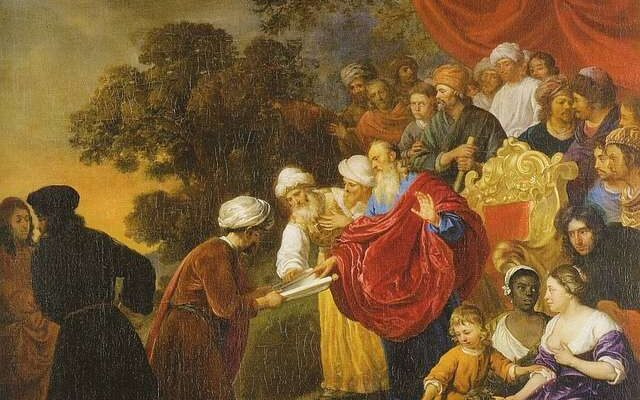
Zerubbabel shows Cyrus the Great a plan of the rebuilt Jerusalem. Jacob van Loo, 1650. Public Domain. Via Picryl
https://www.juancole.com/2026/05/surprising-history-relations.html
Berkshire (Special to Informed Comment; Feature) – After the massive US and Israeli attacks on Iran on 28 February 2026, the second attack in the middle of negotiations within a year, with his characteristic modesty, Israel’s Prime Minister Benjamin Netanyahu said: “The war on Iran fulfils my 40-year dream”. Netanyahu has not only been dreaming of involving the United States in a war against Iran, but he has also been actively working and plotting to bring this about. US Senator Chris Van Hollen put it this way: ‘Netanyahu waited 40 years to find an American president “stupid enough and reckless enough” to start a war with Iran.’
To be fair to Netanyahu, he has not been the only Israeli prime minister to push for a war with Iran. The same policy was followed by most of his predecessors, especially Ariel Sharon, but he has been the most persistent and the most extreme proponent of this idea. Although it was under Netanyahu that the false allegation that Iran planned to develop nuclear weapons emerged as a prime military concern, his predecessors, Yitzhak Rabin and Shimon Peres, also began to drum into the Israeli public, and internationally, the danger that Iran supposedly constituted. Rabin described the revolutionary Iranian government as a “dark, murderous regime.” In 1996, meanwhile, Peres called the Islamic regime “more dangerous than Hitler.”
This is a very unfortunate reversal of the relations between Iranians and Jews, whose contacts go back millennia. The Jews have lived in Iran for over 2700 years, a continuous connection between Iranians and Jews not matched by any other nation. For most of that period, the relations between the Jews and Iranians have been fairly warm and friendly. According to the Book of Kings, in 722 BC, a group of Israelites was brought by King Shalmaneser of Assyria to Iran, and they “settled […] in the cities of the Medes.”1
One of the cities of the Medes where they settled was the ancient Iranian city of Hamadan, which has continued to be a major centre of Jewish settlement in Iran right up to the present time. Later on, they also moved to other major metropolitan areas, namely Rayy, Kashan, Isfahan, Shiraz, Natanz, Borujerd, Khomein, Arak, Nahavand, Malayer and many other cities. The antiquity of the Jewish community of Isfahan is also traced to the post-exilic and Achaemenid periods.
Compared to many countries in the region and certainly in the West, Iran has not had a history of anti-Jewish sentiment. Most Iranian Jews, even many of those who have emigrated to Israel, regard Iran as their home and have a strong feeling of affinity for Iranian culture, literature, music and cooking.
The Hebrew Bible speaks very highly of ancient Persians and reveals very close Jewish connections with ancient Iran and its kings. Fourteen books of the Bible either directly deal with an event that happened in Iran or have references to Iran. There are seven books out of the 14, which are in the form of memoirs of the Jews in the courts of the Medes and the Achaemenids, while seven others refer to events which happened in Iran.
In Jeremiah, we have a reference to the Medes as God’s sword against the enemies of Israel. Ezekiel is about the period of exile in Babylon, when the Jews were freed and allowed to go back home and to rebuild their Temple after Cyrus conquered Babylon. In Ezra, there is the story of the rebuilding of the Temple in Jerusalem with the assistance of Cyrus and Darius.
The Book of Nehemiah is the story of the author, who was a high official at the Persian court in Susa. He was the cupbearer and confidante of Artaxerxes, King of Persia. The king is informed that Jerusalem is without walls, and resolves to restore them. The Persian king appoints Nehemiah as the governor of Judah, and he travels to Jerusalem to rebuild the city walls.
The book of Daniel is about the period of his service at the court of Darius and the forecasts that he made for that king. Daniel’s beautiful tomb in Susa, the ancient capital of the Elamite and Medes Empires, is a place of pilgrimage for Muslims and Jews alike right up to the present time. In Zechariah, we again have the story of the rebuilding of the Temple on the orders of Darius.
In Isaiah, there are many complimentary references to Cyrus and God’s support for him. It describes how God will make Jerusalem the centre of his worldwide rule through a royal saviour (a messiah) who will destroy its oppressor (Babylon). This messiah is the Persian king, Cyrus the Great, who is Yahweh’s agent to redeem the Jews.
The Book of Esther contains the story that marks the 14th of Adar, a holiday called “Purim”, which is the most joyous holiday on the Jewish calendar. It is the story of how Haman, an enemy of the Jews, wanted to massacre the Jews, but through the orders of the Persian king, the Jews were saved, and instead Haman and many of his accomplices were put to death.
It is sad that due to his intense hostility towards the Iranians, Netanyahu even distorted the Bible to blame the Iranians for the alleged massacre planned by Haman. During his address to the joint sessions of Congress on 3 March 2015, Netanyahu tried to sabotage President Barack Obama’s attempt to reach a nuclear agreement with Iran and to remove what Netanyahu had called the existential threat to Israel. In that speech, he distorted the story of Esther for the sake of cheap political propaganda, and he tried to portray the Iranians as responsible for the alleged murder of the Jews, as well as linking that event to what he sees as an existential threat to the Jews coming from contemporary Iran.
He boasted, “We are an ancient people. In our 4,000 years of history, many have tried repeatedly to destroy the Jewish people. Tomorrow night, on the Jewish holiday of Purim, we’ll read the Book of Esther. We’ll read of a powerful Persian viceroy named Haman, who plotted to destroy the Jewish people some 2,500 years ago. But a courageous Jewish woman, Queen Esther, exposed the plot and gave for the Jewish people the right to defend themselves against their enemies.”2
In view of the deliberate distortions of the story of the Book of Esther for political purposes, it is important to dwell a little on the contents of this book. First of all, it should be noted that there are many problems with the Book of Esther. It suffers from many contradictions, and there are some differences between the Hebrew and the Greek versions of the book.
The book tells the story of Esther, the Queen of Ahasuerus. There is no such name among the Achaemenian kings. However, the name is often taken to refer to Xerxes I (r. 519–465 BC), but according to some other details of the book, the name could refer to Artaxerxes I (r. 465 to 424 BC) or Artaxerxes II (c. 445–359/8 BC), or even Artaxerxes III (r. 359/58 to 338 BC). There is no record in Persian sources of any of those kings having a Jewish wife, or of the gruesome episode that the book contains. In view of many historical inconsistencies associated with the Book of Esther, many Biblical scholars believe that it should not be read as a historical book. John Barton, a leading Biblical scholar, wrote that most scholars believe that Esther is “a kind of novella rather than a piece of historical writing.”3
Regardless of its historical authenticity, contrary to Netanyahu’s assertion, the Book of Esther does not blame the Iranians for wanting to kill Jews. According to the book, a wicked man called Haman, son of Hammendatha, the Agagite, had developed a grudge against Mordecai, Esther’s cousin. It should be noted that the Agagites were not Persian or Iranian. According to the Biblical Encyclopaedia, the word Haman is of Elamite origin. This is how the Bible Encyclopaedia describes Agagite:
‘A title of opprobrium given to Haman (Esther 3:1,10; 8:3,5; 9:24). Jewish tradition always assigned the arch-enemies of Israel membership in the house of Amalek, the hereditary foe of the nation. Compare Ant, XI, vi, 5. The word Agag has properly been taken by Delitzsch as related to the Assyrian agagu, “to be powerful,” “vehement,” “angry.” In the Greek parts of Esther, Haman is termed a Macedonian (Esther 1:2-6; 1:6-10). The name Haman is probably of Elamitic origin. Oppert’s attempt to connect the term “Agagite” with “Agaz,” a Median tribe mentioned by Sargon, has found no supporters.’
As the Bible Encyclopaedia points out, Haman, a Macedonian, not a Persian, had ordered all the Jews to be killed. Esther learned of the plot and told the king about it. The Persian king saved the Jews and had Haman killed instead of Mordecai. A more bizarre and bloody episode follows. According to the Book of Esther, the king even allowed the Jews to defend themselves during the attacks by the Amalekites, as the result of which 500 attackers and Haman’s ten sons were killed in Shushan, followed strangely enough by a Jewish slaughter of 75,000 Persians.
The same distortion of facts continues regarding more recent events. Although the tone of the leaders of the Islamic Republic has been harsh and at times disgusting regarding the state of Israel, they have never posed an existential threat to Israel and have not even called for its elimination. Their attacks have always been directed against the “Zionists”, rather than Jews.
A case in point are the remarks made by Iran’s hard-line President Mahmoud Ahmadinejad (2005-2013). In October 2005, he was asked to speak at a conference in Tehran in commemoration of Ayatollah Ruhollah Khomeini. A sentence in his address was loosely translated as Israel should be “wiped off the map”. This sentence gave rise to a storm of condemnation and was extensively used as an example of Iran’s intentions towards the state of Israel.
It is important to analyse that speech and see what Ahmadinejad really said. Referring to Khomeini’s predictions that had been allegedly fulfilled, Ahmadinejad referred to several of Khomeini’s remarks in the past. Ahmadinejad said that Khomeini had said that the Shah had to go and he did. He had said Saddam Hossein had to be toppled and he was. He had declared that the apartheid state in South Africa had to end and it did. In a letter to Mikhail Gorbachev, he had said that the Soviet Union had no future and it fell. Ahmadinejad added that Khomeini had said that the Israeli regime had to collapse and it will.
Many scholars at the time, pointed out that the sentence, “Israel had to be wiped off the map”, had been mistranslated. He simply had called for the end of the Zionist regime, not Israel. The original Persian sentence that he used was “Iman Khomeini goft: in rezhim-e eshghalgar-e Qods bayad az safhe-ye ruzegar mahv shave.” The correct translation of the sentence is “Imam Khomeini said: this regime that occupies Jerusalem must vanish from the pages of time”.
Speaking further about the issue of Israel and the Palestinians, Ahmadinejad said: “The issue of Palestine is not over at all. It will be over the day a Palestinian government, which belongs to the Palestinian people, comes to power; the day that all refugees return to their homes; a democratic government elected by the people comes to power.”
In his subsequent interview with Time Magazine in 2006, he added:
“Our suggestion is that the five million Palestinian refugees come back to their homes, and then the entire people on those lands hold a referendum and choose their own system of government. This is a democratic and popular way.”
It can be argued that Ahmadinejad believed in the Palestinian right of return, and was advocating a single state, including both the Palestinians and the Jews, and for a referendum by all its inhabitants to decide the form of the government. In February 2006 journalists interviewed Iranian Foreign Minister Manouchehr Mottaki about the speech and he said: ‘Ahmadinejad’s comments had been misunderstood and that he had been speaking about the Israeli “regime” not the country and a country could not be removed from the map.’
In an article in Informed Comment, analysing Ahmadinejad’s remarks, Professor Juan Cole, an expert on Persian language and literature and Middle East politics, correctly pointed out that many of Ahmadinejad’s statements were “morally outrageous and historically ignorant, but he did not actually call for mass murder.”
He did not call for the violent overthrow of Israel, the expulsion of its people or “wiping Israel off the map”. It is important to make this distinction because words matter, and a mistranslation can sometimes be used as an excuse for war, as we have seen in a continuous denunciation of Iranians by Israel’s supporters, which has resulted in two unprovoked wars of aggression against Iran. In any case, some of the remarks of Israeli leaders towards Iran and certainly their genocidal remarks about the Palestinians are much harsher than the remarks attributed to Khomeini.
It should also be added that during the extraordinary Arab Summit in Cairo in October 2000, the Arab League unanimously approved to recognise the Israeli state, provided it goes back to the June 1967 borders. Subsequently, the same resolution was also approved by all the 57 members of the Islamic Cooperation Organisation, including President Ahmadinejad, who had attended that meeting. Earlier on, President Mohammad Khatami officially announced that Iran would recognise any agreement between the Arabs and Israelis that was acceptable to the Palestinians. So, the allegation that Iran has always tried to wipe Israel off the map has been false propaganda. The best way to bring Iran closer to Israel would be a rapprochement between Iran and the United States, but anytime that Iran has tried to improve its relations with the United States, the Israelis, led by Netanyahu, have tried to block any agreement between the two. The issue of the non-existent Iranian nuclear weapons is just an excuse to portray Iran as an implacable enemy and maintain billions of dollars of US assistance to Israel flowing.
It should be borne in mind that there is still a large Jewish community living in Iran and, according to the testimony of many Western journalists, including some prominent Jewish journalists who have recently visited Iran, they live peacefully with their Iranian compatriots and freely run Jewish schools or synagogues, which do not even require any guards because they are not threatened. It is inexplicable that, in addition to hundreds of hospitals, residential blocks, universities, schools, banks, bridges, military installations and even UNESCO-registered monuments that have been bombed by the Israelis and Americans, an old synagogue in Tehran was also bombed and destroyed. All this shows that the Israeli and American hostility is not directed only against the Iranian regime, but against Iranian society and civilisation as a whole.
Instead of looking for every excuse to perpetuate the intense hostility between Israel and Iran, it is incumbent upon the rational leaders in both countries to put an end to the unnecessary conflict and to resume the long history of friendship and cooperation between these two ancient communities. After the two devastating wars initiated by Israel and dragging the United States to them too, it is difficult to see a path towards reconciliation. However, the wars have shown how ugly and destructive the continuation of current hostilities could be for both countries. They should provide an added incentive towards ending the conflict and opening a new chapter of cooperation, which is worthy of the long history of friendship between the two people.
Footnotes:
- 2 Kings 18:11
- See Israel’s Ministry of Foreign Affairs, “PM Netanyahu’s speech to a joint session of the US Congress”, 03 March 2015. https://mfa.gov.il/MFA/PressRoom/2015/Pages/PM-Netanyahus-speech-to-Congress-3-March-2015.aspx
- Barton, John (2019). A History of the Bible. Viking. p. 33. ISBN 9780525428770.
Filed Under: Featured, Iran, Israel, Jewish History, Judaism
 F Jahanpour