

Lecture given in Rewley House, Department of Continuing Education, University of Oxford, 2nd September 2017
These days we have moved a long time away from the time that the East, and particularly the Middle East, was seen as the symbol of all things good and beautiful. In one of her two enthusiastic reviews of the Arabian Nights, whose translation into French and then English created a great sensation in the West and was actually responsible for the birth of fiction in Europe, as most early European novels date to a short time after the appearance of the translations of the Arabian Nights, the great novelist George Eliot wrote:
“No art of religious symbolism has a deeper root in nature than that of turning with reverence towards the East. For almost all our good things – our most precious vegetables, our noblest animals, our loveliest flowers, our arts, our religious and philosophical ideas, our very nursery tales and romances, have travelled to us from the East. In a historical as well as in a physical sense, the East is the Land of the Morning.” [Quoted in Charming Orient Shining in England, by Mahmoud F. Al-Ali, Xlibris LLC, 2013, p 108]
Of course, others see the Middle East from different points of view. Military strategists see the Middle East from a strategic and military perspective. In the following statement issued on March 9th, 2017, General Joseph L. Votel, commander of US Central Command, looks at the region from the viewpoint of US military requirements. Here, he refers to the Posture of U.S. Central Command about the Middle East:
“The Central Region is a fascinating area of the world. Spanning over four million square miles, it is populated by 550+ million people from more than 20 ethnic groups representing multiple religions and speaking eighteen languages with hundreds of dialects. The region lies at the intersection of three continents and important commercial sea lanes; flight corridors, pipelines, and overland routes run across it, supporting regional and global economic networks.”
Of course, this region has also been the cradle of civilization, the area of the world that first introduced writing, agriculture, domestication of animals, advances in philosophy and astronomy, and of course the birth place of some of the greatest world religions that have had a lasting effect upon the whole world, namely Zoroastrianism, Mithraism, Manichism, Judaism, Christianity and Islam, and various other sects and religions. It has also been the stage for some of the earliest empires, including Babylonian, Assyrian, Egyptian, Persian, Arab and Turkish empires.
History is never pure; historians select and package it. According to R. G. Collingwood: “St Augustine looked at history from the point of view of the early Christian; Tillemont from that of the seventeenth-century Frenchman; Gibbon from that of the eighteenth-century Englishman; Mommsen from that of a nineteenth-century German. There is no point in asking what the right point of view was. Each was the only one possible for the man who adopted it.” [Cannon Vincent Strudwick, The Naked God (2017), p. 11]
Here we wish to deal with the history of the past 14 hundred years or so, or since the birth of Islam.
1. First encounter (610-632): Muhammad’s mission and the revelation of Islam. The early history of Islam during the lifetime of the Prophet was mainly confined to Arabia, and it did not affect the West.
2. Second encounter (632-661): The four Orthodox Caliphs. The early history of Islam in Arabia was very violent, with three of the four Orthodox Caliphs being assassinated. There were also many battles between the followers of Ali and Othman, thus creating a split in Islam between the Shi’at Ali and the Sunnis, which has continued to the present time. However, that period was also marked by the great expansion of Islam. Shortly after Muhammad’s death, Muhammad’s followers poured out of Arabia and conquered several important neighbouring countries. In 638, they conquered parts of Syria, including Jerusalem, and Egypt. The same year they invaded the Persian Empire, and by 650 they were masters of the entire Persian Empire right up to Central Asia and Northern India.
3. Third encounter (661-750): The Umayyad Caliphate. In the seventh and eighth centuries, armies fighting in the name of the first Muslim Empire, the Umayyad Caliphate based in Syria, expanded into the heart of the Christian world. They occupied some provinces of the Byzantine Empire and spread westwards into North Africa, Spain and Sicily. The defeat of the Visigothic army in July 711 AD in Andalucía was the start of the Moorish rule of Spain. By the winter, Tariq, the Moorish governor of Tangier, was in the Visigothic capital of Toledo. In the summer of the following year, his superior, Musa, joined him with a huge army to mop up the last Visigothic resistance at Mérida. The conquest was not only a military one, but was followed in the course of time by conversions to Islam on a large scale.
4. Fourth encounter (750-1258): The Abbasid Empire and the consolidation of Islam. This was the great age of Islamic civilisation. Islamic sciences flourished. Numerous translations were made from Greek, Indian, Persian, Neo-Platonic, Assyrian and Aramaic sources into Arabic. Classical learning was adopted, expanded and transmitted to Europe.
5. Fifth encounter (1095-1492): The start of the Crusades to the fall of Granada. Between the eleventh and thirteenth centuries, there was a counterattack, successful for a time in the Holy Land, where a Latin kingdom of Jerusalem was created, and more permanently in Spain. The last Muslim kingdom in Spain was brought to an end in 1492 with the expulsion of Muslims and Jews from Spain. That was the end of large-scale Muslim presence in Europe right up to the beginning of the twentieth century.
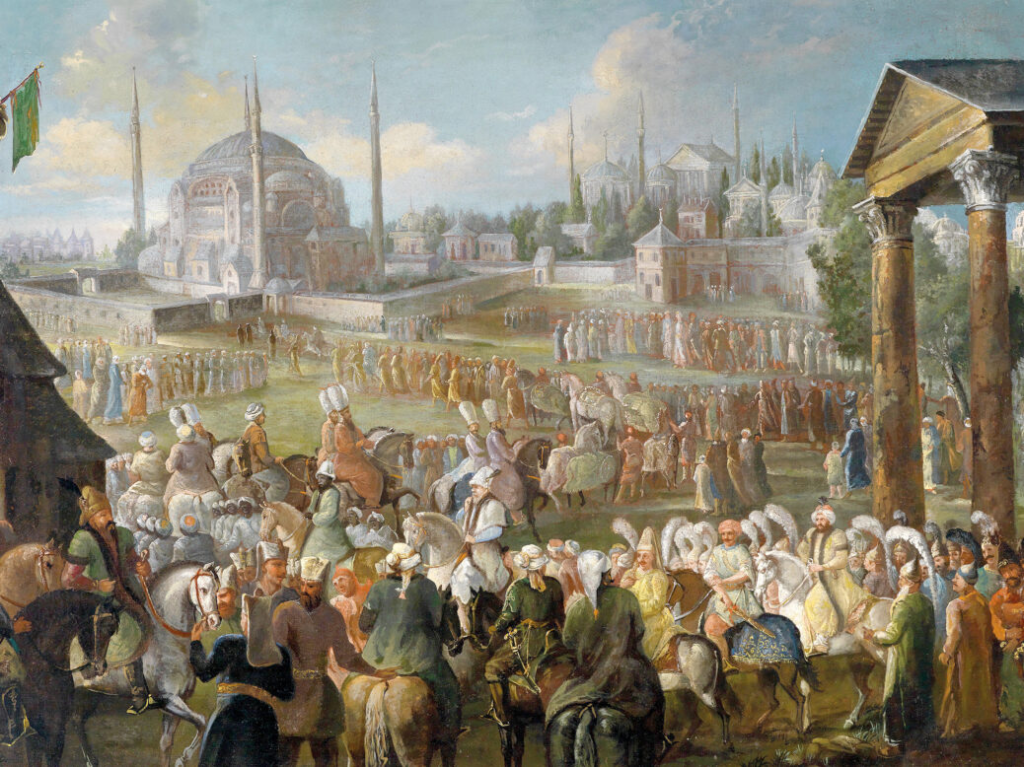
6. Sixth encounter (1453-1683): From the conquest of Constantinople to the failure of the second siege of Vienna. While the Muslims were expelled from Spain, there was a further Muslim expansion elsewhere, by dynasties drawn from the Turkish peoples. The Seljuqs advanced into Anatolia, and the Ottomans extinguished what was left of the Byzantine Empire, and in 1453 they occupied its capital, Constantinople, and expanded into eastern and central Europe. The collapse of the Byzantine Empire marks the beginning of the new era both for the Muslims and for the Christian West. The shock of the defeat and the scattering of the scholars from the Byzantine Empire to Italy and other parts of the West provided an impetus for the Renaissance in the West. It was that defeat which forced the West to find another route to the Far East, leading to the discovery of the New World and the eventual encirclement of the Middle East and the world of Islam.
7. Seventh encounter (1500-1798): The rise of the Safavid Empire in Iran and the Mughal Empire in India. It should be noted that while the Ottoman Empire was expanding in Europe, two other strong Islamic empires emerged in Iran and India. Right up to the middle of the 18th century, the glories of Istanbul in Turkey, Isfahan in Iran and Agra and Delhi in India matched or even surpassed the best of Renaissance Europe.
8. Eighth encounter (1798-1922): The conquest of Egypt by Napoleon and the start of the colonial era. Napoleon’s conquest of Egypt marks a complete reversal of the fortunes of the West and Islam. The occupation of a leading Islamic country was a precursor to the colonisation of nearly all other Islamic countries, with the exception of Iran and Turkey, during the nineteenth and the first part of the twentieth centuries. The nineteenth century marked the gradual collapse and dismemberment of the Ottoman Empire. In 1830, France invaded Algeria; in 1881 Tunisia was lost, and in 1882 Egypt was lost. By the end of the century, nearly all of the Middle East had become part of the British, French and Russian empires. The Balkan Wars of 1912-13 marked the Ottoman Empire’s expulsion from Europe, and in 1922 the Ottoman Empire and the Caliphate were abolished.
9. Ninth encounter (1922-1948): From the start of the British Mandate in Palestine to the establishment of the state of Israel proclaimed on 14 May 1948. Britain occupied Palestine in 1917, and the League of Nations confirmed the British Mandate for Palestine in 1922. An important step towards the creation of the state of Israel was the Balfour Declaration of 1917, which advocated the establishment of “a national home for the Jewish people” in Palestine.
On 20th November 1947, the United Nations, strongly influenced by the Holocaust, voted for a partition plan between an Arab and a Jewish state. The plan called for 55% of Palestine to be allocated to the Jews, although in 1947 Palestine’s population comprised about 600,000 Jews and 1.3 million Palestinians. The partition of Palestine started a conflict that has lasted to the present time. On 14 May 1948, Israel declared its independence.
10. Tenth encounter (1946-1979): The decolonisation of Islamic countries and the rise of Islamic fundamentalism. The colonisation of Islamic countries lasted from 1798 until the 1960s. On 16th July 1946, the last British garrison in Egypt was handed over to the Egyptians, and that event marked the beginning of Egyptian independence. The British withdrawal from the Persian Gulf region in the 1960s marked the end of direct European rule over Muslim countries.
11. Eleventh encounter (1979-1989): The Islamic revolution in Iran to the collapse of the Soviet Union. The triumph of the Islamic revolution in Iran in 1979 marked an Islamic backlash to two centuries of European domination and the resurgence of Islamic militancy and fundamentalism. The Iranian revolution was intended to put an end not only to the West’s military occupation of the Middle East, but also to reassert the Islamic identity of the people and fight against what Ayatollah Khomeini called ‘Westoxication’ or Western cultural domination.
12. Twelfth encounter (1989-2001): From the collapse of the Soviet Union to 9/11. During this period, various Islamic countries that had been used as pawns by big powers in the East-West conflict were suddenly faced with new realities. Iraq, Syria and Libya lost the backing of the former Soviet Union, while countries such as Indonesia, Pakistan, Egypt, Saudi Arabia and others that had received Western backing found a loosening of ties with their former patrons.
13. Thirteenth encounter (11 September 2001 to March 2003): Invasion of Afghanistan and Iraq, and Arab-Israeli Road Map. The terrorist attacks in the United States marked the beginning of a new phase of relations between the Middle East and the West, which has been characterised as a ‘clash of civilisations’. With the so-called ‘war on terror’, the United States attacked Iraq and Afghanistan, allegedly to fight against terrorism and to establish democracy. Nearly a decade later, and despite the death of thousands of Western forces and hundreds of thousands of Afghans and Iraqis, those countries are still in turmoil, and the outcome of the conflict is still uncertain.
14. Fourteenth encounter (2003 to the present). In the aftermath of the disastrous war in Iraq, many Islamic countries, especially in the Middle East, such as Iran, Syria and Lebanon and more recently Pakistan, Yemen, Libya and Syria, find themselves on the receiving end of Western anger and possibly military attacks and regime change. Other regimes friendly to the West, such as those of Saudi Arabia, Yemen, Jordan and Bahrain, are faced with domestic challenges and unpopularity. The present turmoil in the Middle East is the result of these seismic changes, and the region will remain unstable until the conflict between various states in the region and the West is resolved.
15. Fifteenth encounter (January 2011): Arab uprisings. During January-February 2011, in quick succession, the presidents of Tunisia and Egypt, two of the seemingly most stable pro-Western countries, were toppled, and demonstrations and revolutions spread to the rest of the Arab world. The first democratic election in Egyptian history resulted in the election of President Mohamed Morsi, a leader of the Muslim Brotherhood, but just a year later he was toppled in a military coup led by the army chief of staff appointed by him, General Abdel Fattah el-Sisi, who jailed Morsi and started a crackdown on the Muslim Brotherhood. The uprisings in Syria, Libya and Yemen gave rise to civil wars that are still raging.
16. The rise of the so-called Islamic State of Iraq and the Levant (ISIL). A group of terrorists that took the name of ISIL and that were fighting against President Bashar Assad’s government in Syria attacked Iraq and conquered a large chunk of Western Iraq, mainly inhabited by the Sunnis. On 29 June 2014, the leader of the terrorist group Abu-Bakr al-Baghdadi announced the establishment of an Islamic caliphate in Iraq and Syria and declared himself as its caliph. During the past year, the group has committed a large number of outrageous atrocities, not only in the area under its control but also in several other countries, including Britain, France, Belgium, Germany, Turkey, Iran, Tunisia, etc.
As can be seen from the above list, ever since the emergence of Islam and the creation of various Islamic empires, with 57 Muslim-majority countries which are the members of the Islamic Cooperation Council comprising some two billion people, the second largest religious community after Christianity, the West has had to contend with the Islamic world. The encounters between the two religions and civilisations have, at times, been friendly and cooperative, and at other times hostile, such as during the Crusades.
With Muslims now constituting the largest minority groups in most European countries, and with many Islamic countries being either members of the British Commonwealth or the Organisation internationale de la Francophonie (OIF), and all of them being members of the United Nations, the time has come to forge new relationships between the two blocs. Therefore, the next encounter between the two civilisations must be based on mutual respect and cooperation, working for global peace and progress.

