

Edited text of a lecture given at the Religion and Society Meeting, Kellogg College, University of Oxford, 19 January 2011, at the invitation of my late friend, Canon Vincent Strudwick, College Dean
Whether we are believers or agnostics or atheists, there is no denying the importance of the role that religion has played, and still does, for good or ill in human history. Many people see religion as a source of conflict and superstition and as an impediment to the path of progress and scientific development. Nevertheless, even those who have such a negative view of religion cannot deny the influence that various religions have exerted in people’s lives. From the dawn of history, religious beliefs have held a special fascination for people.
It is therefore not surprising that in most cultures their very first artistic, cultural, philosophical and intellectual impulses have been expressed in the form of some religious and spiritual texts. The oldest known texts in ancient Egypt that date from 2400 BC are of a religious nature in the form of inscriptions on the sarcophagus of King Ahiram of Byblos. The Epic of Gilgamesh is one of the earliest texts among the Sumerians, dating from 2150 to 2000 BC, which is again a religious text giving us the first story of the Flood.
In the Hindu civilisation, the Rigveda (composed between 1700 and 1100 BC) and subsequent Vedas provide the very first examples of writing and religious thinking among the Hindus. Among the Iranians, the Gathas of Zoroaster or Zarathustra (living towards the end of the second millennium BC) are the earliest examples of Iranian religious and literary activity. Among the Persians, the Gathas, the earliest parts of the Zoroastrian sacred texts, the Avesta, are the first recorded books that have survived from ancient Persia.
Among the Hebrews, the Bible is their first recorded text. In the Chinese civilisation, the Tao Te Ching or Dao De Jing, simply referred to as the Laozi (written in the 6th century BC by the sage Laozi), is a very early Chinese text, fundamental to both philosophical and religious Taoism. Even among the Arabs, such a relatively late text as the Koran is the first recorded text and the first expression of the religious beliefs of the Arabs that gave rise to the Islamic civilisation.
These books that can truly be called Mother Books have produced great civilisations and have been responsible for the creation of great works of art, literature, music, calligraphy, and many other manifestations of human civilisation down the ages, right up to the present time. As this is the 400th anniversary of the completion of the King James Bible, during the past few books a great deal has been written and spoken about this book. No other book, or indeed any piece of culture, seems to have influenced the English language as much as the King James Bible. Its turns of phrase have permeated the everyday language of English speakers, whether or not they’ve ever opened a copy. It is the most published book and has a circulation that eclipses every other book.
The US statesman, lawyer and orator Daniel Webster said: “If there is anything in my thoughts or style to commend, the credit is due to my parents for instilling in me an early love of the Scriptures.”[1]
Equally celebrated British orator, T. B. Macaulay, praised the new English Bible in the highest terms. In his 1828 essay on John Dryden (later published in his Miscellaneous Writings), Macaulay wrote: “The English Bible – a book which, if everything else in our language should perish, would alone suffice to show the whole extent of its beauty and power.”
Tennyson considered Bible reading “an education in itself, reflecting the immense literary, moral, and cultural impact of the Authorised King James Version on Victorian writers and thinkers.” Charles Dickens called the New Testament “the very best book that ever was or ever will be known in the world.”
The King James Bible and the works of Shakespeare have had the most profound influence on the language and thinking of the British and American people, even those who do not go to church or do not watch many Shakespeare plays. The same, of course, is true of all other religious scriptures that are read, memorised and recited on a daily basis by millions of their followers throughout the world.
While the historical, political and social influence of religion cannot be denied, religious people normally do not regard religion purely as a social phenomenon, but as a metaphysical and divine revelation that transcends time and space. Religions have not just influenced communities, but have profound effects upon the individual psyche, producing feelings of ecstasy, mysticism and union with what is regarded as some form of deity or higher being. They have given rise to many acts of self-sacrifice, charity, mercy, kindness and philanthropy, as well as, of course, to horrendous examples of cruelty and bigotry based on fanaticism and total devotion to a particular set of beliefs.
In view of supernatural claims for religions, it is important to look at the evolution of religious thought in human history and its place in the bigger schemes of things. In order to put religion in perspective and to test its claims, it is important to place it in the context of scientific knowledge about the creation of the universe and the evolution of life on this planet. Most astronomers now estimate the age of the universe to be 13.75 billion years since the Big Bang.
On 23 April 2009, a gamma-ray burst was detected, which was later confirmed to be over 13 billion years old. Astronomers estimate the age of the universe in two ways: 1) by looking for the oldest stars; and 2) by measuring the rate of expansion of the universe and extrapolating back to the Big Bang; just as crime detectives can trace the origin of a bullet from the holes in a wall.
The Solar System is thought to be 4.5 billion years old, and humans have existed as a genus for only a few million years. However, in contrast to the vastness of time and space, organised religion traces its roots to the Neolithic Period that began some 11,000 years ago in the Near East, but may have occurred independently in several other locations around the world. It is an incontrovertible fact that during recorded history religion has played an important role in Man’s life.
There is some inconclusive evidence that even the Neanderthals buried their dead, which is evidence of the use of ritual and perhaps belief in the afterlife. The use of burial rituals is evidence of religious activity.[2] Other scholars believe that religious thought evolved after the discovery of language and communication. Philip Lieberman states: “Human religious thought and moral sense clearly rest on a cognitive-linguistic base”.[3]
The religious mind is one consequence of the development of the human brain that is capable of formulating religious and philosophical ideas. Paul Ehrlich states: “Religious ideas can be traced to the evolution of brains large enough to make possible the kind of abstract thought necessary to formulate religious philosophical ideas.”[4]
Beliefs in the supernatural clearly have had – and continue to have – enormous influence on human behaviour and the evolution of human societies. An examination of why religions evolved, the role of religion, and the evolution of religious thought is critical to understanding human nature, and should be carried out without reference to the “truth” or “falsehood” of the claims of any religion. As one of the leading experts in religious philosophy, Ninian Smart (1927-2001) put it, we can “talk about worship and other activities in meaningful ways without having to comment on their validity, without having to comment on whether there is a Vishnu or a Christ.”[5]
In other words, we can have a kind of secular theology or religious studies purely as an academic discipline. Smart in fact provided a sevenfold scheme for the study of religion:
1- Doctrinal
2- Mythological
3- Ethical
4- Ritual
5- Experiential
6- Institutional
7- Material
He believed that Rudolf Otto’s concept of the Holy as a key to understanding religion was too restrictive, since Buddhism, Taoism and Confucianism are non-theistic. There must be other factors in religions that seem to be so attractive to people and exert such a profound and lifelong influence on their lives.
A main reason for the evolution of religious thought has been the effort to make sense of our human circumstance. Science tells us that we are creatures of accident clinging to a ball of mud hurtling aimlessly through space.
Life is but a walking shadow, a poor player
That struts and frets his hour upon the stage
And then is heard no more: it is a tale
Told by an idiot, full of sound and fury, signifying nothing.[6]
In the words of the great Iranian agnostic poet, Omar Khayyam,
How sweet is mortal Sovereignty! – think some:
Others – “How blest, the Paradise to come!”
Ah, take the Cash in hand and waive the Rest!
Oh, the brave Music of a distant Drum![7]
Or
The Worldly Hope men set their Hearts upon
Turns Ashes – or it prospers, and anon,
Like Snow upon the Desert’s dusty Face
Lightning a little Hour o two – is gone[8]
This is not a notion to warm hearts and rouse multitudes. On the contrary, it produces a load of unbearable anxiety, which forces us to try to find ways of coping with it. In the face of life’s tribulations, people seek a belief system that appears to justify those tribulations or provide solace, enabling us to cope with those tribulations.
The desire to solve the riddle of existence and to find solace in a lonely and frightening world has been one of the main attractions of religion, and it has ingrained itself in our being from childhood, very much like our ability to speak, our language and accent and many other traits that we inherit from birth. Even a major opponent of religion such as Professor Richard Dawkins says that religion has been hardwired into our being, and another atheist, John Paul Sartre, wrote about a “God-shaped hole in his psyche.”
It is known that most modern religions have their origins in the Middle East. However, in the course of time, those primitive beliefs have evolved and matured into the forms that we see them today. Professor Cantwell-Smith of the University of McGill, in his book The Mystery and End of Religion (1963), says that religion can be divided into two parts: Faith that is a personal matter and concerns belief in spiritual values or a revelation from God, like that of Moses, Christ or Muhammad. The other aspect of religion is what he calls “accumulated tradition.”
Naturally, this part of religion by which most religions are known is quite different from one religion to another and different from what the original religion stood for or how it was understood. Most of the texts that we possess, although speaking of ancient myths and stories, were written many centuries after the events that they describe.
A major problem with ancient texts, whether religious or secular, is the unreliability of the texts and of those who really wrote them. At a time when there was a low level of literacy, when life was short and uncertain, when it was difficult to keep records, it is often difficult and even impossible to be certain about the authenticity of those texts, especially as the copies that we possess belong to a long time after they were written by their supposed writers.
The oldest surviving Hebrew Bible manuscripts are the Aleppo Codex (c. 920 AD) and Leningrad Codex (c.1008 AD), describing the events that took place hundreds and, in some cases, thousands of years after they allegedly took place. The oldest extant manuscripts of the 24 books of the Hebrew Bible in Rabbinic Judaism, upon which modern editions are based, date up to the 9th century AD.
The discovery of the Dead Sea Scrolls at Qumran in 1947 has provided us with some fragments of a few books of the Old Testament which are much older than other manuscripts that we possessed, dating from the third century BC to the first century AD. However, even these manuscripts were transcribed hundreds of years after the events that they purportedly report. The oldest record of the complete text that survives in Greek translation (Codex Sinaiticus) dates from the 4th century AD.[9]
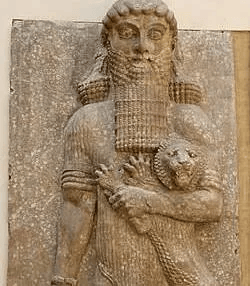
Gilgamesh
Gilgamesh was an historical king of Uruk in Babylonia, on the River Euphrates in modern Iraq, who lived about 2700 B.C. The account begins: “Gilgamesh, two-thirds god and one-third human, is the greatest king on earth and the strongest superhuman that ever existed.”
Although historians tend to emphasise the importance of Hammurabi and his code of law, the civilisations of the Tigris-Euphrates area, which are among the first recorded civilisations, focus rather on Gilgamesh and the legends accruing around him to explain, as it were, themselves.
Many stories and myths were written about Gilgamesh, some of which were written down about 2000 B.C. in the Sumerian language on clay tablets which still survive. As far as we know, the Sumerian language bears no relation to any other human language we know about. These Sumerian Gilgamesh stories were integrated into a longer poem, versions of which survive not only in Akkadian (the Semitic language, related to Hebrew, spoken by the Babylonians) but also on tablets written in Hurrian and Hittite (an Indo-European language, a family of languages which includes Greek and English, spoken in Asia Minor).
The Flood:
Gilgamesh decides that he can’t live unless granted eternal life. He decides to undertake the most perilous journey of all: the journey to Utnapishtim and his wife, the only mortals to whom the gods had granted eternal life. Utnapishtim is the Far-Away, living at the mouth of all rivers, at the ends of the world. Utnapishtim was the great king of the world before the Flood and, with his wife, was the only mortal preserved by the gods during the Flood.
The Flood is so great that even the gods are frightened:
The gods shook like beaten dogs, hiding in the far corners of heaven,
Ishtar screamed and wailed:
“The days of old have turned to stone:
We have decided evil things in our Assembly!
Why did we decide those evil things in our Assembly?
Why did we decide to destroy our people?
We have only just now created our beloved humans;
We now destroy them in the sea!”
All the gods wept and wailed along with her,
All the gods sat trembling, and wept.
The Flood lasts for seven days and seven nights, and finally light returns to the earth. Utnapishtim opens a window and the entire earth has been turned into a flat ocean; all humans have been turned to stone. Utnapishtim then falls to his knees and weeps.
Utnapishtim’s boat comes to rest on the top of Mount Nimush; the boat lodges firmly on the mountain peak just below the surface of the ocean and remains there for seven days. On the seventh day:
I [Utnapishtim] released a dove from the boat,
It flew off, but circled around and returned,
For it could find no perch.
I then released a swallow from the boat,
It flew off, but circled around and returned,
For it could find no perch.
I then released a raven from the boat,
It flew off, and the waters had receded:
It eats, it scratches the ground, but it does not circle around and return.
I then sent out all the living things in every direction and sacrificed a sheep on that very spot.
The gods smell the odour of the sacrifice and begin to gather around Utnapishtim. Enlil, who had originally proposed to destroy all humans, then arrives, furious that one of the humans had survived, since they had agreed to wipe out all humans. He accuses Ea of treachery, but Ea convinces Enlil to be merciful. Enlil then seizes Utnapishtim and his wife and blesses them:
At one time Utnapishtim was mortal.
At this time let him be a god and immortal;
Let him live in the far away at the source of all the rivers.[10]
Egyptian Religion
The Egyptian description of the beginning of creation is very similar to that in the Old Testament. It talks about void and chaos. Yet chaos was not imagined as immaterial: it was a boundless ocean, called Nun. Darkness was on the face of the deep, for there was yet no sun. But within that dark, watery abyss lay, in a latent state, the primal substance out of which the world was to be formed. Also submerged somewhere within it was the demiurge who was to do the forming.
The theologians of Egypt regarded the demiurge as the sun-god Ra, and as the earth-god Ptah. All agreed that he came into full existence at a moment when the primordial hillock emerged. While in the Nun he had been in a state of ‘somnolence’ or ‘inertia’, but as he became aware of himself, he transformed himself. Not begotten of any father, not conceived by any mother, of his own volition he gave himself a body and entered upon active existence.
Probably the greatest text of the ancient Egyptians was what has come to be called the Book of the Dead, but more correctly is called The Book of Going Forth by the Day. It is written on papyrus and dates from the beginning of the New Kingdom (about 2050-1750 BC).
It is based substantially on much earlier so-called Coffin Texts, so in part it is very ancient, and at the same time it represents the standard Egyptian view of the nature of death and the way to survive it. The mythic scene which underlay the process was the life, death and resurrection of the god Osiris. Next to Ra, the great Sun God, Osiris was undoubtedly the most important deity in the Egyptian tradition. By the Middle Kingdom period when the Book of the Dead was assembled, Osiris was the focus of much piety. The living Pharaoh was identified with Osiris’s son, as the ‘living Horus’, and a dead Pharaoh was identified with Osiris himself.
Having overcome death, Osiris becomes the presiding deity of the afterlife for the judging of the dead, which is described in some detail in the Book of the Dead. The soul of the deceased is weighed against the feather of Truth. This notion of the scale of justice became a widely used metaphor. In chapter 125 of the book, there is a protestation of innocence addressed to the forty-two judges trying the dead, which gives a good insight into the ethics of ancient Egypt and the similarity of those ethics with the Ten Commandments.
The person protests that he “has not stolen, or been covetous, or killed a human being, or damaged a grain-measure, or told lies, or trespassed, or practised usury, or gossiped, or committed adultery, or had sex with a boy, or been abusive of a king, and so on.”
In other words: Thou shalt not kill, thou shalt not steal, thou shalt not bear false witness, thou shalt not commit adultery, and so on.
HAMMURABI’S CODE OF LAWS (1780 BC)
The Code of Hammurabi is a well-preserved ancient Babylonian legal text Code of Hammurabi is a well-preserved ancient Babylonian legal text composed around 1750 BC by King Hammurabi. Hammurabi’s detailed code of laws contains 282 separate clauses containing laws on a large number of offences, including murder, rape, stealing, false accusation, etc. Like religious scriptures, Hammurabi speaks with divine authority:
“When Anu the Sublime, King of the Anunaki, and Bel, the lord of Heaven and earth, who decreed the fate of the land, assigned to Marduk, the over-ruling son of Ea, God of righteousness, dominion over earthly man, and made him great among the Igigi, they called Babylon by his illustrious name, made it great on earth, and founded an everlasting kingdom in it, whose foundations are laid so solidly as those of heaven and earth; then Anu and Bel called by name me, Hammurabi, the exalted prince, who feared God, to bring about the rule of righteousness in the land, to destroy the wicked and the evil-doers; so that the strong should not harm the weak; so that I should rule over the [ black-headed people like Shamash], and enlighten the land, to further the well-being of mankind.”[11]
This was the first instance that we have the law of an eye for an eye, a tooth for tooth, including execution for deliberate murder. If a man kills another man, he shall be put to death.
196. If a man put out the eye of another man, his eye shall be put out. [An eye for an eye]
197. If he break another man’s bone, his bone shall be broken.
3. If any one bring an accusation of any crime before the elders, and does not prove what he has charged, he shall, if it be a capital offence charged, be put to death.
5. If a judge tries a case, reach a decision, and present his judgment in writing; if later error shall appear in his decision, and it be through his own fault, then he shall pay twelve times the fine set by him in the case, and he shall be publicly removed from the judge’s bench, and never again shall he sit there to render judgement.
23. If the robber is not caught, then shall he who was robbed claim under oath the amount of his loss; then shall the community, and . . . on whose ground and territory and in whose domain it was, compensate him for the goods stolen.
137. If a man wish to separate from a woman who has borne him children, or from his wife who has borne him children: then he shall give that wife her dowry, and a part of the usufruct of field, garden, and property, so that she can rear her children. When she has brought up her children, a portion of all that is given to the children, equal as that of one son, shall be given to her. She may then marry the man of her heart.
145. If a man takes a wife, and she bears him no children, and he intends to take another wife: if he takes this second wife, and brings her into the house, this second wife shall not be allowed equality with his wife.
195. If a son strikes his father, his hands shall be cut off.
UGARIT AND ITS ECHOES IN THE BIBLE
The history of Ugarit is very short – from the invention of the script in c. 1400 BC to 1200 BC. According to Francis Landy, who translated the Tale of Aqhat: “In some ways the Bible, or at least that part of it known as the Old Testament, has been a great blocker of light. Its grandeur and authority, its canonical position in both the Jewish and Christian world, its acceptance as something absolutely unique and incomparable, have for long stood between the post-Biblical man and an awareness of his pre-biblical culture roots.” One of the great achievements of modern Semitic studies has been to enable us to cross what Francis Landy calls “the other side of the ideological barrier of the Bible.”[12]
The Ugaritans, who were Canaanites, though they speak to us from behind the biblical barrier, can now be seen to have inhabited a world that has all kinds of links with other ancient Middle Eastern cultures, not excepting that of the Israelites themselves.
THE TALE OF AQHAT
The Tale of Aqhat was found, together with the other two epics, the Baal-Anat Cycle and the legend of Keret, in the library of the High-Priest’s House, excavated in the first seasons. It was recorded shortly before an earthquake destroyed half of Ugarit in 1365 B.C.
The epic begins with the ritual Daniel undergoes to obtain a son; its success and his joy. The motif of the righteous man who is childless and granted a son by God is familiar from the Bible; one thinks of Abraham, Isaac and Samuel. The son miraculously conceived is ‘marked’ by divinity and is called the son of god. The magical endowment of fertility initiates the dialectic of the poems. The subsequent bereavement makes the miracle ironic and cancels it out. The same pattern is to be found, in yet more terrible form, in the Sacrifice of Isaac, where the father is commanded to kill his own God-given son; or the miraculous birth of Christ and then his death and resurrection. Thus the question of theodicy is interwoven with that of death and fertility. It centres, however, round the figure of Aqhat himself.
Daniel, Aqhat’s future father, complains that he has no son and pleads to El to give him a son
‘Forlorn is Daniel, man of healing,
The valiant lord of Harnam grieves:
He has no son, child of his loins,
No root like his brothers, his kinsmen.
Let him not be without a son,
A root like his brothers, his kinsmen…
Daniel went to his bed, lay there,
Kissing his wife, caressing her;
Feverish she conceived,
Roused to the glow of conception,
To the heat of generation,
For the man of healing,
Lord of the Shades.
Thus was the house quick with a son,
A seed in the heart of the palace,…
El now addresses the newborn child, makes him the Son of God and gives him immortality
‘Wish, Aqhat, wish; life will I send you –
Ask, hero, ask; deathless I make you.
There you will number years with Baal,
Count seasons with the sons of God.
As Baal, when he returns to life,
A sweet voice plays, I tell you truly –
I offer noble Aqhat life forever!’…
The evil goddess Anat, however, becomes jealous and tries to destroy the son. When Aqhat is having his supper, she kills him. His death causes the whole world to mourn:
And now his murder blights the summer,
Fruits shrivel, and the sap grows sour,
The kernel in the unripe corn.’…
Now Daniel calls to El again to bring his son back to life. El answers his prayers and restores the son to life. On the third day, one day they ride, two days,
On the third day, at sunrise
El says: There is your son!..
Look at your hands!
See how your lips kiss the lost child!
Shoulder to shoulder brothers bustle,
Start up together, roused by El.
In El’s name, flesh forms, and the dead appear,
Aqhat rises from the dead:
The valiant young men his Name’s blessing quickens!
Here one has both the element of an old man being given a son, the son being taken away, and then returned to life on the third day.
Zoroastrianism
(All quotations in this paper from the Gathas of Zarathushtra are from the translation by Dinshah J. Irani)
I. Query: What was Zarathushtra giving to humanity in his teachings?
O Ahura Mazda, and O Spirit of Truth and Right,
Do ye grant me and my followers such authority and power
That with the means of the Good-Mind we may bring the world peace and happiness;
Of which Thou, O Lord, art indeed the original promoter! Y29:10
I shall take the awakened soul to the exalted abode with the help of the Good-Mind,
Knowing the blissful rewards of the Wise Lord for righteous deeds.
As long as I have power and strength, I shall teach all to seek for Truth and Right. Y28:9
II. Query: What is the commitment he seeks of the faithful,
Such an enlightened outlook is very close to Zarathushtra’s ideology, and this vision of a progressive future sets the Zoroastrian commitment fully in accord with the Western ideal of a free society progressively understanding the World and transforming it to a state of our collective well-being.
The simplicity of the Vision, a concern for the moral and social aspects of human existence, is this: There can be no morality in action alone, as there can be no morality without action. For the essence of the moral lies in the functioning of the Good-Mind, which, through reflection and articulation, implements happiness- and harmony-promoting actions. Actions performed through considered, not prescribed, choice. Inevitably, it is this choice, and this choice alone, for which one is responsible, here and hereafter.
This is a vision of a perfecting world and moral order, brought to that state by rational and thoughtful human beings, dedicated to promoting the Truth, by the power of reason, not force or social machination. For ultimately the clarity of Truth requires no additional mechanism to generate its acceptance, and no foundation other than Truth can secure a just and peaceful social order.
Not only is this a vision of a perfecting world, but also of perfecting humans, finding self-realisation in this life and passing to a state of immortal bliss to what the Prophet called the Abode of Songs. At this point I can do no better than to give you the words of the Prophet on this matter.
All these, indeed, gather unto Thee, O Mazda!
They who have done Thy work,
Whose actions accord with the Truth,
Whose words proceed from the Good-Mind,
Whose Inspirer art Thou from the very beginning. Y51:3
At the last turning of life
To the faithful making the right choice according to his norm
Doth Ahura Mazda, the Lord Judge, in His sovereign power
Bestow an end better than good.
But to him who shall not serve the cause of good,
He giveth an end worse than bad,
At the last turning of life. Y51:6
With Truth moving my heart,
With Best Thought inspiring my mind,
With all the might of spiritual force within me,
I venerate Thee, O Mazda, with songs of Thy praise.
And at the last when I shall stand at Thy Gate
I shall hear the echo of my prayers from Thy Abode of Songs. Y50:4
Conclusion
As can be seen from the above examples, religion seems to have been ingrained in the human psyche in most cultures. Their versions of truth are different, but all of them have a few things in common.
1- They try to transcend the daily experiences of most human beings and aspire to something above and beyond the physical world.
2- They all believe in some form of a deity, although the nature of their deity and its characteristics vary from religion to religion. In most of them, their deity is a tribal god who favours their particular tribe. In others, such as Zoroastrianism and Judaism, the hero has universal characteristics, although he still favours a particular tribe or the followers of its own religion.
3- All these early religions have certain scriptures which they believe convey the message of their god and are, therefore, sacred and different from all other books. In fact, in nearly all cultures, their holy texts predate all other texts and seem to be the first text in their language.
4- They all believe in a set of rules and laws sent by their god, which must be obeyed. Following those rules will result in a more holy existence and will lead to redemption or salvation.
5- Nearly all early religions seem to believe in an afterlife, as attested by the rituals that they observe after someone’s death. The belief in the afterlife seems to be associated with some form of recompense for one’s deeds in their life, thus encouraging a pious and charitable life.
6- Most early scriptures employ a sophisticated level of imagination and enjoy great literary merit.
7- All those religions form a system for bringing people together and creating a high degree of social cohesion and a sense of belonging.
[1] [“What Did Daniel Webster Say About the Bible?” Radical in Christ. https://radicalinchrist.com/2013/03/22/what-did-daniel-webster-say-about-the-bible/
[2] Douglas Palmer, Simon Lamb, Guerrero Angeles Gavira, and Peter Frances, Prehistoric Life: The Definitive Visual History of Life on Earth, New York, DK Pub. 2009.
[3] Philip Lieberman, Uniquely human: the evolution of speech, thought, and selfless behaviour (Harvard University Press, 1991)
[4] Paul Ehrlich, Human Natures: Genes, Cultures, and the Human Prospect (Washington, D.C., Island Press, 2000), p 214.
[5] Ninian Smart, The Natural Human Propensity Towards Faith (Word Press, 2010)
[6] A line from William Shakespeare‘s Macbeth, from Act 5, Scene 5
[7] Rubaiyat of Omar Khayyam, translated by Edward Fitzgerald (Harrap Limited, 1984), Ruba’i XII
[8] ibid, Ruba’i XIV
[9] See F. F. Bruce, “The Last Thirty Years” in The Story of the Bible, ed. Frederic G. Kenyon
[10] The Epic of Gilgamesh, trans. by Maureen Gallery Kovacs (Stanford: Stanford University Press, 1990), or Gilgamesh, translated by John Maier and John Gardner (New York: Vintage, 1981)
[11] The Code of Hammurabi, translated by L. W. King.
[12] Francis Landy, The Tale of Aqhat (Small Press Distribution Inc, 1981)
 F Jahanpour