

The Rise of Military Rulers
An article by Farhang Jahanpour, written in 2018
During the past few centuries, most Islamic countries, like most states in Asia, Africa and the New World, came under Western domination, imperialism and colonialism, exercised by military force. In Asia, Western domination started with the rise of the British Empire in India, and Napoleon’s conquest of Egypt and Syria starting from 1798. In time, most colonised countries decided to throw away the yoke of foreign domination and restore their independence.
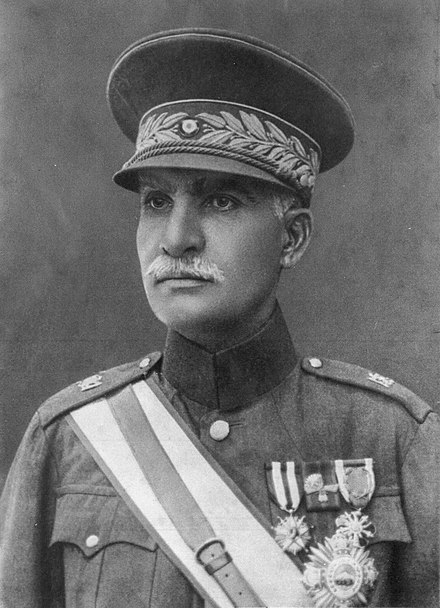
The way that most Islamic countries achieved their independence from the West was through military coups, as the military was the only institution that possessed the means of fighting against Western domination or pro-Western, subservient rulers. Therefore, practically all modern Islamic countries that achieved their independence did so by means of a coup d’état or an uprising staged by a military strongman. We had General Mustafa Kemal, Ataturk, in Turkey; Reza Shah, the commander of the Cossack Brigade, in Iran; Colonel Abdel Nasser in Egypt, Colonel Muammar Gaddafi in Libya, Ahmed ben Bella followed by Hourai Boumediene, both of them officers in the war of independence against France, in Algeria, etc.
Iran was one of the very few countries that was never formally colonised. However, it came under intense pressure from Russia in the north, where the Tsarist invasions from the North resulted in the loss of vast areas of Iran in Central Asia and the Caucasus. In the South, the British Empire, operating from India, occupied many parts of the Persian Gulf and tried to use Iran as a buffer between Russia and India. In the late 19th and early 20th centuries, Britain and Russia divided Iran into zones of influence, with Russia exerting influence in the North, Britain in the South and central parts of Iran designated as neutral in order to prevent clashes between the two imperial powers of the time.
Although military leaders achieved independence for their countries, most of them were alien to concepts of democracy and public participation in the affairs of the state. As a result, one form of domination from abroad was replaced by military domination at home. Consequently, any move to get rid of the strong men who were ruling various Muslim countries had to resort to violence or, in some cases, make use of asymmetric methods, namely guerrilla operations or at times terrorism, to bring the military state to its knees.
The Rise of Radical Islamic Movements
In order to defeat undemocratic, military rulers, the reformers also found it necessary to make use of religious symbols and beliefs that could mobilise the masses. Not only had the military rulers not established democracy, but very often they had not improved the people’s economic fortunes either. Most people felt cheated and frustrated. It was at this point that some religious movements reasserted themselves by claiming “Islam is the answer”. This has given rise to Islamic militancy and in some cases terrorism.
However, it should be stressed that those who engage in terrorist activities constitute a tiny minority of the global Muslim community, and those activities are often out of total desperation and have usually followed massive foreign invasions and great loss of life, as in Iraq, Afghanistan, Syria, Libya, Somalia and Yemen. None of this, of course, in any way excuses terrorism, but it is important to put these events into context.
Furthermore, terrorism has not been limited to Muslim extremists, but sadly has a long history among all religions and nationalities. In the 20th century, the IRA’s campaign against British rule, and the Zionist groups Hagannah, Irgun and Lehi, who fought against the British in Palestine, made use of many terrorist tactics. Even some commendable movements, such as the women’s suffrage movement in the United Kingdom, carried out terrorist attacks before the First World War, including civil disobedience, destruction of public property, arson and bombings.
In more recent times, we have had Spain’s ETA, the German Red Army Faction, the Italian Red Brigades, and many right-wing supremacist, anti-Semitic, Islamophobic and racist groups both in Europe and the United States, sometimes engaging in violence and terrorism. In the United States, a KKK leader claimed that it was a nationwide organisation of 550,000 and that he could muster 40,000 Klansmen within five days’ notice.[1]
There have been other terrorist activities carried out by the likes of the Tamil Tigers in Sri Lanka, extremist movements in the underground network in Japan, etc. However, no one would blame Judaism, Christianity, Hinduism or Buddhism for those atrocities. They would be rightly regarded as acts of terrorism, without any inherent links to those great world religions.
While the activities of Muslim terrorists are reprehensible and have to be condemned in the strongest terms, it is important not to lose sight of the bigger picture. As the great French scholar of terrorism, Olivier Roy, has reminded us in his The Failure of Political Islam: “A strange Islamic threat indeed, which waged war only against other Muslims (Iran/Iraq) or against the Soviets (Afghanistan) and caused less terrorist damage than the Baader-Meinhoff gang, the Red Brigade, the Irish Republican Army, and the Basque separatist ETA, whose small-group actions have been features of the European political landscape longer than Hizbullah and other jihadi movements.”[2]
Some politicians who are habitually given to exaggeration and sensationalism even described ISIS as an existential threat to the West. ISIS certainly posed the greatest threat to the states in the Middle East, and it will probably continue to be a major source of terrorism, but it is not an existential threat, especially now that ISIS has lost its territorial base and is on its way out. According to the New York Times, from the beginning of its formation to July 2016, ISIS had killed about 1,200 people outside Syria and Iraq, i.e. in Europe and elsewhere in South Asia and the Middle East.[3]
According to the US State Department, the total number of US citizens killed as a result of acts of terrorism from 2002 to 2014 was 369. On the other hand, during the same period, the number of people who were killed as a result of the use of firearms in the United States was 440,095. If we add the past four years to it, the figure exceeds half a million.
The Diversity of the Islamic World
The Islamic world consists of about 1.9 billion Muslims, forming a majority in 57 countries, and with large minorities in many other countries. It should be noted that although the Arabian Peninsula was the original home of Islam, the Arabs as a whole do not constitute a majority of Muslims. Sixty-five per cent of Muslims (some 1.2 billion) live in Asia, 242 million in Sub-Saharan Africa, and 54 million in Central Asia, while the total number of Muslims in the Middle East and North Africa accounts for only 315 million. The countries with the largest Muslim populations are Indonesia with 280 million, Pakistan with 240 million, India with 190 million, and Bangladesh with 170 million Muslims. Even in the Middle East, apart from Egypt with 74 million Muslims (out of a total population of 95 million), the two largest populations live in non-Arab Turkey with 85 million and Iran with 88 million.
Islam is the second largest religion after Christianity and, like Christianity, it includes people from all nationalities, cultures, races and backgrounds. It has given rise to a rich tapestry of literature, arts, philosophies and cultures.
An Islamic Reformation?
Meanwhile, an interesting development has been going on in the Islamic world that has not received sufficient attention in the West. It is producing calmer and more rational voices that have rejected violence and fundamentalism. It is turning back to the golden age of Islam when Islamic civilisation was much more rational, tolerant and inclusive.
These ideas may, in time, lead to an Islamic Reformation that will be as significant for the Islamic world as was the 16th-century Christian Reformation and the subsequent Age of Enlightenment. Here, we will analyse some of the current trends in Islamic reformist thinking, particularly in Iran, the home of the Islamic revolution. The only lasting response to Islamic fundamentalism and radicalism is a home-grown Islamic Reformation that interprets Islamic teachings in the light of new scientific, social and political realities and moves away from old dogmas and superstitions.
It may come as a surprise to many people that the Muslim attitude towards the West at the beginning of the twentieth century was very positive and admiring. Many Muslim intellectuals, including clerics, were in love with the West and Western ideas of democracy, freedom and the rule of law. At the end of the 19th and the beginning of the 20th centuries, there were many political movements in Turkey, Iran, Egypt and some other Muslim countries that were fighting for constitutional and democratic forms of government, and many of them achieved a remarkable degree of success and put an end to old despotic regimes. Most of those movements received their inspiration from the democratic movements in the West.[4]
Footnotes
[1] See: Marty Gitlin, The Ku Klux Klan: A Guide to an American Subculture (2009).
[2] Olivier Roy, The Failure of Political Islam, (I.B. Tauris, 1994, Preface, p ix).
[3] “How Many People Have Been Killed in ISIS Attacks Around the World?”, The New York Times, July 16, 2016
[4] See: Albert Hourani, Arabic Thought in the Liberal Age, 1798-1939 (London, Oxford University Press. 1970); Leonard Binder, Islamic Liberalism: A Critique of Development Ideologies (The University of Chicago Press, Chicago and London, 1988); Ali Rahnema, ed., Pioneers of Islamic Revival (Zed Books, London, 1994).
 F Jahanpour