

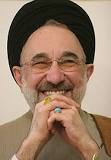
President Mohammad Khatami
By Farhang Jahanpour
These ideas also considerably changed the political climate in Iran and led to the election of the reformist President Mohammad Khatami, to the great amazement of the hard-liners. In four presidential elections, two parliamentary elections and local council elections, the Iranian electorate has voted overwhelmingly for reformist candidates and has rejected narrow interpretations of Islam.
President Khatami himself has enunciated similar views in his own books and has called for a new form of Islamic democracy. Addressing university students in Tehran on 23rd May 1998, on the first anniversary of his election as president, he said:
“Dear brothers and sisters, I would like to say candidly that social acceptance of religion today and its fate tomorrow depend on our ability to see religion in such a way that is compatible with freedom. If you look at human history, you see that whatever has opposed freedom, even if it has been the greatest of human virtues, has suffered a setback. Whenever religion has taken a stand against freedom, it has sustained a loss; and if movements aiming to establish justice in the society have denied freedom, they too have been undermined. If some movements have tried to achieve progress and development at the expense of freedom, they too have been damaged. Now, I can give you one or two historical examples already known to you, who are a well-informed audience. The first is the experience of medieval times when religion and freedom were set one against the other and consequently religion was defeated as the result of its opposition to freedom. And the other, and more contemporary instance, has been communism which pursued economic justice in opposition to freedom. The result was that communism was also defeated and freedom triumphed.”[1]
Khatami has written eloquently about the achievements of Western civilisation, especially its advocacy of democracy, freedom and human rights.[2] He has called for a “Dialogue of Civilisations” and the need for the Islamic and Western civilisations to learn from each other. However, despite these fine words, the backlash from the hard-liners meant that scores of reformist newspapers were closed down, a large number of reformist intellectuals were jailed on trumped up charges and the initial mood of optimism was replaced with pessimism and apprehension.
What religious leaders must realise is that change will come with or without them, and that no amount of repression is able to stop forever the desire of the young generations that form the majority in all Islamic countries for freedom and democracy. It would be preferable for change to take place peacefully, but if they block peaceful reforms, they will have to face much more violent and destructive reactions.
Although
the reform movement has experienced many reverses during the past few years,
nevertheless, the reform movement goes on. The new ideas and religious interpretations
that have been released into the public domain and have received wide coverage
in the Iranian media, and many scholarly books and papers that have been widely
disseminated have created an irreversible movement for reform and for greater
religious tolerance. These ideas may be suppressed by force for a short time,
but they cannot be undone, nor can the thirst for religious, political and
social change that has gripped society be suppressed.
[1] My translation of a section of the speech.
[2] See: Mohammad Khatami, Az Donya-ye Shahr ta Shahr-e Donya (Tehran, Ney Publication, 1994); A’in va Andisheh dar Dam-e Khodkamegi (Tehran, Tarh-e Now, 2000).

