

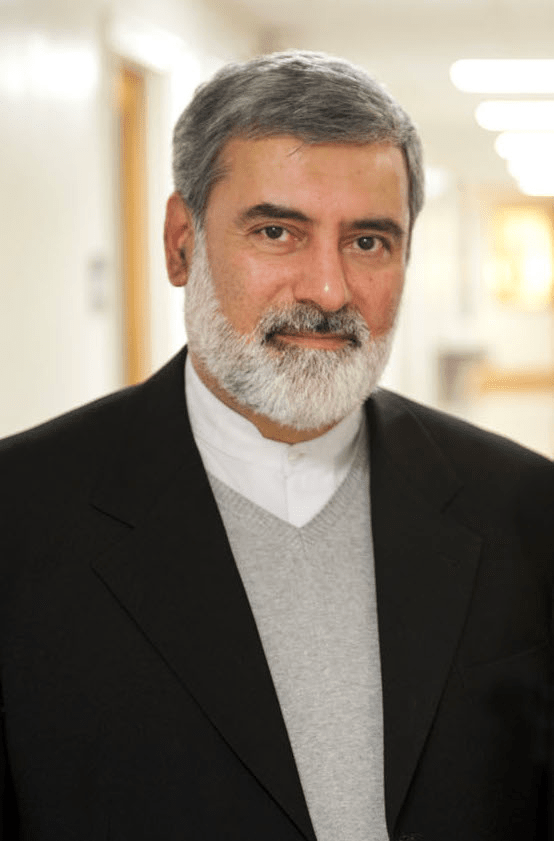
Mohsen Kadivar
By Farhang Jahanpour
Mohsen Kadivar (b. 1959) is a middle-ranking cleric who achieved prominence for questioning the legitimacy of Velayat-e Faqih and the role of the “Supreme Leader” mainly on religious grounds. In a number of learned books, Kadivar has attempted to demonstrate the lack of any Qur’anic authority or rational argument for Velayat-e Faqih. He has also demonstrated the lack of evidence to support Velayat-e Faqih in Shi’i traditions.[1]
In his book on Shi’i Theories of Government[2], Kadivar has divided the periods in which different theories about government and political philosophy have been formulated by Shi’i scholars into five periods. The first period starts from the death of the Prophet in 632 A.D. to the disappearance of the Hidden Imam in the year in 940 A.D. The second period begins from 940 and ends with the establishment of the Safavid Dynasty in 1501 that made Shi’ism the official religion in Iran. The third period lasts from the establishment of the Safavid Dynasty until the Constitutional Revolution in 1906. The fourth stage covers the period from the Constitutional Revolution to the start of the Islamic Revolution in 1979. The fifth period encompasses the years from the start of the Islamic Revolution to the present time.[3]
Kadivar has shown that during the first three periods there was no theory of Velayat-e Faqih that involved the interference of the faqih in the government. The functions of the Velayat-e Faqih were believed to be limited to the guardianship and supervision of the affairs of minors, the insane, the mentally disabled, and the supervision of the property of those who were away or who had disappeared without a trace. In other words, it was mainly regarded as a pastoral function. The concept of the interference of the faqih in political affairs was only referred to vaguely after the Constitutional Revolution, but later on it was fully developed by Ayatollah Khomeini.
There are two main theories about the legitimacy of religious government. According to one theory, there is direct divine legitimacy. In other words, God bestows legitimacy upon the Prophet, the Imams and the faqihs (jurists), and the people play no role in accepting or rejecting the legitimacy of the religious government. The second theory is based on divine-human legitimacy. In other words, the people are the source of direct legitimacy from God, provided that they abide by divine injunctions, and consequently the government derives its legitimacy from the people.
Kadivar maintains that there are four different interpretations stemming from the first theory of legitimacy. They are: 1- Divine monarchy. 2- The faqihs are appointed directly by God to rule. 3- A general council composed of the sources of emulation is authorized by God to rule. 4- The absolute guardianship of the faqihs, the faqihs being appointed directly by God.
There are also five different interpretations stemming from the second theory of legitimacy. They are: 1- A constitutional government acting on the basis of religious laws. 2- People’s sovereignty under the supervision of the faqihs. 3- The faqih is elected by the people and has a limited range of powers. 4- The Islamic government is directly elected by the people. 5- The ruler acts as the representative of the people and exercises the power of attorney on their behalf.
It is only in Ayatollah Khomeini’s theory that we have the absolute guardianship of the faqih. In other theories, throughout Shi’a history, the power of the faqih had been limited to the guardianship of minors and those in need of pastoral care, but Ayatollah Khomeini extended that concept to the entire nation and government.
In its fiqhi (jurisprudential) context, Kadivar argues that Velayat-e Faqih may be taken to mean:
“The management, control, and supervision of the affairs of the Other … The closest terms to Velayat are: domination, supremacy, lordship and ascendance. Velayat and Melkiyat are comparable. Melkiyat is domination over objects, and Velayat is domination over persons. As all the aspects of the objects are under the control of the owner [of the objects], all the affairs of the “client” are under the control of the custodian [vali].”[4]
Significantly, Kadivar points out that this reading of the power of Velayat (guardianship) has as its logical corollary the notion of mahjuriyat, namely being a minor or being incapable of taking care of oneself. But he argues that in Islamic jurisprudence there is no concept that the people as a whole are minors and incapable of looking after their own affairs. He goes on to say:
“In Fiqh, there is the absence of mahjuriyat. This means that the principle is that no one has sovereignty over another and everyone is the manager of his own affairs and others have no right to interfere in his affairs and destiny. Within the framework of religion and reason, every individual is in charge of his own affairs. The individual has authority to dispose of his property, determine whom to marry or whether to marry, what type of clothes to wear and in what colour, where to live, and how to behave. Of course, he is responsible to God for his deeds and has to answer [for his behaviour] on the Day of Judgement.”[5]
Based on the above premises, Kadivar has totally rejected the interpretation of Velayat-e Faqih that authorises the clerics to rule over society and to institute a theocracy: “The principle is the absence of mahjuriyat for humans, that is all humans are dominant over their destinies and it is mahjuriyat, not competence [rashid budan], that needs to be proved.”[6]
On the contrary, he argues that Islam favours jumhuriyat as opposed to Velayat. In a republican state, Kadivar argues, the people are equal in the public sphere and considered competent [rashid], whereas under Velayat-e Faqih people are not on a par with their leaders and are considered incapable or mahjur.[7]Kadivar also believes in the supremacy of reason over revelation and says that should the exoteric of religion seem to contradict the dictums of reason, the exoteric need to be reinterpreted [ta’wil].[8] He equates reason with revelation. He describes reason as an “internal messenger” [rasul bateni] of God, while revelation is an “external messenger” [rasul khareji].
Kadivar was jailed for his views, and after his release he was often prevented from expressing his views freely. Speaking about his life in Iran following his jail term, he said: “Now that I have served my sentence and have been released from prison, the regime wants to turn the whole country off-limits to my thoughts and opinions. In such a case, the whole of Iran will become my prison…Do they really think that they can lead the Iranian nation towards heaven and morality in chains and shackles?”
However, despite all restrictions, Kadivar demonstrated that man’s spirit cannot be imprisoned. As soon as he was released from jail, he wrote a brilliant article about the concept of prison in Islam in which he showed that in the Koran the only time that there is any mention of imprisonment it refers to the action of tyrants and oppressors against wronged and righteous people.[9]
In a major book exhibition organised in Shiraz after his release from prison, Kadivar attacked the record of the clergy after the victory of the Islamic revolution, and said that they were under major scrutiny by the nation. Criticising the restrictions imposed on political and religious opposition groups, he concluded: “In a society where the opponents do not enjoy freedom, one cannot expect cultural development. If we cannot establish security and freedom as a precursor for religious freedom we cannot claim that we have implemented religious principles. The biggest test of a religious society is whether it respects ‘freedom for the opposition’ and whether it tolerates differences.”[10]
In a 2004 interview, Kadivar told a journalist: “Every member of society and every member of government is subject to the law. No one can be above it. Everyone has the same rights, yet the root of the faqih is inequality. He assumes he is above it. … It is time for the supreme leader to be subject to the constitution too. After all, the Supreme Leader doesn’t come from God.”[11] On the issue of clerics in government, he has said: “Our job as religious people is not politics. … They are taking Iran backward, not toward the future.”[12]
Sadly, as the result of continuous persecution and being unable to speak his mind openly, Kadivar has been forced to live abroad. For the past few years he has been teaching as a visiting professor at a number of American universities.
Footnotes:
[1] Kadivar’s main works on Islamic government are: Daftar-e ‘Aql: Majmu’eh-ye Maqalat-e Falsafi-Kalami (The Book of Reason: Collection of Philosophical-Theological Articles) (Tehran: Entesharat-e Ettela’at, 1998); Andishe-ye Siyasi dar Islam, jeld-e 1, Nazariyyeha-ye dowlat dar feqh-e Shi’a (Political Thought in Islam, volume 1, Theories on Government in Shi’i Jurisprudence) (Tehran, Nashr-e Ney, 1377/1998); jeld-e 2, Hokumat-e Vela’i (Government based on Guardianship) (Tehran, Nashr-e Ney , 1378/1999); and Daghdagheh-ye Hokumat-e Dini [Anxieties Regarding Religious Governments] (Tehran, Nashr-e Ney, 1379/2000). For his biographic details and his trial see the following book written by his wife: Zahra Rudi-Kadivar, Baha-ye Azadi: Defa’iyat-e Mohsen Kadivar dar Dadgah-e Vizhe-ye Ruhaniyat [Price of Freedom: Mohsen Kadivar’s Defence in the Special Court for the Clergy] (Tehran, Nashr-e Ney, 1378/1999).
[2] Mohsen Kadivar, Nazariyyeha-ye Dowlat dar Fiqh-e Shi’a (Ney Publication, Tehran, 1998).
[3] Andishe-ye Siyasi dar Islam, jeld-e 1, Nazariyyeha-ye dowlat dar feqh-e Shi’a (Political Thought in Islam, volume 1, Theories on Government in Shi’i Jurisprudence) (Ney Publications, Tehran, second edition, 1377/1998).
[4] Mohsen Kadivar, Hukumat-e Vela’i, p. 42.
[5] Ibid, p. 56.
[6] Ibid, pp. 56-57.
[7] Ibid, p. 207.
[8] Mohsen Kadivar, Daftar-e ‘Aql: Majmu’e-ye maqalat-e falsafi-kalami [The Book of Reason: Collection of Philosophical and Theological Essays], p. 117.
[9] Mohsen Kadivar, “Zendan dar Qur’an” [Prison according to the Koran], Kiyan, No 53, Aug-Sept 2000, pp 2-10.
[10] Keyhan newspaper, 16 Dey 1380/ 6 January 2002, 0 2.
[11] Sadri, Ahmad; “KADIVAR, MOHSEN”, in Esposito, John L. (editor in chief); Oxford Encyclopedia of the Islamic World, (Oxford University Press, New York, 2009); Vol. 3, pp. 288–290.
[12] ibid

