

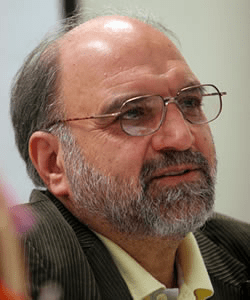
ABDOLKARIM SOROUSH
By Farhang Jahanpour
Abdolkarim Soroush (b. 1945) came to prominence after the revolution as a member of the Supreme Council for Cultural Revolution. It was under the direction of that Council that universities were closed down for over two years and hundreds of university lecturers and students were purged. However, in recent years, Soroush has changed his stance towards the Islamic revolution and about religion as a whole.
Soroush is a prolific writer who has published many interesting books, has delivered a large number of public lectures, and has written dozens of articles enunciating his latest views on religion and politics. One can see a clear evolution in Soroush’s religious thinking, to such an extent that, contrary to the time when he was one of the main ideologues of the Islamic Republic, he has now become a leading reformer and dissident.
In the West, he is sometimes referred to as Iran’s Luther, while at home he was dismissed from his university job, and even his lectures were often the scenes of bloody clashes between his supporters and Hezbollahi thugs who came to prevent him speaking. The large-scale disturbances in Khorramabad in August 2000, which resulted in the death of a policeman and the injuring of dozens of students and demonstrators, were due to the fact that Soroush and Kadivar had been invited to speak at the annual student conference in that city. Right-wing vigilantes and members of the Revolutionary Guards prevented the two speakers from leaving the airport, and they were forced to flee to Tehran by car. Like most reformers, Soroush was forced to leave his country and for the past few years he has been teaching at a number of prestigious American universities, including Harvard, Yale, Princeton and Columbia.
In his latest works, Soroush has further developed his ideas on religion. In one of his 1995 lectures he defined ethics as existing independently of religion: “This means a religion that contradicts eternal ethical values advocates its own destruction. No religion can be against justice, freedom, or human rights.”[1] Soroush goes on to say that scientific knowledge has been successful in changing the world and in defining the laws of nature. This proves a certain internal coherence between science and the nature of physical reality. Hence: “If there is a way forward, it must begin with science.”[2]
The focus on rational and critical philosophy, as opposed to metaphysics, mysticism, and nihilistic relativism, is central to Soroush’s contribution to the secularisation of Islamic thought and a significant step towards bridging the gap between religious and secular intellectuals.
Soroush is against an absolutist and monopolistic interpretation of religion by the mullahs or by anyone else. He maintains that even if one believes in the absolute truth of what is in the mind of God, when that message is revealed to a prophet it has already gone through one layer of exposition or interpretation, because no prophet has claimed that he knows the mind of God. It is like pouring an ocean into a cup.
When that message is set out in words, it goes through a major transformation, for words are not capable of expressing the whole essence of divine truth and give only an approximation of truth. Mystics maintain that in communicating spiritual truths, silence is often more eloquent than words. When the message has been set down in the form of a book such as the Bible or the Koran, even if one accepts the authenticity of every verse of the text to be divine revelation, the Koran itself teaches that many of the verses are not clear muhkamat, while others are mutishabahat, or symbolic and allegorical and would need interpretation.
When the Koran is interpreted by the Imams, who according to the Shi’is are infallible, we have another layer of meaning superimposed on truth. All these interpretations are not identical, and sometimes we have different interpretations of some verses by different Imams. After the Imams, the interpretations of their words by the mullahs who have never claimed to be infallible – and different mullahs have provided quite different and sometimes contradictory interpretations of the words of the imams and the verses of the Koran – are yet another stage removed from the ultimate meaning of the word of God. Indeed, major doctrinal differences existing between various sects are the best proof that our understanding of the word of God is very defective and partial. Therefore, Soroush maintains that no faqih has the right to lay claim to a true and an exclusive understanding of the word of God.
Furthermore, it is the beauty of revelation that it allows for ambiguity of meaning, thus making the same religion adaptable to different societies and historical circumstances.[3] Consequently, the claims of religions, like those of ideologies, must be evaluated only in their concrete historical manifestations and not according to abstract definitions. Thus, the meaning and truth of a religion is nothing other than what we see in its “natural history”; and this leads to an important conclusion, in line with historical and secular thought: “Religion is that which the history of religion shows.”[4] Soroush claims that while unchanging truths exist, our understanding of them remains contingent and evolutionary.
Based on his understanding of religion and its limitations, Soroush is against a non-democratic religious government. Soroush rejects the foundation of Iran’s present system of government based on the concept of Velayat-e Faqih. Soroush makes another criticism of the Islamic regime in Iran and the power of the clergy in all religions. Arguing that since the members of clergy make a living by leading people in matters of religion, they have a vested interest in the maintenance of a religious government, and it inevitably turns into a corporate group placing its own power and material interest above religious ideals or public good.
Soroush’s words are applicable not only to Islam but to other faiths as well, when he says: “The cause of religion is too great to be entrusted only to the clergy who, by making a living from religion, turn it into an institution whose function will eventually become its own perpetuation.”[5]
Soroush criticizes the anti-Western phobia of the mullahs and of the popular press in many Islamic countries. Most Islamists accuse the West of both political, as well as cultural colonialism. They believe that the West is ungodly and any contact with it would contaminate Muslims and would lead them astray. They believe that Western materialism negates all religious values, and the West is trying to undermine Islam by its materialistic nihilism. This limited understanding of the West allows vague but loaded phrases, such as “Westoxication” (gharbzadegi) and the Western “cultural onslaught” (tahajom-e farhangi) to be used as ideological weapons against political opponents.
Soroush questions this ill-informed rejection of the West:
“At any rate, no one knows whether ‘the West’ is the Western world, its culture, or certain condemned parts of it. Is the West a particular set of ideas, a way of being human, a method of administration and organisation, the embodiment of egotism, a form of history being realised, the onslaught of technology and decline of tradition, U.S foreign policy, or various other things.”[6]
In his recent writings and lectures and especially in a number of frank interviews with the BBC’s Persian Television, Soroush has gone further than any of the modern reformers and has questioned the very notion of revelation and the infallibility of the Koran. In a series of programmes on “What is Revelation”[7] and also “Muhammad’s Dreams”[8] with the BBC and other Persian-language foreign-based television stations, Soroush has pushed the debate about the nature of revelation and whether the Koran can be regarded as the direct and literal word of God to new directions.
In these programmes and a number of articles that he has written on these issues he describes the Koranic verses not as direct divine revelation, but as Muhammad’s dreams. When we wake up from a dream often we have a vague recollection of what we dreamed. The words of the prophets similarly may contain a germ of truth, but that truth goes through the filter of the prophets’ minds and are only partial recollections of what was dreamed.
Of course, there are many criticisms that one can make
regarding what these reformers have said, and there is still a long way to go
before we can bring about a true Islamic Reformation, but these thinkers have
shattered many taboos and have moved a long way towards a rational critique of
Islam and the Shari’a. If Muslim reformers among the Sunnis and in other
Islamic countries as well take up these ideas and open new vistas on Islamic
scholarship and hermeneutics, one can hope for a fully-fledged Islamic
Reformation and a new era in Islamic scholarship and in a new form of dialog
between Islam and other religious faiths.
[1] Soroush, “Khadamat va hasanat-e din” [Services and Benefits of Religion], Kiyan 5, no. 25 (1995): 2-11, quoted by Afshin Matin-Asgari, “‘Abdolkarim Soroush and the Secularization of Islamic Thought in Iran,” Iranian Studies, volume 30, numbers 1-2, Winter/Spring 1997, p 103.
[2] Ibid, 8-10
[3] Abdolkarim Soroush, Farbeh tar as ide’olozhi [More substantial than ideology] 95-155.
[4] Ibid, 155-69
[5] Soroush, “Horriyat va ruhaniyat” [Freedom and Clericalism], Kiyan 5, no 24 (1995): 8.
[6] Zehniyat-e moshavvash” [Confused thinking], pp 7-8, quoted in ‘Iranian Studies’, ibid, p 108.
 F Jahanpour