

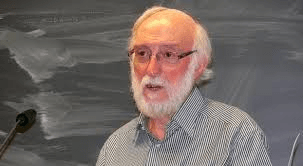
Mohammad Mojtahed Shabestari
By Farhang Jahanpour
Ayatollah Mojtahed Shabestari (b. 1936) is a professor of theology at Tehran University, and he also lectures at Qom religious seminary. He received a traditional seminary education in Qom and studied with Ayatollah Khomeini. He stayed at the religious seminary for 17 years, achieving both the religious degree of ijtihad (the highest religious qualification entitling him to be addressed as an ayatollah), as well as a Doctorate in Philosophy.
From 1970 until the victory of the Islamic Revolution in 1979, he was the director of the Islamic Centre at Hamburg, where he came into contact with Western theological and philosophical scholarship. He learned German and studied the works of some Christian theologians, such as Paul Tillich, Karl Barth, and Karl Rahner, as well as the philosophical works of Immanuel Kant, Wilhelm Dilthey and Hans Georg Gadamer. During the past few years, Shabestari has emerged as a leading advocate of reforms and has provided new interpretations of Islam.[1]
Shabestari maintains that Islam has three main categories of teachings. They are: Spiritual and devotional (Ibadat); issues dealing with social matters, including politics, economics, various forms of social transactions between people (Mu’amilat); and finally religious injunctions (Ahkam), including hudud (religious punishments) and qisas (retribution), based on the Shari’a or Islamic law.
He maintains that the spiritual elements of Islam–like those of other faiths–are eternal and unchangeable and can provide Muslims with guidance and spirituality today. Some of the teachings belonging to the second category, namely social teachings, can be adapted to present circumstances through ijtihad (independent interpretation of the law). As far as the third category, namely ahkam, hudud, qisas, etc., are concerned, their time has passed, and they are no longer applicable.
Shabestari says that when he asks his colleagues why they no longer refer to Islamic laws regarding slavery, their response is that the time for slavery has come to an end. He maintains that in the same way that the laws dealing with slavery are no longer operative because the time for slavery has come to an end, harsh medieval punishments and the concept of retribution should also be confined to history, as they are no longer in keeping with modern human rights to which all countries have agreed to adhere. In the modern world, Muslims must formulate new laws on the basis of modern requirements.
In a debate with Mohsen Kadivar, Shabestari argued that contemporary Muslims are facing many new challenges in the modern world for which the Shari’a has no answer. Muslims must try to find new rational solutions to these problems, as the situation now is so different from that which existed at the time of the Prophet. Kadivar insisted that although the Shari’a does not have the answers to all modern problems, nevertheless, by making use of traditional tools of ijtihad, Muslims will be able to find solutions to those modern problems. Shabestari disagreed:
“Mojtahed Shabestari: Do you mean that by making use of theological methods of ijtihad, you can deduce modern concepts concerning human rights?
Kadivar: What I mean by deducing these concepts is that we can show that these concepts are not contrary to the Shari’a.
Mojtahed Shabestari: What you are saying is not very different from saying that we wish to manufacture an aircraft. We will refer to the Book [the Koran] and the traditions, and we will see that there is no prohibition of manufacturing aircraft in those texts. Is this what you are saying?”[2]
By simply finding that the Shari’a is not opposed to an idea, we will not be able to find a solution; in the same way that just because the Shari’a does not prohibit the manufacturing of an aircraft, this does not mean that we will be able to make an aircraft. In order to manufacture an aircraft, we need to familiarise ourselves with all the new sciences that are required for it. In the same way, in order to develop rational concepts about economics, civil society, democracy and human rights, etc., we need to turn to new academic disciplines that deal with these topics.
Shabestari believes: “Religion does not wish to replace science and technology, and lay claim to the place of reason … God has only offered answers for some of the needs of human beings. As for other needs, He has left it to reason and human effort to supply the answer.”[3]
Shabestari lays a great deal of emphasis on the importance of individual freedom, as freedom constitutes the “authentic identity of humans”, and without it, no religious faith would be valuable or complete. Without the ability to choose freely, faith has no meaning because “Faith is an act of choosing, a fateful act.” He maintains that a collective notion of faith is meaningless, as it is only individuals who can undergo an experience. He argues that the Koran preaches only the general values underpinning government and society, while in each age, people must develop their own forms of government based on spiritual principles.
Consequently, not only does he oppose a religious government or a theocracy, he is even against institutionalised religion because: “When religion is institutionalised, the danger appears that man is negated by the institution. Why? Because when religion is institutionalised, God’s ‘absoluteness’ is denied”[4]. Rejecting various restrictions imposed on freedom of thought and expression in religious societies, Shabestari maintains: “In the society of the faithful, there are no ‘red lines’ to demarcate the limits of critique. The critics must have all the space to engage in a critique without any red lines.”[5] In fact, he goes on to say that there must be institutional guarantees for freedom, since “in totalitarian and despotic societies the seeds of faith would rot.”[6]
Notes:
[1] His major works on his reformist ideas are: Hermeneutik, Ketab va Sunnat: Farayand-e Tafsir-e Vahy [Hermeneutics, the Book and the Sunna: The Process of Interpreting Revelation] (Tehran, Tarh-e Now, 1996) and Iman va Azadi [Faith and Freedom] (Tehran: Tarh-e Now, 1996). Naghdi bar Ghera‘at e Rasmi az Din (A Critique of the Official Reading of Religion), 2000, Tarh e No Publications, Tehran. Iman va Azadi, (Faith and Freedom) 1998, Tarh e No publications, Tehran. There is also a book containing his long debate with Mohsen Kadivar, and he has also written a large number of articles on reformist issues.
[2] Kiyan, No 45, February-March 1999, PP 6-19.
[3] Quoted in The Constitution of Iran: politics and state in the Islamic Republic by Asghar Schirazi (I.B. Tauris, 1997, London), p. 279.
[4] Shabestari, Iman va Azadi, p 29, quoted by Farzin Vahdat in Critique (Spring 2000), pp 51-52.
[5] Shabestari, Hermeneutik, p 187, quoted by Farzin Vahdat in Critique (Spring 2000), p 53.
[6] Shabestari, Imam va Azadi, p. 8.
 F Jahanpour