

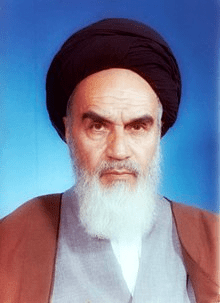
Ayatollah Ruhollah Khomeini
As pointed out earlier, Ayatollah Khomeini was the main architect of the new concept known as “Velayat-e Faqih” (the Guardianship of Jurisprudent). However, although in this and his other writings he gave a special status to Muslim clerics and regarded any government not led by the clerics as illegitimate, nevertheless, he was also very critical of the Muslim clerics of his time, both in Iran and in the rest of the Islamic world. His was a revolutionary form of Islam that was in opposition to Islamic institutions as they had existed for centuries.
Therefore, contrary to the usual description of Ayatollah Khomeini as a fundamentalist, we have to realize that within the context of the Shi’i clerical establishment, he was a radical cleric and a reformer. It is not often realized in the West that Ayatollah Khomeini remained almost alone among the leading ayatollahs – the Grand Ayatollahs – in advocating a radical and politicized Islam. Out of the four grand ayatollahs universally recognized as such in Iran and Iraq, the two grand ayatollahs based in Iran, Ayatollah Mohammad Kazem Shari’atmadari and Ayatollah Hassan Tabataba’i Qomi, voiced open opposition to Khomeini’s views, and the other two who were based in Najaf, Ayatollah Abul-Qasim al-Kho’i, and Ayatollah Shahab al-Din Mar’ashi-Najafi remained silent and non-committal.
The tone of the language that Ayatollah Khomeini used against what he called obscurantist and ossified clerics showed the depth of pain and anguish that they had caused him. In a message to the members of the clergy throughout the country he wrote:
The amount of pain that has been inflicted upon your old father [Khomeini] by these ossified individuals has been much greater than the pain that has been inflicted by any other group… When my young son, the late Mostafa, drank from a jug in Feyziyyeh School [the leading theological college in Qom where Khomeini taught] they would cleanse the jug because I taught philosophy.[1] I have no doubt that if that situation had continued, the condition of the clergy and of the seminaries would resemble that of the churches in the Middle Ages.”[2]
Referring to another period in the history of the Islamic uprising, he said:
“In addition to all the attacks by the Shah’s forces, we were attacked with the bullets of deceit and sanctimonious religion from among our own insider front [the mullahs]. We were targeted with the bullets of accusation, hypocrisy and dishonesty that pierced our heart, and were a thousand times more painful than the bullets made with lead and gunpowder… They spread many false rumours and accusations against us. They even accused those who were in charge of guiding the uprising of neglecting their prayers, of being communists or British agents… Islam has not been harmed by any other group as much as it has been harmed by these sanctimonious clerics.”[3]
In another speech, Khomeini again repeated his attack on the reactionary clergy and warned against the harmful effect of their ideas on the country and on Islam:
“From inside the religious seminaries and universities, a number of sanctimonious clerics – I have repeatedly warned the people about the danger that such clerics pose to Islam – with their deceit and hypocrisy wish to destroy Islam and the revolution from within. By pretending to be the true believers and supporters of religion and of Velayat, they accuse all others of being irreligious. We must take refuge in God from the evil of such individuals!”[4]
Yet, although Khomeini was against what he called ossified and reactionary clerics, his own idea of Velayat-e Faqih was regressive and anti-democratic. Throughout his discourse, Khomeini rejected the vision of legislation by humans on the grounds that since, in the final analysis, true consciousness and justice are not within the human realm, man has no right to “forge” legislation. He even specified that “in Islamic government, instead of a legislative assembly which constitutes one of the branches of the government, there is a programming assembly that draws up programs for different ministers … in the light of laws of Islam.”[5]
Khomeini’s doctrine of the guardianship of the jurist (Velayat-e Faqih) in effect rejects the notion of popular sovereignty and participatory democracy. Indeed, Khomeini had stated that: “The custodian [Vali] of the nation, with regard to duty and position, is no different from the custodian of the minors.”
Nevertheless, armed with his new revolutionary concepts, Ayatollah Khomeini succeeded in toppling the shah’s government in a popular revolution that he led from exile in Iraq. The revolution was mainly about the rejection of the Shah’s despotic rule and the establishment of freedom and democracy, but Ayatollah Khomeini’s involvement in the revolution gave it a religious character that later dominated the system that replaced the monarchical regime.
After the establishment of the Islamic Republic, the concept of “Velayat-e Faqih” was incorporated in the new constitution and has formed the basis of the government in Iran ever since. In fact, if anything, in the revised constitution that was amended after Ayatollah Khomeini’s death on 3 June 1989, the powers of the spiritual leader have been increased. The present supreme leader, Ayatollah Ali Khamene’i is in overall charge of all the three powers. He confirms the mandate of the president, appoints the head of the judiciary, six clerical members of the Guardian Council, the Friday Imams, the head of the Broadcasting Organisation, and as Commander-in-Chief of the armed forces, he is in overall charge of the armed forces, the security forces, and the police. He wields a power that is much greater than that of the elected president.
With the failure of Islamist regimes in Iran and in other Islamic countries, many Muslims are reassessing their views about Islamic fundamentalism and militancy. Many Islamic reformers, while remaining faithful to the spirit of Islam, are questioning the radical and fundamentalist interpretations of Islam, and are asking “whose Islam” and “which Islam”.
They are disputing the political, economic and social systems that have hijacked the name of Islam but are not necessarily based on the Koran, on the consensus of the views of the believers, or on the requirements of the present age. Nearly two decades after the establishment of the Islamic Republic in Iran, the failed promises of freedom and democracy, the suppression of women and of religious minorities, economic failure and international isolation have forced many sincere Muslims to question the premises of an Islamic government. Recent polls have shown that a very small minority of Iranians bother to go to congregational prayers, and most are turning away from religion.
Contradictions Inherent in Islamic Republic
The contradictions inherent in an “Islamic Republic” or “religious democracy”, and the failure of Islamic ideology to deliver on its earlier promises, have created a vibrant environment for intellectual discourse on the themes such as the powers of the supreme leader, civil society, human rights, citizenship rights and democracy.
The movement that started during the past decade has revolutionised the Islamic discourse in Iran and has paved the way for the election of a moderate president on the slogans of democracy, human rights, pluralism and the rule of law. While in the early days of the revolution, many observers were speaking of the export of Islamic fundamentalism to the rest of the region, during the past few years many people, both inside and outside Iran, have talked about the possibility of the export of Islamic democracy from Iran.
Although the cause of reforms and the movement towards the establishment of civil society have experienced some severe reversals during the past few years, the desire for reform, especially among educated young people and particularly women, has not gone away, and the process seems to be irreversible.
Many
people, even from among the highest-ranking clergy, have questioned the powers
of the supreme leader on religious grounds. The list of these reformers is long
and their campaign has been courageous and sustained. Many of them have paid
dearly for their outspoken criticism of the clerical rule and of fundamentalist
Islam, but imprisonment, loss of jobs, persecution and house arrest and even
occasional murders have not prevented them from speaking their minds. Here are
a few leading reformers whose ideas have revolutionised the Islamic discourse
in Iran.[6]
[1] According to fanatical Muslims if a non-believer touches a jug or a dish it becomes ritually unclean and it has to be ritually cleansed before it can be used again.
[2] Sahife-ye Nur [The Book of Light, compilation of all Khomeini’s writings and speeches], volume 21, p 91, message to the sources of emulation and the members of the clergy throughout the country, 3/12/67 [22nd February 1988].
[3] Sahife-ye Nur, vol. 21, p 92
[4] Sahife-ye Nur, vol. 20, p 235.
[5] Ayatollah Ruhollah Khomeini, Islamic Revolution.
[6] Most works of these authors are not available in English, although some scholars are beginning to introduce them to the West. For a study of the works of Kadivar and Mojtahed Shabestari in English see: Farzin Vahdat, “Post-revolutionary discourse of Mohammad Mojtahed Shabestari and Mohsen Kadivar: Reconciling the Terms of Mediated Subjectivity”, Part I Mojtahed Shabestari, Critique, Spring 2000, Number 16, PP 31-54; Part II Mohsen Kadivar, Critique, Fall 2000, number 17, PP 135-157. On Abdol-Karim Soroush see: Reason, Freedom and Democracy in Islam: Essential Writings of Abdolkarim Soroush, translated, edited with a critical introduction by Mahmud Sadri, and Ahmad Sadri (Oxford University Press, 2000). Some of Ayatollah Montazeri’s works are available in his web site.

