

By Farhang Jahanpour
Lecture delivered at Oxford University on 18 February 1999
We are living in a world that is dominated by the media, in which instant, twenty-four-hour news plays a very important role. Our perception of the world around us is very much coloured by the images that are transmitted to us from near and far. We are bombarded by direct and indirect propaganda, and knowingly or unknowingly, our attitudes to events and especially to foreign countries and cultures are influenced by this all-pervasive intrusion into our lives. In Europe and the United States, people on average watch over six hours of television every day. The hours that are spent watching game shows or films, or other forms of entertainment are hours that could have been spent on thinking or reading books.
Consequently, our knowledge of history and of the long record of inter-relationships between various peoples, civilisations and cultures is somewhat diminished. Most school and even university textbooks concentrate on national or, at most, on European and Western history and civilisation. As a result, at a time when the barriers of time and space are greatly diminished, and the world is turned into a global village, the gulf of misunderstanding and incomprehension among various cultures has remained intact.
I spent many years working as a monitor and editor at the BBC Monitoring, the main BBC newsgathering centre in Britain. We have dozens of television sets that bring the news from all corners of the world, as seen by people in different countries and in different languages. Watching these different television stations reporting the same major events that have happened in some part of the world brought to me as clearly as anything could the sense that we are truly living in a global village.
However, despite the similarity of images and the events, the spins that are put on those images show that the same event could be interpreted in quite different and even contradictory ways by different people. Although all those people from China, Japan, India, Russia, Europe, the United States, Africa or the Middle East watch the same events and know the bare facts, their perception of the events is quite different. Their interpretation of what lies behind those events is coloured by their own particular political, mental, emotional, and cultural backgrounds, not to mention anything about the propaganda spin imposed on the news by commentators and pundits who have their own agenda.
What is needed urgently is not to provide more information, but to try to narrow the gulf of misunderstanding and hostility among various nations and cultures. In order to do that, we need to listen to other people from other religions, cultures and civilisations and hope that they will also listen to us. The problem with “dialogue” is that it cannot be one-sided. It requires both talking as well as listening. Even listening is not enough by itself, but it should be accompanied by a genuine respect for other points of view and a desire to learn from them. If we start our discussion with the conviction that our culture and civilisation are superior and there is nothing that we can learn from others, no amount of talking and dialogue will produce any results. We can only fill an empty cup, but if a cup is already full, anything added to it will simply spill over. If someone’s mind is already made up, there is very little one can do to change it.
Our modern world is also dominated by politics, and politics of a very parochial type. Although political issues are very important, one should remember that political developments do not take place in a vacuum, but follow more civilizational, religious, ideological, scientific, economic and cultural developments. When one looks at history, one is amazed by the power of ideas, which far exceeds the power of guns and missiles. The rise and fall of civilisations seems to be less due to sheer military might or economic power, and more to do with the rise of greater ideas and concepts that prove the inadequacy of former worldviews and ideas.
The fall of the Soviet Union in our own time was not due to a military defeat, or even to economic collapse – although with hindsight we have learnt that neither the Soviet military nor the Soviet economy was as powerful and as dangerous as we assumed. The Soviet system collapsed because Western democracy proved to be much more powerful and more appealing to human beings than the communist ideology and its authoritarian tendencies.
Many historians have examined the full course of human history and tried to discover the reasons for the rise and fall of different civilisations. Arnold Toynbee, in his monumental 12-volume ‘A Study of History’, dealt with various civilisations, and concluded that when we look at ancient history from the dawn of recorded time to the Renaissance and the Age of Enlightenment, we are dealing with religious civilisations.[1] Instead of talking about Indian, Chinese, Persian, Hebrew, Arab or European civilisations, we should be talking about the Hindu, Buddhist, Zoroastrian, Jewish, Islamic or Christian civilisations. There is no doubt that each of these religions made a huge impact on the countries and civilisations that came under their influence. They gave rise to distinctive literatures, philosophies, art forms, customs and ways of life.
Edward Gibbon dealt with the rise and fall of the Roman Empire and the miraculous replacement of the mighty Roman Empire with originally a very insignificant and obscure “Sect of the Nazarene”.[2] The Gospels tell us that many people at the time of Christ questioned: “Does any good come out of Nazareth?” Yet, the ideas of an almost illiterate Jewish carpenter from the remotest corner of the Roman Empire, who lived barely 30 years, whose mission lasted just over one year, who was crucified and nearly all his early disciples were also killed most cruelly, not only survived but triumphed over the might of the Roman Empire.
Stalin once asked how many divisions the Pope possessed. I am sure that if the Roman emperor at the time of Christ had ever heard of him, which is very unlikely, he could have asked with much greater justification how many divisions this carpenter from Nazareth possessed. Yet a few centuries later, as the result of an incredible historical irony (religious people call it a miracle), the capital of the Roman Empire, the Eternal City, became the centre of Christianity. As we are about to celebrate the second millennium of his birth, over a quarter of the entire human race is, at least in name, an adherent of that carpenter from Nazareth.
Earlier on, an exiled Jew who had been torn away from his home and people and had been living among a group of Jewish slaves under the most powerful government of its time rose up against the might of Pharaoh and led a movement to free his people from slavery. He claimed to have received a direct revelation from God. Long after the dynasty of Pharaohs had disappeared, the message revealed by that seemingly weak and marginalised character continues to live, and 3,000 years later, a state has been founded based on the teachings left by him and on a land conquered by his successor.
The Hebrew Bible or the Old Testament has acted as a basis both for the Gospels and for the Koran, and many early Semitic stories have formed the basis of literature and philosophy in the Middle East and the Western world. Nearly one-half of mankind has been converted to one of the three Abrahamic faiths, and what we call Islamic and Western civilisations have at their basis the teachings of the Bible, the Gospels and the Koran. Although many people speak of Christianity as a Western religion, and although hundreds of millions of Muslims live in the Far East and the Indian Sub-Continent, the adherents of these two universal faiths are converts to two Middle Eastern religions.
Ibn Khaldun (1332-1406), one of the greatest philosophers of history that the world has ever known, mainly concentrated on the rise of Islam and the subsequent decline of the Persian and Byzantine empires. Arnold Toynbee calls ‘al-Muqaddima’, the introduction to Ibn Khaldun’s history of the world (Kitab al-Ibar), the greatest work of its kind, written in any country in any age.[3] Ibn Khaldun tried to grapple with the mystery of the rise of Islam. Almost an identical miracle to that of Christ took place in the case of Muhammad. In Muhammad’s time in the early 6th century, Arabia had nothing but endless sand dunes. It was so barren and poor that it was not even colonised by one of the two great powers of the time, the Persian and the Byzantine empires. When an illiterate camel driver known as Muhammad broke ranks from his family and tribe, who were idol-worshippers and preached belief in one God, he was persecuted, ridiculed, beaten and eventually was forced to flee his native Mecca because his enemies had formed a conspiracy to kill him.
Later, from Medina, Muhammad sent letters to the Persian and Byzantine emperors calling on them either to follow his religion or to be prepared to fight against him. Muhammad’s emissaries were unceremoniously thrown out of the Persian court, and we have a record of the reaction of a court poet in the court of Khosrow Parviz, the great Sassanian emperor, to Muhammad’s demand. According to Ferdowsi, the great epic poet who chronicled the ancient history of Iran in his Shah-Nameh (or the Book of Kings) over a thousand years ago, the courtier dismissed the invitation, declaring:
ز شیر شتر خوردن و سوسمار
عرب را بجایی رسیدست کار
که تاج کیان را کند آرزو
تفو بر توای چرخ گردون تفو
“By drinking camel’s milk and eating lizards, the Bedouin Arab has now grown so insolent as to dream of the crown of the Khosrows! Woe and alas to you, o fickle world, woe and alas!”[4]
Yet a mere two or three years after Muhammad’s death, the Muslims poured out of Arabia. In 638 AD the Persian and Byzantine empires collapsed in the face of the advancing Muslim armies and were ruled by these illiterate Arabs, carrying with them their new Holy Book, the Koran.
The whole of the Persian Empire and huge chunks of the Byzantine Empire, including Syria, Palestine, Egypt and parts of Eastern Europe, became provinces of the Islamic empires of the Umayyads and the Abbasids that extended from Spain to China. 1400 years later, there are over one billion Muslims scattered in all corners of the globe. 55 countries have a majority Muslim population and are members of the Islamic Conference Organisation.
In addition to these countries, there are some 30 million Muslims in China, about 20 million within the Russian Federation, and 150 million in India. For the first time since the 1492 Reconquest of Spain and the expulsion of Muslims from Europe, there is again a sizable and growing Muslim presence in Europe. There are at least ten million Muslims in the EU and about six million Muslims in the United States. Recently, the US Secretary of State Madelaine Albright remarked that Islam was the fastest-growing religion in the United States.
Although at the moment, the supremacy of Western civilisation seems to be assured, one has to realise that history does not stand still, and events move and change in quite mysterious ways. In the past decade, we have already witnessed the incredible changes that have come about in the fortunes of the former Soviet bloc. Shortly after the collapse of the Soviet Union, Francis Fukuyama advanced the thesis of the “End of History.” He argued that the end of the Cold War meant the triumph of Western liberal democracy over other ideologies. He predicted the end of significant conflict in global politics and the emergence of a relatively harmonious world dominated by Western civilisation.
In a very famous article under the same title, he wrote: “We may be witnessing … the end of history as such: that is, the end point of mankind’s ideological evolution and the universalisation of Western liberal democracy as the final form of human government.” To be sure, he said, some conflicts may break out in some places in the Third World, but the global conflict was over, and not just in Europe. “It is precisely in the non-European world” that the big changes have occurred, particularly in China and the Soviet Union. The war of ideas was at an end. Believers in Marxist-Leninism may still exist “in places like Managua, Pyongyang, and Cambridge, Massachusetts,” but overall liberal democracy has triumphed.[5]
Nearly ten years ago, when I first read those words, I was struck by how premature that prophecy seemed, as though human evolution could ever come to an end and as though an imaginary utopia would remain forever. His remarks sounded very similar to some remarks made by the great 10th-century Iranian historian and scholar Abu-Reyhan al-Biruni (973-1051 AD). In his introduction to the “History of the World”, Biruni made similar remarks about the all-inclusive Islamic culture that had united warring factions from Europe to China. Muhammad was the seal of the Prophets, and according to many Muslims, sooner or later, all conflicts would end as more and more nations would come under the unifying banner of Islam, God’s final revelation to mankind, and live as members of a united umma. At the time of Biruni, when the Islamic civilisation was triumphant, and Europe was passing through its Dark Ages, the dream about the ultimate triumph of Islam did not seem very far-fetched.
As Professor Samuel Huntington points out:
History ends at least once and occasionally more often in the history of every civilisation. As the civilisation’s universal state emerges, its people become blinded by what Toynbee called “the mirage of immortality”, as they are convinced that theirs is the final form of human society. So it was with the Roman Empire, the ‘Abbasid Caliphate, the Mughal Empire, and the Ottoman Empire. The citizens of such universal states “in defiance of apparently plain facts … are prone to regard it, not as a night’s shelter in the wilderness, but as the Promised Land, the goal of human endeavours.” The same was true at the peak of the Pax Britannica. For the English middle class in 1897, “as they saw it, history, for them, was over… and they had every reason to congratulate themselves on the permanent state of felicity which this ending of history had conferred on them.”[6] Societies that assume that their history has ended, however, are usually societies whose history is about to decline.[7]
This does not mean that American power is going to decline or disappear in the near future. It merely means that the only constant fact in human history is change itself. Henry Kissinger has noted that: “The International system of the twenty-first century… will contain at least six major powers – the United States, Europe, China, Japan, Russia and probably India – as well as a multiplicity of medium-sized and smaller countries.”[8]
The Middle East and the West
In this lecture, I am going to talk about the Middle East and the West, and mainly about Western perceptions of the Middle East. Except for the Jewish population in Israel and smaller Jewish communities in most Middle Eastern countries, and small Christian communities in Egypt, Sudan, Iran, Lebanon and elsewhere, the Middle East population is predominantly Muslim. I believe that the present climate of mutual hostility and suspicion between Islam and the West is not healthy. It does a great deal of harm and injustice to both cultures. Apart from the fact that this feeling of mutual hostility is unhealthy and unrealistic from a philosophical, ideological and cultural point of view, it is also very unfortunate and dangerous from a political point of view.
At the moment, the United States is the only unchallenged superpower in the world. Not only have the Americans come from all the nations under the sun, and naturally they should be more open and receptive to all cultures, but America’s international commitments and responsibilities as a superpower also mean that the United States should be able to deal with all countries, regardless of their racial, cultural or religious proclivities.
America is not and cannot be a parochial and insular country. It cannot retreat to fortress America, and it cannot turn its back on the world. Whether the American people and politicians like it or not, they are at the moment carrying the mantle of leadership responsibility for the whole world. The term “the leader of the free world” is sometimes used with cynicism and even derision, especially by some in Europe and elsewhere who are envious of American supremacy. However, from the Far East and South-East Asia to the Persian Gulf, to Bosnia and now to Kosovo, we have seen that without American leadership and involvement, even Europe is not able to achieve very much.
In order to discharge these responsibilities, the United States must have a much greater understanding of and empathy with other cultures and civilisations. Strangely enough, in the nineteenth century, there were remarkable movements in America, such as the Transcendental Movement led by Ralph Waldo Emerson, which were amazingly cosmopolitan, universal, broad-minded and all-inclusive. They were deliberately outward-looking and collected ideas from the four corners of the world. Emerson, Margaret Fuller, Henry David Thoreau, Bronson Alcott, Walt Whitman and other members of the Transcendental Movement avidly studied books on Islam, Hinduism, Buddhism, Confucianism and Zoroastrianism. Thoreau even claimed that he was more acquainted with Eastern scriptures than he was with the Bible. He wrote:
“I never read a novel, they have so little real life and thought in them. The reading which I love best is the scriptures of the several nations, though it happens that I am better acquainted with those of the Hindoos, the Chinese and the Persians, than of the Hebrews, which I have come to last. Give me one of these bibles and you have silenced me for a while.”[9]
They believed that America’s mission was to look beyond Europe and to extend a hand of friendship to all the people of the world. Addressing America, Emerson himself, as a 21-year-old student at Harvard, wrote: “Strong man! Youth and glory are with thee. As thou wouldst prosper, forget not the hope of mankind. Trample not upon thy competitors, although unworthy. Europe is thy father, bear him on thy Atlantean shoulders. Asia, thy grandsire, regenerate him.”[10]
Unfortunately, as America has become more involved with foreign conflicts and with various contending foreign and domestic pressures, that broader and more universalist outlook has somehow faded. There is, rightly or wrongly, a perception among most Middle Eastern nations that America’s views towards Islam are hostile, and its attitude towards Middle Eastern affairs is partisan.
As the foremost military, political, economic, technological, scientific, and cultural power in the world, especially as a country that has had so many dealings with the Middle East and involvement with Middle East oil, it is simply not right that America has no diplomatic relations with several leading Middle Eastern countries. The US has imposed sanctions on Iran, Iraq, Sudan, and Libya, and these countries, which are the cradles of some of the oldest civilisations of the world, are labelled as “terrorist” or “rogue” states.
American relations with many other Middle Eastern countries, including Syria, Lebanon, Afghanistan, Pakistan, and Yemen, are tense. American nationals have been attacked and killed in Saudi Arabia. America’s embassies in most other so-called friendly countries, including nearly all the Persian Gulf littoral states, have been turned into fortresses. There may be good and justifiable reasons for all this, but this is not a situation that can continue indefinitely. Political necessity requires that the root causes of these problems and misunderstandings are identified and remedied.
After the collapse of the Soviet Union, “Islamic fundamentalism” has become the great bogey. Many Western scholars have viewed the 1990s as the era of Islamic fundamentalism, and the end of this century as the era of “Islamic threat”. The irruption of Islam into the political landscape, in Iran and in many Islamic countries, is viewed as an anachronism. The Islamic revolution in Iran exactly 20 years ago this month caught everybody by surprise.
Since then, “Islamic terrorism” has almost become synonymous with “Islamic fundamentalism”, and “Islamic fundamentalism” has become synonymous with Islam. The terrorist acts committed by a small number of militant Muslims, who often have grudges against their own rulers, are attributed to an inherently violent Islamic doctrine. Olivier Roy, in his The Failure of Political Islam, writes: “A strange Islamic threat indeed, which waged war only against other Muslims (Iran/Iraq) or against the Soviets (Afghanistan) and caused less terrorist damage than the Baader-Meinhoff gang, the Red Brigade, the Irish Republican Army, and the Basque separatist ETA, whose small-group actions have been features of the European political landscape longer than Hizbullah’s and other jihad movements.”[11] No one criticises Christianity for the activities of those terrorist gangs, but any terrorist action by crazy Muslim groups is often attributed to Islam.
This is not to say that terrorist acts committed by various Muslim groups against local rulers or against Western targets are not serious. They are very serious and have to be dealt with. There has been an ominous intensification of such terrorist acts in various countries, and if they remain unchecked, they may pose serious problems in the future. America has already paid a high price as a result of the activities of some terrorist groups.
We have had terrorist activities in the United States by Omar Abd al-Rahman and his associates, who were originally involved in the assassination of President Sadat, and also the dreadful bombings at American embassies in Kenya and Tanzania, where again Muslim groups seem to have been implicated. However, an overemphasis on the Islamic nature of these grievances can become a self-fulfilling prophecy and can create a situation that is much more difficult to deal with.
At the same time, many unrelated terrorist activities in America and Europe have also been attributed to Muslims. Shortly after the Oklahoma City bombing, Bernard Levin, writing in ‘The Times’, pondered: “Do you realise that in perhaps half a century, not more, and perhaps a good deal less, there will be wars in which fanatical Muslims will be winning? As for Oklahoma, it will be called Khartoum-on-the-Mississippi, and woe betide anyone who calls it anything else.”
One British tabloid newspaper on the same day published a photograph of the bombed building and a dead child with the caption: “In the name of Islam.” Even when it was established that those terrible acts were the work of some Christian fanatics, committed on the anniversary of the massacre of the followers of David Koresh in Waco, Texas, the followers of the Branch Davidian sect were referred to as members of a cult, not as Christian fundamentalists or Christian terrorists.
There were similar outbursts after the crash of the TWA flight on 17 July 1996. I remember the day after the crash, the BBC studio announcer interviewing an American official asked if the bomb explosion on the aircraft had been connected with the attack on an American air base in Khobar, Saudi Arabia, on 25 June 1996.
After years of campaigning and many Labour Party promises when in opposition that it would allow direct-grant Muslim schools, last year the Labour government announced that it would allow two Muslim direct-grant schools. The day after the news was announced, one of the tabloids devoted its entire front page to the picture of a Muslim school with the caption “Government surrender to segregation.” Although there are many Church of England, Catholic and Jewish schools in Britain, in the case of one Islamic school, there is the use of emotion-charged terms such as “surrender” and “segregation.”
A report of the Runnymede Trust, a race-relations think-tank, compiled by a committee including the Bishop of London, Richard Chartres, Rabbi Julia Neuberger and Professor Akbar Ahmed, published on 28th December 1996, concluded that Britain had become a nation of Muslim haters, and Islamophobia was in danger of becoming institutionalised unless the law was changed to outlaw religious as well as racial discrimination. The report concluded: “In 20 years it has become more explicit, more extreme, more pernicious and more dangerous… [it] is part of the fabric of everyday life in modern Britain, in much the same way that anti-Semitic discourse was taken for granted earlier in this century.”[12]
These journalistic attitudes towards Islam have their counterparts in academic writing on the Middle East and Islam. During the past few years, there have been many academic writings portraying Islam as the new enemy of the West. In the wake of the end of the Cold War, the increasing intensity of this historical antagonism has been widely recognised by members of both communities. In 1991, for instance, Barry Buzz saw many reasons why a societal cold war was emerging “between the West and Islam, in which Europe would be on the front line.”
This development is partly to do with secular versus religious values, partly to do with the historical rivalry between Christendom and Islam, partly to do with jealousy of Western power, partly to do with resentment over Western domination of the post-colonial political structuring of the Middle East, and partly to do with the bitterness and humiliation of the invidious comparison between the accomplishments of Islamic and Western civilisations in the last two centuries.[13]
In addition, he noted a “societal Cold War with Islam would serve to strengthen the European identity all around at a crucial time for the process of European union.” It is amazing that as soon as one hate-figure in the form of communism has left the scene, another enemy should be found to act as a tool for the process of the European Union.
In 1990, Professor Bernard Lewis analysed “The Roots of Muslim Rage” in an article, and concluded:
“It should now be clear that we are facing a mood and a movement far transcending the level of issues and policies and the governments that pursue them. This is no less than a clash of civilisations — that perhaps irrational but surely historic reaction of an ancient rival against our Judeo-Christian heritage, our secular present, and the worldwide expansion of both.”
He then went on to say: “It is crucially important that we on our side should not be provoked into an equally historic but also equally irrational reaction against that rival.”[14]
The use of the term Judeo-Christian has been a welcome recent addition to the political and religious vocabulary of the West. After centuries of animosity, persecution, pogroms and discrimination, the West has finally realised that Christian and Western culture has many things in common with the Jewish culture, and indeed the Gospels are firmly rooted in the earlier books of the Hebrew Bible or the Old Testament. However, one can argue that there has been a much longer and more meaningful “Judeo-Islamic civilisation” than the ‘Judeo-Christian’ civilisation.
The Jews, who had been for the last time expelled en masse from Palestine by the Romans in 70 AD, were allowed to go back to Jerusalem when the city was conquered by the Muslims in 638 AD. When the Crusaders poured out of Europe to fight the Muslim heathens, en route for good measure, they massacred all the Jews they could find. When the Crusaders conquered Jerusalem, they indiscriminately massacred both the Muslims and the Jews. When the city was reconquered by Saladin, the Jews once again regained their freedom and were allowed to settle there.
Throughout the Middle Ages, when the Jews were severely persecuted in Europe and were subjected to pogroms and forced conversion, there was a great deal of cooperation and coexistence among the Jews and Muslims, both in Spain as well as in the Middle East. Great Jewish scholars and mystics lived and worked not in the Christian West but in the Muslim Middle East. Sa’adia Gaon, often referred to as the first Jewish Aristotelian philosopher, lived and worked in Egypt. The greatest Medieval Jewish Scholar, Maimonides (Moses ibn Maimon), who was forced to flee his native Spain, where he had lived under Muslim rule, took refuge and composed most of his philosophical work in Alexandria and mainly in Arabic.
The systematic and continuous persecution and expulsion of the Jews, and above all the dreadful Holocaust – certainly one of the worst crimes in human history – did not take place among the Muslims, but among the Europeans. It is sad and ironic that now a leading Jewish scholar of Islam talks about the “Muslim Rage” against “our Judeo-Christian heritage”. Maybe the time has come for us to acknowledge the contribution that Islam has made to the evolution of Western civilisation, and start talking of Judeo-Christian-Islamic heritage.
However, Professor Bernard Lewis’s remarks are quite indicative of what many people in the West now think about the Middle East and Islam. According to Edward Said, at the basis of what Europe and America think about the ‘Orient’ lies the reality of power. It is this power which perpetuates the distinction between ‘them’ and ‘us’, and by so doing, distorts even what may seem to be the most academic and detached work. As a discipline of mind, “Orientalism” has become a closed system, having an internal consistency, ‘self-perpetuating, with little essential relationship with the reality it purports to be describing, having less to do with the Orient than with “our” world.’[15] Although some of the modern views about Islam and the Middle East have to do with the events of the past few decades, many of them have unconsciously much longer and deeper roots. They have to do with the historical encounter between Islam and the West over the past 1,400 years.
ENCOUNTERS BETWEEN ISLAM AND CHRISTIANITY
From the time that Islam appeared in the Middle East, it has been a problem for the West. Those who believed in it were enemies on the frontier. Wherever the West turned before the discovery of the New World, it encountered an Islamic country: the Umayyad, the Abbasid or the Ottoman empires to the East, and North African Muslim countries to the South. This long history of contact with the Islamic Middle East has gone through various phases.
First encounter: In the seventh and eighth centuries, armies fighting in the name of the first Muslim empire, the Caliphate, expanded into the heart of the Christian world. They occupied provinces of the Byzantine Empire in Syria, the Holy Land and Egypt, and spread westwards into North Africa, Spain and Sicily; and the conquest was not only a military one, but it was also followed over time by conversions to Islam on a large scale. No other part of the world, the Far East, China, India, Africa or even Russia has had such a long history of rivalry and confrontation with the West.
Second encounter: Between the eleventh and thirteenth centuries, with the waging of the Crusades (incidentally, a holy war declared by a Pope against Islam), there was a Western counterattack. The Crusades became successful for a time in the Holy Land, where the Latin kingdom of Jerusalem was created, and more permanently in Spain. The last Muslim kingdom in Spain was brought to an end in 1492, but by that time, there was a further Muslim expansion elsewhere, by dynasties drawn from the Turkish peoples. The Seljuqs advanced into Anatolia, and later the Ottomans extinguished what was left of the Byzantine Empire; in 1453, they occupied its capital, Constantinople, and expanded into eastern and central Europe. As late as the seventeenth century, they were able to occupy the island of Crete and to threaten Vienna (the last siege of Vienna was in 1683).
Third encounter: The aftermath of the Ottoman conquests. Indeed, to see the change of fortunes between the East and the West, we have to go to the fifteenth century. The collapse of the Byzantine Empire marks the beginning of a new era both for the Muslims and for the Christian West. The shock of the defeat and the scattering of the scholars from the Byzantine Empire to Italy and other parts of the West provided an impetus for the Renaissance in the West. It was that defeat which forced the West to find another route to the Far East. One of the by-products of this search was the discovery of the New World and the eventual encirclement of the Middle East and the world of Islam. This, of course, greatly strengthened Europe and marked the beginning of the decline of the Middle East.
Fourth encounter: The era of Western colonialism. It is also just as important to remember that the history of Western colonialism in the Middle East only goes back a couple of centuries. The first time that a major Middle Eastern country had been conquered by a European country since the rise of Islam was in 1798 when Napoleon invaded Egypt. In historical terms, both events, the colonisation of the Americas and the Middle East, belong to the very recent past. The Declaration of Independence by the American colonies coincided with the European expansion into the Islamic lands. It is clear that the memories of these events, especially in the Middle East, where people have a much longer historical memory, are quite fresh in the minds of many people. The colonisation of Islamic countries lasted until about 50 years ago; in the case of Algeria and the Gulf region, even later.
Fifth encounter: 16th July 1998 marked the 50th anniversary of the handing over of the last British garrison in Egypt to the Egyptians and the beginning of Egyptian independence. That means that just about half a century ago, Egypt, the most important Arab country, was part of the British Empire. The period of decolonisation, which started about fifty years ago, has continued till the present time.
During the past half-century, we have seen the process of more and more countries in the Middle East and North Africa achieving their independence. To begin with, many of these newly independent states experimented with some essentially Western concepts, such as nationalism as in Turkey and Iran, Arab nationalism as in Egypt and Syria, secular nationalism as in Ba’athist Iraq and Syria, and Marxism as in Aden and Yemen.
For the past twenty years, we have witnessed a new phenomenon. Having been disappointed with their earlier experimentation with those imported ideologies, starting with the 1979 Islamic revolution in Iran, some Muslim countries have turned to a militant and revivalist form of Islam. The turmoil that we witness in most Middle Eastern countries today is due to the rise of Islamism (which is radical or political Islam rather than traditional Islam) as a reaction to rapid modernisation and Westernisation; very much as the Puritan Revolution in England and Counter-Reformation in Europe were reactions against the Renaissance and the Age of Enlightenment.
In his acclaimed Gifford lectures at the University of Edinburgh, Professor Owen Chadwick convincingly argued that the rise of secular democracy and concepts of human rights and individualism have their roots in the religious wars of the 17th and 18th centuries.[16] When President Mohammad Khatami of Iran, in his CNN interview, linked the experience of the early Puritan fathers with the development of freedom and individual liberty in the United States, he was referring to an important historical fact. It was the religious strife and the Puritan beliefs of the early settlers that eventually led to the Declaration of Independence, the American Constitution and the Bill of Rights.
Therefore, the current fundamentalist movements in the Middle East may also paradoxically lead to the establishment of democracy in Islamic countries. The signs of this development and of a new interpretation of Islam in the light of new democratic ideas can already be witnessed in the lively and unprecedented debates that are taking place in Iran, the first country that ushered in an Islamist government.
The West needs to be aware of this fact and not allow the harsh rhetoric of some Islamic polemicists or the terrorist activities of some deranged individuals or groups to create panic or hostility. Even a Muslim like the Aga Khan, who scrupulously avoids political controversy and is known to be sympathetic to the West, is concerned about the relationship between Islam and the West. He feels that Islam, as a threat to order, as darkness, is never far from the Western mind:
“With Islam encompassing such a large area of the world with significant populations, Western society can no longer survive in its own interest by being ill-informed or misinformed about the Islamic world. They have to get away from the concept that every time there is a bushfire or worse than that, it is representative of the Islamic world. So long as they make it representative of the Islamic world, they damage both themselves and their relations with the Islamic world itself because they are sending erroneous messages back. There is what I would call a ‘knowledge vacuum’. It is hurting everyone.”[17]
In Europe, we have already seen how former enemies who in this century have been involved in two deadly world wars can now work together in a European Union, and try to build a better future for all. Shortly after the Second World War, anti-German feeling was still quite palpable in most parts of Europe. Yet now, when one travels to Europe, one cannot help but be impressed by an amazing transformation which has taken place when former enemies are now truly regarding themselves as citizens of one united, peaceful continent. The recent remarks of the new German culture minister about the need for British people to, at last, bury the memories of the last war is another example of the desire to look forward to the future rather than dwell in the past.
The collapse of the Soviet Union is another amazing example of how two hostile blocs whose conflict had the potential to unleash Armageddon and probably bring about the end of human civilisation as we know it are now working together. Two decades ago, the Cold War was at its height and the Eastern and Western blocs regarded each other with intense fear, suspicion and hostility. President Ronald Reagan famously described the Soviet Union as the “evil empire”, and the communist propagandists never tired of castigating the “imperialist West.”
Yet, all of us have witnessed how Russia peacefully dismantled its empire — one of the largest and most powerful the world had ever known — and abandoned its tyrannical political system. Only last year, Russia and NATO signed an agreement for the enlargement of NATO and future cooperation between the two former superpowers. It was due to the basically benign nature of the democratic West that Russia felt secure enough not only to dismantle its empire but even to count on Western support for rebuilding its shattered economy.
The Arab-Israeli conflict, which had gone on for half a century and seemed to be one of the most intractable conflicts, was on the way to a solution through a peace process which has been, unfortunately, suspended due to the assassination of the Israeli prime minister Yitzhak Rabin on 4 November 1995 and the election of a hard-line government in Israel, and the present paralysis before the next Israeli election. However, hope of a peaceful settlement has not completely faded and, sooner or later, the two sides must learn to live together in peace and harmony. It is the duty of all peace-loving people to prevent another disastrous war in the Middle East, which has had its fair share of conflict and calamity.
The century, which is about to come to an end, has been an amazing one in many respects and a dreadful one in other respects. This century has changed human life for the better and has brought about technological advances that were unimaginable even a century ago. However, this century has also been the century of wars and conflicts on a global scale. It is estimated that over 170 million human beings have perished in the wars and conflicts of the 20th century. As we approach the next millennium, the greatest challenge facing the human family is the realisation of world peace, not only among individual countries, but among the entire human race.
Samuel Huntington’s Clash of Civilisations
Yet, at the end of this century and millennium, many prophets of doom and gloom come with dreadful prophecies and warnings about future conflicts; this time not among nations or blocs of nations, but among civilisations. It seems that some people can only function if they can define themselves in terms of a real or imaginary enemy, their identity being closely tied to the other, their nemesis.
The collapse of the Soviet Union has left a vacuum in their psyche, which has to be filled by another bogey. One such work that has achieved enormous fame and aroused a great deal of controversy is the book published a few years ago by a Harvard professor of political science, Samuel P. Huntington. Huntington wrote an article in the 1993 summer issue of Foreign Affairs, the influential American foreign policy magazine, entitled “The Clash of Civilisations.” In that article, he predicted that future conflicts would not be between countries or blocs but between civilisations. He wrote:
“It is my hypothesis that the fundamental source of conflict in this new world will not be primarily ideological or primarily economic. The great divisions among humankind and the dominating source of conflict will be cultural… The clash of civilisations will dominate global politics. The fault lines between civilisations will be the battle lines of the future.”[18]
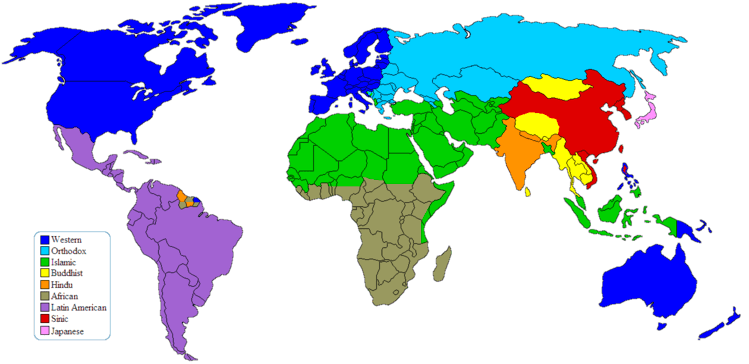
Huntington has further elaborated those ideas in a much-discussed book entitled The Clash of Civilisations and the Remaking of World Order, which was published in 1996.[19] In this book, Professor Huntington has analysed major civilisations and has concluded that the conflicts among the six or seven leading civilisations, but mainly between Islam and the West, will determine global politics in the next few decades. His theory has sparked off a furious debate in which perceptions of Islam have figured prominently.
Huntington’s theory has encouraged some politicians and military men to exaggerate the strategic threat to Western interests posed by Islam. The then Secretary General of NATO, Willie Claus, declared shortly after the publication of Huntington’s article on “The Clash of Civilisations” that Islam was as great a threat to the West as communism had ever been. The danger comes when an intellectual exercise by a professor of political science, like Huntington, is believed and manipulated by someone who is running the most powerful military machine in the world.
What Huntington says is not entirely new. I have already referred to Arnold Toynbee’s A Study of History. In that book, Toynbee also discussed encounters between civilisations, particularly civilisations based on religion. To his credit, at the height of the Cold War and the threat of communism, Toynbee said that communism was not a genuine, long-lasting ideology, but more of an economic system. He divided the present world among the five great religious civilisations — Hindu India, Buddhist China and the Far East, the Greek Orthodox Eastern Europe and Russia, the Christian West and the world of Islam.
Toynbee, who had a firm grasp of history, could put the present situation in its historical context. He praised each of those civilisations for having contributed a great deal to the universal human civilisation. Although he believed in the inherent superiority of the Western Christian civilisation, which he thought would eventually predominate over other existing civilisations, he nonetheless believed that all other great civilisations had a considerable contribution to make to the future global civilisation. His view of the future was not of a clash of civilisations but of a mixing of civilisations.
In Professor Huntington’s view, however, different existing civilisations are not merely in a state of healthy competition but are in the process of a deadly conflict. Toynbee defined civilisations mainly based on their predominant religious affiliation. Huntington’s definition of civilisation is not as clear. While one can praise Huntington for bringing the concept of culture and civilisation into the debate of international relations — for they are a very important part of the political map of the world — yet, his definition of various civilisations is not very convincing. His distinction between the democratic West and the rest of the world, including the hostile Islamic world, is simplistic and imprecise. There are a number of other difficulties with the concept of a clash of civilisations. One is bound to ask:
1- What is the West? Where does it start and where does it end? Are we talking about abstract, intellectual ideas when we refer to the West, or are we talking about geographical boundaries? Are we including the Russian Federation, which, apart from its European part, also extends to Siberia and the Far East as part of the West? Do we include Latin America, with its rather distinct culture, as part of the West? What about Japan and the rest of the so-called ‘tiger economies’ in the Far East, which are competing with the West in the field of industrial and technological development and regard themselves as parts of modern industrial civilisation? If they are included in a single civilisation, then surely the term “Western civilisation” is used very loosely, and if they are not, then it is difficult to ignore some major characteristics that they share with the Western civilisation. There are many cross-cultural influences cutting across all cultures and civilisations, so much so that it is very difficult to isolate any one of them and endow it with some unique qualities.
2- What is Islam? Does it refer to all the 55 member-states of the Organisation of Islamic Conference? Are we talking about Indonesia, which has the largest number of Muslims of any country, bigger almost than the entire Arab world put together, followed by India, Bangladesh and Pakistan, none of which are either Arabs or Middle Eastern? Is he seriously proposing a united challenge posed against “the West” by the combined forces of Indonesia, India, Pakistan, Bangladesh, the Middle East and North Africa, where by far the largest number of Muslims live? Or is he talking merely about the Middle East?
If it is the Middle East that he is talking about, the Middle East itself is very diverse in nature, with Arab, Persian and Turkish civilisations having challenged each other for the past few thousand years. The longest war fought during recent times was not between Islam and the West, but between Iran and Iraq, two Muslim countries, in fact, two countries with majority Shi’i populations. Moreover, the Middle East has not been historically very hostile to the West and has not been very unstable either. The present perception of Middle Eastern instability belongs to the past century or so, when the Middle East came under Western domination, followed by anti-colonialist struggles, as well as to the more recent history of the Arab-Israeli conflict. These recent events have provided the West with an impression of endemic instability and conflict in that part of the world.
The Middle East has been the cradle of human civilisation, and the Egyptian, Mesopotamian and Persian civilisations created some of the oldest empires which lasted for thousands of years and laid the foundations of recorded history and world religions, including Zoroastrianism, Judaism, Christianity and Islam. Some 5,500 years ago, a Nilotic civilisation, which would in time become one of the world’s greatest cultures, was spawned in Egypt. The Egyptian civilisation continued for thousands of years until it was eventually conquered first by the Persians, then by Alexander the Great, before being absorbed into the Roman Empire in 30 BC.
At the beginning of the fourth millennium BC, Sumerians first started a great civilisation in the southern parts of Iran and Mesopotamia. Shortly afterwards, the Akkadians, the Babylonians, the Assyrians and later the Chaldaeans occupied the Tigris-Euphrates valley. About 2,500 BC, the Amorites and Canaanites (including the Phoenicians) populated Syria, and about 1,500 BC, the Aramaeans settled in Syria and the Hebrews in Palestine.
The Medes, the Achaemenians, the Parthians and the Sassanian empires, which originated in Iran and lasted from the 7th century BC to the 7th century AD, provided long periods of stability and prosperity as a result of which many different races and ethnic groups worked together in perfecting the art of civilisation. During the Islamic period, the Abbasid Caliphate, which lasted from 750-1258 AD, or the Ottoman Empire, which lasted from 1292-1922 AD, have been among the most stable and enduring civilisations the world over. Therefore, the prevalent notion that the Middle East is an inherently unstable part of the world is not borne out by facts.
Even in the post-Second World War period, the Middle East has not been the most violent part of the world. The war in Korea (1950-54) cost between 3 and 4 million lives, and those in Vietnam (1945-75) were upward of 4 million. The most costly Middle Eastern wars were those of Algerian independence (1954-62), in which an estimated one million people died as a result of the violent French opposition to the Algerian demands for independence, and the Iran-Iraq war (1980-88) in which around three-quarters of a million people are believed to have died. Iran, which is often viewed as a violent and aggressive power, has not attacked any of its neighbours in the past two and a half centuries. The human toll of the Arab-Israeli conflict as a whole, from 1948 onwards, including Israeli attacks on Lebanon, is believed to be between 100,000 and 200,000, most of the casualties being on the Arab side.
In recent years, other parts of the world have also produced many examples of appalling bloodshed and barbarism. Only a few years ago, the world witnessed the massacre of some two hundred thousand Bosnians in the heart of Europe, and the conflict still continues in Kosovo. About 50,000 Muslim women were gang-raped by Serb soldiers. In Rwanda, about one million people were hacked to death in less than a month by feuding tribes who are pagan or Catholic. The Russian invasion of Afghanistan resulted in the death of more than a million Afghans and forced more than five million Afghans to flee to Iran and Pakistan. The Russian suppression of Chechen independence and Russia’s military involvement in Tajikistan’s civil war have also produced massive devastation and human misery.
The problem with some modern authors, and probably with our fast-moving, media-dominated, sound-bite civilisation, is that we have lost sight of the long sweep of history and have forgotten the long record of inter-relationship and mutual influences that have shaped human history during the past few thousand years. We seem to have forgotten the long history of contact between the Greeks and Persians, the Romans and the Persians, the Byzantines and the Arabs and the Islamic-Christian contacts during the Middle Ages, and the long history of inter-relationship in Spain and Eastern Europe.
3- What is a civilisation? When Huntington has been quick to speak about clashes between civilisations, he has not bothered to define the term civilisation in a precise and convincing manner. Is it peculiar to a country or to blocs of countries and cultures? Is a civilisation to be defined mainly as the result of the existing religious beliefs of the majority of the people in a given country at a given time, or are there other equally important factors which seem to remain the same regardless of the changes in the predominant religion of the time?
Did Iran’s civilisation fundamentally change as a result of the conversion from Zoroastrianism to Islam, or were there some constant factors which remained the same despite the change of faith? Did the civilisation of many Byzantine territories that had converted to Islam and became part of the Islamic Empire suddenly change? Conversely, did the Spanish civilisation fundamentally change after the expulsion of Muslims from Granada in 1492? Was the British civilisation totally transformed as a result of the Reformation, or the recent triumph of secularism?
4- Furthermore, what do we mean by religion? There are wide varieties of sects and denominations within the same religion, some of which are completely at variance with others. What we need to bear in mind in looking at religious traditions such as Christianity or Islam is that although we use the singular label “Christianity” or “Islam”, in fact, there are wide varieties of Christianity and Islam. Looking at Christianity, there are some movements about which we may have doubts as to whether they count as Christian. To list some of the denominations of Christianity is to show something of its diverse practice — Orthodox, Catholic, Anglican, Coptic, Nestorian, Armenian, Lutheran, Calvinist, Methodist, Baptist, Unitarian, Mennonite, Congregationalist, Quakers, Disciples of Christ — and we have not reached some of the newer, more problematic forms: Latter-Day Saints, Christian Scientists, Mormons, Unificationists, Zulu Zionists, and so forth.
Moreover, each faith is found in many countries and takes colour from each region. German Lutheranism differs from American, Ukrainian Catholicism from Irish, and Greek Orthodoxy from Russian. The same is true about Islam. In addition to the major divide between the Sunnis and the Shi’is, there are the four main orthodox Sunni sects and no less than 400 other minor sects and Sufi orders. Islam has given rise to perhaps the world’s greatest mystical literature in the works of Sufi writers and poets. It has also produced militant fundamentalist movements. Which of them represents true Islam? Religions or sects are merely one factor and one contributor to the complex notion of culture. An Iranian Muslim is different from an Arab Muslim and very different from an Indonesian or Malaysian Muslim; in the same way that a British or American Christian is very different from a Chinese or African Christian.
On the other hand, very often one religion cuts across many cultures and civilisations. This is notably true of Islam, Christianity and Buddhism, whose adherents are present among some of the allegedly competing civilisations enumerated by Huntington. Which of these two predominates over the other? Is a Syrian or Lebanese Muslim residing in the United States more representative of Islam or of Western civilisations? Does an Iraqi or Iranian Christian belong more to Iran or Iraq, or to Western civilisation? Equally, is a Chinese or Japanese Buddhist more representative of Chinese and Japanese civilisations or of India, which gave birth to Buddhism?
5- Do civilisations represent a single philosophy? Another problem with a blanket definition of civilisation is that even the non-religious aspects of different civilisations are not always representative of a single concept and a single philosophy. Western civilisation has produced liberal democracy. It has also given rise to fascism and Nazism. Western civilisation has created capitalism, as well as communism. The Soviet Union’s dogmatic Marxism, its faith in material progress and the cult of technology, and indeed its nationalism and patriotism, all had precedents only in European history. Western civilisation has produced philosophies of individualism, as well as collectivism. It has produced the Industrial Revolution, as well as otherworldly, nihilistic and Utopian ideologies, right to modern positivism or post-modernism. Which of these are truly representative of Western civilisation?
In the Islamic civilisation, we have the highly rational philosophy of Ibn Rushd (Averroes), whose scientific and non-religious ideas scandalised Medieval Europe when the Church condemned “Averroism” as a dangerous heresy. On the other hand, there have been many idealistic and mystical philosophers in Islam, such as Avicenna, Ibn Arabi and Suhrwardi, who provided the inspiration for many idealist European philosophers of the 19th century, including Hegel, Schopenhauer, and Nietzsche. Iranian Islam has produced one of the greatest agnostics in the ever-fresh Omar Khayyam. It has also produced one of the greatest theological thinkers, Abu Hamid Ghazzali, who was a contemporary of Khayyam and was engaged in a famous debate with him. It is clear that at different periods both the Western and the Islamic civilisations have gone through different phases of development, and different worldviews and philosophies have prevailed at different times.
6- Have civilizational differences been sources of conflicts? It is also not at all evident that civilizational differences have ever been the basis of international conflicts, in this century or ever in the past, or that they will be the basis of conflict in the future. The trade problems between America and Japan; the competition for supremacy between America and China, and for that matter between Japan and China; and the intense hostility which existed between the West and the Soviet bloc, were all these based on civilizational differences or were they quite divorced from any concept of civilisation and were primarily clashes of interests, to do with the economics, with territory and with rivalry? The former Eastern European countries in the Eastern bloc, which have now become friendly with the West and are queuing to join the EU and even NATO, have they completely changed their civilisation, or were the former hostilities not based on civilisation?
7- What do we mean by pluralism? When we talk of a pluralistic world, do we mean that pluralism is acceptable only if the rest of the world adopts Western culture, or are we looking forward to a world in which all different cultures can live side by side in peace and harmony? Clearly related to this is the need to listen to the voices of other cultures and peoples who had been formerly excluded from consideration, not least the voices of Third World peoples.
Too often, monopolies of power have created monopolies of knowledge and even monopolies of culture. This is manifest in the role of the powerful West in creating the international system. When President George Bush proclaimed the dawn of a New World Order after the Persian Gulf War, he was clearly referring to a world order modelled on the American way of life and dominated by it. In these cases, a critique of existing power structures and monopolies of knowledge is long overdue.
Throughout history, there have been periods when one or more powers have dominated the world or a large part of the world. As was pointed out earlier, we have witnessed the supremacy of the Babylonian, Assyrian, Egyptian, Persian, Greek, Roman, Islamic, and Ottoman empires. During the past two centuries, the European empires, particularly the British Empire, ruled the world, followed by America, which is dominating the current world scene as the only remaining superpower.
The world would have been a much poorer place if any of those ruling powers had been able to completely dominate and assimilate other cultures and civilisations. Yet we seem to be demanding the total assimilation of all other cultures into what we regard as Western civilisation. We seem to have chosen one “particular” culture and civilisation and would want to turn it into a “universal” civilisation.
None of the former monopolies of power lasted forever, and, certainly, the present superiority of one political and military bloc over the rest will also not be exempt from this rule. However, what makes the present situation different from the past is both the reach and the globalisation of political power, the tremendous advances in science and technology, including the science of war, and also the universal nature of information technology and means of intellectual and cultural, as well as political and economic domination. The speed of communication and the material advancement and superiority of the West have led some to the conclusion that all the different cultures have no option but to submit to the dominant secular culture of the West and be submerged in it.
Jean-Jacques Servant Schreiber, over 30 years ago, published The American Challenge, which analysed Europe’s economic decline because of American goods and ideas. “The confrontation of civilisation will now take place in the battlefield of technology, science and management,” he concluded. He predicted: “The war we face will be an industrial one.” H. G. Wells described civilisation as “a race between education and catastrophe.” If some Europeans are worried about this perceived American technological superiority, then the people in the Third World have much more reason to be alarmed. Modern technology is ruling the world, both in military fields, as could be seen during the Gulf War, and in economic fields. The countries that possess more sophisticated technology are jealously guarding their technical superiority. The attempt to prevent third-world countries from acquiring the most sophisticated technology is one of the main preoccupations of the developed world.
Another area where the West has an enormous superiority over the rest of the world is in the field of economic globalisation. It is the result of a long process of economic and technological development, by means of which large Western multinational corporations have controlled a major part of economic activity and global investment. Globalisation has led to an almost total internationalisation of markets, investment, management and finance. World finance, for example, is enormously important as it translates into the daily flow of billions of dollars, transferred instantly from one financial centre to another, mainly dominated by more advanced countries. The collapse of the communist bloc has further intensified this trend of financial globalisation, to the interest of major Western financial institutions.
All this is not meant as an indictment of the West, or to suggest that one should turn a blind eye to the shortcomings of the developing countries, whether Islamic or non-Islamic. It would be mistaken to go from an acceptance of established orthodoxies to the assertion that all alternatives are to be welcomed, or have equal validity. One should clearly be able to criticise oppression, dictatorship, prejudice and injustice wherever they are found. However, one should be consistent in one’s condemnation; not as is the case at the moment, when the so-called friends of the West can literally get away with murder, while other countries which are not so friendly towards the West are condemned for the slightest offence.
One should also realise that the present atmosphere of mistrust, suspicion and hostility which exists among some Middle Eastern countries is itself a legacy of their past history and the alleged ills of colonialism and imperialism to which they were subjected. What we are witnessing today is not the result of a “clash of civilisations”, or a war between Islam and the West. It has mainly to do with national or regional conflicts, economic problems, and ethnic and sectarian differences. At the moment, the ball is in the American court. By trying to devise a just and balanced system for the whole Middle East, as a result of which all the countries of the region can feel that they have a stake in the maintenance of peace, the West can create peace, prosperity and hope for the future in that turbulent area.
The study of peace and conflict reveals two notions of peace: positive and negative. Negative peace is the absence of violence and an end to bloodshed, not an end to prejudice and hatred. Negative peace is an example of many treaties that were signed in Yugoslavia, in the Middle East, and in the Far East. Positive peace is more than the absence of war; it is the elimination of the deep-rooted structural divisions that lead to conflict and violence. It brings an end to hatred and prejudice, racism, religious bigotry, chauvinism, economic and political injustices and indifference to suffering.
To help achieve positive peace, we must study how enemies can achieve reconciliation through the development of mutual understanding and respect. If people are not to be derailed from that goal, they must start practising a collective form of forgiveness and reconciliation leading to permanent peace. If the ‘New World Order’ is not to remain forever just a slogan, then we must start to apply principles of forgiveness and reconciliation in the conduct of international relations. More important than that is a positive effort by all of us, not merely to tolerate other cultures and religions, but to actively try to learn from them and see all of them as manifestations either of the same God or at least of the same universal human culture.
We can start by studying different literatures that appeal to the common poetic imagination of mankind. We must begin to speak in the language of science that knows no boundary. We must speak in the language of art, which is universal. We must speak about the language of mysticism, which is common to all religions. And we should speak less about minor dogmatic and doctrinal ideas, which do not constitute the main element of any religion. The East can learn from the West’s science and technology, its rationalism, its concepts of democracy and individual freedom, the equality of rights of men and women and respect for minorities; while the West can learn from the East’s more integrated view of life, its union of science and religion, its respect for tradition, family values and a deeper affinity with nature.
In the 1950s, Lester Pearson warned that humans were moving into “an age when different civilisations will have to learn to live side by side in peaceful interchange, learning from each other, studying each other’s history and ideals and art and culture, mutually enriching each other’s lives. The alternative, in this overcrowded little world, is misunderstanding, tension, clash, and catastrophe.”[20] Our apprehension about the possibility of a nuclear confrontation during the Cold War helped us to avoid war and to find a peaceful solution to the East-West conflict. Professor Huntington’s book and other similar works, by drawing our attention to the possibility of a clash between civilisations, can help us to avoid a real clash between civilisations and learn to resolve our differences in a spirit of mutual respect, tolerance, humility and reconciliation.
Notes
[1] Arnold J. Toynbee, A Study of History (London: Oxford University Press, 12 vols., 1934-1961). There is also an abridged version of this book in two volumes by D. C. Somervell (London: Oxford University Press, 1957).
[2] E. Gibbon, The History of the Decline and Fall of the Roman Empire.
[3] There are two good translations of this book, one by Dr Franz Rosenthal of Cambridge and another by Professor Mohsen Mahdi of Harvard University.
[4] Abol-Qasem Ferdowsi, Shah-Nameh (the Book of Kings, the great 10th-century Persian epic poem). Although these lines are attributed to Ferdowsi and included in some manuscripts of the Shah-Nameh, many scholars have doubted this attribution. They believe that similar lines first appear in a book called Hamzeh-Nameh, which was written in the second century AH/ 8th century AD, before Shah-Nameh’s composition.
[5] Francis Fukuyama. “The End of History,” The National Interest, 16 (Summer 1989), 4, 18.
[6] Arnold J. Toynbee, A Study of History (London: Oxford University Press, 12 vols., 1934-1961), VII, 7-17; Civilisation on Trial (Oxford University Press, 1948), 17-18; Study of History IX, 421-422.
[7] Samuel P. Huntington, The Clash of Civilizations and the Remaking of World Order (Simon and Schuster, New York, 1996), p. 301.
[8] Henry A. Kissinger, Diplomacy (New York: Simon and Schuster, 1994), pp. 23-24.
[9] H. D. Thoreau, Writings, 20 vols. (Boston, 1906), I, 72.
[10] R. W. Emerson, Journals (Centenary Edition, Boston, 1902), I, 342.
[11] Olivier Roy, The Failure of Political Islam (I.B. Tauris, 1994, Preface, p ix).
[12] See ‘The Observer’ magazine, 29th Dec. 1996.
[13] Barry Buzan, New Patterns, pp. 448-449.
[14] Bernard Lewis, “The Roots of Muslim Rage: Why So Many Muslims Deeply Resent the West and Why Their Bitterness Will Not Be Easily Mollified,” Atlantic Monthly, 266 (September 1990), 60.
[15] Edward W. Said, Orientalism (London, 1978), pp. 2f.
[16] Owen Chadwick, The Secularisation of the European Mind in the 19th Century (Cambridge University Press, 1975).
[17] Quoted in: Akbar S. Ahmed, Post Modernism and Islam: Predicament and Promise (Routledge, 1992), p. 97.
[18] Samuel P. Huntington, ‘The Clash of Civilisations?’, Foreign Affairs, Summer 1993.
[19] Samuel P. Huntington, The Clash of Civilisations and the Remaking of World Order (Simon and Schuster, New York, 1996).
[20] Lester Pearson, Democracy in World Politics (Princeton University Press, 1955), pp. 83-84.

